Pileated Woodpecker Suet Feeders: Tail Prop Setup
Pileated Woodpecker Suet Feeders: How to Actually Attract the Crow-Sized Bird Most Feeders Fail
Most backyard birders have heard the sound before seeing the bird. A hollow, resonant hammering — louder than any downy or hairy woodpecker, more deliberate, almost prehistoric in its rhythm. Then a flash of black and white in the canopy, that unmistakable red crest catching the light. A pileated woodpecker. And if you're standing at your window watching it work a dead oak sixty feet away while your suet feeder hangs empty and ignored, you're experiencing one of the most common frustrations in intermediate-level bird feeding.
Attracting pileated woodpeckers to a suet feeder is genuinely achievable — but it requires understanding why standard feeders fail these birds, what their bodies actually need from a feeding structure, and how their cautious, slow-to-trust temperament shapes every decision you'll make about placement and setup. For general woodpecker suet feeder options covering Downy, Hairy, and Red-bellied, see our best suet feeders for woodpeckers guide. Get those three things right, and a bird that once seemed mythically difficult to attract can become a regular visitor.
Key Takeaways
- Pileated woodpeckers require a tail prop feeder with at least 8 inches of vertical backing below the suet cage to brace their tails while feeding.
- Insect-enhanced suet containing mealworms or crickets outperforms plain beef suet because pileateds eat carpenter ants for up to 97% of their diet.
- Mount the feeder directly on a tree trunk within 10–15 feet of mature trees, away from high-traffic areas that trigger flight responses.
- Allow two to six weeks for a first visit — pileateds observe new feeders from 50–100 feet away before approaching.
- Leaving standing dead trees on your property supports nesting pileateds, as they excavate new cavities each year and will not use nest boxes.
Why Standard Suet Feeders Don't Work for Pileated Woodpeckers
The typical wire cage suet feeder — the $8 version hanging at every hardware store — was designed with downy and hairy woodpeckers in mind. Those birds weigh between 0.7 and 3.4 ounces. A pileated woodpecker weighs between 8.8 and 12.3 ounces and measures up to 19 inches long. Asking one to use a standard cage feeder is a bit like asking someone to eat dinner while crouching on a step stool. Physically possible, briefly. Comfortable and repeatable, no.
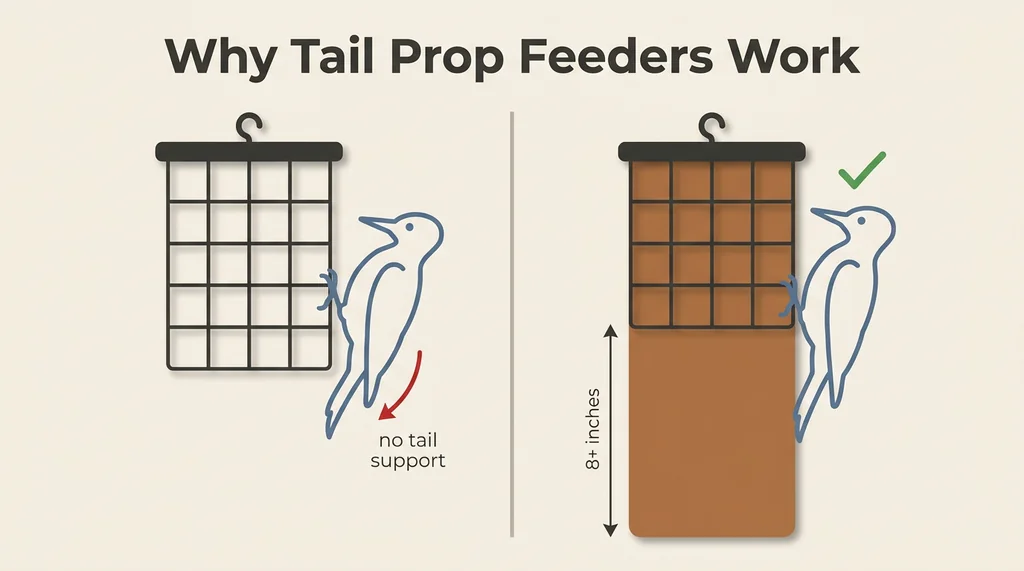
The specific problem is the tail prop. Woodpeckers in general, and pileateds in particular, are anatomically built around a three-point support system: two feet gripping a vertical surface, and a stiff tail pressed against that same surface for balance and leverage. Watch a pileated work a tree trunk and you'll see the tail doing real structural work, bracing the bird so its neck and beak can deliver those powerful blows. Standard suet feeders offer nowhere for that tail to go. The cage ends abruptly. The bird either abandons the attempt or clings awkwardly in a posture that's exhausting to maintain.
This isn't stubbornness on the bird's part. It's physics. A pileated woodpecker that can't brace its tail is a bird that can't feed efficiently — and a bird that can't feed efficiently at your feeder will simply go find a dead tree instead.
The Tail Prop Feeder: What to Look For
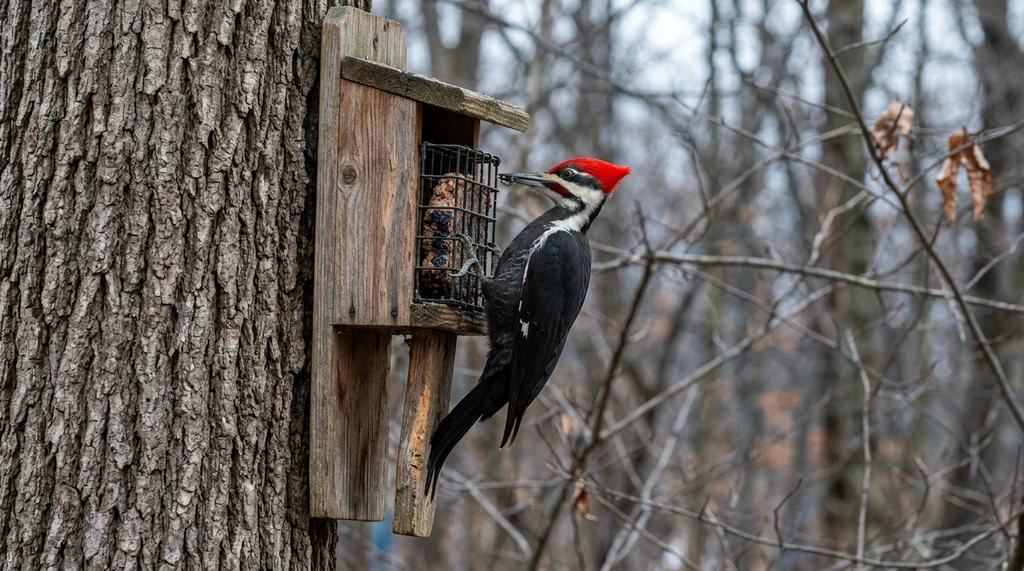
The solution to this problem has a name: the tail prop suet feeder. These feeders extend the wooden backing surface well below the suet cage, giving the bird a vertical surface to press its tail against while feeding. The difference in uptake between a standard cage and a proper tail prop model is significant enough that most serious pileated-feeding resources identify it as the single most important equipment decision.
When evaluating tail prop feeders, the measurement that matters most is the length of the prop area below the suet cage. The Duncraft Pileated Tail Prop Feeder, one of the most commonly referenced models in this category, features an 8.75-inch tail prop section specifically sized for large woodpeckers. That's not an arbitrary number — it's long enough to accommodate the tail length of a bird that can measure nearly 20 inches from bill to tail tip.
What to look for in any tail prop feeder:
- Minimum 8 inches of vertical backing below the suet cage. Less than this and you're back to the awkward-crouching problem.
- Solid wood construction. Pileated woodpeckers are heavy birds that land with some force. Flimsy materials flex and wobble, which spooks a bird that's already cautious about approaching new objects.
- Top-filling design. Suet needs to be replaced regularly, especially in warm weather when it can go rancid quickly. A lift-up roof or top-access design makes this fast enough that you'll actually do it consistently.
- Secure mounting point. These feeders should be attached directly to a tree trunk or substantial post rather than hung from a thin wire, which swings unpredictably and discourages approach.
What to Put in the Feeder
Here's where some backyard birders get warmly exasperated with the oversimplified advice they've encountered online: "just use suet" covers a lot of ground, and not all of it equally effective.
Pileated woodpeckers are, at their core, insect hunters. Up to 97% of some individuals' diets consist of carpenter ants — specifically the large wood-boring colonies they excavate from dead and dying trees. The rectangular holes they leave behind, sometimes four inches wide and eight inches deep, are essentially mining operations targeting ant galleries. When they visit a feeder, they're looking for something that approximates that caloric density.
Standard beef suet works, but it's the baseline. Pure suet without additives is better than nothing, particularly in winter when fat calories are critical for thermoregulation.
Insect-enhanced suet — specifically varieties containing mealworms, crickets, or ant-flavored formulations — performs better for pileateds because it more closely resembles their natural diet. Several commercial brands offer "woodpecker" or "insect" varieties that birders consistently report outperforming plain suet for these larger species.
Bark Butter, a spreadable suet product developed by Jim Birdfeeder (and now sold under the Wild Birds Unlimited brand), deserves specific mention. It can be smeared directly onto tree bark or applied to a wooden feeder surface, which mimics the foraging experience pileateds have in the wild. Birds that won't approach a cage feeder sometimes respond readily to Bark Butter applied to a rough-barked log or post. If you're struggling to get initial visits, this can be a useful bridging technique.
Whole nuts, particularly whole peanuts and shelled walnuts, also attract pileateds. They won't replace suet as the primary draw, but adding a tray of nuts near your suet feeder can increase overall activity and give the birds a reason to linger.
Placement: The Part Most People Get Wrong
A pileated woodpecker approaching a new feeder doesn't fly in directly. It arrives in the trees nearby — sometimes 50 to 100 feet away — and watches. For minutes. It's assessing the area for predator risk, observing whether other birds are using the feeder without incident, and deciding whether the approach path is clear enough for a confident exit if something goes wrong.
This scouting behavior means that placement decisions have outsized importance for pileateds compared to smaller, bolder species.
Tree-adjacent placement works better than open-yard placement. Mounting a tail prop feeder directly on a large tree trunk, or on a post within 10 to 15 feet of mature trees, gives pileateds the cover approach they prefer. They can move through the canopy to within a short flight of the feeder before committing.
Avoid high-traffic areas. A feeder visible from a busy walkway, near a door that opens frequently, or in line with a window that reflects movement will be abandoned by pileateds even if it's perfect in every other respect. These birds are not habituated to human proximity the way house sparrows or chickadees become. Sudden movement — even through glass — can reset weeks of slowly building comfort.
Height matters, but not the way you might expect. Pileateds naturally feed at all heights, from ground level (where they excavate ant mounds) to the tops of standing dead trees. A feeder mounted at six to eight feet off the ground on a tree trunk is accessible and feels natural to them. Very low placement, however, increases predator anxiety, and very high placement makes the feeder harder to maintain consistently.
Give it time. A new pileated suet feeder in a suitable location may take two to six weeks to receive its first visit. This is normal. The birds in your area need to discover it, observe it repeatedly from a distance, and build enough confidence to approach. Removing the feeder after two weeks because "it's not working" is the most common reason people conclude pileateds can't be attracted to feeders — when in reality, the birds were already watching.
Understanding the Birds You're Trying to Attract
Pileated woodpeckers are non-migratory, which means the birds in your area are year-round residents with established home ranges. A mated pair typically maintains a territory of 150 to 200 acres, which they defend consistently. This is both a challenge and an advantage: there may only be one or two pairs within range of your yard, but once you've attracted them, you've potentially attracted them for years.
They're frequently seen in pairs and will bring juveniles to reliable food sources. Young pileateds, identifiable by their slightly duller plumage and less precise drilling behavior, often appear at feeders in late summer and fall as parents introduce them to supplemental food sources. A yard that successfully attracts an adult pair has a reasonable chance of seeing that pair's offspring return in subsequent years.
One thing pileateds will not do, regardless of how ideal your setup: use a nest box. Unlike bluebirds or even some other woodpecker species, pileated woodpeckers require large-diameter standing dead trees for nesting cavities. They excavate new cavities each year, and the resulting old cavities become critical habitat for owls, wood ducks, and other secondary cavity nesters. If you want to support nesting pileateds, the most effective thing you can do is leave standing dead trees on your property rather than removing them.
The gap between "I can hear them in the woods" and "they're at my feeder every other day" is mostly a gap in equipment and patience. A proper tail prop feeder loaded with insect-enhanced suet, mounted on a tree trunk in a low-disturbance location, addresses the equipment side. The patience side is simply what pileated woodpeckers require — and given that these are among the most spectacular birds to visit any backyard feeder, they're worth every week of waiting.