Heated Hummingbird Feeders for Winter: Complete Guide
Heated Hummingbird Feeders for Winter: Everything You Need to Know
Most people assume hummingbirds are a summer affair. The feeders come down in September, get rinsed, and go into storage alongside the patio cushions. Done until May.
That assumption is mostly correct—and mostly harmless. But for an increasing number of backyard birders across the country, particularly in the American West and Southwest, winter hummingbirds are not a hypothetical. They're a reality that shows up at an empty hook and finds nothing. Understanding heated hummingbird feeders for winter isn't just useful trivia. For some readers, it's the difference between supporting a hummingbird that stayed behind and leaving it to fend for itself in freezing temperatures.
This is what you need to know.
Key Takeaways
- Hummingbirds in the West, Southwest, and Gulf Coast may stay year-round and need unfrozen nectar to survive winter mornings after torpor.
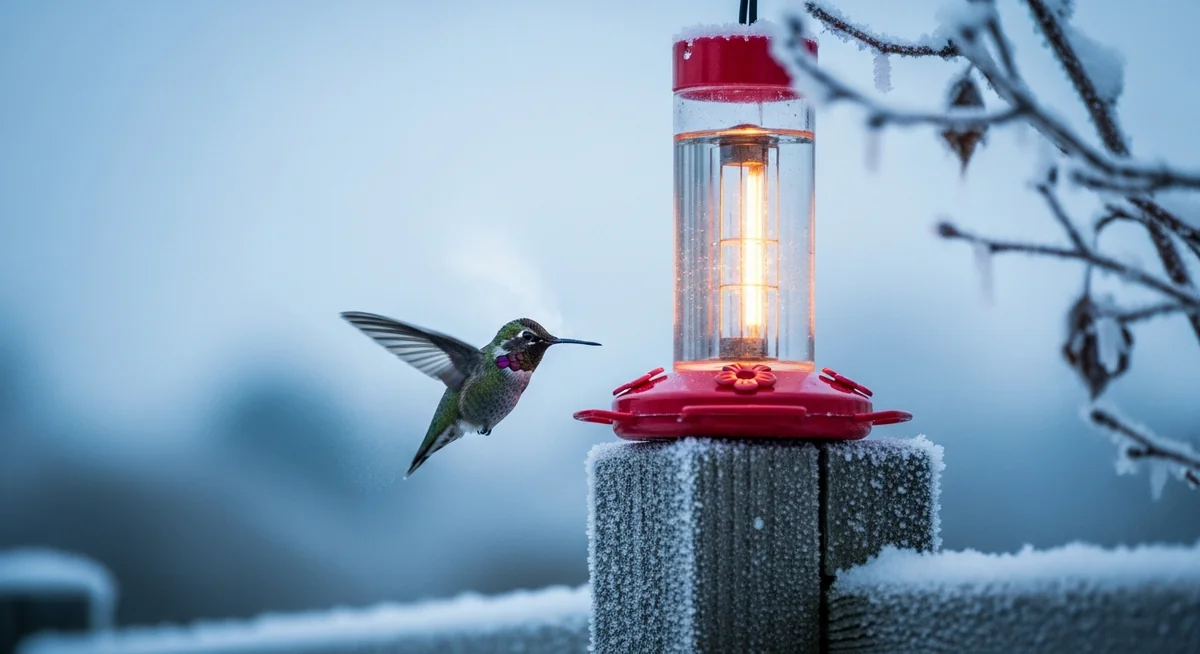
- Standard 1:4 nectar freezes at 27°F — a heated feeder (all-in-one or heater attachment) is the only reliable solution in freezing climates.
- Choose feeders with food-grade BPA-free materials, secure mounting options, and easy-to-clean designs for cold-weather maintenance.
- Change nectar weekly even in winter, clean with dilute bleach every two weeks, and monitor the heating element regularly — especially after power outages.
- Place feeders in wind-sheltered spots at 4–5 feet height, and commit to consistent refilling since hummingbirds build their survival routines around your feeder.
Why Some Hummingbirds Don't Migrate
Before diving into equipment, it helps to understand what you're actually dealing with. The United States hosts about 15 species of hummingbirds that regularly visit feeders, and while the Ruby-throated Hummingbird dominates in the East and follows a fairly predictable migration window of May through September, the western half of the country tells a different story.
Anna's Hummingbirds, for instance, are year-round residents across much of the Pacific Coast. Rufous Hummingbirds winter along the Gulf Coast in surprising numbers. Allen's, Broad-tailed, and Costa's Hummingbirds all have populations that either don't migrate at all or push their ranges into winter territory that gets genuinely cold. Even in the East, vagrant western species occasionally appear and, lacking the instinct to head south, simply stay.
What this means practically: if you live in California, Oregon, Washington, Texas, Arizona, New Mexico, or along the Gulf Coast, there's a reasonable chance you have hummingbirds in your yard right now, in January, trying to find food.
The physiological stakes are not trivial. Hummingbirds must feed every 10 to 15 minutes throughout the day. Their hearts beat up to 1,260 times per minute. They consume approximately half their body weight in sugar daily. These are not animals with significant energy reserves to draw on when food sources disappear. A hummingbird that spends an hour searching for nectar on a 28-degree morning is a hummingbird in genuine danger.
Hummingbirds do have one remarkable cold-weather adaptation: torpor. At night, they drop their heart rate and body temperature dramatically to conserve energy, essentially entering a state of suspended animation until morning. But torpor only works if the bird has enough fuel to survive the night and enough food waiting when it wakes up. A frozen feeder provides neither.
The Core Problem: Nectar Freezes
The standard 1:4 sugar-to-water nectar solution freezes at approximately 27 degrees Fahrenheit—slightly below the freezing point of plain water, thanks to the sugar content. In climates where winter temperatures regularly dip into the 20s overnight, an unheated feeder will be solid ice by dawn, precisely when a hummingbird emerging from torpor needs its first meal most urgently.
This is the problem heated hummingbird feeders solve. Not elegantly, not expensively—just reliably.
There are two approaches to keeping nectar liquid in freezing temperatures, and both have merit depending on your situation.
Two Types of Heated Hummingbird Feeders for Winter
All-in-One Heated Feeders
The most straightforward solution is a feeder with integrated heating built directly into the design. Hummers Heated Delight, an American-made family operation that markets itself as "The Original Heated Hummingbird Feeder," produces models in 16-ounce and 32-ounce capacities. These units use food-grade, BPA-free PET plastic containers engineered specifically for heating functionality—an important distinction, since standard plastic feeders aren't designed to handle the thermal stress of a heating element cycling on and off through a winter night.
The 32-ounce "Brock" Bundle from Hummers Heated Delight runs $46 with free shipping (discounted from $53), which positions it as a mid-range investment for something you'll potentially use for years. Customer testimonials for this brand lean enthusiastic: one documented review notes, "My hummingbirds didn't migrate last winter, so I kept them happy through the colder days with a heated feeder from Hummers Heated Delight!" The same reviewer was already ordering a second unit.
All-in-one heated feeders are the right choice if you're starting from scratch or if your existing feeders are aging out anyway. You're buying one piece of equipment that does everything.
Heater Attachments for Existing Feeders
The second approach is modular: a standalone heater that attaches to the bottom of a feeder you already own. The Backyard Bird Centre Hearth Hummingbird Feeder Heater is a representative example—a U.S.-made device that mounts to feeder bases without requiring you to replace the feeder itself.
This option makes obvious sense if you have a feeder you love and don't want to replace. It also tends to be more economical at the entry level, with heater attachments available starting around $11.30. The tradeoff is compatibility: not every heater works with every feeder, and you'll want to verify that your existing feeder's base geometry matches the heater's mounting system before ordering. Some heater products are sold without feeders included, which can create confusion when reading product listings.
One creative heating approach worth mentioning: some winter feeders use waterproof outdoor decorative holiday lights as the heating mechanism. This sounds improvised, but it's actually elegant—the lights generate consistent low-level warmth, are weatherproof by design, and run efficiently. The Hummingbird Market of Tucson uses this approach and describes the result as keeping nectar "warm enough to feed from throughout the winter months," while also giving hummingbirds "a place to get warm while they drink." That secondary benefit—the warmth itself, not just the liquid nectar—matters more than it might seem. A hummingbird consuming heated nectar on a freezing morning is recovering energy faster than one drinking cold nectar.
What to Look for When Choosing a Heated Feeder
Capacity
Winter hummingbird populations are typically smaller than summer peaks, but you still want enough capacity to avoid constant refilling in cold weather. The 15-ounce to 32-ounce range covers most situations. If you're hosting a single Anna's Hummingbird, a 16-ounce feeder is plenty. If you're in a warmer western region with multiple winter visitors, the larger capacity reduces how often you're going outside in January to refill.
Materials and Safety
Food-grade, BPA-free construction isn't optional—it's the baseline for any feeder you're going to fill with a solution your birds drink every 15 minutes. Heated feeders face additional material demands because the plastic needs to handle repeated thermal cycling without degrading or leaching. Reputable manufacturers specify this explicitly; if a product listing doesn't mention food-safe materials, that's worth noting.
Mounting Options
Winter conditions create mounting challenges that don't exist in summer. Ice, wind, and snow load can dislodge feeders that were perfectly stable in August. Look for feeders that offer both suction cup and hook mounting options—suction cups work well for window placement where you can monitor the feeder easily, while hook mounting provides more flexibility for placement away from the house. Secure mounting also matters because a feeder that swings dramatically in wind can make it difficult for hummingbirds to hover and feed effectively.
Ease of Cleaning and Filling
This matters more in winter than summer. You'll be filling and cleaning this feeder in cold weather, potentially with cold hands, possibly in the dark at 6:30 AM before the birds wake up. Feeders with simple disassembly, wide openings, and accessible ports make the difference between a maintenance routine you'll actually keep and one you'll start skipping by February.
Winter Hummingbird Feeder Maintenance
A heated feeder solves the freezing problem, but it doesn't eliminate the need for regular maintenance. If anything, winter feeding demands more diligence, not less.
Nectar Change Frequency
The standard nectar change schedule—every 3 to 5 days under normal conditions, every 2 to 3 days when temperatures exceed 75 degrees—shifts in winter, but not in the direction you might expect. Cold temperatures slow fermentation and mold growth, which means nectar lasts longer in winter than in summer. However, "longer" doesn't mean indefinitely. Nectar that's been sitting for a week in a heated feeder, even in cold ambient temperatures, should be replaced. When in doubt, if the nectar looks cloudy or has any visible growth, replace it immediately.
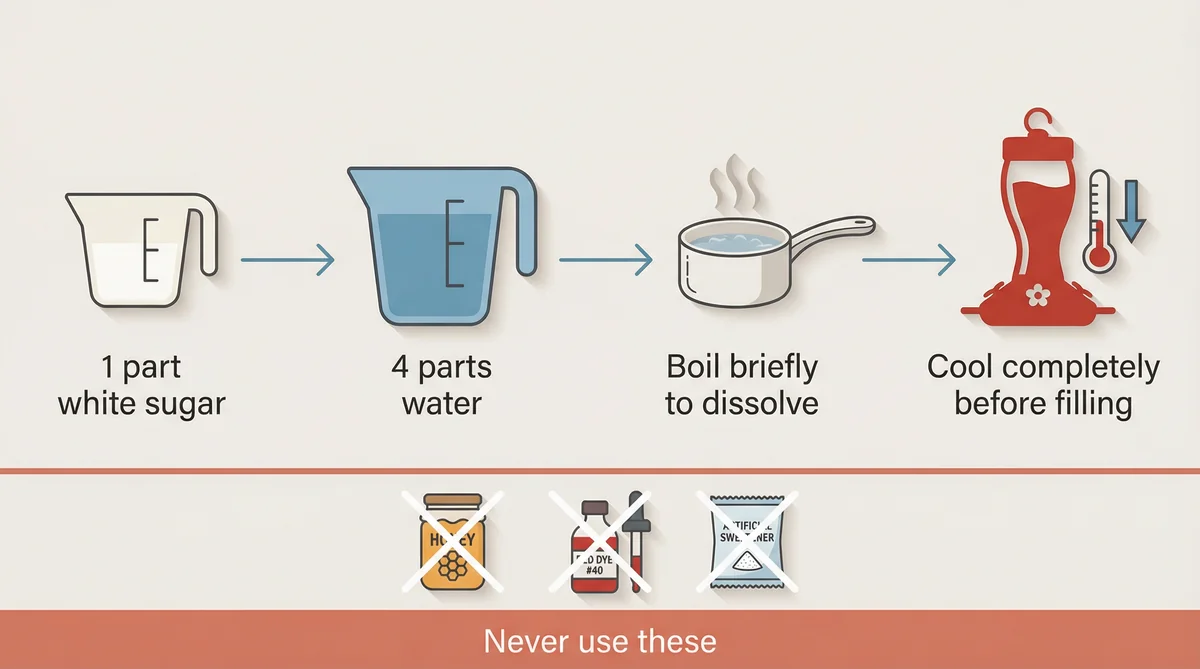
Always use the standard 1:4 ratio: one part white granulated sugar to four parts water. Nothing else. No red dye—research suggests red dyes can be harmful to hummingbird kidneys, and the feeder itself provides enough visual cuing for birds that have already found it. No honey, no brown sugar, no artificial sweeteners. Just white sugar and water, boiled briefly to dissolve and then cooled completely before filling.
Cleaning Protocol
The same cleaning schedule that applies to summer feeders applies in winter: thorough washing with a dilute bleach solution (1 part bleach to 9 parts water) every two weeks, followed by complete rinsing and full drying before refilling. Cold weather doesn't suspend the need for hygiene—mold and bacteria grow more slowly in cold, but they still grow, and a sick hummingbird in January has far fewer resources to recover than one in July.
Monitoring the Heater
Check that the heating element is actually functioning, especially after power outages or during temperature extremes. A feeder that looks full but has frozen solid is worse than no feeder at all, because it gives the impression of a food source that doesn't deliver. If you notice hummingbirds approaching the feeder and leaving quickly without feeding, frozen nectar is the first thing to check.
Placement Considerations for Winter Feeding
The placement principles for hummingbird feeders hold in winter with some additional considerations.
Optimal feeder height remains 4 to 5 feet above the ground. Window placement—using suction cup mounting within 3 feet of the glass—is particularly valuable in winter because it lets you monitor the feeder's condition and the heating element's function without going outside. The window strike rule still applies: feeders should be within 3 feet of windows or more than 10 feet away, never in the 3-to-10-foot danger zone.
Wind protection becomes more important in winter. A feeder in a sheltered location—near a wall, under an overhang, or adjacent to dense evergreen shrubs—will lose heat more slowly and require less energy to keep nectar liquid. It also gives visiting hummingbirds a break from wind exposure while they feed, which matters when every calorie counts.
If you're in a region that gets significant snowfall, check the feeder after storms. Snow accumulation on feeding ports can block access even when the nectar inside is liquid and warm.
The Broader Picture: What Winter Hummingbirds Need
A heated feeder is the most critical single piece of equipment for winter hummingbird support, but it works best as part of a slightly larger picture.
Water: Hummingbirds get most of their hydration from nectar, so a heated water source is less critical for them than for other winter birds. But they do bathe, and a shallow water source that stays liquid can attract hummingbirds as well as support the broader winter bird community you're likely already feeding.
Shelter: You can't provide this directly, but feeder placement near dense native plantings—particularly evergreen shrubs—gives hummingbirds somewhere to perch between feeding bouts and somewhere to shelter overnight. If you're planning any winter or spring planting, native plants that provide both cover and natural nectar sources are a meaningful investment.
Consistency: This is the most important thing. A hummingbird that has found your feeder and incorporated it into its winter survival strategy is depending on it. Letting the feeder run empty for several days, or failing to maintain the heating element, removes a resource the bird has built its daily routine around. Winter feeding is a commitment in a way that summer feeding isn't, because the margin for error is so much smaller.
Is a Heated Hummingbird Feeder Right for You?
If you live in the eastern United States and your Ruby-throated Hummingbirds reliably depart by mid-September, you probably don't need a heated feeder. Keep your feeders up for two weeks after your last sighting, then store them until late March or early April.
But if you're in the West, the Southwest, along the Gulf Coast, or anywhere that Anna's Hummingbirds or other non-migratory species are known to overwinter—or if you've noticed hummingbirds lingering unusually late in your yard—a heated feeder is one of the more straightforward investments in your bird feeding setup. The technology is simple, the products are reliable, and the price range from about $11 for a heater attachment to $46 for a complete integrated unit makes it accessible at almost any budget.
The Hummingbird Market of Tucson puts it simply: the restorative heat gives hummingbirds "the strength to go on." For a bird burning through half its body weight in fuel every single day, that's not a luxury. It's the whole point.