Yankee Flipper Review: Squirrel Deterrent Feeder
Yankee Flipper Review: The Spinning Squirrel Deterrent That Actually Entertains While It Works
There's a particular kind of feeder that divides the bird-feeding community right down the middle. On one side: people who consider $150 for a bird feeder an obvious sign of financial irresponsibility. On the other: people who have done the math on seed losses, replaced three feeders in two years, and are now prepared to invest in something that treats the squirrel problem with appropriate seriousness.
The Droll Yankees Yankee Flipper lives firmly in that second category. It is expensive, unapologetically mechanical, and it solves the squirrel problem in the most direct way imaginable: it flings them off. Not metaphorically. The perch literally spins at 240 RPM the moment a squirrel lands on it, and the squirrel departs involuntarily. Whether this counts as cruelty or justice probably depends on how much seed you've lost this year.
This review covers what the Yankee Flipper actually does, how it performs over time, where it falls short, and whether the price tag is defensible for someone who has already tried the alternatives. The short answer is: it depends on your situation. The longer answer follows.
Key Takeaways
- The motor triggers at 5 ounces, ejecting squirrels (14–21 oz) within 2 seconds at 240 RPM while leaving songbirds undisturbed.
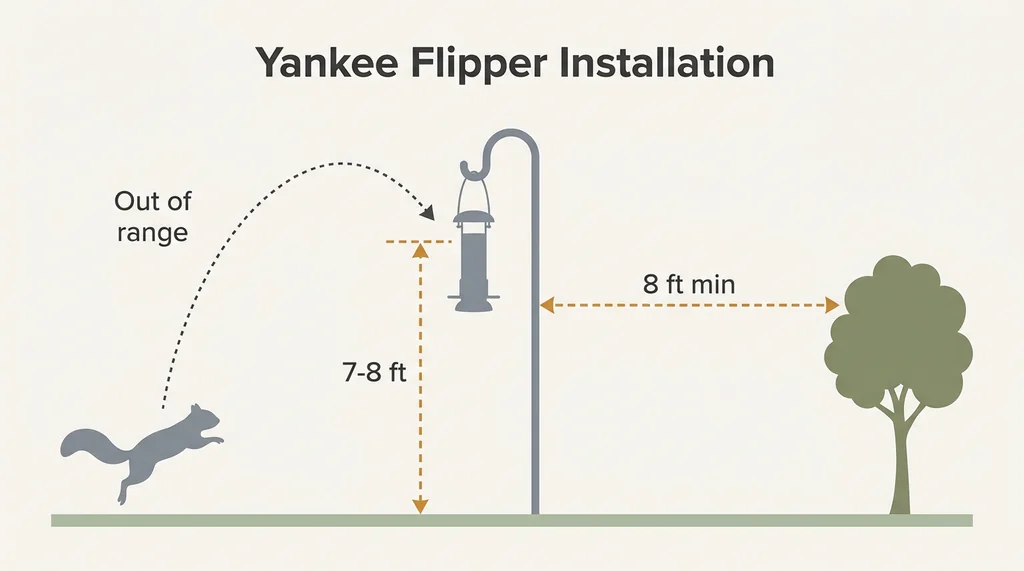
- Hang the feeder at 7–8 feet with at least 8 feet of clearance from fences, branches, and structures to prevent squirrels bypassing the perch.
- Droll Yankees' acquisition by Perky-Pet has led to documented parts shortages; keep purchase records and verify parts availability before buying.
- Passive weight-activated feeders like the Brome Squirrel Buster Plus cost $40–$60 and achieve 95–99% exclusion, making them a better starting point than this $150 feeder.
- Recharge the motor every 4–6 weeks during high squirrel activity; in bear country, bring the feeder inside at night.
How the Yankee Flipper Actually Works
Most squirrel-resistant feeders rely on passive exclusion. Weight-activated mechanisms close feeding ports when something heavier than a songbird lands on the perch. Cage designs physically block access. Baffles interrupt the climbing route. All of these work by denying access without any active response to the squirrel's presence.
The Yankee Flipper takes a different approach entirely. It responds.
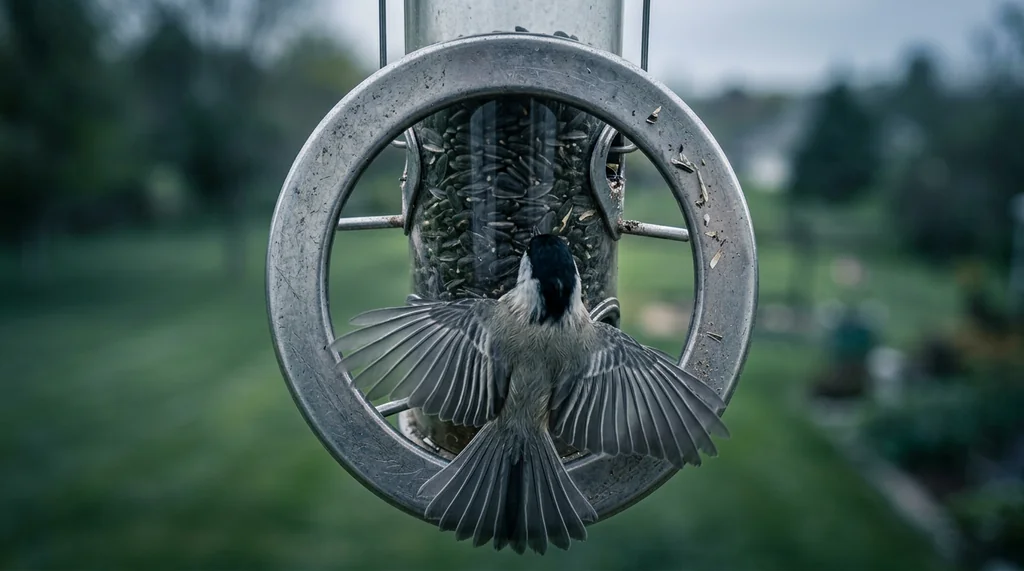
When a squirrel lands on the circular perch ring surrounding the base of the feeder, the motor activates and the perch begins to spin. At 240 RPM, holding on becomes physically impossible within about two seconds. The squirrel is launched outward, lands in the grass, and sits there for a moment reconsidering its life choices. The seed remains untouched. The birds, which are too light to trigger the motor and too sensible to sit on a spinning surface, continue feeding from the four ports above.
The weight threshold that triggers the motor is approximately five ounces. Most songbirds fall well below this. Squirrels, which typically weigh between 14 and 21 ounces, trigger it immediately and reliably. Chipmunks, which are smaller but still above the threshold, are also deterred effectively.
The Hardware Behind the Mechanism
The feeder itself is built to a standard that justifies some of the price. The tube is polycarbonate, which means squirrels cannot chew through it regardless of how motivated they become after being ejected. The exterior metal components are powder-coated, which handles outdoor exposure without rusting. The four feeding ports accommodate cardinals, finches, chickadees, and woodpeckers, and the tube holds five pounds of seed, which is a reasonable capacity for a busy feeding station.
The motor is battery-operated and requires recharging every one to two months, depending on how frequently squirrels attempt access. In yards with heavy squirrel pressure, the motor will cycle more often and drain faster. In yards where squirrels learn quickly to stay away, a charge can last considerably longer.
The feeder measures 21 inches along the tube and 28 inches total including the hanging wire. When full of seed, it carries meaningful weight, which has direct implications for how and where you hang it.
Installation: Where Most Problems Begin
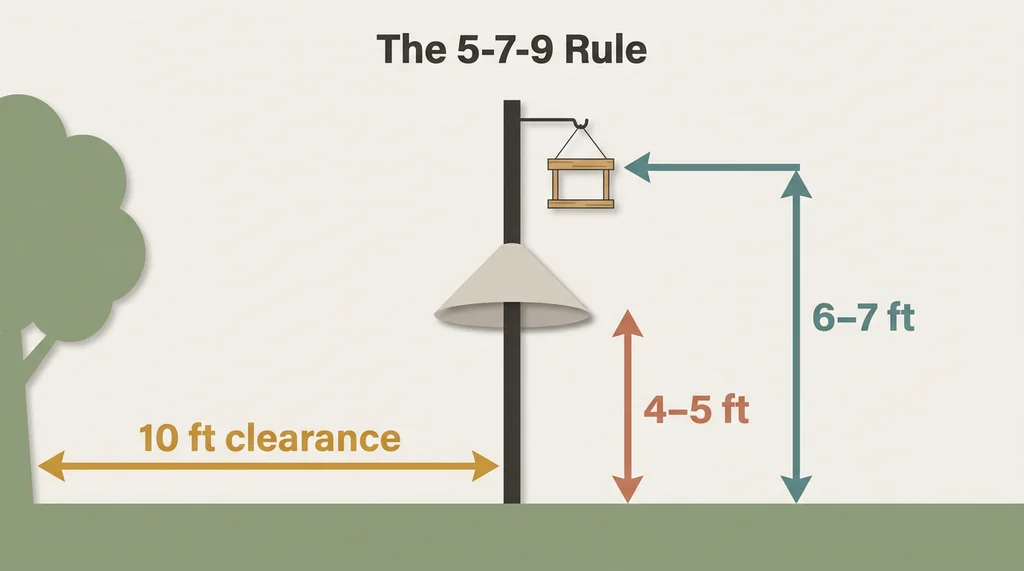
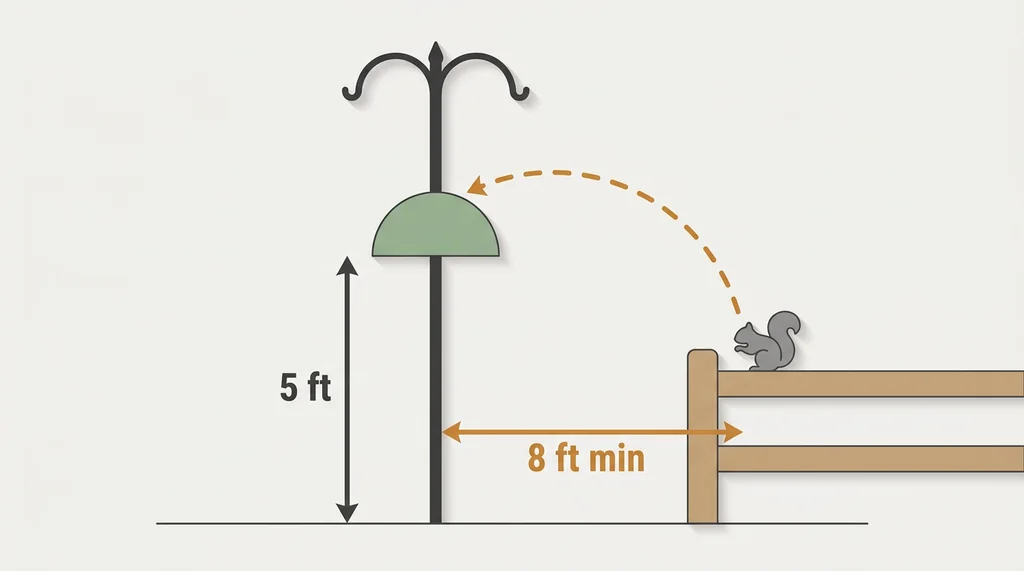
The Yankee Flipper fails most often not because of any flaw in the mechanism but because of where people hang it. Squirrels can leap horizontally up to ten feet and jump vertically nearly five feet from a standing position. They remember feeding locations for months. They will approach from every possible angle until they find one that works, and if the feeder is positioned within reach of a fence, a deck railing, a tree branch, or a roof overhang, they will find it.
The clearance requirement is at minimum eight feet from any structure a squirrel could use as a launching point. This means the feeder needs to hang from a sturdy branch well away from the trunk, or from a heavy-duty shepherd's hook positioned in open space. The weight of the feeder when full makes a flimsy hook a genuine problem: the feeder will swing, the perch will be harder to trigger consistently, and the whole assembly will eventually fail structurally.
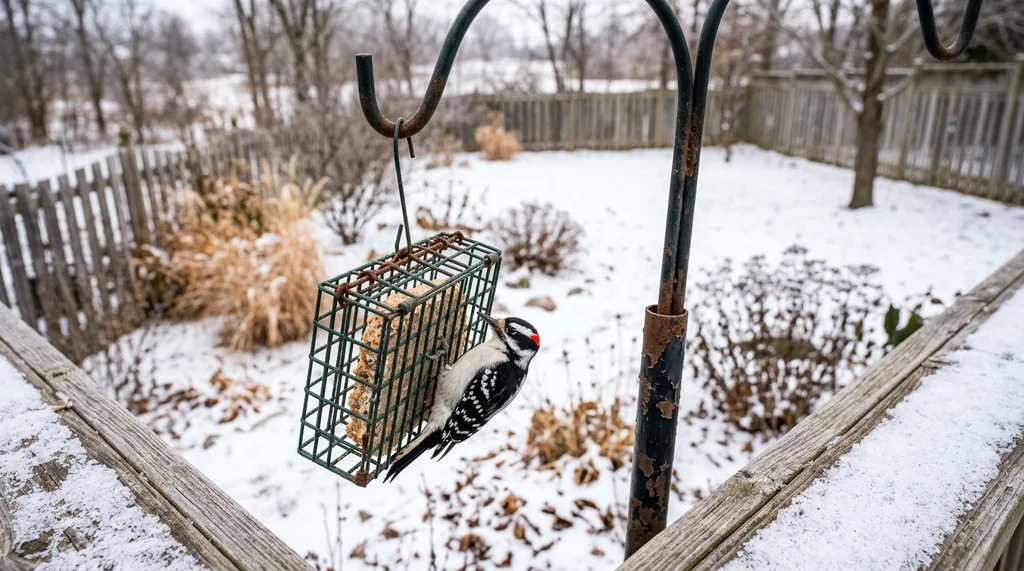
A heavy-duty shepherd's hook with a wide base, or a dedicated feeder pole rated for significant weight, is the right choice here. The feeder is not light, and the spinning mechanism adds dynamic force during ejection events. Under-engineering the mounting point is the single most common installation mistake.
Height matters as well. The feeder should hang high enough that a squirrel cannot leap directly to the perch ring from the ground. Given the five-foot vertical jumping ability, hanging the feeder at seven or eight feet eliminates ground-level approaches entirely and forces squirrels to attempt access from above, which the spinning mechanism handles efficiently.
Performance in Practice: What Users Actually Report
The Yankee Flipper's reputation for squirrel deterrence is well-earned. Users consistently report that squirrels attempt access several times, experience the spinning perch, and then begin to avoid the feeder entirely. This "sheer intimidation" effect is one of the more interesting behavioral outcomes: the feeder doesn't just deter squirrels in the moment, it trains them over time to redirect their attention elsewhere.
The deterrence rate for properly installed units is high. Squirrels that do reach the perch are ejected before they can access any seed, and the physical experience of being spun off a perch appears to be memorable enough that repeat attempts decrease over time. For comparison, passive weight-activated mechanisms achieve 95 to 99 percent squirrel exclusion when properly calibrated, but they require the squirrel to actually land on the mechanism before exclusion occurs. The Yankee Flipper excludes through ejection rather than denial, which produces different behavioral outcomes in the squirrel population.
The feeder is also effective against chipmunks, which are small enough to slip past some cage-style feeders but still heavy enough to trigger the motor. This is a meaningful advantage in regions where chipmunks are significant seed competitors.
What the Feeder Cannot Do
Bears. The Yankee Flipper will not survive a bear encounter, and the research on this point is unambiguous. Multiple users report damage or destruction when bears investigated the feeder. This is not a design flaw so much as a category mismatch: no standard bird feeder is bear-proof, and the Yankee Flipper is not marketed as one. In bear country, the feeder should be brought inside at night, which is standard practice for any feeder in those regions.
The feeder is also not effective if the installation allows squirrels to reach the seed ports directly, bypassing the perch ring entirely. A squirrel that can access the feeder from above, by dropping from a branch directly onto the tube rather than landing on the perch, may be able to reach seed without triggering the motor. This reinforces the importance of placement: the perch must be the only viable approach.
The Warranty and Customer Service Situation
This section requires careful attention because the picture here is genuinely complicated.
The Yankee Flipper carries a lifetime warranty on the body and non-electrical components, and a one-year warranty on the motor and battery. Historically, Droll Yankees had a strong reputation for honoring these warranties generously, including replacing entire units at no cost when problems arose. That reputation was built over decades and is well-documented.
The complication is the acquisition. Since Droll Yankees was acquired by Perky-Pet, multiple users report that customer service has become significantly harder to reach, and that obtaining replacement parts, including lids and batteries, has become difficult to the point where some units have become non-functional without any viable repair path. The phrase "expensive paperweight" appears in user accounts with enough frequency to be taken seriously.
This creates a genuine risk calculation for prospective buyers. The feeder is built to last, and the body warranty is meaningful if it can be honored. But if the motor fails after the one-year window and replacement batteries or parts are unavailable, a $150 investment becomes irretrievable. This is not a hypothetical concern; it is a documented pattern under current ownership.
The practical implication is this: if you purchase a Yankee Flipper, do so from a retailer with a strong return policy, keep your purchase documentation, and contact customer service early in the ownership period to verify that parts support is actually available. The warranty language is only as valuable as the company's willingness and ability to fulfill it.
The Real Cost Question
The Yankee Flipper retails for approximately $150 to $165 depending on the retailer. For a bird feeder, this is a significant investment, and it deserves honest evaluation against the alternatives.
Passive weight-activated feeders like the Brome Squirrel Buster Plus retail for $40 to $60 and achieve 95 to 99 percent squirrel exclusion through a different mechanism. Cage-style feeders run $20 to $40 and achieve 85 to 90 percent deterrence. A quality shepherd's hook and baffle system costs $60 to $120 and, when properly installed, stops squirrels through physical obstruction rather than any feeder-level mechanism.
The Yankee Flipper costs more than any of these alternatives and does not necessarily outperform the best passive mechanisms on raw deterrence rates. What it does differently is the behavioral training effect: squirrels that experience the spinning perch tend to avoid the feeder entirely rather than continuing to probe for weaknesses. A passive mechanism that closes ports when a squirrel lands still requires the squirrel to land repeatedly before abandoning the effort. The Yankee Flipper produces faster behavioral change in the squirrel population.
For feeders placed in high-squirrel-pressure environments where passive mechanisms are being defeated regularly, the behavioral training effect has real value. For feeders where passive mechanisms are already working, the premium is harder to justify.
The seed savings math is worth considering. Monthly seed spending in a yard with uncontrolled squirrel access can run to $47 or more, with squirrels accounting for roughly 30 percent of that consumption. Effective deterrence reduces monthly spending meaningfully. Over 36 months, those savings accumulate to numbers that make even a $150 feeder look reasonable in comparison to doing nothing.
Who Should Buy the Yankee Flipper
The Yankee Flipper is the right choice for a specific type of buyer: someone who has already tried passive mechanisms, found them insufficient for their particular squirrel pressure, and is prepared to pay a premium for a feeder that changes squirrel behavior rather than just blocking individual access attempts.
It is also genuinely appropriate for someone who values entertainment alongside function. Watching the spinning perch in action is, by most accounts, deeply satisfying. There is something about the feeder's active response to squirrel incursion that passive mechanisms simply cannot replicate.
The Yankee Flipper is probably not the right first feeder for someone new to squirrel-proofing. The passive alternatives are less expensive, easier to install without placement errors, and, when properly set up, highly effective. Our ranking of the best squirrel-proof bird feeders covers the full range of options at every price point. Starting with a $40 weight-activated feeder and learning the placement requirements makes more sense than starting with a $150 motorized one. The placement principles are the same regardless of mechanism, and learning them on a less expensive feeder reduces the cost of inevitable early mistakes.
For buyers in bear country, the feeder requires a management routine of bringing it inside at night. This is not onerous, but it is a genuine operational requirement that should be factored in before purchase.
Practical Setup Checklist
For anyone who has decided the Yankee Flipper is the right choice, these are the installation details that determine whether the feeder performs as advertised:
Mounting support: Use a heavy-duty shepherd's hook with a weighted or wide-stance base, or a dedicated pole rated for significant weight. The feeder is heavy when full, and the spinning mechanism adds dynamic load.
Height: Hang the feeder at seven to eight feet to eliminate ground-level jumping approaches. Squirrels can reach five feet vertically from a standing position.
Horizontal clearance: Maintain at least eight feet of clearance from any structure a squirrel could use as a launch point. Measure from fences, deck railings, tree trunks, and roof edges.
Charging schedule: Charge the motor every four to six weeks during periods of high squirrel activity. If squirrel pressure is low and the behavioral training effect has taken hold, charging intervals can extend to six to eight weeks.
Cleaning: Mild soap and water on the polycarbonate tube and baffle components, rinsed thoroughly. The motor component should not be submerged.
Documentation: Keep purchase records and register the product if registration is available. Given the reported warranty fulfillment challenges under current ownership, having documentation readily accessible is practical insurance.
The Yankee Flipper is a genuinely effective squirrel deterrent with a mechanism that produces behavioral change in squirrel populations, not just individual ejection events. Its construction is solid, its capacity is practical, and its entertainment value is, frankly, unmatched in the category. The price is real, the warranty situation requires clear-eyed evaluation, and the installation requirements are non-negotiable.
For the right buyer in the right yard, it earns its place. For everyone else, the passive alternatives remain excellent options that cost considerably less. Either way, the squirrels are going to try. The question is just how dramatically you want them to fail.