Squirrel Proof Bird Feeder Poles: Setup Guide
Squirrel Proof Bird Feeder Poles: A Complete Guide to Winning the Vertical Arms Race
There's a particular kind of frustration that comes with watching a squirrel dangle upside-down from your feeder, methodically emptying it while making direct eye contact with you through the window. You've tried the domed feeder. You've tried the "squirrel-resistant" seed blend. You've tried reasoning with yourself that squirrels are just nature too. None of it helped. The squirrel is still there.
Squirrel proof bird feeder poles represent the most reliable long-term solution to this problem — not because they're magic, but because they work with physics rather than against animal intelligence. A properly configured pole system doesn't try to outsmart a squirrel. It simply removes the physical pathways squirrels need to reach the feeder in the first place. After three years of feeding birds and testing every squirrel deterrent strategy imaginable, pole-based systems have proven more consistently effective than any feeder modification alone.
This guide covers everything you need to know to choose, set up, and maintain a squirrel proof pole system — including the specific measurements that separate functional setups from expensive failures.
Key Takeaways
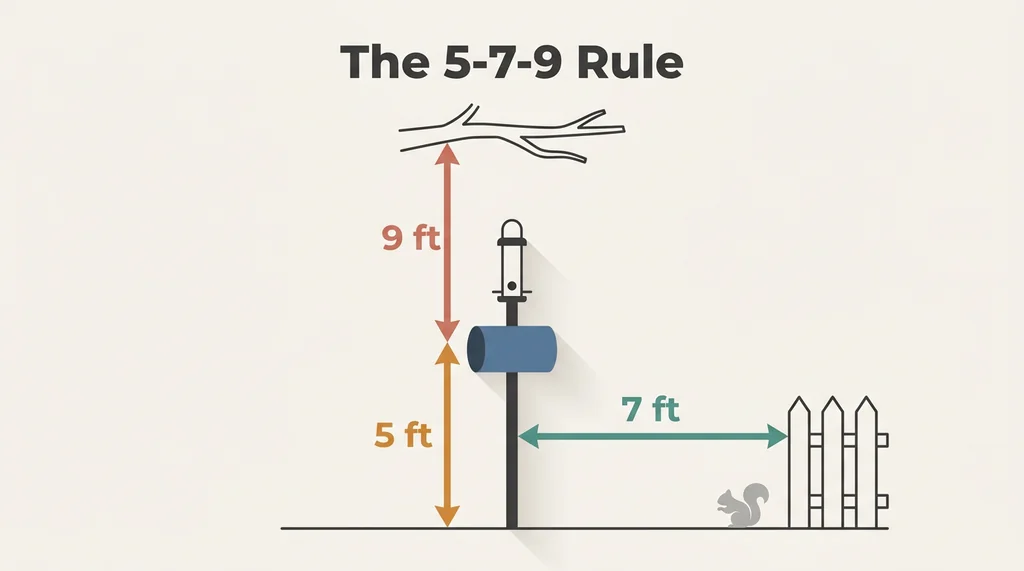
- Apply the 5-7-9 rule: position feeders 5+ feet above ground, 7+ feet from horizontal surfaces, and 9+ feet below overhead branches
- Mount cylinder baffles at least 5 feet above ground on poles standing 6-7 feet above grade to block squirrel climbing
- Place poles at least 10 feet from fences, tree trunks, and structures to eliminate running-jump access
- Add a squirrel feeding station with corn and peanuts 30 feet from bird feeders to reduce raiding frequency
- Mix safflower seeds at 10-15% of your blend and add cayenne to cut squirrel motivation without deterring songbirds
Why Feeder Poles Beat Feeder-Only Solutions
Most squirrel deterrence products focus on the feeder itself: weight-activated ports, spinning perches, caged enclosures. These work reasonably well in isolation, but they share a fundamental vulnerability. A squirrel that can reach the feeder will eventually find a way to extract seed from it, whether through persistence, weight manipulation, or simply clinging to the cage and shaking seed loose.
Pole-based squirrel proofing works differently. The goal isn't to frustrate a squirrel that's already at the feeder — it's to prevent them from reaching it at all. A feeder mounted on a properly positioned, properly baffled pole is physically inaccessible, not just inconvenient.
Squirrels are genuinely impressive athletes. They can leap horizontally up to ten feet, jump vertically nearly five feet from a standing position, and drop nine feet from above without difficulty. These aren't estimates — they're the measurements that determine whether your pole setup works or fails. A baffle positioned too low, a pole too close to a fence, or a feeder hanging within drop distance of a tree branch will be defeated by a squirrel that doesn't know it's supposed to be deterred.
The good news is that the physics are consistent and learnable. Once you understand the squirrel's movement envelope, you can design a pole system that genuinely excludes them rather than merely slowing them down.
The 5-7-9 Rule: The Foundation of Every Effective Pole Setup
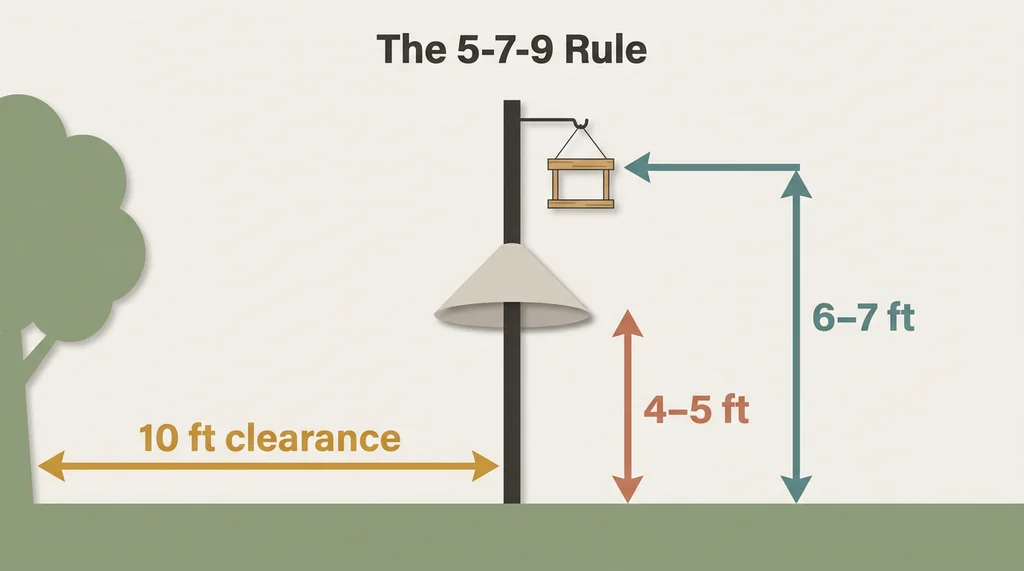
The single most useful framework for squirrel proof pole placement is the 5-7-9 rule. Memorize this before you buy anything else.
5 feet: Squirrels can jump five feet vertically from a standing position. Your feeder must be positioned so that the lowest accessible point — including the baffle — is more than five feet above any surface a squirrel could stand on.
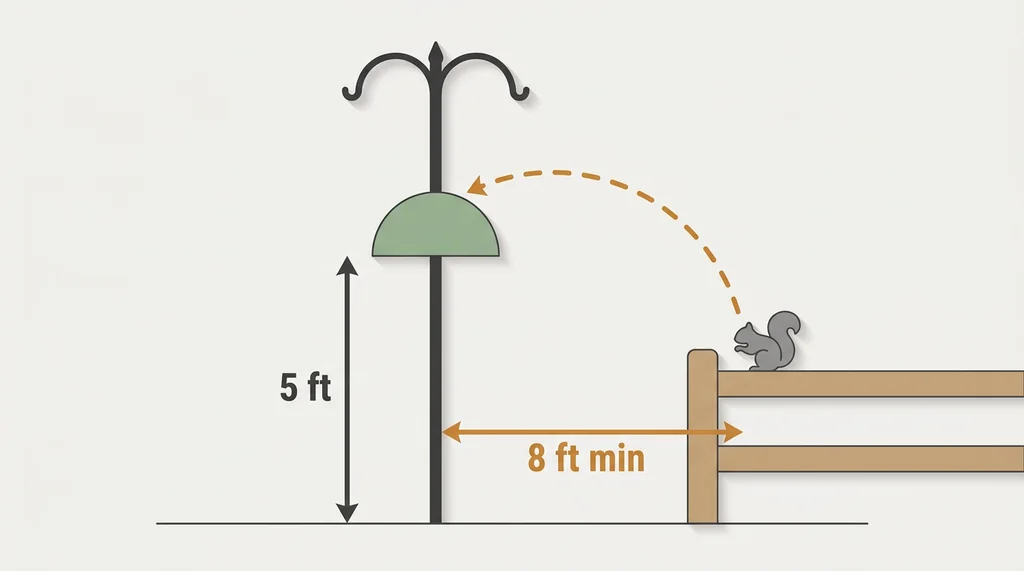
7 feet: Squirrels can leap seven feet horizontally. Your feeder must be more than seven feet from any horizontal launching surface: fences, deck railings, tree trunks, garden walls, or anything else a squirrel could use as a runway.
9 feet: Squirrels can drop nine feet from above without hesitation. Your feeder must be more than nine feet below any overhead branch, wire, or structure a squirrel could access.
In practice, this means your pole needs to stand in open space, away from structures, with adequate clearance in all three dimensions. Premium pole systems are designed with this in mind — quality models stand over 80 inches above ground when properly installed, providing the height needed to accommodate both a baffle and a feeder while maintaining adequate clearance from the ground.
The most common setup failure is placing a pole too close to a fence or shrub that looks harmless. A squirrel standing on a fence rail eight feet away can clear seven feet horizontally with room to spare. Measure before you commit to a location.
Choosing the Right Pole System
Single-Pole vs. Multi-Arm Systems
Single poles work well for one or two feeders and are easier to position correctly. Multi-arm systems — which extend horizontal arms from a central pole, allowing multiple feeders at different heights — offer more flexibility but require more open space to maintain proper clearance from all directions.
For most yards, a single pole with a quality baffle handles the squirrel problem effectively. Multi-arm systems are worth the additional planning if you want to attract a variety of species simultaneously, since different birds prefer different feeder heights and styles.
Premium pole systems run $60 to $120 depending on construction quality and included hardware. The price difference between budget and quality poles is mostly about durability and stability — a pole that wobbles or corrodes quickly will require replacement, making the cheaper option more expensive over time.
Pole Material and Construction
Steel poles outlast aluminum and wood in outdoor conditions. Look for powder-coated finishes, which resist rust better than painted surfaces. Pole sections that connect via internal threading rather than external clips tend to stay more stable over years of use.
The diameter of the pole matters for baffle compatibility. Most commercial baffles are designed for poles in the 0.75-inch to 1.5-inch diameter range. Verify compatibility before purchasing a baffle separately from a pole.
Pole Height Requirements
After accounting for ground installation depth (typically 12 to 18 inches buried or anchored), your feeder needs to sit at least five feet above ground level, with the baffle positioned at least four feet above ground — five feet preferred. This means your total above-ground pole height should be at least six to seven feet to accommodate a baffle at the five-foot mark and a feeder above it.
The recommended clearance from jumping surfaces is at least eight to ten feet horizontally. When scouting locations, physically measure the distance from nearby fences, trees, and structures before committing to a pole position.
Baffles: The Critical Component Most People Get Wrong
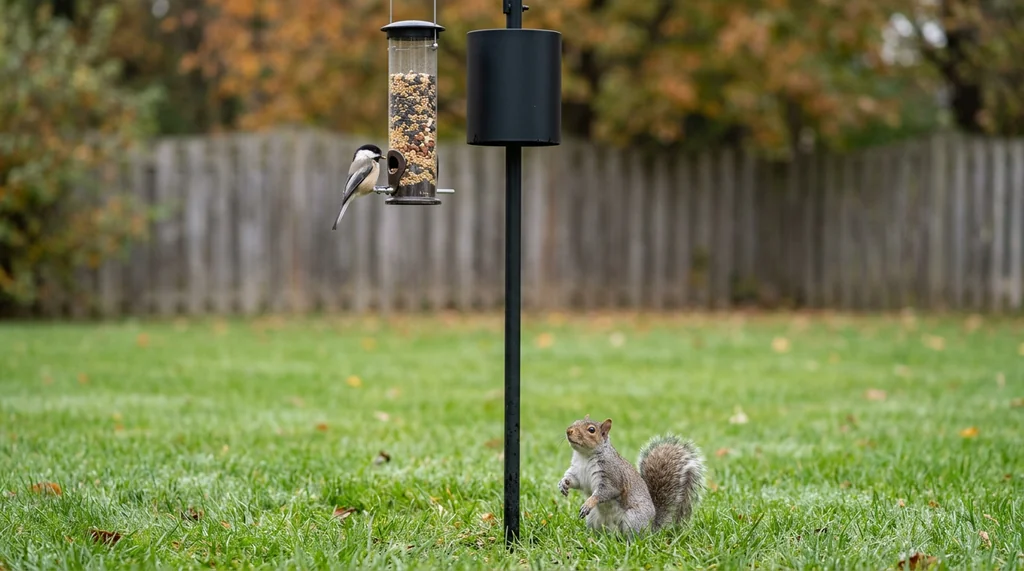
A pole without a baffle is just a climbing structure with a feeder on top. Baffles are the mechanism that actually prevents squirrels from ascending the pole, and their effectiveness depends almost entirely on correct positioning.
Types of Baffles
Cylinder baffles (also called stovepipe baffles) wrap around the pole and create a slippery, unstable surface that squirrels cannot grip or climb over. They're among the most effective designs available. A cylinder baffle properly positioned at the five-foot mark on an eight-foot pole has proven highly resistant to squirrel access over extended testing periods — two years of continuous outdoor service without significant degradation is achievable with quality construction.
Dome baffles mount below the feeder and create a curved shield that squirrels slide off when attempting to climb past. They're effective but require careful positioning — too low and squirrels reach around them, too high and they interfere with bird access.
Torpedo baffles are elongated versions of dome baffles, offering more surface area and a steeper angle. They tend to outperform standard domes in wet conditions where squirrels might otherwise grip a flatter surface.
Baffle Positioning Requirements
Baffles must be placed at least four feet above ground level, with five feet strongly preferred. This placement accounts for the squirrel's vertical jumping ability — a baffle positioned at three feet can be bypassed by a squirrel jumping from the ground.
The baffle should be positioned on the pole so that no gap exists between the baffle edge and the pole where a squirrel could insert a paw and grip. Cylinder baffles that fit snugly around the pole diameter leave no such gap, which is why they tend to outperform loose-fitting dome designs on the same pole.
Combining Pole Systems With Squirrel-Resistant Feeders
A well-positioned pole with a quality baffle solves most squirrel access problems. Combining that setup with a weight-activated feeder adds a second layer of protection for situations where the pole placement isn't perfect — yards with limited open space, complex landscaping, or persistent squirrels that keep finding creative approaches.
The Brome Squirrel Buster Plus ($79 to $95) uses a weight-activated mechanism that closes seed ports when any animal exceeding 1.3 pounds lands on it. Squirrels average eight to sixteen ounces, which puts them well above this threshold. The mechanism has proven reliable across extended use — customer testimonials consistently report lifespans exceeding ten years, and the design has held up through eighteen months of continuous operation without mechanism degradation in documented testing.
The seed savings from effective squirrel exclusion are meaningful. Monthly seed spending dropped from $47 to $31 after implementing a combined pole-plus-weight-activated-feeder approach — a reduction of $192 annually that pays for a quality baffle within a single season.
Over 530 squirrel baffle products are currently available on Amazon, which means the category is mature but also noisy. Focus on cylinder designs from established manufacturers, verify pole diameter compatibility, and prioritize products with documented multi-year longevity over those emphasizing novel features.
Pole Placement Strategy for Different Yard Configurations
Open Lawn Situations
Open lawns offer the most flexibility. Position the pole at least ten feet from the nearest fence, tree trunk, or structure in any direction. In truly open spaces, seven feet of horizontal clearance technically meets the standard, but ten feet provides a comfortable margin for squirrels that attempt running jumps rather than standing leaps.
Near Trees and Shrubs
Trees and large shrubs complicate pole placement because branches extend horizontally at varying heights, creating overhead drop zones. Before finalizing a pole location, look up and identify every branch within nine feet of your intended feeder position. A branch at twelve feet that extends horizontally to within eight feet of your feeder is a problem — a squirrel can access that branch and drop to the feeder.
Ideally, position poles in open areas between trees rather than adjacent to them. If your yard doesn't offer this option, prioritize maintaining the nine-foot overhead clearance over the horizontal clearance, since drops are harder to prevent with baffles than lateral jumps.
Deck and Patio Situations
Deck-mounted poles are popular for their convenience but require extra attention to clearance. Deck railings are typically 36 to 42 inches high, which means a squirrel standing on a railing has already gained significant elevation toward your feeder. The pole and baffle positioning must account for this elevated starting point.
A squirrel standing on a 42-inch railing can still jump five feet vertically — meaning the inaccessible zone must begin at least 42 plus 60 inches (five feet) above the deck surface. This pushes required baffle height up significantly. For deck-mounted setups, a baffle positioned at seven feet above the deck surface provides reliable exclusion.
The Distraction Station Strategy: Working With Squirrel Behavior
Squirrels are food-motivated and territorial. A dedicated squirrel feeding station placed thirty feet or more from primary bird feeders gives squirrels a reason to stay away from the bird feeding area — not because they're deterred, but because they have their own food source that's easier to access.
Corn and peanuts in a dedicated squirrel station satisfy the same foraging drive that sends squirrels to bird feeders. The thirty-foot separation is important: close enough that squirrels find and use the station, far enough that they don't treat it as a staging area for raids on nearby bird feeders.
This approach doesn't eliminate squirrel interest in bird feeders entirely, but it meaningfully reduces the frequency and persistence of attempts. Combined with a properly configured pole and baffle system, it shifts squirrel behavior from active raiding to opportunistic checking — and a well-baffled pole gives opportunistic checking a zero percent success rate.
Seed Choices That Reinforce Pole-Based Exclusion
Even the best pole system benefits from seed selection that reduces squirrel motivation. Safflower seeds have a bitter taste that squirrels find largely unpalatable, while cardinals eat them almost as readily as black oil sunflower seeds. Incorporating safflower at roughly ten to fifteen percent of your seed mix reduces squirrel pressure without deterring target species.
Hot pepper additives — either pre-treated seeds or loose cayenne mixed into seed — deter squirrels effectively because mammals experience capsaicin as burning while birds lack the relevant receptors entirely. Hot pepper-treated seed achieves approximately ninety to ninety-five percent deterrence in documented testing. The limitation is cost: pre-treated seed runs significantly more per pound than untreated alternatives. Buying loose cayenne and mixing it yourself reduces this expense substantially.
Black oil sunflower seeds remain the highest-value seed for attracting a broad range of songbirds. They're also highly attractive to squirrels, which is why pole and baffle placement matters so much when using them as your primary seed.
Maintenance and Seasonal Considerations
A squirrel proof pole system requires less maintenance than feeder-only deterrence strategies, but it isn't entirely hands-off.
Check pole stability seasonally. Frost heave in cold climates can gradually shift a buried pole, reducing its clearance from nearby surfaces. Inspect pole angle and reposition if the base has shifted more than an inch or two from vertical.
Inspect baffles after storms. High winds can rotate or displace baffles that aren't secured tightly to the pole. A baffle that's shifted position may leave gaps that didn't exist during initial installation.
Reassess clearances as vegetation grows. A shrub that was seven feet from your pole in spring may extend branches to within five feet by August. Annual trimming of vegetation within the clearance zone prevents gradual erosion of your setup's effectiveness.
Clean the pole itself periodically. Squirrels mark territory with scent. A pole that squirrels have repeatedly investigated carries olfactory information that encourages continued attempts. Wiping the pole with soapy water a few times per season removes this scent marking and reduces squirrel interest.
Feeder maintenance frequency remains constant regardless of pole configuration: every other day minimum, with daily checks during wet weather. Wet seeds mold quickly, and a moldy feeder loses bird traffic faster than any squirrel problem.
A properly configured squirrel proof pole system is one of those rare backyard investments that genuinely solves the problem it promises to address. The physics are straightforward, the materials are durable, and the results are measurable — both in seed savings and in the quality of watching birds feed without constant interruption.
The key is treating pole placement as a geometry problem rather than a product purchase. The best squirrel-proof feeders still fail if the pole sits three feet from a fence. The right measurements, applied before installation, make the difference between a setup that works for a decade and one that frustrates you for years while squirrels continue their efficient work. Get the clearances right first. Everything else follows from there.