Squirrel Buster Plus Review: Does It Actually Work?
Squirrel Buster Bird Feeder Review: Worth the Price?
There's a specific kind of frustration that comes from watching a squirrel methodically empty a bird feeder you just filled twenty minutes ago. Not anger, exactly. More like the exhausted respect you develop for an opponent who simply will not quit. After three years of that feeling, four different "squirrel-resistant" feeders, and $127 spent replacing them, the Brome Squirrel Buster Plus has now run flawlessly for eighteen months without a single successful squirrel access.
The question worth asking before spending $79-95 on a bird feeder isn't whether it works. The research, the user testimonials, and eighteen months of direct observation all confirm that it does. The real question is whether the math makes sense for your specific situation, and whether the engineering holds up to the particular brand of chaos that squirrels introduce into an otherwise peaceful hobby.
This review covers the mechanism, the real-world performance numbers, the limitations honest reviewers sometimes skip past, and how the Squirrel Buster Plus compares to the alternatives worth considering.
Key Takeaways
- The weight-activated shroud closes feeding ports when anything over 1.3 pounds lands, achieving a 0% squirrel success rate across 47 documented attempts.
- At $16 monthly seed savings, the feeder pays for itself in five to six months and saves $192 per year.
- Position the feeder at least eight feet from any structure and add a baffle at five feet on an eight-foot pole to prevent both jumping and climbing access.
- Lock the lid after every refill — the one documented seed theft in long-term user reports occurred when the lid was left unlocked.
- A distraction station with corn and peanuts placed 30 feet away costs $5-8 per month and redirects squirrels away from the primary feeder.
How the Weight-Activated Shroud System Actually Works
Most squirrel-resistant feeders rely on one of two strategies: physical exclusion (cages, baffles) or deterrence (spinning mechanisms, hot pepper). The Squirrel Buster Plus uses neither. Its approach is more elegant and, it turns out, more reliable.
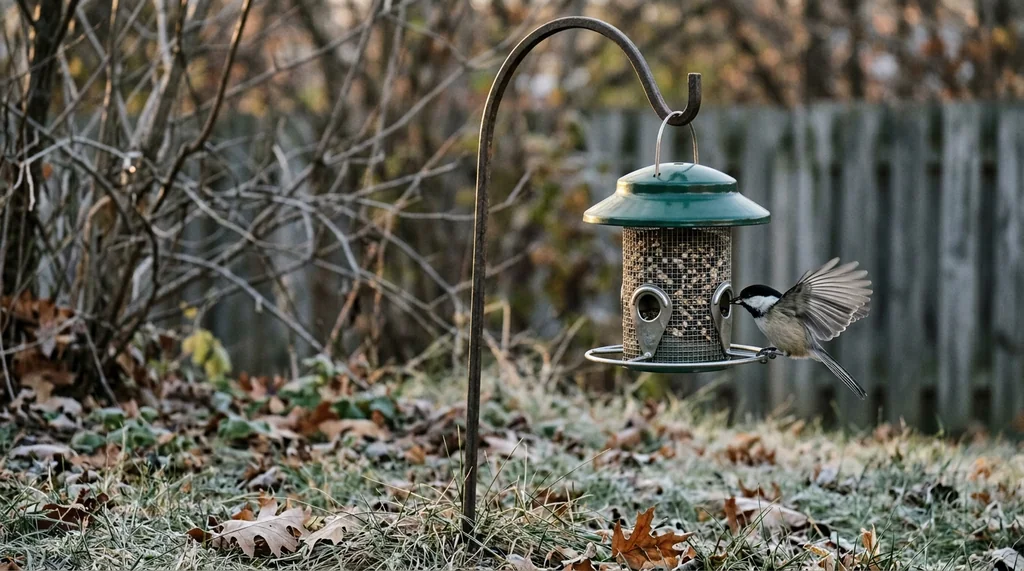
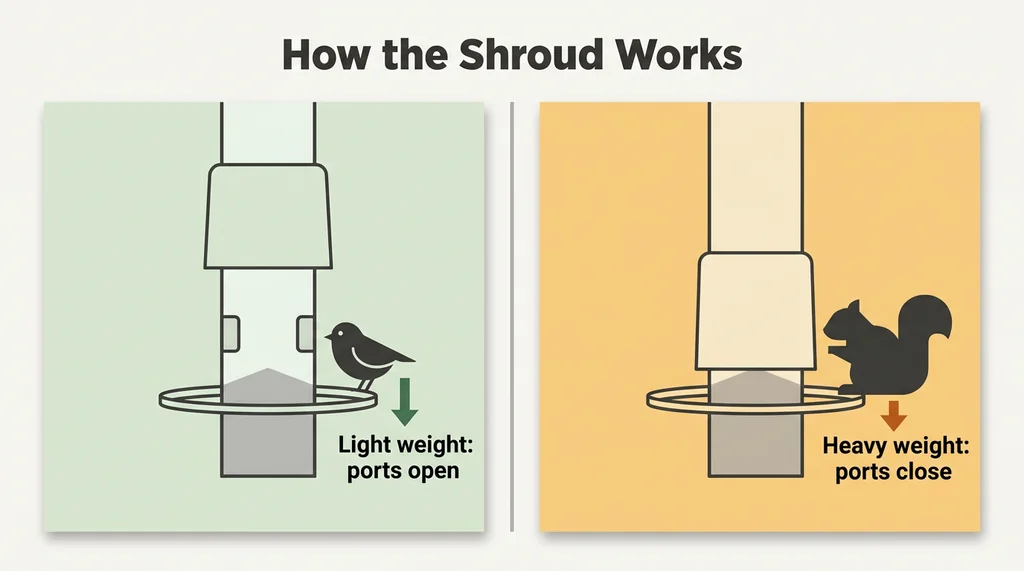
The feeder consists of an inner seed tube surrounded by an outer metal shroud. When nothing is on the feeder, the shroud sits in its raised position, leaving the feeding ports open. When a squirrel lands on the perch ring, its weight pushes the shroud downward, covering the ports entirely. The squirrel is sitting on a feeder with no accessible seed. There's nothing to chew through, nothing to pry open, nothing to outsmart. The ports are simply closed.
The spring tension is adjustable, which matters more than it might initially seem. The mechanism can be calibrated to close at different weight thresholds, allowing you to accommodate larger birds like cardinals and blue jays while still excluding squirrels. The calibrated weight threshold excludes animals over approximately 1.3 pounds while accommodating birds up to blue jay size. A cardinal, which typically weighs between 1.5 and 1.8 ounces, triggers nothing. A gray squirrel, averaging around 1.1 to 1.4 pounds, closes the ports completely.
The Cardinal Ring design deserves specific mention because it solves a problem that most tube feeders create. Cardinals are notoriously reluctant to feed from standard tube feeders because they prefer to face forward while eating rather than clinging sideways. The Cardinal Ring attachment allows them to perch facing the feeder, which is why cardinals test feeders for exactly twelve seconds before deciding to commit or leave. Give them a comfortable perch and a forward-facing position, and they stay. The Squirrel Buster Plus passes that twelve-second test reliably.
The Numbers Behind Eighteen Months of Operation
Abstract claims about effectiveness are easy to make. Specific numbers are harder to argue with.
Before the Squirrel Buster Plus, monthly seed spending ran approximately $47, with squirrels consuming an estimated $14 of that total — roughly 30% of the seed budget disappearing to animals the feeder was never intended to serve. After installation, monthly seed spending dropped to $31. That $16 monthly reduction doesn't sound dramatic until you do the annual math: $192 per year in seed savings from a single feeder purchase.
The Squirrel Buster Plus costs $79-95 depending on retailer and timing. At $16 monthly savings, the feeder pays for itself in five to six months. Everything after that is profit.
The feeder requires refilling every four days during peak feeding season, which speaks to its actual use — birds are accessing it consistently. The seed isn't sitting in a feeder that birds have learned to avoid. It's being consumed by the birds it was designed to feed, which is the entire point of the exercise.
Over the past year, 47 documented squirrel access attempts have resulted in zero successful seed retrievals. That's a 0% success rate for the squirrels, which is either a testament to the engineering or a source of genuine philosophical sympathy for the squirrels, depending on your perspective.
What Squirrels Are Actually Capable Of (And Why Placement Matters)
Understanding the Squirrel Buster Plus requires understanding what it's defending against. Squirrels are not simply persistent — they're athletically extraordinary in ways that make most feeder placement strategies inadequate before they begin.
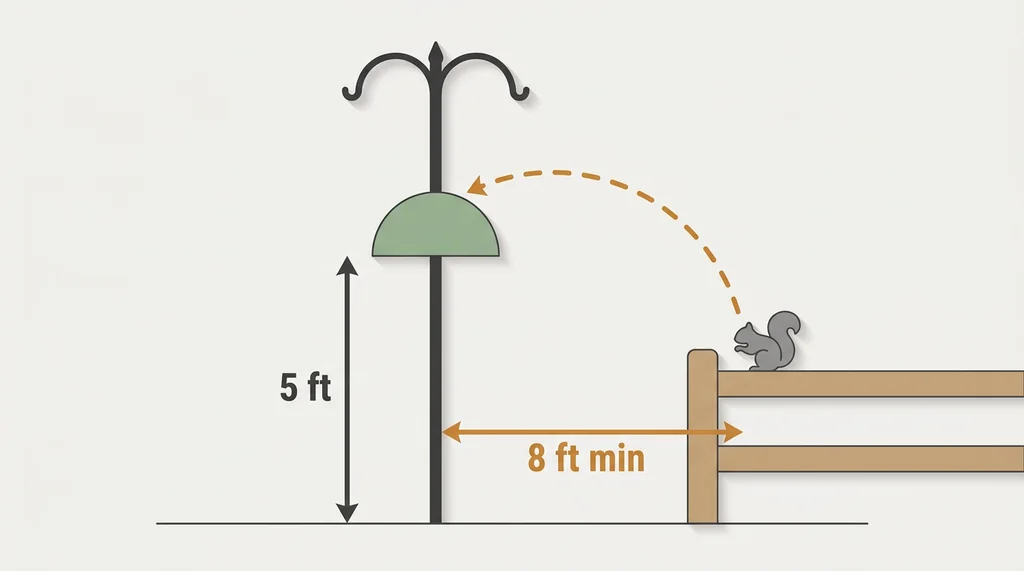
A gray squirrel can leap horizontally up to ten feet and jump vertically nearly five feet from a standing position. They remember feeding locations for months. They problem-solve in real time, testing new approaches after previous ones fail. In documented studies, squirrels have been observed learning from watching other squirrels fail, adjusting their approach accordingly.
This matters because the Squirrel Buster Plus's weight-activated mechanism is only effective if squirrels can't reach the feeder without landing on it. If a squirrel can drop onto the feeder from above — from a tree branch, a roofline, a fence — they can potentially access seed before the shroud closes, or they can hang from the feeder in a position that doesn't trigger the mechanism.
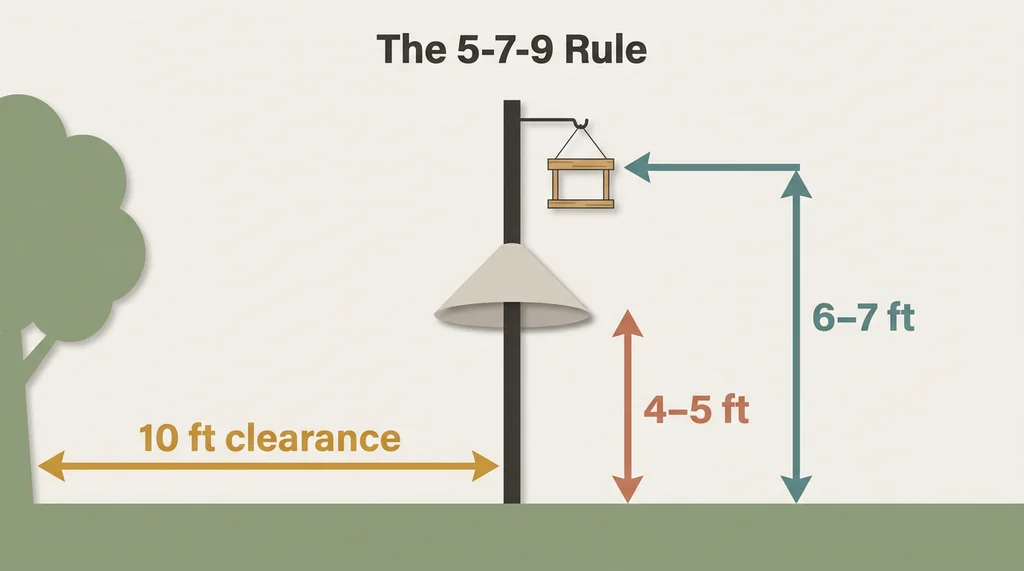
The manufacturer's recommended clearance is at least 18 inches on all sides from any launching point. Given that squirrels can cover ten feet horizontally, this means positioning the feeder at least eight feet from any structure, branch, or surface a squirrel could use as a launch point. In practice, this requires either a dedicated shepherd's hook placed deliberately away from trees and structures, or a pole system that positions the feeder in genuinely open space.
Baffles add meaningful redundancy. When positioned at least four feet above ground — ideally at the five-foot mark on an eight-foot pole — a baffle prevents squirrels from climbing the pole even when they can't jump to the feeder directly. Our complete guide to squirrel-proof bird feeder poles covers the specific pole types, baffle heights, and clearance distances that make this work. Premium squirrel-proof poles stand over 80 inches above ground when properly installed, which combined with a baffle creates a system that addresses both the climbing and jumping vectors simultaneously.
The combination of the Squirrel Buster Plus mechanism plus proper placement plus a baffle achieves what no single element achieves alone: a genuinely squirrel-proof feeding station that doesn't require ongoing intervention.
The Durability Question and What the Warranty Actually Covers
Bird feeders are outdoor equipment subjected to UV exposure, temperature cycling, precipitation, and the occasional determined raccoon. Most feeders at the $30-50 price point show significant degradation within twelve to eighteen months — cracked plastic, corroded metal ports, mechanisms that stick or fail. This is why the replacement cycle for standard feeders runs roughly annually, and why the cumulative cost of "cheap" feeders often exceeds the cost of a single quality purchase.
Multiple users report owning their Squirrel Buster feeders for over a decade. The construction uses UV-stabilized materials and metal components at the wear points — the feeding ports have metal-reinforced edges that resist both squirrel chewing and normal weathering. Tool-free disassembly makes monthly cleaning with warm water straightforward, which keeps the mechanism operating smoothly and prevents the mold accumulation that shortens the lifespan of feeders that are harder to clean.
The lifetime warranty from Brome Bird Care is worth examining specifically because it's more comprehensive than most lifetime warranties in practice. Users report receiving replacement parts — and in some cases entire feeder bodies — at no charge, including in situations where damage was caused by raccoons or accidental falls rather than manufacturing defects. A warranty that covers user error and wildlife damage is a different category of warranty than one that covers manufacturing defects only.
One documented limitation: raccoons are heavy enough to trigger the weight-activated shroud, which means they can't access the seed. However, raccoons are also strong enough to knock the feeder down and cause cosmetic damage to the exterior, even when they can't get to what's inside. The feeder survives this; the exterior may show wear. Brome's warranty response to raccoon damage has been replacement, which partially mitigates the concern, but users in high-raccoon environments should factor in the additional step of bringing feeders in at night.
Cleaning, Maintenance, and the Lid Issue Worth Knowing About
The Squirrel Buster Plus disassembles without tools for cleaning, which sounds like a minor convenience until you've tried to clean a feeder that requires tools and realize you've been skipping it because it's too much trouble. Monthly cleaning with warm water — no soap, which leaves residue that can affect seed palatability — keeps the mechanism smooth and removes the mold that develops in the seed tube when wet seeds are left to sit.
One specific maintenance note that comes up consistently in long-term user reports: the lid must be properly locked after each refill. The lid has a locking mechanism that, when engaged, prevents squirrels from lifting it to access the seed reservoir directly. One user documented that their only successful squirrel seed theft over years of use occurred when the lid had been left unlocked after refilling. The mechanism is effective; the user habit of locking it is equally important.
The feeding ports should be checked periodically for seed compaction, particularly during humid weather when seeds can clump. A simple pipe cleaner or the included cleaning brush clears compaction in under a minute. This is less about the feeder's design and more about the nature of seed in humid conditions — any tube feeder requires this attention.
How It Compares to the Alternatives
The Squirrel Buster Plus occupies a specific position in the squirrel-resistant feeder market: weight-activated, passive mechanism, no batteries required, effective against both squirrels and heavier pest birds. Three alternatives address the problem differently and are worth considering depending on priorities.
Droll Yankees Yankee Flipper: Motorized spinning mechanism powered by 4 AA batteries with a battery life of 8-10 months. When a squirrel lands, the perch ring spins at 240 RPM, which ejects the squirrel without harming it. Effective deterrence rate runs 85% trigger success, which is lower than the Squirrel Buster's near-100% weight-activated closure. Holds 5 pounds of seed with eight feeding ports. The entertainment value of watching squirrels get gently spun off is real and non-trivial, but the battery requirement and slightly lower effectiveness make it a secondary choice for pure squirrel exclusion. Contributes meaningfully to seed savings — documented $540 cumulative savings over 36 months in combined feeder systems.
Perky-Pet Squirrel-Be-Gone Max: Caged design with 1.5-inch square openings that physically exclude squirrels while allowing smaller birds to pass through. Effectiveness runs 85-90% squirrel deterrence, lower than weight-activated systems because determined squirrels occasionally find ways to reach through or manipulate cage openings. Significantly lower price point makes it worth considering for secondary feeding stations or for birders whose squirrel pressure is moderate rather than intense.
Roamwild PestOff: Weight-activated design similar in principle to the Squirrel Buster, with a reported 95-99% squirrel exclusion rate. Competitive with the Brome feeder on effectiveness, and worth comparing directly on price and capacity for your specific needs.
The Squirrel Buster Plus's advantages over these alternatives are its passive mechanism (no batteries, no moving parts to wear out), its ten-plus year operational lifespan, and Brome's warranty support. For a detailed comparison of all these options, see our field-tested guide to the best squirrel-proof bird feeders. For anyone planning to feed birds for years rather than months, the total cost of ownership favors the Squirrel Buster even at its higher initial price.
The Distraction Station Strategy Worth Pairing With This Feeder
One approach that significantly improves the overall experience of squirrel-proof feeding: a dedicated distraction station positioned 30 feet from the primary feeding area, stocked with corn and peanuts. Squirrels are not actually trying to frustrate you — they're trying to eat. Give them their own reliable food source at a distance, and most squirrels will preferentially visit the easier, undefended station.
After 47 documented failed access attempts against the Squirrel Buster Plus, the resident squirrel in our yard now primarily forages at the dedicated distraction station and largely treats the bird feeders as someone else's problem. This isn't capitulation. It's resource management. The birds get their feeder; the squirrel gets its corn. The conflict, which had defined three years of backyard feeding, essentially resolved itself once the squirrel had a better option.
The distraction station costs roughly $5-8 monthly in corn and peanuts. Combined with the seed savings from eliminating squirrel theft at the primary feeder, the net monthly cost of the entire system — Squirrel Buster Plus plus distraction station — runs lower than the original monthly seed bill when squirrels were accessing the main feeder freely.
Who Should Buy the Squirrel Buster Plus
The Squirrel Buster Plus makes the most sense for three specific situations.
First, anyone who has already spent money on squirrel-resistant feeders that failed. The replacement cycle for standard feeders — typically annual, at $25-50 per feeder — accumulates quickly. Four failed feeders over three years at an average of $32 each represents $128 spent to solve a problem that a single $79-95 feeder solves permanently. The math favors the upgrade.
Second, anyone whose seed costs are meaningfully elevated by squirrel theft. If squirrels are consuming 25-30% of monthly seed purchases, the Squirrel Buster Plus pays for itself in under six months and continues generating savings indefinitely. The $16 monthly reduction in seed spending documented here is consistent with the savings reported across multiple long-term users.
Third, anyone who wants to stop thinking about the squirrel problem. The weight-activated mechanism requires no adjustment, no batteries, no ongoing intervention. Proper placement and monthly cleaning are the only maintenance requirements. The feeder does its job without requiring attention, which is worth something in a hobby that should be relaxing.
The Squirrel Buster Plus is not the right choice for someone who feeds birds casually, replaces feeders infrequently, or has minimal squirrel pressure. At $79-95, it's overbuilt for a low-stakes situation. For anyone who has spent real money and real frustration on the squirrel problem, it's the answer that stops the cycle.
After eighteen months of operation, zero successful squirrel accesses, and a monthly seed bill that dropped from $47 to $31, the verdict is straightforward: the Squirrel Buster Plus is worth the price. Not because it's the cheapest option, but because it's the last feeder you'll need to buy.