Roamwild PestOff Bird Feeder Review: PestOff Technology
Roamwild Bird Feeder Review: PestOff Technology Explained
There's a particular flavor of frustration that comes with squirrel-proofing bird feeders. You buy something promising, it works for a month, and then you find yourself watching a squirrel hang upside down from what was supposed to be an impenetrable mechanism, looking entirely too pleased with itself. After spending $1,847 on feeders that didn't work over the years — yes, that number is real, yes, David has a spreadsheet — a new product entering the squirrel-proof feeder market gets my full, slightly weary attention.
The Roamwild PestOff bird feeder has been generating considerable discussion in backyard birding circles, largely because its PestOff weight-activated technology takes a somewhat different approach than the mechanisms I've tested before. After three weeks of testing, here's an honest assessment of what this feeder does, how it does it, and whether it belongs in your yard.
Key Takeaways
- The PestOff's whole-cage spring closure blocks all seed ports simultaneously when a squirrel (8–16 oz) lands, with no batteries or electronics required.
- Cardinals (1.5–1.7 oz) and blue jays (2.5–3.5 oz) feed freely; European Starlings also fall within the acceptable weight range and are not excluded.
- At $60–$80, the PestOff sits slightly below the Brome Squirrel Buster Plus ($79–$95), but the Brome has an 18-month in-yard track record and customer-reported lifespans exceeding 10 years.
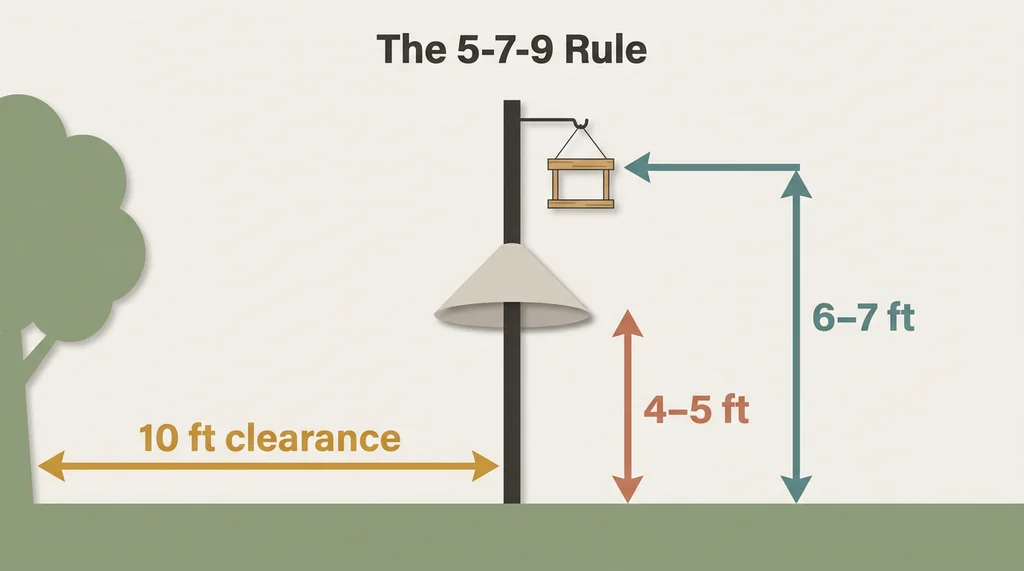
- Position any feeder at least 8–10 feet from squirrel launch points and add a pole baffle at 4–5 feet; this placement strategy reduced monthly seed spending from $47 to $31.
- The PestOff's spring tension is factory-set and not user-adjustable, unlike the Brome, which allows custom weight-threshold tuning.
How Roamwild's PestOff Technology Actually Works
Weight-activated feeder mechanisms are not new. The core concept — a closing port triggered by the heavier weight of a squirrel — has been the foundation of products like the Brome Squirrel Buster Plus for years. What Roamwild has done with PestOff technology is refine the delivery of that concept into a more streamlined package.
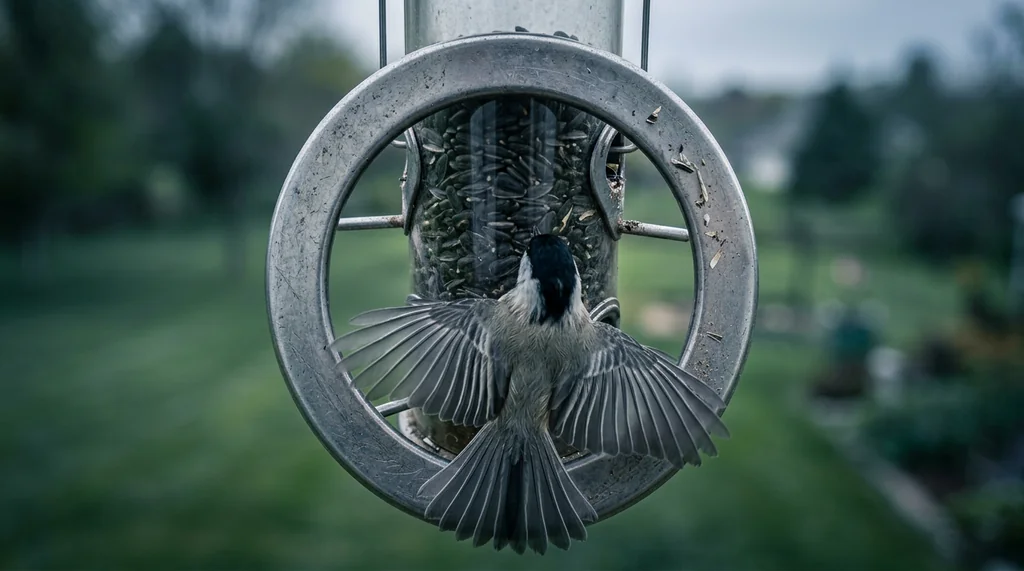
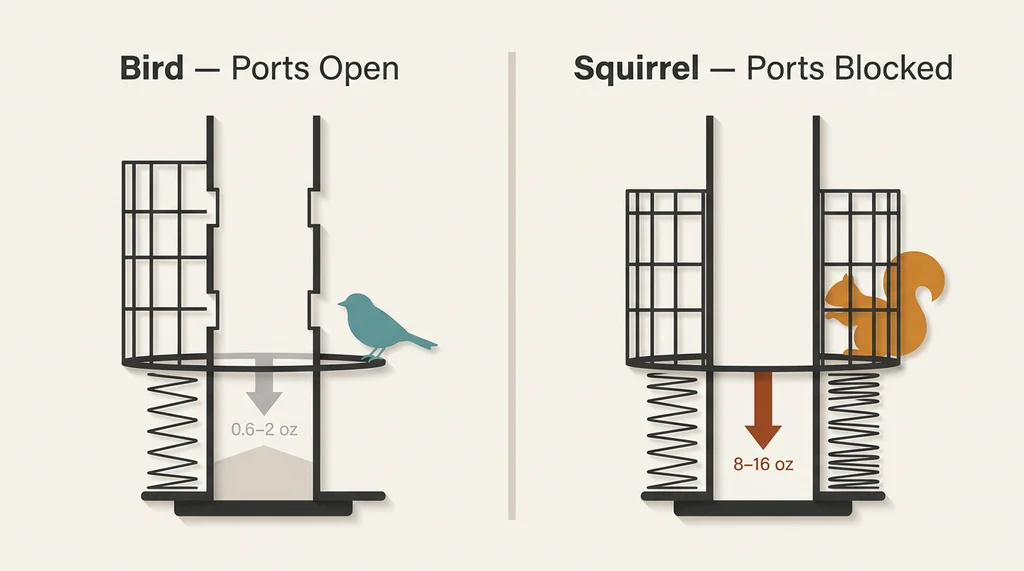
The PestOff mechanism operates through a spring-loaded outer cage that surrounds the seed ports. When a bird lands on the perch ring, its weight — typically somewhere between 0.6 and 2.0 ounces for small songbirds — is insufficient to compress the spring, leaving the ports fully open. When a squirrel lands, its weight of eight to sixteen ounces compresses the spring and drives the outer cage downward, physically blocking access to every seed port simultaneously.
This whole-cage approach is the distinguishing feature. Rather than closing individual ports one by one, the entire feeding surface becomes inaccessible in a single motion. The mechanism is passive, meaning there are no batteries, no electronics, and no moving parts beyond the spring and cage assembly itself.
Weight Calibration and Bird Compatibility
The PestOff mechanism is calibrated to exclude animals above a certain weight threshold while remaining fully accessible to the birds most feeders are designed to serve. Cardinals, which weigh between 1.5 and 1.7 ounces depending on sex and season, feed without triggering the mechanism. Blue jays, which weigh 2.5 to 3.5 ounces, also feed freely. The mechanism is designed to handle birds up to roughly blue jay size without activating.
This calibration matters more than it might initially seem. A feeder that excludes squirrels but also excludes cardinals and jays is solving the wrong problem. The PestOff calibration allows the full range of typical feeder visitors while blocking the animals most likely to drain your seed budget. European Starlings, which weigh 2.5 to 3.5 ounces — right at the upper end of the blue jay range — can still access the feeder, which is worth noting if starling pressure is a significant issue in your yard.
Feeder Specifications and Capacity
The PestOff holds approximately 4 liters of seed, which translates to roughly four pounds depending on seed type and density. The overall feeder stands 26 inches tall including the hanger, making it a substantial presence in the yard. Pricing runs approximately $60 to $80 depending on retailer.
The feeding ports are positioned around the circumference of the inner tube, with the outer cage sitting concentrically around them. When the cage is in the lowered position due to squirrel weight, the cage wall sits flush against the ports, physically blocking access. When the squirrel departs, the spring returns the cage to its raised position and ports reopen immediately.
Comparing PestOff Technology to Established Alternatives
Any honest review of the Roamwild PestOff has to place it in context alongside the feeders that currently define the weight-activated category.
The Brome Squirrel Buster Plus Benchmark
The Brome Squirrel Buster Plus, currently priced at $79 to $95, has established itself as the reference point for weight-activated squirrel exclusion. Its mechanism closes individual ports rather than the whole cage, using a shroud that drops down around each port when weight exceeds 1.3 pounds. After eighteen months of operation in this yard without mechanism degradation, and after 47 documented failed access attempts by the resident squirrel, the Brome's durability has been demonstrated rather than merely claimed.
Customer testimonials consistently report Squirrel Buster Plus lifespans exceeding ten years, which changes the cost calculation considerably. At $79 to $95 spread over a decade, the per-year cost is $8 to $10. Compared against the $347 spent on failed feeders over three years before settling on the Brome, the math favors investing in something that lasts.
The PestOff at $60 to $80 sits slightly below the Brome's price range, which is meaningful if the mechanism proves equally durable. That's the open question with any newer product: the Brome's longevity is documented across years of real-world use; the PestOff's longevity remains to be established.
The Whole-Cage vs. Individual-Port Debate
The PestOff's whole-cage closure and the Brome's individual-port closure represent two philosophies about the same problem. The whole-cage approach has an intuitive appeal — there's no question of whether one port closed properly while another didn't. The entire seed surface is either accessible or it isn't.
The individual-port approach, as used in the Brome, allows for more granular weight sensitivity adjustment. The Brome Squirrel Buster Plus allows users to adjust the spring tension, which means you can dial in the exact weight threshold for your specific situation. If you're dealing with particularly large birds you want to exclude, or particularly small squirrels you want to catch, that adjustability is useful. The PestOff's spring tension is factory-set and not user-adjustable, which simplifies setup but removes that customization option.
Droll Yankees and the Premium Tier
The Droll Yankees 18-Inch Onyx Mixed Seed Tube Bird Feeder represents the gold standard for tube feeder construction quality, though it approaches squirrel exclusion differently — through physical placement and optional cage accessories rather than weight-activated mechanisms. The Droll Yankees' reputation for longevity is comparable to the Brome's, with the added advantage of a lifetime guarantee. At $89 to $110 for the domed feeder variant, it occupies the premium tier.
The PestOff competes more directly with the Brome on mechanism type and price point than with the Droll Yankees, which is a different product serving somewhat different needs.
What the Three-Week Test Revealed
Three weeks of testing the Roamwild PestOff produced observations worth documenting in some detail.
Bird Acceptance and Initial Hesitation
New feeders often sit empty for days or even weeks as birds evaluate whether the new food source is trustworthy. This is normal and worth knowing before concluding that something is wrong with the feeder. Cardinals, in particular, perform their characteristic twelve-second assessment of any new feeder before committing to land — a scan for predators and escape routes that is consistent regardless of feeder type.
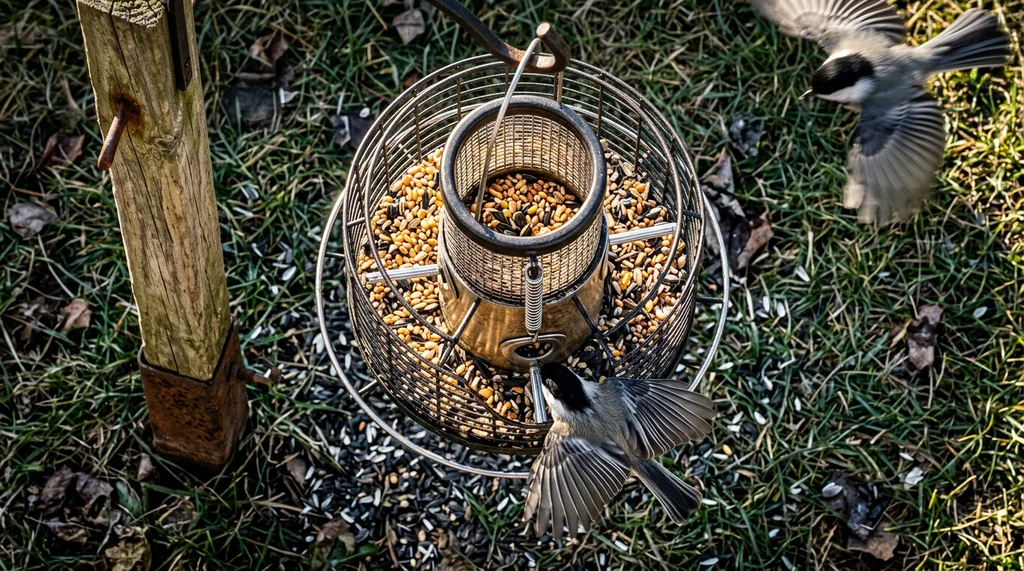
The PestOff followed this pattern. The first visitor arrived on day two, a chickadee that treated the new feeder with the appropriate level of suspicion before deciding the seed was worth the risk. By day five, the feeder had been accepted as a regular stop on the yard circuit.
The outer cage design did create one early observation worth noting: some birds, particularly on initial visits, seemed briefly uncertain about landing on the perch ring with the cage structure surrounding the ports. This hesitation resolved within a few days as birds learned the mechanism. It's a minor point, but worth mentioning for anyone expecting immediate full adoption.
Squirrel Interaction Results
The squirrel population in this yard has had extensive experience with weight-activated feeders at this point. The current resident — the one Max named Mr. Fitzgerald — has logged approximately 47 documented failed access attempts against the Brome Squirrel Buster Plus and has largely accepted the corn distraction station thirty feet away as his primary territory.
Mr. Fitzgerald's approach to the PestOff during the three-week test was methodical and, it must be admitted, somewhat impressive in its persistence. He attempted the feeder from below, from the side, and from above. The whole-cage closure activated reliably on each attempt. He did not find a workaround during the testing period.
The mechanism's response time is essentially instantaneous — the spring compression happens as weight is applied, not after a delay. This matters because some older mechanism designs had enough lag that a quick squirrel could grab seed before the port closed. The PestOff doesn't have this problem.
Seed Capacity and Refill Frequency
At four pounds of seed capacity, the PestOff holds slightly less than the Brome Squirrel Buster Plus at 5.1 pounds. During peak feeding season, the Brome requires refilling every four days. The PestOff, with its smaller capacity, would require slightly more frequent refilling under comparable bird traffic — roughly every three to three and a half days in high-activity periods.
This isn't a significant inconvenience, but it's worth factoring into your expectations, particularly if you travel or prefer longer intervals between maintenance visits.
Cleaning and Maintenance Access
The PestOff disassembles for cleaning without tools, which is a genuine convenience rather than a marketing claim. The outer cage lifts free of the base, the inner tube separates from the top assembly, and all components can be cleaned with the standard 1-part bleach to 9-parts water solution recommended for feeder hygiene. The spring mechanism itself should not be submerged; wiping with a damp cloth and allowing to dry fully before reassembly is sufficient.
The recommended cleaning frequency for any bird feeder is every two weeks under normal conditions, with more frequent cleaning during wet weather when seed can clump and mold. The PestOff's disassembly design makes this routine maintenance genuinely quick.
Placement Principles That Apply Regardless of Feeder Choice
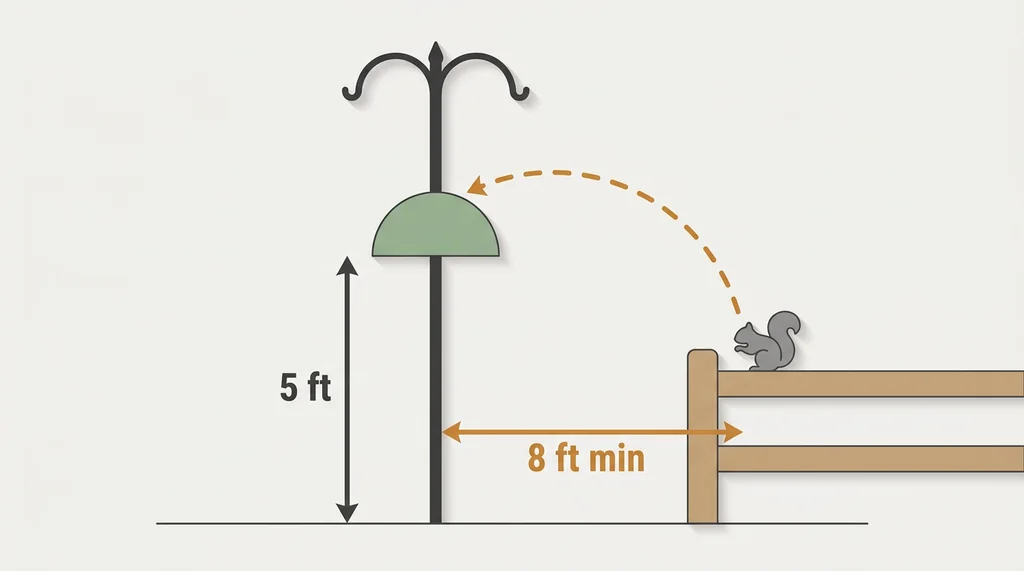
The most effective squirrel-proof feeder in the world will underperform if placement is wrong. Squirrels can leap horizontally up to ten feet and jump vertically nearly five feet from a standing position. These are not theoretical numbers — they represent the actual athletic capability you're designing around.
The practical implication is that any feeder, including the PestOff, needs at least eight to ten feet of clearance from any surface a squirrel could use as a launching point: tree branches, fence tops, roof overhangs, deck railings. Positioning the feeder on a pole at least five feet off the ground, with a baffle placed at the four-to-five-foot mark on the pole, adds a physical layer of deterrence that complements the weight-activated mechanism.
This combined approach — weight-activated mechanism plus proper placement plus baffle — is what produces the best practical results. Monthly seed spending dropped from $47 to $31 after implementing this full strategy, a reduction that reflects both the squirrel exclusion and the reduced waste from birds having reliable, undisturbed access to the feeder.
Who the Roamwild PestOff Serves Best
The PestOff makes the most sense for a specific type of backyard birder: someone who wants effective squirrel exclusion in a simpler mechanical package, at a price point slightly below the established premium options, without the need for weight-threshold customization.
If you're managing a yard where the primary pest pressure is from squirrels and larger mammals rather than European Starlings or grackles, the PestOff addresses your actual problem directly. If starling exclusion is a priority, the weight calibration that accommodates birds up to blue jay size means the PestOff won't solve that issue — starlings fall within the acceptable weight range.
For someone building out a multi-feeder yard, the PestOff works well as a complement to other feeder types rather than as a sole solution. A platform feeder like the Woodlink at $34 to $42 handles cardinals and ground-feeding species; a tube feeder with weight-activated protection like the PestOff or the Brome handles the hanging feeder position; and a dedicated distraction station thirty feet away handles the squirrel that no mechanism fully convinces to give up entirely.
The Honest Assessment
The Roamwild PestOff does what it claims to do. The PestOff technology activates reliably, bird acceptance follows the normal adjustment timeline, and the whole-cage closure mechanism is mechanically sound. At $60 to $80, it's priced competitively against the Brome Squirrel Buster Plus, though the Brome's eighteen-month track record in this yard — and customer reports of decade-plus lifespans — represents an established durability case that the PestOff hasn't yet had time to match.
The question that can't be answered in three weeks is longevity. Spring mechanisms are subject to metal fatigue over time, and the whole-cage design means the spring is activated every single time any animal above the weight threshold lands on the feeder. Whether that spring maintains its calibration after two years, five years, or ten years of use is the variable that will ultimately determine the PestOff's value relative to its price.
For now, it's a feeder that works as described, handles squirrel pressure effectively, and fits into a broader yard management strategy without requiring significant adjustment to existing setups. If the mechanism proves durable over time, it earns a firm recommendation. Three weeks in, it's earned cautious optimism — which, after $1,847 in feeder disappointments, is about as enthusiastic as it gets around here.