DIY Squirrel Proof Bird Feeder Setup That Works
How to Build a DIY Squirrel Proof Bird Feeder Setup That Actually Works
Squirrels are not stupid. After three years of watching them test, probe, and occasionally dismantle feeding stations with what can only be described as professional focus, the one thing I can tell you with complete confidence is that a single product, a single trick, or a single afternoon of effort will not solve this problem. What works is understanding the physics of the situation and building a system around those constraints.
The good news: the physics are knowable, the materials are cheap, and once you set things up correctly, you stop losing $14 worth of seed every month to a rodent that weighs less than a pound.
Here's how to actually do it.
Key Takeaways
- Place the feeder pole at least 10 feet from any tree, fence, or structure a squirrel can use as a launch point
- Mount the baffle at 4-5 feet up the pole — lower positions allow squirrels to jump over it from the ground
- Build a stovepipe baffle from an 8-inch diameter, 24-inch pipe section for $15-20 to fit 4x4 posts that commercial baffles won't grip — or see our DIY squirrel baffle guide for four complete homemade designs
- Hang the feeder bottom at 6-7 feet above ground to block deer reach while satisfying the minimum height requirement
- Mix safflower seed at a 50/50 ratio with black oil sunflower to reduce squirrel motivation without deterring cardinals or chickadees
Why Most DIY Squirrel Proof Bird Feeder Attempts Fail
The failure pattern is almost always the same. Someone installs a baffle on a pole, watches a squirrel bypass it in forty seconds, and concludes that baffles don't work. Or they hang a feeder from a tree branch, add a dome above it, and wonder why squirrels are still eating the seed. The baffle isn't the problem. The placement is.
Squirrels can jump horizontally up to ten feet and vertically up to five feet from a standing position. That's not an exaggeration for dramatic effect — it's the physical reality you're working against. Any feeder within ten feet of a tree trunk, fence post, deck railing, wall, or any other structure is accessible to a squirrel regardless of what you've attached to the pole. The baffle becomes irrelevant because they're jumping over it, not climbing past it.
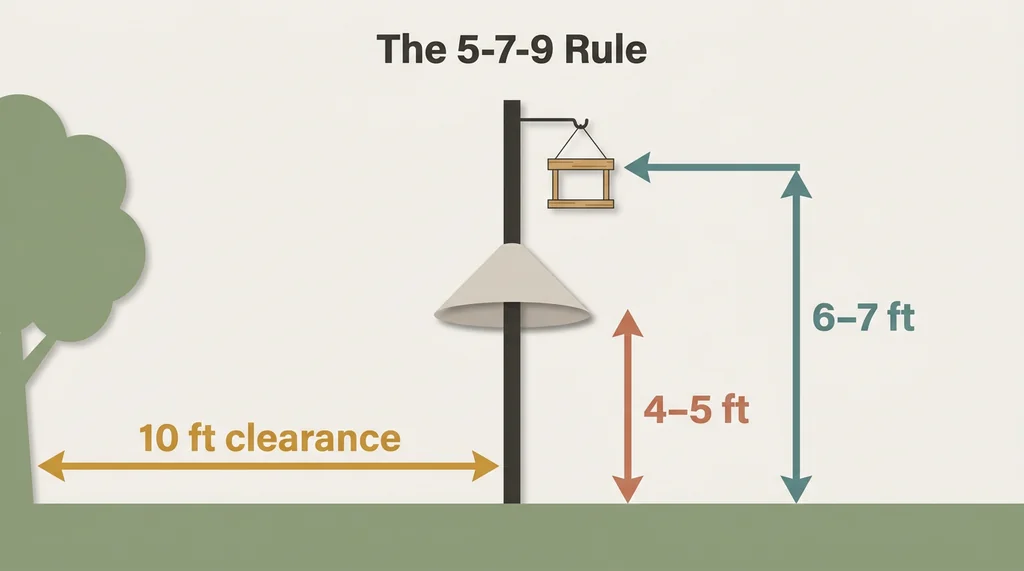
This is sometimes called the 5-7-9 rule, though the numbers vary slightly depending on the source: the feeder must be at least five feet off the ground, the baffle must be positioned at least four to five feet up the pole, and the entire setup must sit at least ten feet away from any launching point. Get all three right simultaneously, and you've eliminated roughly 90% of the access routes squirrels use.
Most DIY attempts get one or two of these right. Getting all three requires actually measuring your yard before you start building anything.
Choosing the Right Pole for Your Setup
The pole is the foundation of everything, and the wrong choice creates problems that no baffle can fix.
Shepherd's Hooks
Modern shepherd's hooks that extend beyond nine feet are a legitimate option, provided you've done the placement math first. Their main advantage is that standard cone or dome baffles fit them well — the thin diameter is compatible with most commercial baffle hardware. Their main disadvantage is stability: a tall, thin shepherd's hook will wobble in wind, which can dislodge baffles over time and makes heavier feeders impractical.
If you go this route, look for hooks with a ground stake that extends at least eighteen inches into the soil, and consider adding a concrete anchor if your soil is sandy or loose.
Pressure-Treated 4x4 Posts
For anyone who wants a genuinely permanent installation, a pressure-treated 4x4 is the most durable option available. It can support multiple feeders, handles wind without flexing, and lasts decades. The tradeoff: standard cone baffles won't work on a post this thick. You'll need a stovepipe baffle, which is a slightly more involved DIY project but still very manageable.
If you're not burying the post, you can build a simple base from 1x4 or 1x6 boards arranged in a cross pattern and secured with lag bolts. This works reasonably well for lighter setups, though buried posts are more stable.
Natural Wood Posts
Black Locust, Eastern Red Cedar, and White Cedar are all naturally rot-resistant and work well as rustic feeder poles. They need to be buried two to four feet deep depending on height — the general rule is that one-quarter to one-third of the total post length should be underground. A seven-foot post with two feet buried gives you five feet of working height, which is the minimum you need.
The aesthetic appeal is real, and these materials are often free or very cheap if you have access to a wooded area or know someone clearing land.
Galvanized Fence Posts
These are weather-resistant and long-lasting, but drilling them to mount feeder hooks requires a metal-rated drill bit and some patience. If you're comfortable with that, they're a solid middle-ground option between shepherd's hooks and full 4x4 posts.
Building a Stovepipe Baffle for Thicker Posts
If you're using a 4x4 or any post thicker than about two inches in diameter, a stovepipe baffle is the right tool. Commercial baffles designed for thin poles will simply slide down or fail to grip a thicker post properly.
What you need:
- One section of stovepipe, approximately 8 inches in diameter and 24 inches long (available at hardware stores for around $12-15)
- Chicken wire or hardware cloth
- Wire staples or zip ties
- A drill with a metal bit
- Two U-bolts or pipe clamps that fit your post diameter
How to build it:
First, and this is the most important installation note you'll read: attach the stovepipe baffle to the post before you bury or permanently mount the post. Retrofitting a stovepipe baffle onto an already-installed post is genuinely miserable. The baffle needs to slide over the post from the top, which is impossible once the feeder hardware is mounted above it.
With the post horizontal, slide the stovepipe section over it and position it where you want the baffle to sit — this should be four to five feet above where the ground level will be. Secure it using U-bolts or pipe clamps through pre-drilled holes in the pipe.
The squirrel's next move, once they realize they can't climb the smooth pipe, is to jump and grab the top edge of the stovepipe. To prevent this, cut a circle of chicken wire slightly larger than the pipe diameter and attach it to the top of the pipe section so it forms a loose, floppy cap. Squirrels can't grip the wire mesh without it collapsing under them, which ends the attempt.
Total material cost for this baffle: roughly $15-20 per station. Across four feeding stations, that's $60-80 total — compared to $200 or more for commercial pole-and-baffle systems that accomplish the same thing.
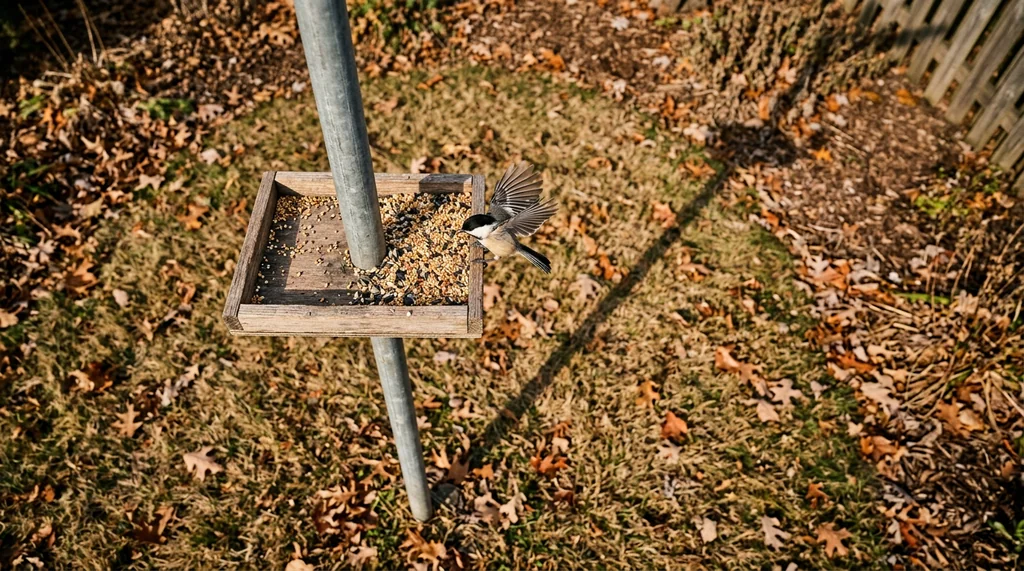
Placement: The Part Everyone Skips
Before you dig a single hole, walk your yard with a tape measure. This is not optional.
Mark where you're considering installing the feeder pole. Then measure to every tree trunk, fence post, deck post, wall, and raised surface within fifteen feet. If anything is closer than ten feet, move the mark. Keep moving it until you've found a location that genuinely clears ten feet in all directions from any surface a squirrel could use as a launch point.
For deer deterrence, the bottom of the feeder needs to hang six to seven feet above the ground. Deer can reach five to six feet without difficulty, so six feet is the minimum and seven is better. This height requirement, combined with the baffle position requirement (four to five feet up the pole), means your total pole height needs to be at least eight feet, and preferably nine or ten.
If your yard is small and surrounded by fencing or structures, you may find there's no location that genuinely clears ten feet. In that case, your options are a weight-activated feeder (more on this below), safflower seed (squirrels strongly dislike it, and three years of testing confirms it dramatically reduces squirrel visits), or accepting that your yard's geometry makes full exclusion impractical.
The Baffle Height Problem Nobody Mentions
Even when people install baffles, they frequently install them too low. A baffle positioned two or three feet up a pole is essentially decorative — a squirrel can jump four to five feet vertically from a standing position, so they'll simply leap over it.
The baffle needs to be positioned at the four-to-five-foot mark on the pole. At this height, a squirrel approaching from the ground hits the baffle before it can get purchase on the pole above it. The smooth, angled surface of a cone or dome baffle gives them nothing to grip, and the stovepipe design prevents them from gripping the top edge.
This is also why baffle placement needs to be planned before installation. If you bury a post and then realize the baffle is at the wrong height, you're either digging up the post or living with an ineffective setup.
When DIY Isn't Enough: Weight-Activated Feeders
Some yards simply don't have the geometry for placement-based exclusion. If you've measured carefully and genuinely cannot get ten feet of clearance in any direction, a weight-activated feeder is the practical alternative.
These work by using a spring mechanism calibrated to close seed ports when an animal heavier than a typical bird lands on the perch. The Brome Squirrel Buster Plus, which runs $79-95, calibrates to exclude animals over roughly 1.3 pounds while accommodating birds up to blue jay size. After 47 documented access attempts and eighteen months of operation, it has maintained a zero percent squirrel success rate in direct testing — and the mechanism shows no signs of degradation.
The seed savings are real: monthly seed spending dropped from $47 to $31 after installation, a reduction of $192 annually that more than pays for the feeder within its first year.
The honest comparison: a DIY setup with a proper pole, stovepipe baffle, and correct placement costs roughly $68 across four stations and can last years with minimal maintenance. A commercial weight-activated feeder costs $79-95 for a single station but works in yards where placement-based solutions aren't feasible. They solve different problems, and the right choice depends on your specific yard constraints.
A Note on Seed Choice
Even a perfectly built, correctly placed squirrel-proof setup benefits from thoughtful seed selection. Squirrels strongly dislike safflower seeds — the bitter coating is unappealing to them while remaining perfectly acceptable to cardinals, chickadees, and most common feeder birds. Switching to a safflower-heavy mix reduces the motivation for squirrels to keep testing your setup.
Black oil sunflower seeds remain the highest-value option for bird diversity, but mixing in safflower at roughly a 50/50 ratio provides meaningful deterrence without significantly affecting which birds visit. Avoid cheap seed mixes that include cracked corn and milo as filler — squirrels actively seek these out, and the birds you want to attract largely ignore them.
Putting It All Together
A functional DIY squirrel proof bird feeder system requires three things working simultaneously: correct placement (ten feet from all structures), correct baffle position (four to five feet up the pole), and sufficient height (feeder bottom at six to seven feet). Miss any one of these and the other two don't matter much.
The materials are inexpensive, the construction is genuinely straightforward, and once it's installed correctly, it requires almost no ongoing attention beyond normal feeder maintenance. The squirrels don't disappear — they'll test the setup periodically, because that's what squirrels do — but they stop succeeding, and eventually they redirect their energy toward easier food sources.
Measure twice, mount the baffle before you bury the post, and keep everything ten feet from the nearest tree. That's the whole system.