DIY Squirrel Baffles: Homemade Designs That Work
DIY Squirrel Baffle: Homemade Solutions That Actually Work
There are over 530 squirrel baffle products available on Amazon right now. That number is both reassuring and overwhelming — reassuring because clearly you're not alone in this particular battle, overwhelming because it implies that no single solution has been so obviously perfect that the market stopped inventing alternatives.
Here's what three years of squirrel-proofing experiments have taught me: the most effective baffle in your yard might cost you $12 in materials and an afternoon of your time. Commercial baffles have their place, but the physics of squirrel exclusion is actually quite simple once you understand what you're working against. And once you understand the physics, you can build something that works just as well — sometimes better — than products costing four times as much.
The $68 total investment across four feeding stations in my yard? It replaced what would have been $200-plus in commercial equivalents. Two years later, the original stovepipe cylinder baffle is still in service. That's the case for doing this yourself.
Key Takeaways
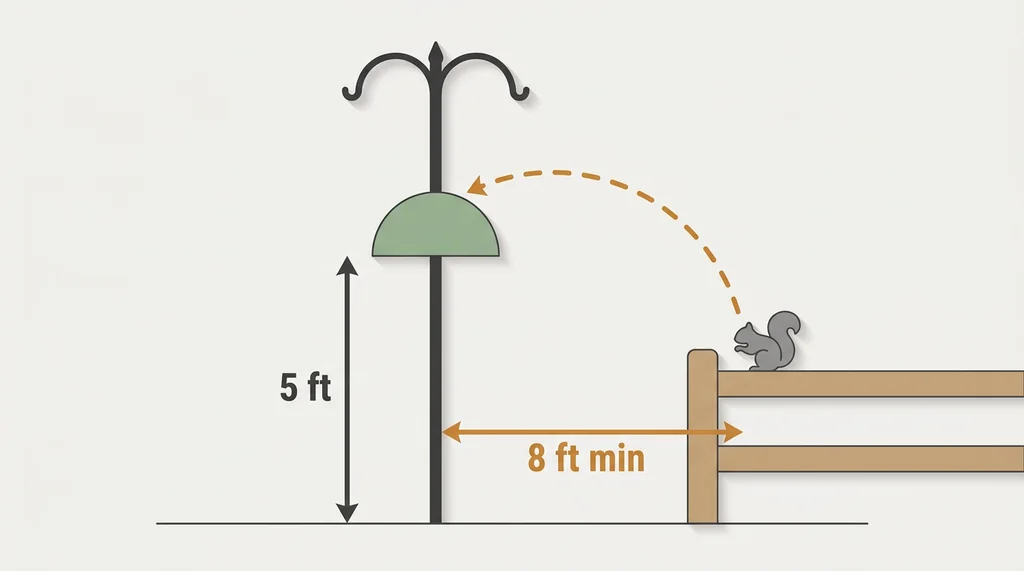
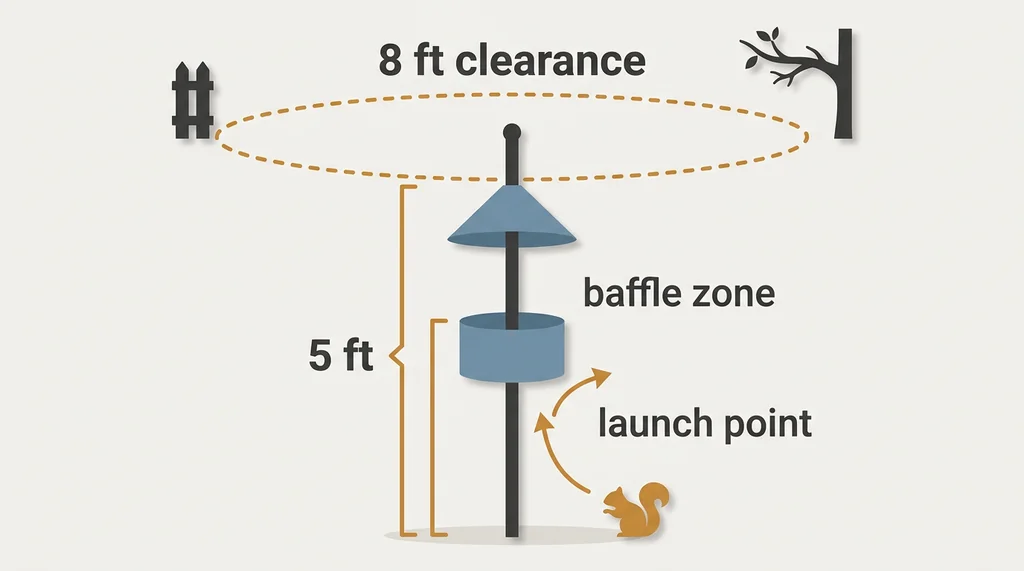
- Mount any baffle at the five-foot mark on an eight-foot pole and maintain eight feet of clearance from all launching points to defeat squirrels that jump rather than climb. For a full breakdown of pole clearance rules, see our squirrel-proof pole setup guide.
- An 8-inch diameter galvanized stovepipe section ($8-12) forms a self-tilting cylinder baffle that has proven effective for two or more years without modification.
- A 24-inch diameter sheet metal cone replicates a $30-50 commercial torpedo baffle for roughly $15-20 in materials when cut to a 45-degree angle.
- Layering a cylinder baffle at four feet and a torpedo baffle at five feet on the same pole creates two separate defeat mechanisms, reducing successful squirrel access far more than a single baffle.
- Place a distraction feeder stocked with corn and peanuts 30 feet away to reduce attempt rates at baffled feeders without removing squirrels from the yard.
Understanding What You're Actually Up Against
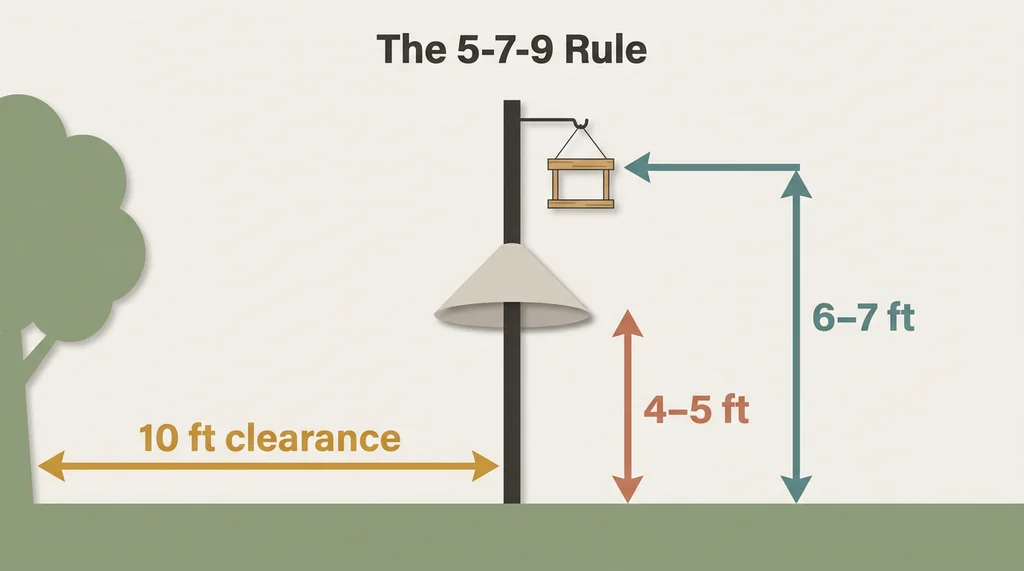
Before any baffle design makes sense, you need to respect what squirrels can do. These animals can leap horizontally up to ten feet and jump vertically nearly five feet from a standing position. They remember feeding locations for months. They are, in the most neutral scientific sense, impressive.
This means a baffle positioned too low, too close to a launching point, or too small in diameter isn't a baffle — it's an obstacle course they'll clear in two attempts. Effective DIY design starts with internalizing these numbers:
- Minimum baffle height: four feet above the ground
- Recommended placement: at the five-foot mark on an eight-foot pole
- Clearance from any launching point: at least eight feet in every direction
That last measurement catches most people off guard. Eight feet. That's not just the tree branch overhead — it's the fence post six feet away, the deck railing, the garden shed roof. Squirrels don't need a running start. They need a surface to push off from, and they're calculating angles you haven't considered yet.
Premium commercial squirrel-proof poles stand over 80 inches above ground when properly installed. If you're building your own pole system, that's your benchmark. The baffle itself is only as effective as its positioning.
The Stovepipe Cylinder: The Classic DIY Baffle
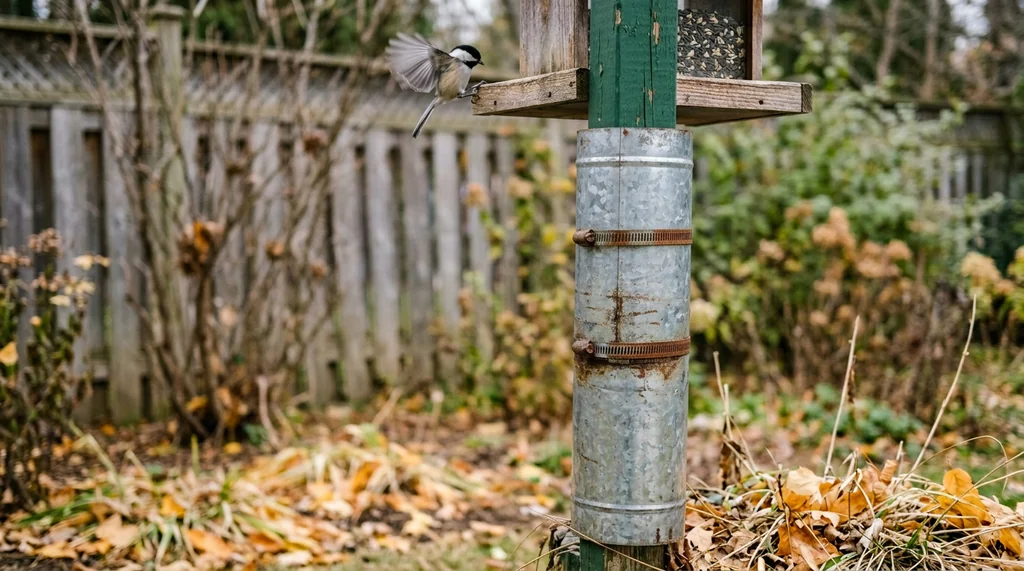
The stovepipe cylinder is the oldest trick in the bird-feeding playbook, and it works for the same reason it always has: squirrels cannot grip the inside of a smooth metal cylinder with enough purchase to climb through it, and the wide diameter defeats their ability to reach around it.
Materials needed:
- 8-inch diameter galvanized stovepipe section, 24 inches long (approximately $8-12 at hardware stores)
- Two hose clamps sized for your pole diameter
- A drill with metal bit
- Work gloves
Construction:
Drill two small holes opposite each other near the top of the stovepipe section. Thread the hose clamps through these holes and around your pole, positioning the top of the cylinder at the five-foot mark. The cylinder should hang loosely enough to tilt when a squirrel grabs the bottom edge — this self-tilting action is part of what makes it effective.
The 8-inch diameter matters. Squirrels attempting to climb past the cylinder reach the bottom edge, find nothing to grip on the smooth interior surface, and cannot swing their body weight around the outside diameter. The combination of smooth metal and wide circumference is what defeats them, not any single factor alone.
This design has been running at the primary feeding station for two years without modification. The galvanized steel shows surface oxidation but remains structurally sound and just as slippery as the day it went up.
What can go wrong:
If the cylinder is mounted rigidly rather than loosely, squirrels occasionally figure out they can brace against the pole itself while climbing the outside. The slight wobble of a loosely mounted cylinder disrupts this. Also, if your pole is thinner than 3/4 inch, the cylinder may tilt too dramatically and slide down over time — add a second set of hose clamps below the cylinder as a stop.
The Torpedo Baffle: Building Your Own
Commercial torpedo baffles — those dome or cone shapes you see on poles everywhere — can be replicated with a mixing bowl, a large plastic plant saucer, or sheet metal cut into a cone. The principle is identical: a wide, smooth, angled surface that squirrels slide off when they try to climb past it.
The mixing bowl method:
A large stainless steel mixing bowl (12-14 inch diameter, $6-10 at kitchen supply stores) becomes a functional torpedo baffle with a single modification. Drill a hole in the center sized to your pole diameter, thread it onto the pole facing downward (convex side up), and secure it at the four-to-five-foot mark with a hose clamp above and below.
The inverted bowl creates a dome that squirrels hit from below and slide off. The smooth stainless surface provides no grip. Unlike plastic alternatives, it won't crack in winter temperatures.
The plant saucer method:
A 16-18 inch diameter plastic plant saucer works similarly and costs about $4. The larger diameter provides better protection but requires that you reinforce the center hole with a metal grommet — plastic alone will crack at the mounting point within a season. Drill the hole, insert the grommet, mount it dome-side-up on the pole.
The plant saucer's advantage is weight: it's light enough that the pole doesn't need to be anchored more deeply than usual. The disadvantage is longevity — even UV-resistant plastic degrades faster than metal in direct sun.
The sheet metal cone:
This is the most labor-intensive option and the most effective. Cut a circle approximately 24 inches in diameter from 26-gauge galvanized sheet metal (available at hardware stores, roughly $15-20 for a small sheet). Cut a straight line from the outer edge to the center, then overlap the edges to form a cone shape with a 5-6 inch diameter opening at the top. Rivet or bolt the overlapping edges together.
The cone mounts with the point facing up and the wide opening facing down, creating a flared skirt around the pole. Squirrels climbing the pole hit the underside of the cone's flared edge and cannot get past it. The steeper the cone angle, the more effective — aim for roughly 45 degrees from horizontal.
This design is what commercial torpedo baffles replicate at $30-50. The sheet metal version, built carefully, performs identically.
Wrap-Around Baffles for Trees and Existing Structures
Pole-mounted feeders give you control over placement. Tree-mounted feeders are more complicated, because the tree itself is the squirrel's highway. A wrap-around baffle interrupts that highway at the right point.
Materials:
- 24-inch wide aluminum flashing (sold in rolls at hardware stores, $15-20)
- Foam pipe insulation to protect the tree bark
- Zip ties or soft wire
Construction:
Wrap the foam pipe insulation around the trunk at about 6 feet above ground — this protects the bark from the metal. Cut the aluminum flashing to wrap around the trunk with about 6 inches of overlap, forming a smooth metal collar. The flashing should be loose enough not to constrict the tree but tight enough that it can't be pushed upward.
The collar needs to be at least 24 inches wide (measured vertically along the trunk) to prevent squirrels from leaping over it. Squirrels approaching from below hit the smooth metal surface and find no purchase. Squirrels jumping from nearby branches still face the clearance problem — which is why this method works best when combined with aggressive branch trimming to maintain that eight-foot clearance zone.
One critical note: check the collar every spring and loosen it as the tree grows. A collar that constricts a tree's growth can cause long-term damage. This is a maintenance commitment, not a set-and-forget installation.
The Slinky Method: Surprisingly Effective, Genuinely Cheap
This one looks absurd. It works anyway.
A standard metal Slinky ($3-4 at toy stores) threaded onto a pole and allowed to hang freely creates a baffling obstacle for squirrels attempting to climb. When a squirrel grabs the Slinky, it stretches and drops, providing no stable climbing surface. The squirrel's weight causes the Slinky to extend downward, depositing them back near the ground.
Thread the Slinky over the pole before mounting the feeder, attach the top coil loosely to the pole just below the feeder with a zip tie, and let the rest hang freely. The free-hanging portion is what makes it work — a Slinky attached at both ends just becomes a spring they can navigate around.
This method has limitations. It works poorly in high wind, as the Slinky can wrap around the pole and become climbable. It also requires a pole with some clearance below the feeder — if your feeder is mounted too close to the Slinky attachment point, squirrels can bypass it by reaching directly for the feeder.
For a backup layer on an already-baffled pole, though, it's an effective deterrent for approximately $3.
Combining Methods: The Layered Approach
Single baffles have single failure modes. Layered approaches are harder to defeat.
The most effective DIY setup combines:
- Proper pole placement following the eight-foot clearance rule
- A cylinder baffle at the four-foot mark to defeat climbers
- A torpedo or cone baffle at the five-foot mark as a secondary barrier
A squirrel that somehow defeats the cylinder — by jumping from a nearby object, for instance — still faces the torpedo baffle before reaching the feeder. Two different mechanisms requiring two different defeat strategies is significantly harder to beat than one.
This layered setup is what's running across four stations at a combined material cost of $68. The equivalent commercial hardware — a quality torpedo baffle plus a wrap-around cylinder guard — runs $50-60 per station. At four stations, that's $200-240 versus $68 built yourself.
What DIY Baffles Won't Solve
Honest accounting matters here. DIY baffles work on the physics of squirrel movement, which means they work on squirrels approaching from below. They don't address:
Aerial approaches: Squirrels jumping from overhead branches bypass pole baffles entirely. No baffle design compensates for inadequate clearance. If you can't achieve eight feet of clearance in every direction, a baffle alone won't solve the problem.
Feeder design vulnerabilities: A well-baffled pole still delivers seeds to squirrels if the feeder itself can be accessed from above. Tube feeders with wide-open tops or platform feeders without cages are still vulnerable to aerial jumpers that clear your baffle zone.
Determination over time: Given enough attempts and enough motivation, squirrels find failure modes that weren't anticipated. The 47 documented access attempts against a properly baffled and weight-activated feeder system in one yard represent months of persistent effort. Baffles reduce success rates dramatically — they rarely reduce attempt rates.
The practical solution that works alongside DIY baffles: a dedicated distraction station. A separate feeder 30 feet away stocked with corn and peanuts gives squirrels a reliable food source that requires zero effort to access. Once squirrels have an easier option, the attempt rate at baffled feeders drops substantially. This isn't defeat — it's resource allocation. They get the easy food; the birds get the good feeder.
Material Durability and Long-Term Maintenance
Galvanized steel outlasts everything else in outdoor conditions. Aluminum is lighter and corrosion-resistant but dents more easily. Plastic is cheap and easy to work with but degrades in UV exposure — even "UV-resistant" formulations show brittleness within two to three years in direct sun.
For any DIY baffle expected to last, galvanized steel is the right material. The stovepipe cylinder that's been running for two years shows surface oxidation but no structural degradation. The sheet metal cone, if properly constructed, should last five or more years with no maintenance beyond an occasional wipe-down to remove debris that might give squirrels something to grip.
Check all mounting hardware annually. Hose clamps can loosen over winter freeze-thaw cycles. Zip ties degrade in UV exposure and should be replaced every spring. A baffle that was perfectly positioned in April may have shifted three inches by October — and three inches at the five-foot mark can mean the difference between effective exclusion and a squirrel highway.
The physics of squirrel exclusion is not complicated. Wide smooth surfaces defeat grip. Proper height defeats jumping. Adequate clearance defeats launching. Build to those specifications, use durable materials, maintain your hardware annually, and a $15 stovepipe section will protect your feeders just as effectively as a $60 commercial baffle. For a comparison of commercial options, see our guide to the best squirrel baffles for poles.
The squirrels will still try. That's what squirrels do. But trying and succeeding are very different things, and a well-built DIY baffle makes the gap between them quite wide.