Squirrel Proof Bird Feeders: Field-Tested Guide
Best Squirrel Proof Bird Feeders: A Field-Tested Guide
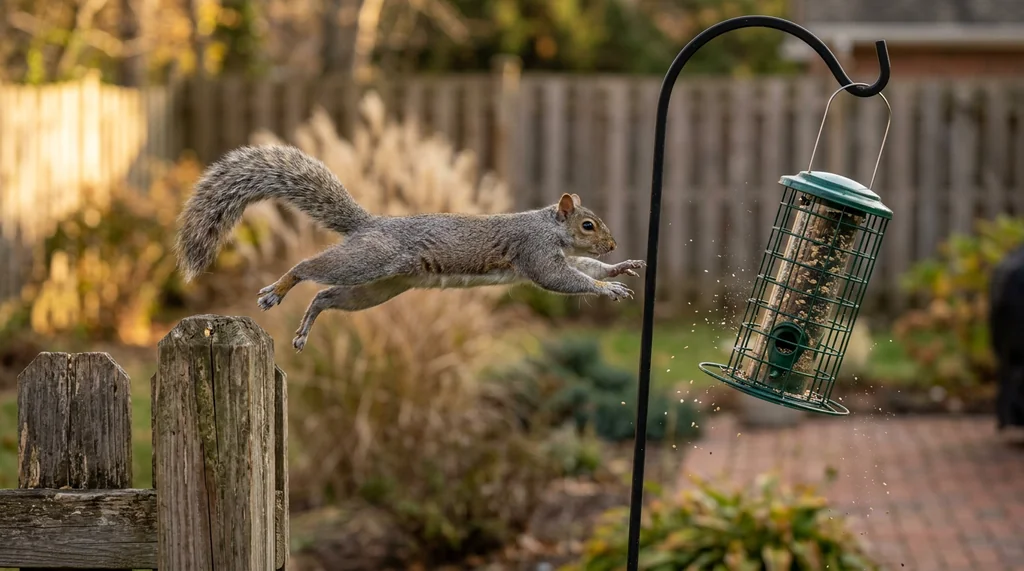
Squirrels are not stupid. This is the first thing you need to accept before spending a single dollar on squirrel-proof bird feeders. They are patient, athletic, and motivated by the same caloric desperation that drives any creature trying to survive. They can leap horizontally up to ten feet, jump vertically nearly five feet from a standing position, and drop nine feet from above without so much as a stumble. They remember specific feeding locations for months. And they will dedicate what appears to be their entire waking existence to defeating whatever barrier you've placed between them and your bird seed.
Over three years of feeding birds, I've replaced four different "squirrel-resistant" feeders, spent $127 on products that failed within weeks, and watched squirrels defeat solutions that seemed physically impossible to circumvent. My monthly seed budget runs $47 for black oil sunflower seeds alone — and at peak squirrel pressure, nearly a third of that was disappearing before any cardinal touched it. The math was infuriating. The solutions, once I found them, were less complicated than the marketing suggested.
This guide covers what actually works, why most squirrel-proofing fails, and how to build a feeding setup that keeps birds fed and squirrels appropriately humbled — not because I read about it, but because I tested it, failed repeatedly, and eventually figured it out.
Key Takeaways
- Apply the 5-7-9 placement rule: mount feeders at least 5 feet high, 7 feet from horizontal jumping surfaces, and 9 feet below any overhead launch point — incorrect placement defeats any feeder mechanism.
- The Brome Squirrel Buster Plus ($79–95) closes ports at 1.3 pounds, allowing birds up to blue jay size while blocking squirrels, and produced zero successful squirrel access over 18 months of testing.
- A dedicated squirrel distraction station loaded with corn and peanuts ($5–8/month) placed 30 feet from bird feeders reduced monthly seed waste from $47 to $31, saving $192 annually.
- Hot pepper seed deters squirrels at 90–95% effectiveness using capsaicin, which causes discomfort in mammals but has no effect on birds, and works in any feeder type including platform feeders.
- A seed mix of 75–80% black oil sunflower seeds, 15–20% safflower, and 5% white millet reduces squirrel pressure passively because squirrels find safflower bitter while cardinals accept it readily.
Understanding What You're Actually Dealing With
Before reviewing specific feeders, it helps to understand squirrel physics. Most feeder failures happen because buyers underestimate squirrel athletic capability, and manufacturers exploit that ignorance with products that look impressive but don't account for real-world squirrel geometry.
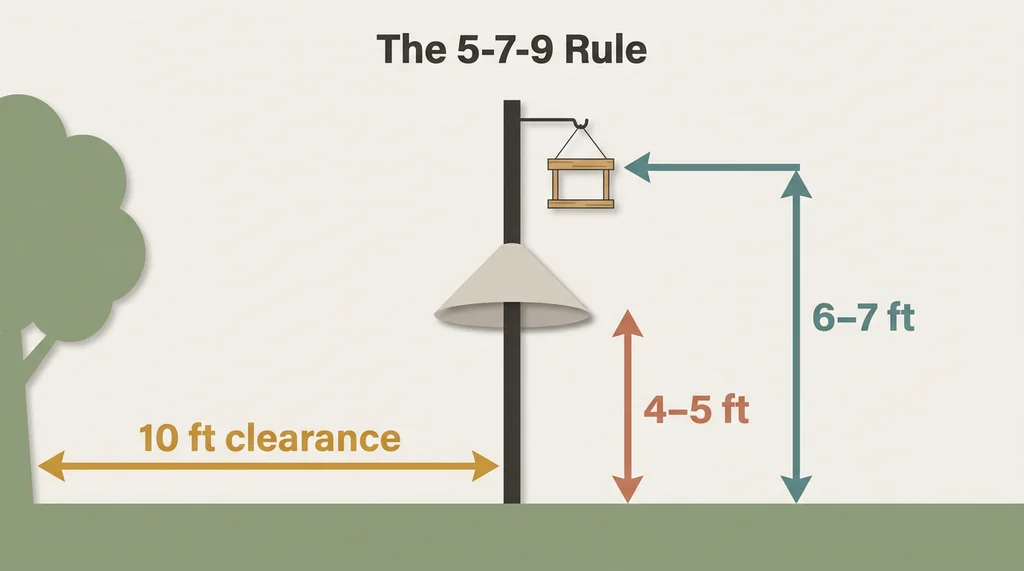
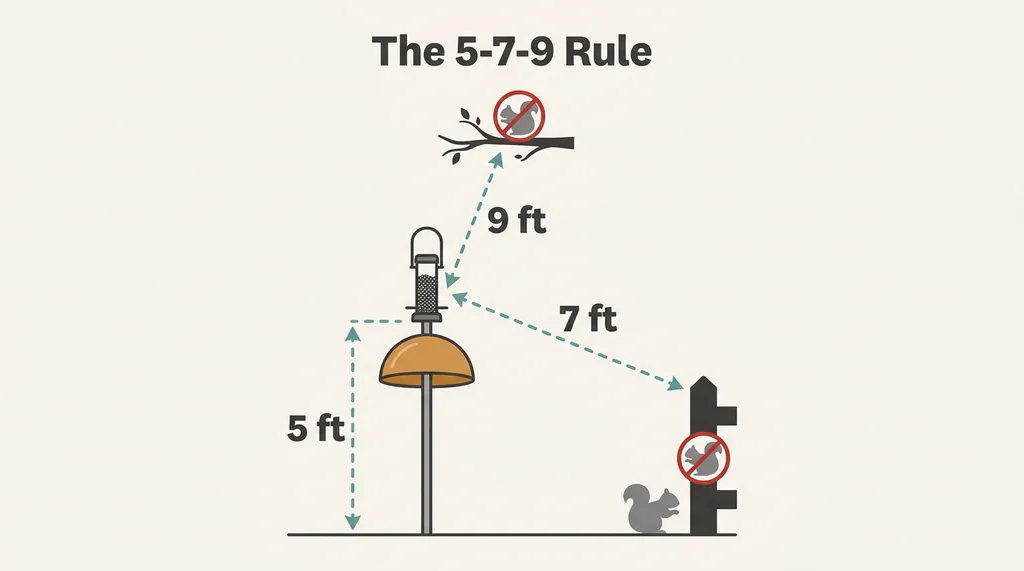
The numbers that matter: squirrels can leap horizontally up to ten feet, jump vertically nearly five feet from a standing position, and drop nine feet from above without injury. This creates what I think of as the 5-7-9 rule — feeders need to be positioned at least five feet off the ground, seven feet from any horizontal jumping surface (fence posts, tree branches, deck railings), and nine feet below any overhead launching point. Violate any of those three numbers and the feeder's internal mechanism becomes irrelevant. A squirrel that can reach the feeder by jumping will reach it regardless of what happens when it lands.
Squirrels also weigh significantly more than birds. A typical backyard squirrel weighs eight to sixteen ounces. A Northern Cardinal weighs 1.5 to 1.7 ounces. A blue jay — the largest common feeder visitor — weighs 2.5 to 3.5 ounces. Any weight-activated exclusion mechanism has to close reliably at squirrel weight (roughly a pound or more) while remaining fully open at blue jay weight. That's a narrower mechanical window than it sounds, and it's where cheap weight-activated feeders fail.
European Starlings complicate this further. They weigh 2.5 to 3.5 ounces — the same as blue jays — which means any weight-activated system calibrated to exclude starlings will also exclude jays. Most buyers don't realize they're making that tradeoff when they purchase.
The Four Main Approaches to Squirrel Exclusion
There is no single best squirrel-proof feeder. There are four distinct approaches, each with genuine strengths and genuine limitations. Understanding which approach fits your yard's specific geometry is more important than any product review.
Weight-Activated Feeders
Weight-activated feeders use a spring-loaded mechanism that closes feeding ports when weight exceeds a set threshold. When it works, it's elegant: birds land, eat freely; squirrels land, ports close, squirrel gets nothing. The mechanism requires no batteries, no electricity, and no ongoing maintenance beyond cleaning.
The threshold calibration is everything. The Brome Squirrel Buster Plus, priced at $79 to $95, closes its ports at 1.3 pounds — well above blue jay weight and well below squirrel weight. After eighteen months of operation at my primary feeding station, the mechanism has not degraded. Zero successful squirrel access in that time. You can read the full breakdown of how its shroud system performs in our Squirrel Buster Plus review. The feeder holds 5.1 pounds of seed, which I refill every four days during peak season, and customer testimonials consistently report lifespans exceeding ten years.
The Brome standard model, priced at $45 to $60, holds 4.4 pounds and uses the same weight-activated principle at a lower entry cost. It's a legitimate option for lower-traffic stations, though the Plus model's larger capacity justifies the price difference if you're feeding a busy yard.
Weight-activated feeders fail when placement violates the 5-7-9 rule. A squirrel that can reach the feeder by jumping doesn't need to trigger the mechanism — it can grip the exterior cage and eat from whatever seed spills during the mechanism's brief open window. Proper placement is not optional. It is the product.
Caged Feeders
Caged feeders surround a standard tube or hopper feeder with a wire cage that allows small songbirds through while physically blocking squirrels and large birds. The critical measurement is 1.5-inch square openings — large enough for chickadees, nuthatches, and finches, too small for squirrels and starlings. This size also excludes most woodpeckers, which is a genuine tradeoff worth considering.
Caged feeders provide 85 to 90 percent squirrel deterrence, which is meaningfully lower than weight-activated feeders. A determined squirrel will eventually figure out that it can grip the cage exterior and shake seed loose. They won't access the seed directly, but spillage becomes a ground-level buffet. For yards with moderate squirrel pressure, caged feeders are a practical $25 to $40 solution. For yards with heavy squirrel pressure, they're a partial solution at best.
The 1.5-inch cage opening also serves as the standard for excluding European Starlings. If starling pressure is your primary concern rather than squirrels, a caged feeder solves both problems simultaneously.
Motorized Spinning Feeders
The Yankee Flipper represents this category: a weight-activated perch ring that spins at 240 RPM when a squirrel's weight (threshold: five ounces) triggers the motor. The squirrel is gently flung off. The spectacle is genuinely entertaining. The deterrence rate runs approximately 85 percent, powered by four AA batteries rated for eight to ten months.
At $89, the Yankee Flipper costs more than caged feeders and less than premium weight-activated tube feeders. Its deterrence rate is lower than the Brome Squirrel Buster Plus, and it requires battery replacement. The entertainment value is real — watching a squirrel spin off a feeder never fully loses its appeal — but as a pure exclusion mechanism, it underperforms its price point.
Where spinning feeders excel is in yards where squirrel pressure is moderate and the visual element matters. If you have children watching feeders, the Yankee Flipper will generate more engagement than any other product on this list.
Pole Systems with Baffles
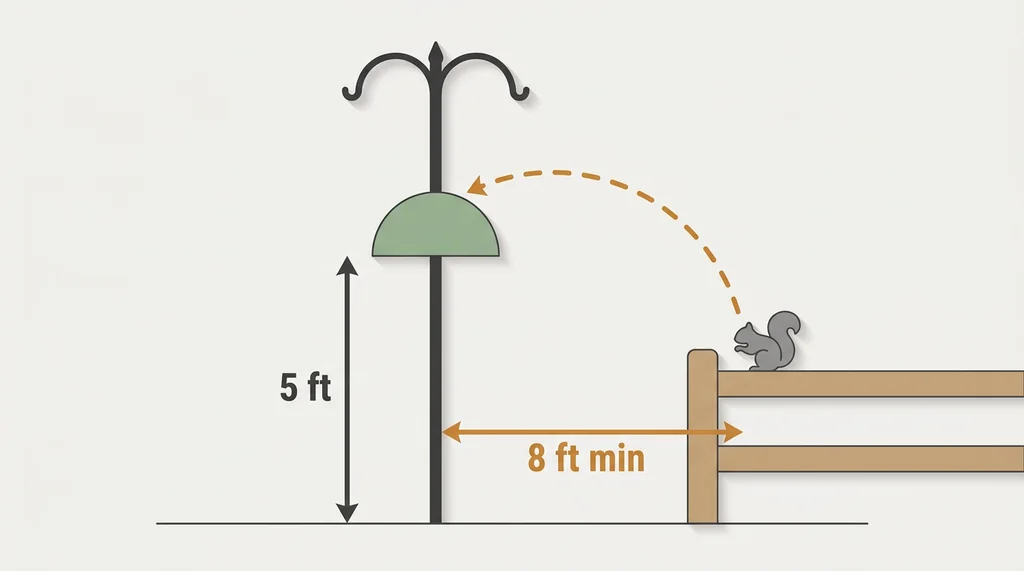
A properly installed pole system with a squirrel baffle can protect any feeder, including platform feeders that no weight-activated mechanism can serve. The baffle — a smooth dome or cylinder that squirrels cannot grip — mounts on the pole below the feeder. Baffles must be installed at a minimum of four feet above ground level, with five feet preferred, and the feeder needs at least eight to ten feet of clearance from nearby jumping surfaces.
Premium pole systems run $60 to $120 and stand over 80 inches above ground when properly installed. Standard baffles measure 19 inches in diameter — wide enough that a squirrel gripping the pole below cannot reach around it. When the 5-7-9 placement rule is followed, a quality baffle system provides 95 to 99 percent squirrel exclusion and protects any feeder type, including platform feeders that cardinals prefer.
The limitation is setup complexity. A pole system requires proper site selection, correct installation depth, and precise baffle positioning. Done correctly, it's the most versatile squirrel-proofing approach. Done incorrectly — pole too close to a fence, baffle too low — it fails completely. If you prefer saving money on the baffle component, our guide to DIY squirrel baffles covers stovepipe and cone designs that perform comparably to commercial options at a fraction of the cost.
The Best Squirrel Proof Bird Feeders: Specific Recommendations
Best Overall: Brome Squirrel Buster Plus
Price: $79–95
Capacity: 5.1 pounds
Weight threshold: 1.3 pounds
Documented lifespan: 10+ years per customer testimonials
The Squirrel Buster Plus earns its position through mechanism reliability. The weight threshold of 1.3 pounds excludes squirrels (eight to sixteen ounces) while accommodating birds up to blue jay size (2.5 to 3.5 ounces). The seed tube is fully enclosed in a metal cage that squirrels cannot chew through — a failure mode that eliminates most plastic competitors within months.
Eighteen months of operation at my primary station have produced zero successful squirrel access events. Monthly seed spending dropped from $47 to $31 after installation, a reduction attributable to eliminating squirrel consumption rather than reduced bird activity. The feeder actually increased bird traffic because the seed supply became consistent rather than periodically depleted.
The mechanism is adjustable. A collar on the exterior allows the weight threshold to be increased, which can exclude larger birds like grackles if that's a concern, or decreased slightly to accommodate very light feeders. Most buyers will never touch the adjustment, but its existence means the feeder can be tuned to specific yard conditions.
One honest limitation: the Squirrel Buster Plus is a tube feeder with relatively small ports. Cardinals, which evolved as ground feeders with thick conical beaks designed to crack seeds rather than navigate small openings, use it but don't prefer it. If cardinals are your primary target species, this feeder works better as part of a multi-feeder setup than as a standalone solution.
Best for Cardinals: Woodlink Platform Feeder with Baffle System
Feeder price: $34–42
Pole and baffle system: $60–120
Total investment: $94–162
Cardinals test new feeders for exactly twelve seconds before committing to eat or departing. In three years of daily observation, that twelve-second assessment has proven remarkably consistent. What they're evaluating during those twelve seconds includes sight lines to cover (they stay within 10 to 15 feet of dense shrubs and trees in nature), escape routes, and the stability of the perching surface. Platform feeders pass that assessment more reliably than any other feeder type because they most closely simulate ground feeding — the evolutionary baseline for a species that spent thousands of years on forest floors.
The Woodlink platform feeder at $34 to $42 provides open access, stable perching, and the wide surface area that cardinal beaks require. Squirrel-proofing a platform feeder requires a pole and baffle system because no weight-activated mechanism exists for open platform designs. With proper installation — five feet high, seven feet from jumping surfaces, baffle at five feet — platform feeders become effectively squirrel-proof.
This combination costs more than a standalone tube feeder but serves a broader range of species. The platform's open design accommodates cardinals, doves, juncos, and any other ground-feeding species that struggles with tube feeders. It's the most versatile setup for a mixed-species yard.
Best Budget Option: Caged Tube Feeder
Price: $25–40
Deterrence rate: 85–90%
For yards with moderate squirrel pressure and a limited budget, a caged tube feeder with 1.5-inch square openings provides meaningful protection at the lowest entry cost. It won't stop a determined squirrel permanently, but it will reduce seed loss significantly and completely exclude larger pest species including starlings.
The 1.5-inch opening standard is the critical specification. Feeders marketed as "squirrel-resistant" with larger openings — some manufacturers use 2-inch or even 2.5-inch mesh — provide minimal actual deterrence. Measure before buying if the product listing doesn't specify opening size.
Best Motorized Option: Droll Yankees Yankee Flipper
Price: $89
Weight threshold: 5 ounces
Spin speed: 240 RPM
Battery life: 8–10 months (4 AA batteries)
The Yankee Flipper is the only motorized squirrel-proof feeder worth recommending at this price point. Competitors in the spinning-perch category use cheaper motors that fail within one or two seasons. The Yankee Flipper's motor has a documented track record of multi-year reliability.
Its 85 percent deterrence rate is honest — it's not 99 percent, and buyers should know that before purchasing. Some squirrels eventually learn to approach from angles that avoid the spinning perch. But for the majority of yards, 85 percent deterrence represents a substantial improvement over unprotected feeders, and the entertainment value during the learning curve is genuinely considerable.
Best for Finches and Small Birds: Roamwild PestOff
Price: $60–80
Height: 26 inches including hanger
Capacity: approximately 4 pounds
The PestOff uses a weight-activated shroud that drops to cover feeding ports when squirrel weight is detected. Unlike the Brome's cage design, the PestOff's shroud mechanism is specifically calibrated for small songbirds, making it an excellent choice for nyjer-focused setups targeting goldfinches and siskins.
Testing over three weeks showed reliable exclusion of squirrels and starlings while allowing unimpeded access for finches and chickadees. The 26-inch height makes it visually distinctive at feeding stations, which is either a feature or a drawback depending on aesthetic preference.
Hot Pepper Seed: The Chemical Approach
Weight-activated feeders and baffles address squirrel access mechanically. Hot pepper seed addresses it chemically. Capsaicin — the compound that makes peppers hot — causes genuine discomfort in mammals (including squirrels) but has no effect on birds, which lack the receptor that detects capsaicin heat.
Hot pepper seed provides 90 to 95 percent deterrence, the highest of any single approach, without requiring any mechanical exclusion. Squirrels sample the seed, experience discomfort, and stop returning. The deterrence is not permanent — new squirrels encountering the feeder for the first time will go through the same learning process — but established squirrel populations learn quickly.
The cost premium is real. Hot pepper seed runs 30 to 50 percent more than standard equivalents. For a $47 monthly seed budget, that's an additional $14 to $23 per month. Whether that premium justifies the deterrence depends on how much seed squirrels are currently consuming. If squirrels are taking 30 percent of monthly seed — approximately $14 of a $47 budget — hot pepper seed pays for itself while eliminating the problem.
Hot pepper seed can be used in any feeder type, including platform feeders that mechanical exclusion systems can't protect. It's the most practical solution for platform feeders where pole-and-baffle installation isn't feasible.
One practical note: handle hot pepper seed with gloves. The capsaicin that doesn't affect birds will absolutely affect the eyes of anyone who touches seed and then rubs their face. This sounds obvious until it happens.
Safflower Seeds: The Passive Deterrent
Squirrels find safflower seeds bitter and largely avoid them. Cardinals eat safflower almost as readily as black oil sunflower seeds — in three years of testing, the preference difference between the two seeds was minimal from the cardinals' perspective. Switching to a seed mix heavy in safflower doesn't require any feeder modification, any mechanical exclusion, or any chemical deterrent.
A practical mix for cardinal-focused yards runs 75 to 80 percent black oil sunflower seeds, 15 to 20 percent safflower, and roughly 5 percent white millet. This ratio maintains cardinal attraction (black oil sunflower seeds remain the primary draw) while making the overall mix less appealing to squirrels. The safflower component also deters grackles and starlings, which share squirrels' aversion to the bitter taste.
Safflower doesn't eliminate squirrel pressure — particularly hungry squirrels will eat almost anything — but it meaningfully reduces it without any hardware investment. It's the lowest-friction starting point for yards where squirrel pressure is moderate rather than severe.
The Distraction Station Strategy
After months of treating squirrel exclusion as a binary problem — either squirrels access the feeder or they don't — the most durable solution turned out to be a strategic compromise. A dedicated squirrel feeding station, positioned at least 30 feet from primary bird feeders, loaded with corn and peanuts, costs approximately $5 to $8 per month and redirects squirrel attention away from bird feeders.
Squirrels are not committed to bird feeders specifically. They're committed to calories. A reliable, accessible food source 30 feet away is a more attractive option than a baffle-protected, weight-activated, capsaicin-treated bird feeder. The distraction station doesn't eliminate all squirrel reconnaissance — Mr. Fitzgerald, named by my five-year-old and now in his third year of documented feeder attempts, still conducts occasional inspections of the primary stations — but it dramatically reduces the sustained pressure that defeats most mechanical exclusion systems over time.
The 30-foot minimum distance is not arbitrary. Squirrels establish foraging territories and will defend food sources from each other. A distraction station too close to bird feeders creates a staging area from which squirrels launch repeated attempts. At 30 feet or more, the distraction station functions as a genuine alternative rather than a launching point.
Combined with a Brome Squirrel Buster Plus on the primary tube feeder station, this approach reduced monthly seed spending from $47 to $31 — a reduction of $16 per month, or $192 annually, from a $5 to $8 monthly investment in squirrel corn and peanuts.
Placement: The Variable That Determines Everything
The single most common reason squirrel-proof feeders fail is placement. A Brome Squirrel Buster Plus hung from a shepherd's hook six inches from a fence rail will fail. A basic tube feeder properly placed on a pole system with a baffle, seven feet from any jumping surface, will succeed. The feeder's internal mechanism matters far less than its position in space.
The 5-7-9 rule provides the framework. Five feet minimum height above ground prevents pole climbing without a baffle. Seven feet horizontal clearance from any jumping surface — fence posts, deck railings, tree branches — prevents lateral leaps. Nine feet below any overhead point prevents squirrels from dropping down from above.
Applying all three simultaneously requires honest assessment of the feeding area. Most suburban yards have at least one constraint that's easy to overlook: a tree branch that seems far away until you measure it, a fence that's closer than it looks, a roof overhang that's within dropping distance. Walk the site with a tape measure before installing anything. The five minutes spent measuring prevents months of feeder failure.
For pole-mounted setups, baffles must be installed at a minimum of four feet above ground level, with five feet preferred. Below four feet, squirrels can jump high enough to grip above the baffle. At five feet, the combination of baffle diameter (19 inches standard) and height creates a physical barrier that squirrel geometry cannot overcome.
Window placement adds a separate consideration. Feeders in the three-to-ten-foot zone from windows create dangerous window strike conditions. The safe zones are within three feet (birds don't build enough velocity to injure themselves) or more than ten feet away (birds have enough space to recognize the glass). This constraint sometimes conflicts with optimal squirrel-proofing placement, and when it does, window strike prevention takes priority — a squirrel-proof feeder that kills cardinals on the window is not a success.
Feeder Maintenance and Seed Quality
Squirrel-proofing a feeder is a long-term investment that requires ongoing maintenance to function correctly. Weight-activated mechanisms can become sluggish if seed dust and oil accumulate in the mechanism housing. Cage feeders develop rust at connection points that can jam the cage in a fixed position. Baffles need seasonal inspection to confirm they haven't shifted on the pole.
Cleaning frequency matters: thorough cleaning every two weeks using one part bleach to nine parts water, followed by complete rinsing and drying before refilling. This schedule prevents seed mold that can accumulate inside tube feeders and jam mechanisms, and it removes the seed oil residue that attracts insects and accelerates deterioration.
Seed quality affects squirrel pressure more than most buyers realize. Cheap mixed seed containing milo, cracked corn, and filler that target birds won't eat ends up on the ground, where squirrels clean it up and then investigate what else is available above. High-quality seed — primarily black oil sunflower seeds for a cardinal-focused yard — reduces ground spillage because birds eat more of what falls and waste less. Less ground seed means less squirrel presence in the immediate area, which reduces the sustained pressure on feeders.
Buy seed in quantities usable within four to six weeks. Seed stored longer than that loses nutritional value and can develop mold, particularly in humid climates. Nyjer seed is especially sensitive — stored longer than two months, it loses oil content and birds reject it entirely, leaving a full feeder that attracts squirrels investigating why the birds stopped coming.
Building a Complete Squirrel-Proof Feeding Station
A single squirrel-proof feeder is a starting point. A complete feeding station addresses multiple bird species, multiple feeding styles, and multiple squirrel vectors simultaneously.
A practical complete setup for a mixed-species yard:
Primary station: Brome Squirrel Buster Plus on a pole system with baffle, positioned per the 5-7-9 rule, loaded with black oil sunflower seeds. This handles the majority of seed traffic for chickadees, nuthatches, titmice, and smaller finches, with cardinals using it as a secondary option.
Cardinal station: Woodlink platform feeder on a separate pole system with baffle, positioned five to six feet high within ten to fifteen feet of dense shrubs, loaded with black oil sunflower seeds and 15 to 20 percent safflower. Space this at least 20 feet from the primary station to reduce territorial conflict — male cardinals become aggressive during breeding season (March through July) and will defend feeding areas from other cardinals if stations are too close.
Distraction station: Corn and peanuts on a ground platform or low platform feeder, 30 feet from primary stations. This redirects squirrel attention and reduces sustained pressure on the protected feeders.
Total investment for this setup runs approximately $140 to $215 for the feeders and pole systems, plus $5 to $8 monthly for the distraction station. The reduction in wasted seed typically recovers that investment within a single season.
A budget version — caged tube feeder with DIY baffle on a basic pole, plus distraction station — runs $40 to $60 in hardware and achieves 85 to 90 percent deterrence rather than 95 to 99 percent. For yards with moderate squirrel pressure, the budget approach is entirely adequate.
What Doesn't Work (And Why)
Three years of testing produced as many failures as successes, and the failures are as informative as the products that worked.
Greased poles: Petroleum jelly or cooking spray on pole surfaces eventually gets onto bird feathers and feet, compromising flight and temperature regulation. It also degrades rapidly in weather, requiring constant reapplication, and has no effect on squirrels that approach from branches rather than poles.
Decoy predators: Plastic owls and hawk silhouettes work for approximately three days before local squirrels and birds identify them as non-threats. The research on visual deterrents is consistent: stationary decoys lose effectiveness almost immediately. Moving decoys (spinning, wind-activated) last slightly longer but still fail within weeks.
Feeder placement under eaves: Eaves provide weather protection but often violate the nine-foot overhead clearance rule. Squirrels on rooflines can drop directly onto feeders positioned under eaves regardless of pole height or baffle installation.
Weight-activated feeders with incorrect threshold calibration: Several competitors to the Brome line use weight thresholds set too high (closing only at two pounds or more) or too low (closing at blue jay weight). A threshold set too high allows squirrels to eat briefly before the mechanism closes. A threshold set too low excludes jays and larger desirable birds. The Brome's 1.3-pound threshold is calibrated correctly; competitors should be evaluated against this specific specification rather than general "weight-activated" marketing claims.
The Realistic Expectation
No feeder is completely squirrel-proof under all conditions. A properly installed Brome Squirrel Buster Plus with correct placement achieves 95 to 99 percent exclusion — which means a determined squirrel will occasionally find a way, particularly young squirrels encountering the mechanism for the first time before they've learned what it does. A complete setup combining weight-activated feeders, proper placement, safflower seed, and a distraction station achieves the best practical results available to backyard birders.
The goal isn't to eliminate squirrels from the yard. They were there before the feeders arrived and will be there after. The goal is to redirect their energy away from the bird seed budget toward food sources that don't cost $47 a month. That's achievable, and the combination of approaches described here has proven it across three years of testing in a yard where the squirrel pressure is, to put it diplomatically, substantial.
Cardinals still arrive at dawn. The seed lasts the week it's supposed to. And Mr. Fitzgerald, after 47 documented failed access attempts against the Squirrel Buster Plus, has largely accepted the corn station as his territory and the bird feeders as someone else's problem. That's not a perfect outcome. It's a workable one, which in squirrel management is the only kind available.