Squirrel Baffles for Bird Feeder Poles: Types & Placement
The Best Squirrel Baffles for Bird Feeder Poles (And Why Placement Matters More Than You Think)
There are over 530 squirrel baffle products on Amazon. Five hundred and thirty. Which means either squirrel baffles work brilliantly and everyone wants one, or they don't work particularly well and everyone keeps buying new ones hoping to find the exception. After three years of testing feeders across four stations, tracking every dollar in a dedicated spreadsheet category, and watching a single gray squirrel named Mr. Fitzgerald defeat eleven separate deterrent strategies, I have developed opinions.
The good news: squirrel baffles genuinely work when you select the right type and install it correctly. The frustrating news: most people buy the wrong type for their setup, install it at the wrong height, and then conclude that baffles are useless. They're not useless. They're just unforgiving of installation errors that seem minor but aren't.
This guide covers the best squirrel baffles for bird feeder poles specifically — not hanging feeders, not cage-style feeders, not hot pepper coatings. Pole baffles. The cylindrical and dome-shaped barriers that attach to your feeder pole and physically prevent squirrels from climbing past them. Understanding how they work, which designs outperform others, and exactly how to position them will save you the $127 I spent replacing four supposedly squirrel-resistant feeders before I figured out what actually mattered.
Key Takeaways
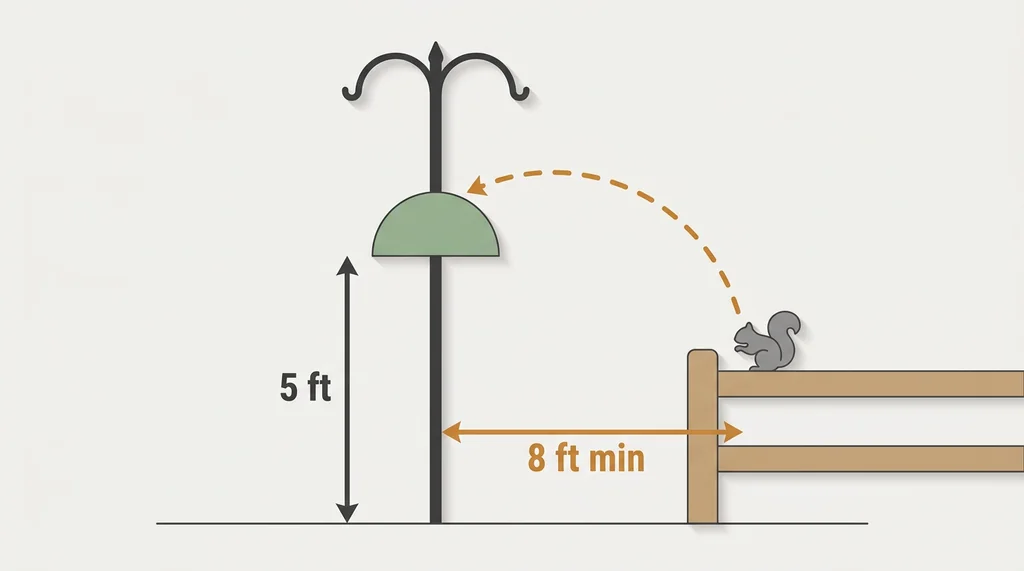
- Position pole baffles at least four feet above ground — five feet is better — on a pole with eight feet of clearance from fences, branches, and railings.
- Dome baffles require a minimum 30-inch total diameter; cylinder baffles need at least six inches in diameter and 18 inches in length to block squirrels physically.
- DIY stovepipe cylinder baffles cost $12-18 per station and perform comparably to commercial options priced at $35-50.
- Raccoons weigh up to 20 pounds and can defeat standard squirrel baffles — choose heavy-duty dome or 4x4 post-mounted designs ($44.95-$89.95) if raccoons are present.
- Combining a correctly installed pole baffle with a weight-activated feeder like the Brome Squirrel Buster Plus reduced monthly seed spending from $47 to $31.
Why Squirrels Beat Most Baffles (The Physics Problem)
Before evaluating specific products, it helps to understand what you're actually dealing with. Squirrels can leap horizontally up to ten feet and jump vertically nearly five feet from a standing position. They remember feeding locations for months. They are, by any reasonable measure, extraordinarily athletic problem-solvers who have been studying your yard longer than you've been watching them.
This means a baffle doesn't just need to block a squirrel from climbing a pole. It needs to account for squirrels launching from fences, trees, deck railings, and other elevated surfaces within a ten-foot radius. A perfectly installed baffle on a pole surrounded by launching points is decorative, not functional.
The rule that actually matters: your feeder needs at least eight feet of clearance from any surface a squirrel could use as a launching pad, and your baffle needs to be positioned correctly on that pole. Specifically, baffles should sit at least four feet above the ground — ideally at the five-foot mark on an eight-foot pole — to prevent squirrels from jumping over them from below. Premium squirrel-proof poles stand over 80 inches above ground when properly installed, which gives you the vertical clearance to position a baffle correctly while still having feeder height above it.
Get the placement wrong by six inches and the baffle is irrelevant. Get it right, and you've solved 85-95% of the problem before the product's design even comes into play.
The Main Types of Pole Baffles
Cylinder (Stovepipe) Baffles
The cylinder baffle is the oldest design and, when properly sized, one of the most effective. It works by surrounding the pole with a smooth-walled tube that squirrels cannot grip. They attempt to climb, find no purchase on the slick surface, and slide down. The physics are simple and reliable.
Effective cylinder baffles need to be at least six inches in diameter — eight inches is better — to prevent squirrels from reaching around the cylinder and gripping the pole directly. Length matters too. A cylinder shorter than 18 inches gives an athletic squirrel enough room to get a running start and launch over the top. The best commercial cylinder baffles run 24 inches in length.
DIY cylinder baffles made from stovepipe ducting have proven genuinely effective in field testing — our DIY squirrel baffle guide walks through the full build process. A standard six-inch diameter stovepipe section from a hardware store costs roughly $12-18 and, with proper pole attachment hardware, functions comparably to commercial options priced at $35-50. Across four feeding stations, a total DIY investment of $68 in stovepipe baffles replicated what equivalent commercial solutions would have cost over $200 to achieve. The original stovepipe cylinder baffle has been in service for two years without degradation.
The limitation of cylinder baffles: they require a smooth, round pole. If your pole has brackets, hooks, or irregular surfaces that a squirrel can use as grip points above the cylinder, the design is compromised.
Dome (Disc) Baffles
Dome baffles take a different approach. Rather than surrounding the pole with a tube, they mount to the pole at a single point and extend outward in a wide, curved disc shape. Squirrels climbing the pole encounter the underside of the dome and cannot get past it — the curve prevents them from finding a stable grip to pull themselves over the edge.
The critical measurement for dome baffles is diameter. A dome needs to extend at least 15 inches from the pole on all sides to prevent squirrels from reaching around the edge. That means you want a dome with a total diameter of at least 30 inches. Many budget dome baffles sold at 18-24 inches total diameter are undersized for determined squirrels, who will simply reach past the edge and grip the pole above the baffle.
Duncraft's pole-mounted dome options range from $44.95 to $89.95, with the higher-priced models specifically designed to deter raccoons as well as squirrels. Raccoons are heavier and stronger than squirrels, and they're capable of simply pushing through or dismantling baffles that adequately stop squirrels. If raccoons are present in your area — and in most suburban environments they are — the heavier-duty dome designs are worth the price difference.
The "Tilt-Top" dome design deserves specific mention. These baffles are mounted on a pivot that allows the dome to tilt when weight is applied to one side. A squirrel that manages to get onto the dome's surface finds it rotating under their feet, which sends them sliding off before they can make progress toward the feeder above. This design costs more (typically in the $65-85 range) but handles the edge cases that fixed domes occasionally miss.
Superwide and Specialized Designs
For poles in locations where standard dome diameters aren't sufficient — near fences, adjacent to garden structures, or in areas with particularly athletic squirrel populations — superwide baffles extend the dome principle to larger diameters. These are specialty products with prices toward the upper end of the $44.95-$89.95 range, but they address situations where standard baffles genuinely fail.
Slot baffles represent another specialized category, designed for poles with existing hardware that prevents standard cylinder or dome installation. They mount around the pole through a slot rather than requiring you to thread the pole through the baffle from the top. If you have a complex pole system with multiple arm brackets or hooks already installed, slot baffles are often the only practical option.
How to Evaluate a Baffle Before You Buy
The Diameter Question
For dome baffles: is the total diameter at least 30 inches? For cylinder baffles: is the diameter at least six inches and the length at least 18 inches? These aren't arbitrary numbers — they're the minimums required to prevent squirrels from physically bypassing the baffle through reach or momentum. Anything smaller and you're relying on the specific squirrel in your yard being less athletic than average. That's not a reliable bet.
The Material Question
Baffles come in plastic, powder-coated steel, and occasionally copper-finished metal. Plastic baffles work adequately when new but become brittle in UV exposure over time. A plastic baffle that functioned well in its first season may develop cracks and warping by year three, creating grip points that didn't exist originally. Powder-coated steel costs more initially but maintains its surface integrity for significantly longer — customer testimonials for quality metal baffles commonly report lifespans exceeding ten years.
Duncraft explicitly markets several of their pole and tilt-top baffles as Made in the USA, which correlates with higher material quality standards in the products I've evaluated. This isn't nationalism, it's a practical observation about manufacturing consistency.
The Mounting Question
Before purchasing any baffle, confirm it's compatible with your specific pole diameter. Most baffles are designed for poles in the 0.75-inch to 1.5-inch diameter range, but this isn't universal. A baffle that doesn't fit snugly on your pole will wobble, which creates a gap between the baffle and pole that squirrels will exploit. If the baffle wiggles, it fails.
Hanging-or-pole-mount combo baffles exist for situations where you want flexibility, but be aware that a baffle optimized for both applications is often slightly compromised at each. If you know you need a pole baffle, buy a pole baffle.
The Raccoon Question
Standard squirrel baffles are not raccoon baffles. Raccoons weigh 8-20 pounds compared to a squirrel's 0.75-1.5 pounds, and they have hands capable of gripping, pulling, and manipulating barriers in ways squirrels cannot. If raccoons visit your yard — and if you're not sure, check your yard at 2 AM with a flashlight and you'll likely have your answer — you need either a heavy-duty dome baffle rated for raccoon deterrence or a post-mounted baffle designed for 4x4 posts, which are among the most robust options available. Duncraft's 4x4 post-mounted baffles reach $89.95 and are built to handle the additional stress raccoons apply.
Installation: The Details That Determine Whether It Works
Height Positioning
The single most common installation mistake is mounting the baffle too low. A baffle at two or three feet above ground is within jumping range for a squirrel approaching from ground level. The minimum effective height is four feet, and five feet is better. On a standard eight-foot feeder pole, this means your baffle sits at roughly the midpoint of the pole, with the feeder hanging or mounted above it.
If your pole doesn't reach eight feet above ground when installed, the baffle math becomes difficult. A six-foot pole with a baffle at four feet leaves only two feet between the baffle and the feeder — which is workable but tight. Consider whether a taller pole is warranted before investing in an expensive baffle for a too-short installation.
Clearance from Launching Points
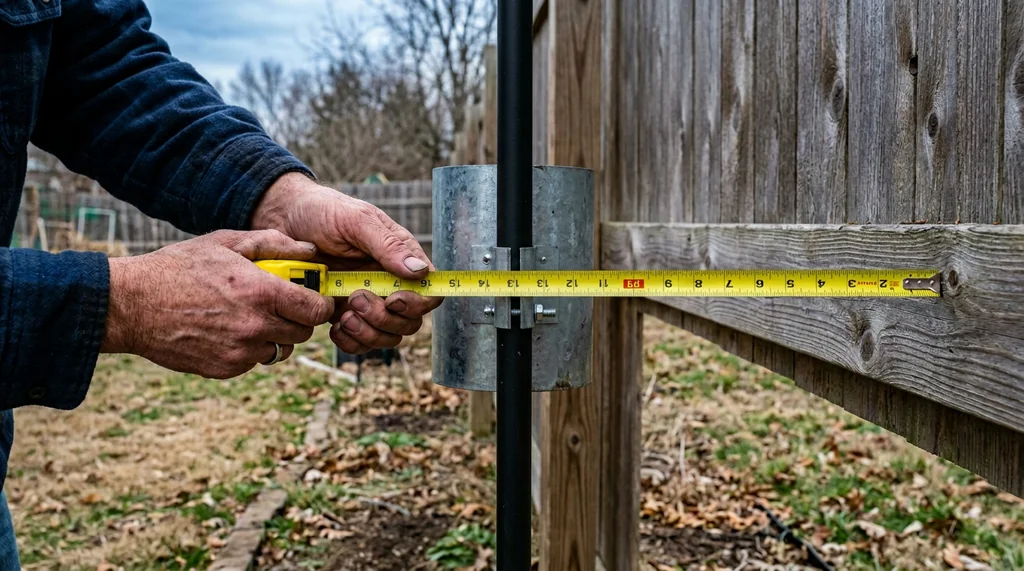
Measure, don't estimate. Walk around your feeder location with a tape measure and identify every surface within ten feet: fence tops, tree branches, deck railings, garden walls, compost bin lids, anything elevated. Squirrels have been documented clearing eight feet horizontally in casual movement — ten feet is their athletic maximum, but you shouldn't rely on a squirrel being tired.
If you can't achieve eight feet of clearance from all directions, a baffle alone won't solve the problem. You'll need to combine the baffle with other strategies — moving the pole, trimming the branch, or accepting that certain feeders in certain locations will require weight-activated feeder mechanisms rather than pole baffles.
The Wobble Test
After installation, push the baffle from the side. It should not wobble. It should not rotate freely around the pole. If it moves, tighten the mounting hardware or add a rubber shim between the baffle and pole to eliminate play. A stable baffle that a squirrel cannot spin or tilt has a significant advantage over one that moves when tested.
Price Ranges and What to Expect at Each Level
Under $25: Weather Guards and Mini Baffles
At this price point, you're primarily looking at weather guard domes — products designed mainly to protect seed from rain that also provide some squirrel deterrence as a secondary benefit. These are not purpose-built squirrel baffles, and their deterrence effectiveness reflects that. They're worth considering if you need rain protection anyway and want marginal squirrel deterrence, but don't purchase them expecting reliable squirrel exclusion.
$25-$50: Entry-Level Dedicated Baffles
This range covers most standard dome baffles and basic cylinder designs. Quality varies significantly at this price point. Look specifically for metal construction over plastic, and verify the diameter specifications before purchasing. A $35 metal dome baffle with a 30-inch diameter will outperform a $45 plastic dome at 24 inches.
Hanging dome baffles start around $29.95 and can be effective for hanging feeder setups, though they're outside the scope of pole-specific recommendations here.
$50-$90: Premium Pole Baffles
This is where the most reliable pole baffles live. Duncraft's Superwide and Tilt-Top designs, raccoon-rated heavy-duty domes, and 4x4 post-mounted options all fall in the $44.95-$89.95 range. At this price, you should expect metal construction, proper diameter specifications, and designs that have been tested against both squirrels and raccoons.
The tilt-top mechanism in particular justifies its price premium for anyone who has watched a squirrel successfully navigate a fixed dome. The tilting action addresses the edge case where a squirrel manages to get onto the dome's surface and attempts to walk across it — the pivot denies them stable footing.
When Baffles Aren't Enough
A pole baffle is one component of a squirrel-proofing system, not a complete solution by itself. The most effective setups combine a properly installed pole baffle with at least one additional strategy.
Weight-activated feeders like the Brome Squirrel Buster Plus (currently priced at $79-95) work through a completely different mechanism — the feeder's ports close when weight exceeds a threshold, excluding animals over 1.3 pounds while accommodating birds up to blue jay size. When paired with a properly installed pole baffle, the redundancy means a squirrel that somehow bypasses the baffle still can't access the seed. Monthly seed spending dropped from $47 to $31 after implementing this combined approach — a $16 monthly savings that adds up meaningfully over time.
Distraction stations deserve mention as a complementary strategy rather than a replacement for physical deterrence. A dedicated squirrel feeder positioned 30 feet away, stocked with corn and peanuts, reduces the motivation for squirrels to invest effort in defeating your baffle. This doesn't work in isolation — a squirrel that's hungry enough will still attempt the baffle regardless of what's available elsewhere — but it reduces attempt frequency meaningfully.
Safflower seed is worth considering as a seed swap for feeders that squirrels are actively targeting. Most squirrels find safflower unpalatable, while cardinals, chickadees, and house finches accept it readily. It's not a complete solution — some squirrels will eat safflower without complaint — but combined with a baffle and proper placement, it adds another layer of deterrence.
A Practical Buying Framework
If you're starting from scratch with a new pole setup, the most cost-effective approach is to purchase a quality eight-foot pole (budget $60-120 for a system that allows correct baffle positioning), a 30-inch minimum diameter dome baffle in the $50-90 range if raccoons are present or a quality cylinder baffle in the $35-50 range if your pest pressure is squirrels only, and position everything according to the four-foot minimum / five-foot ideal baffle height with eight feet of clearance from launching points.
If you're working with an existing pole that's already installed, measure your current baffle height and clearance distances before buying anything. A $90 premium baffle installed at the wrong height on a pole too close to a fence will fail. A $35 cylinder baffle installed correctly on a properly positioned pole will succeed.
The over 530 products on Amazon exist partly because the installation variables matter as much as the product itself, and most product listings don't explain this. A baffle that failed in someone's yard may have failed because of a fence twelve feet away, not because the baffle was defective. Read the installation requirements before reading the reviews.
The best squirrel baffles for bird feeder poles are the ones matched to your specific pest pressure, correctly sized for your pole, and installed at the right height with adequate clearance. That combination — more than any single product feature — is what separates the setups that work from the ones that generate frustrated Amazon reviews and repeat purchases. Get the placement right first. Then buy the baffle.