Smart Bird Feeders With No Subscription: What Works
Smart Bird Feeder Without a Subscription: What Actually Works
The smart bird feeder market has a subscription problem. You buy a $200 camera feeder, spend an afternoon setting it up, and then discover that the feature you actually wanted — automatic bird identification — costs another $80 per year. Indefinitely. That's not a product. That's a lease.
The good news is that this has changed. Subscription-free smart feeders with lifetime AI identification are now a legitimate product category, and some of them are genuinely excellent. Here's what you need to know before spending any money.
Key Takeaways
- True no-subscription feeders like BROAIMX and CINMOORE include lifetime AI identification for under $100, versus $699 over five years for Bird Buddy Pro with its $80/year subscription.
- A 32GB onboard TF card stores weeks of 1080p footage at 50–100 daily clips, eliminating cloud storage fees entirely.
- All major smart bird feeders connect only to 2.4GHz WiFi; brick siding reduces signal by 40%, often requiring a $30–$60 extender.
- Switching to black oil sunflower seeds increases yard bird visitation by 300% compared to generic mixed seed blends.
- Birdfy's detachable solar panel and hot-swap battery allow 30-second battery replacement, making it more practical for winter use than fixed-panel competitors.
What "Smart Bird Feeder No Subscription" Actually Means
Before comparing products, it helps to be precise about what "no subscription" covers — because manufacturers aren't always consistent.
In the current market, there are three tiers of smart feeder:
Subscription-required models charge monthly or annually for AI identification, cloud video storage, or both. Without the subscription, you get a camera that takes pictures of birds you have to identify yourself. The AI that made the product worth buying is paywalled.
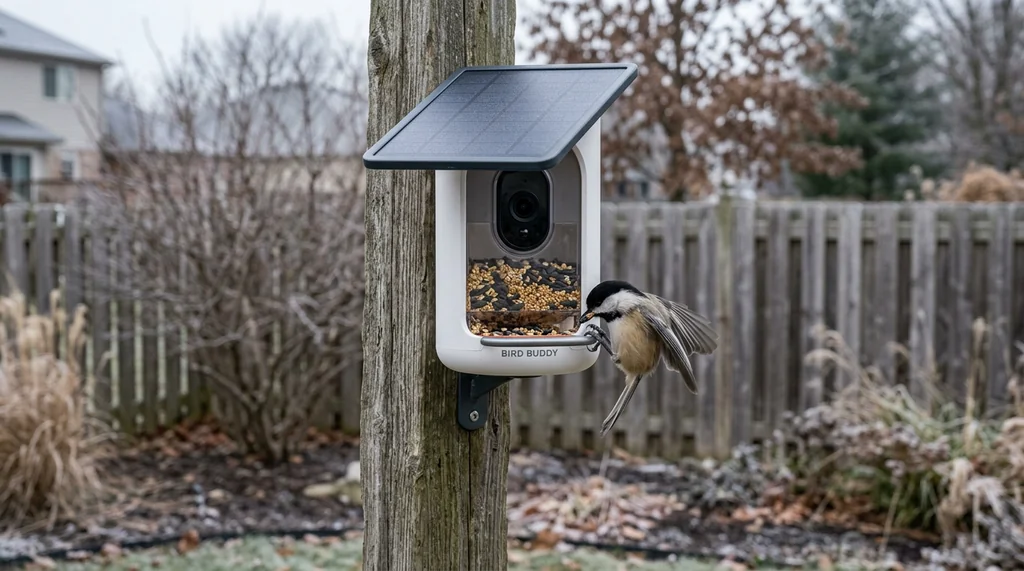
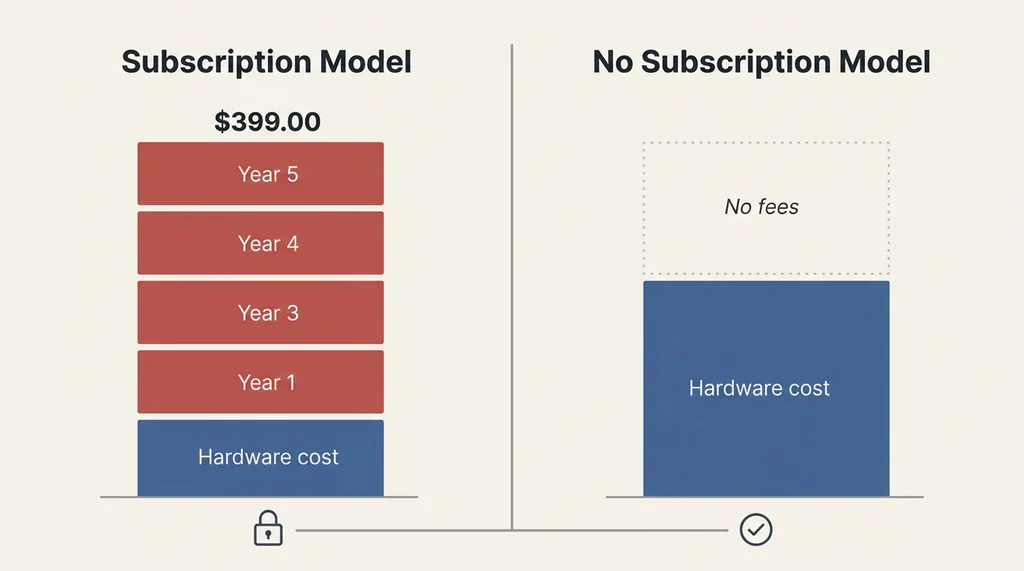
Freemium models offer basic AI identification for free but restrict features like HD video quality, extended cloud storage, or species history to paid tiers. Bird Buddy falls into this category — the core app is free, but full 1080p video requires a premium subscription at roughly $80 per year. At $80 annually, five years of subscription fees adds $400 on top of the hardware cost.
True no-subscription models include lifetime AI identification, local video storage, and full app functionality with the purchase price. No recurring charges. This is the category that has genuinely expanded in the last two years.
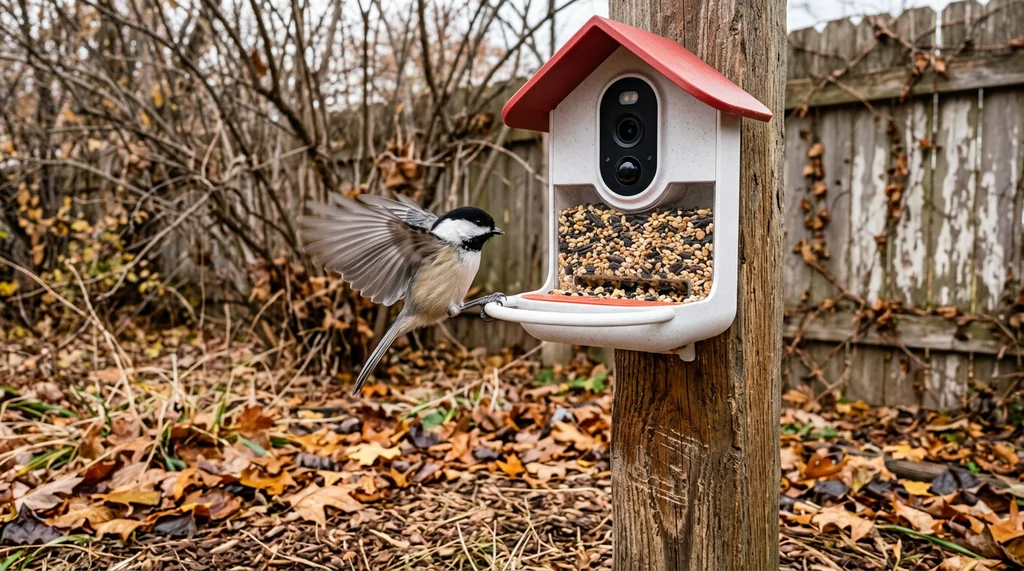
The BROAIMX and CINMOORE feeders represent the clearest examples of the subscription-free approach. The BROAIMX ships with a 32GB to 64GB high-speed TF card for local storage, shoots 1080p HD video, and its AI identifies over 11,000 bird species — free, permanently. The CINMOORE shoots at 2.5K resolution, covers 10,000-plus species, and similarly offers lifetime access. Neither requires a cloud account to function.
For comparison, there are roughly 10,000 bird species on Earth. A system that claims 11,000 species is pulling from a comprehensive global database, not just common backyard visitors.
Bird Feeder Camera Free: Local Storage vs. Cloud
The subscription question and the storage question are closely linked. Most subscription fees exist to cover cloud storage costs — someone has to pay for the servers holding your bird videos.
Local storage changes the economics entirely.
A feeder that saves footage to an onboard TF card gives you complete control over your data and eliminates the ongoing cost. The tradeoff is that you need to periodically transfer or review footage manually rather than accessing it through an app from anywhere. For most backyard birders, this is a perfectly acceptable compromise.
The practical consideration: a 32GB card holds a substantial amount of 1080p footage. At typical backyard activity levels — let's say 50 to 100 triggered clips per day — you're looking at weeks of storage before needing to clear space. High-activity yards with heavy squirrel traffic will fill cards faster. (Squirrels, it turns out, are extremely photogenic and completely uninterested in being ignored by AI systems.)
For those who prefer cloud access without a subscription, some no-fee models offer optional cloud storage through third-party services like Google Drive or Dropbox. This gives you remote access while keeping recurring costs under your control.
No Monthly Fee Bird Feeder: The Real Cost Comparison
The honest financial comparison between subscription and subscription-free models requires looking at total cost of ownership, not just purchase price.
Bird Buddy Pro costs $299. With a $80/year subscription, the five-year total is $699. The Birdfy, which offers 1080p or 2K resolution and operates entirely without subscription fees, costs $164 to $190 depending on configuration. Over five years, that's still $164 to $190.
The BROAIMX and CINMOORE options come in at lower price points still, typically under $100, with no recurring fees.
This isn't an argument that premium feeders are never worth it — Bird Buddy Pro remains PCMag's top-rated smart bird feeder, and its build quality and app experience are genuinely excellent. But the subscription model means you're renting access to features you've already paid for. For buyers who use the feeder for five or more years, the gap between subscription and no-subscription models widens considerably.
There's also a practical reliability consideration. Subscription-based features disappear if the company changes its pricing model, discontinues the product, or ceases operations. Local storage and offline AI identification work regardless of what happens to the company's servers.
AI Bird Identification Camera: How the Technology Actually Works
The AI identification in current smart feeders uses a class of neural network called MobileNet, specifically designed for efficient image recognition on devices with limited processing power. This is why these systems can run on a small battery-powered camera rather than requiring a connection to a powerful server.
When a bird lands on the feeder, the camera's motion sensor triggers image capture. The onboard processor runs the image against a trained model and returns a species identification, typically within a second or two. More advanced systems flag low-confidence identifications rather than guessing — this matters because a blurry photo of a House Sparrow shouldn't confidently return "Indigo Bunting."
Manufacturer accuracy claims run above 90% for common backyard species. Independent testing suggests this is roughly accurate for clear, well-lit images of birds that hold still for half a second, which is most of them. Accuracy drops for juvenile birds, species in transitional plumage, and poor lighting conditions.
The species count numbers — 6,000, 10,000, 11,000 — reflect the training database, not necessarily the number of species the system can reliably distinguish in real-world conditions. North America hosts roughly 900 to 1,000 regularly occurring bird species, so even a 6,000-species system covers every bird you're likely to see at a backyard feeder with substantial margin.
One meaningful distinction: some systems process identification on the device (edge inference), while others send images to a server for processing. Edge inference is faster, works without internet, and doesn't raise data privacy questions. It also constrains model complexity, which is why some subscription-based systems claim higher accuracy — they're running larger models on better hardware in a data center.
For the subscription-free models with onboard AI, the practical accuracy for common backyard species is sufficient for most users. If you're trying to distinguish between two rare warblers in fall plumage, you may want a field guide regardless of what the app says.
Solar Powered Bird Feeder Camera: What the Numbers Mean
Solar charging sounds like a complete solution to the battery problem, but the details matter.
Current smart feeder solar panels require at least four hours of direct sunlight daily for consistent operation. Pollen and dust accumulation on solar cells can reduce charging efficiency by roughly 20% — worth knowing for spring setup. Cold weather reduces lithium battery capacity by 30% to 50% during cold snaps, which means a feeder that runs for a month in summer might need more frequent attention in January.
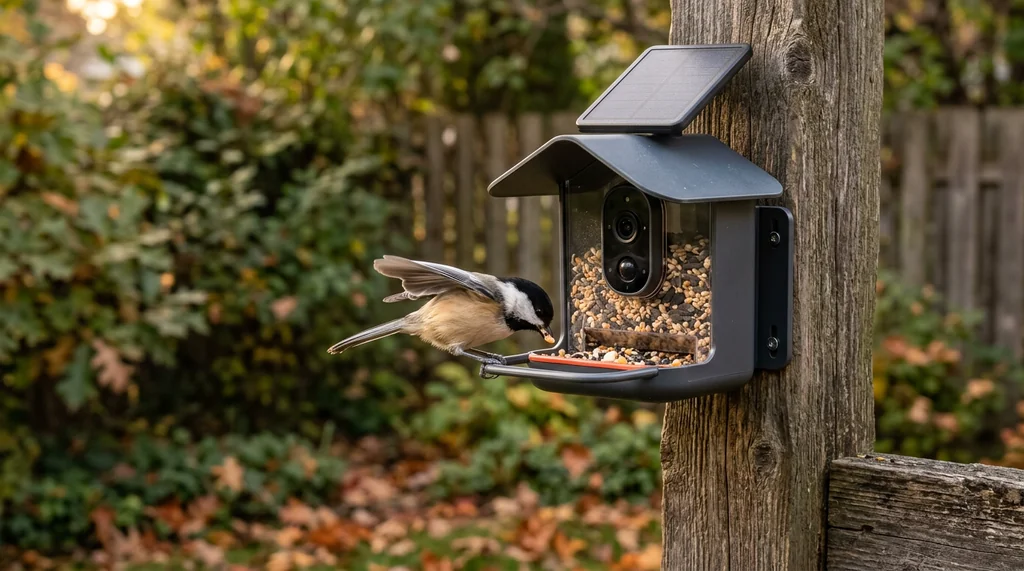
The Birdfy has a meaningful advantage here: its solar panel is detachable and adjustable, allowing you to aim it directly at the sun independent of the feeder's orientation. The Bird Buddy's solar panel is fixed position with limited adjustability. In yards where the optimal feeder placement doesn't align with optimal sun exposure — which is common, since cardinals prefer feeders within 10 to 15 feet of dense cover, and dense cover often means shade — the Birdfy's adjustable panel is genuinely useful.
The Birdfy also features a removable battery pack allowing hot-swap replacement without bringing the feeder indoors. For winter feeding, this matters. You can keep a charged spare inside and swap it out in 30 seconds rather than losing days of footage while the feeder charges.
In high-traffic yards, battery life on any model can drop from the advertised one month to five or six days. This isn't a flaw — it's a consequence of the camera triggering more frequently. A busy feeder is a successful feeder. Plan the charging strategy accordingly.
Practical Setup Considerations
A few technical details that don't appear in product descriptions but consistently affect whether these feeders work well:
WiFi band: All major smart bird feeders operate exclusively on 2.4GHz WiFi networks. They do not connect to 5GHz bands. If your router broadcasts both, make sure you're connecting to the 2.4GHz network during setup. Exterior brick siding can reduce WiFi signal strength by nearly 40%, so feeders mounted on brick walls may need a dedicated WiFi extender ($30 to $60) for reliable performance.
Upload speed: Stable streaming requires a minimum of 2 Mbps upload speed at the feeder's physical location — not at your router. Run a speed test from your phone standing where the feeder will hang before purchasing.
Feeder placement for birds: The technology works best when birds actually use it. Cardinals perform a characteristic twelve-second scan before committing to a feeder — if placement doesn't feel safe, they leave. Optimal placement is 5 to 6 feet high, within 10 to 15 feet of dense shrubs or trees, and either within 3 feet of windows or more than 10 feet away to prevent window strikes. The 3-to-10-foot zone is the danger zone for fatal collisions.
Seed selection: The AI identification is only as useful as the birds visiting. Switching exclusively to black oil sunflower seeds has been documented to increase yard visitation by 300% compared to generic mixed seed blends. More birds mean more identifications, more footage, and more value from the technology.
The subscription-free smart feeder category has matured enough that the tradeoffs are real and the products are reliable. The right choice depends on whether you prioritize app experience and build quality (Bird Buddy Pro, with its subscription caveat), long-term cost and solar flexibility (Birdfy), or the lowest possible total cost with no recurring fees (BROAIMX, CINMOORE). All of them will identify the birds at your feeder. Only some of them will keep charging you to do it.