AI Smart Bird Feeders: How They Work and What to Expect
Smart Bird House Technology: How AI Bird Boxes Are Changing Backyard Birding
There's a particular kind of frustration that comes from missing something. You step away from the window for four minutes to refill your coffee, and when you return, the feeder is empty and your neighbor is texting you a photo of the pileated woodpecker that apparently visited your yard while you were gone. For three years, this was my life. Good birds, bad timing, zero documentation.
Smart bird house technology exists because birders are fundamentally impatient people who love their yards too much to look away. And now, increasingly, you don't have to.
What follows is a practical explanation of how AI bird box systems actually work — the technology underneath, what the hardware does, where it genuinely helps, and where it still falls short. No breathless enthusiasm. Just what you need to know before spending $150 to $300 on a camera that may or may not capture the bird you care about most.
Key Takeaways
- Smart feeders require 2.4GHz WiFi and at least 2 Mbps upload speed at the feeder location — not at the router — to stream reliably.
- Consumer AI identifies around 6,000 species with above 90% accuracy for common backyard birds, but accuracy drops for juveniles, partially visible birds, and similar-looking species pairs.
- Cold weather reduces lithium battery performance by 30–50%, and pollen accumulation cuts solar charging efficiency by roughly 20% — clean the panel every two to three weeks.
- Birdfy's detachable solar panel allows independent aiming from feeder orientation; Bird Buddy's fixed panel forces a trade-off between bird attraction placement and solar charging.
- A $30–$60 WiFi extender placed at the installation site resolves most connectivity failures and is cheaper than returning hardware.
What Makes a Bird House "Smart"
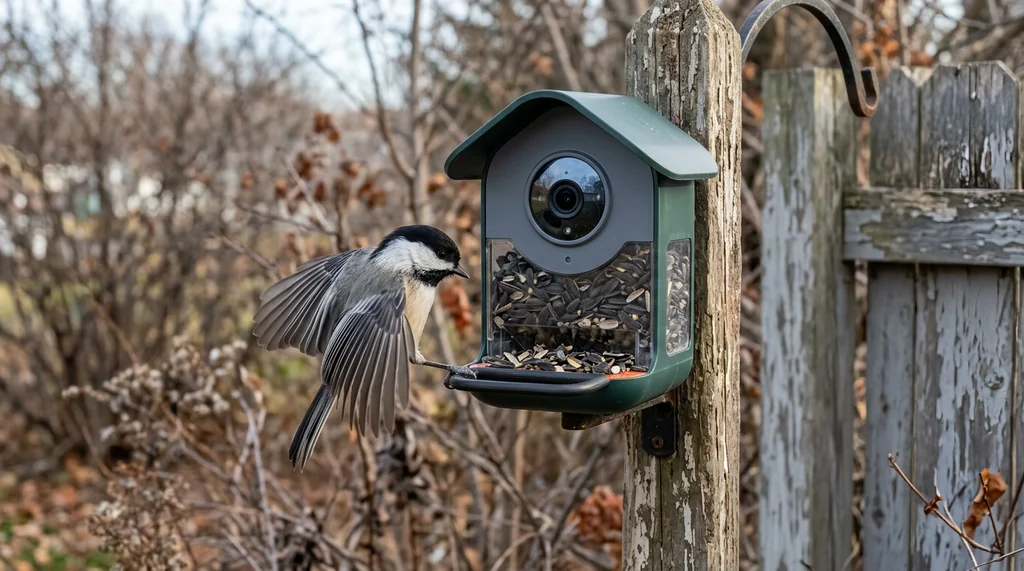
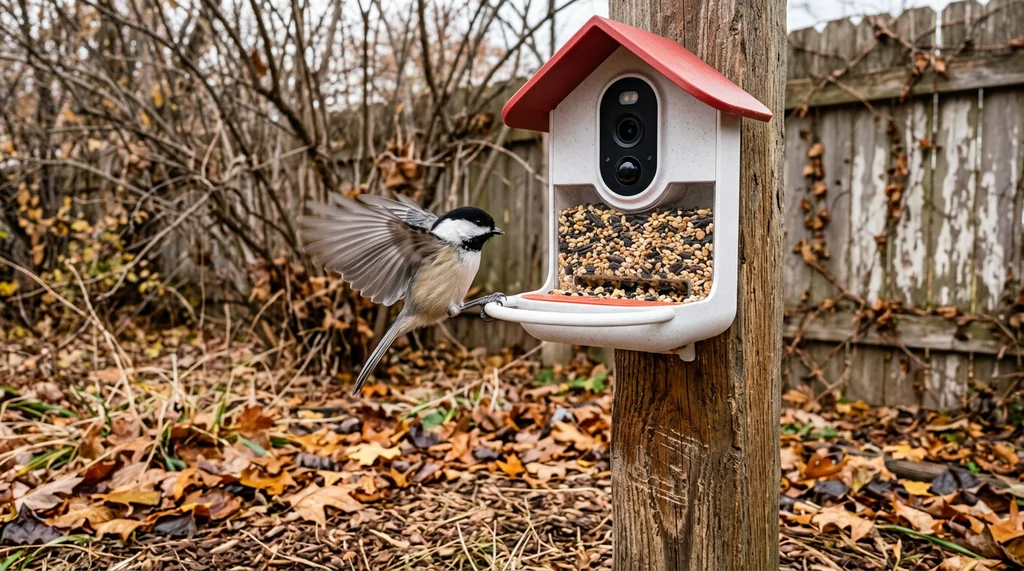
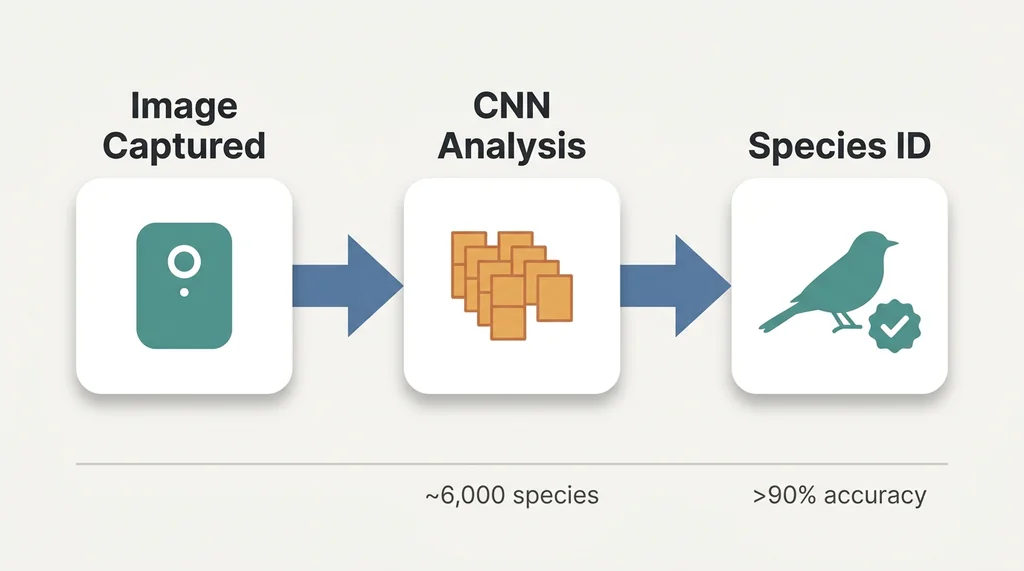
A smart bird house is, at its core, a weatherproof camera mounted inside or adjacent to a feeder or nesting box, connected to your home WiFi and paired with an app on your phone. The "smart" part refers to what happens after the camera captures an image: an AI identification engine analyzes the photo, cross-references it against a species database, and sends you a notification identifying what just landed.
The hardware components are straightforward. You have a camera sensor — typically 1080p to 2K resolution in current consumer models — a motion or infrared trigger that activates recording when something approaches, a battery or solar charging system, and a wireless radio for data transmission. Most major brands, including Bird Buddy and Birdfy, operate exclusively on 2.4GHz WiFi networks. The 5GHz band is incompatible with current smart feeder hardware, which matters if your router broadcasts primarily on the faster band. Minimum upload speed for stable streaming is 2 Mbps at the feeder's physical location — not at your router, but at the feeder itself. Exterior brick siding can reduce WiFi signal strength by nearly 40%, which has surprised more than a few buyers who assumed their yard was well-covered.
The battery situation varies significantly by model. Bird Buddy's base unit carries a 3,800 mAh battery rated for roughly one month under normal conditions, but in high-traffic yards that number can drop to five or six days. Birdfy's base model runs a 5,200 mAh pack, with premium versions reaching 9,000 mAh. Cold weather degrades lithium battery performance by 30 to 50 percent during cold snaps, which is worth knowing before mounting a camera on the north side of your house in January.
How the AI Bird Box Identification Engine Works
This is where things get genuinely interesting, and where the gap between marketing claims and technical reality is widest.
The AI identification system in a smart nesting box or feeder camera uses a type of neural network called a convolutional neural network, or CNN. These networks are trained on thousands of labeled bird photographs — in the better commercial implementations, actual feeder footage rather than museum specimens or controlled studio photography. The distinction matters because feeder birds are often partially obscured, backlit, moving, or presenting unusual angles that a museum specimen photograph would never capture.
Most consumer smart feeders use a compressed neural network architecture called MobileNet, which is optimized to run efficiently on hardware with limited processing power. This is called edge inference — the identification happens locally on the device, not in the cloud. Edge inference reduces latency (you get your notification faster) and keeps the system functional during internet outages, but it constrains how large and complex the identification model can be.
Consumer-grade AI in current smart feeders typically recognizes around 6,000 species. More advanced commercial systems reach past 11,000 species. For context, North America hosts roughly 900 to 1,000 regularly occurring bird species, so even the consumer-grade models cover the relevant territory well. Manufacturer accuracy claims run above 90% for common backyard species — and in my three seasons of testing, that tracks reasonably well for the birds that visit frequently. The system gets better at your regulars over time.
Where it struggles: partially visible birds, juveniles in transitional plumage, and species pairs that look nearly identical to each other. A first-year male cardinal doesn't look much like an adult male cardinal, and the AI knows this imperfectly. A Northern Cardinal performing his characteristic twelve-second safety scan before feeding — a behavior I've documented consistently across three years of observation — gives the camera plenty of time to capture a clear image. A warbler moving through for thirty seconds does not.
The Smart Nesting Box as Citizen Science Tool
Beyond the novelty factor, smart nesting box and feeder camera technology serves a genuine conservation function. Several platforms integrate directly with citizen science databases. Open-source DIY implementations can connect to iNaturalist via API, automatically contributing feeder data to research efforts. This is meaningful: three billion birds have vanished from North American skies since 1970, a 29% decline documented by the Smithsonian's National Zoo, and understanding where species are present — or absent — requires data at a scale that professional ornithologists cannot collect alone.
The practical result is that a smart bird house in your backyard can contribute real data to population monitoring while simultaneously telling you which warbler just landed on your platform feeder. This dual function — personal enjoyment and scientific contribution — is one of the more compelling arguments for the technology beyond pure entertainment.
Platforms like Bird Buddy allow feeder data to be shared across user networks, building aggregate species maps from thousands of individual yards. The accuracy of these maps depends on the accuracy of the underlying AI identification, which is why the species recognition capability matters beyond the individual user experience.
Bird House Camera Hardware: What to Actually Evaluate
When comparing bird house camera options, four specifications determine day-to-day usability more than any others.
Resolution and image quality. Bird Buddy's Smart Feeder Pro shoots 2K vertical video and 5-megapixel stills. Birdfy offers 1080p or 2K depending on the model. The resolution difference is visible in fine feather detail — the difference between a satisfying identification photo and an ambiguous blur — but both are adequate for common species in good light.
Solar panel design. Bird Buddy's solar panel is fixed position, which means feeder placement for optimal bird attraction (within 10 to 15 feet of dense cover, at 5 to 6 feet height) may conflict with optimal solar charging placement (direct southern exposure). Birdfy's solar panel is detachable and adjustable, allowing you to aim it independently of feeder orientation. Solar panels on current models require at least four hours of direct sunlight daily for consistent operation, and pollen and dust accumulation can reduce charging efficiency by roughly 20% — worth knowing during spring.
AI species database and subscription model. Bird Buddy historically operated on a subscription model for full AI features. Several newer competitors, including some models from BROAIMX and CINMOORE, offer lifetime free AI identification — a meaningful long-term cost consideration. At $80 per year, five years of subscription fees adds $400 to the total cost of ownership beyond hardware.
WiFi reliability at installation distance. Before purchasing any smart bird house camera, test your WiFi signal strength at the planned installation location. A $30 to $60 WiFi extender often solves signal problems that would otherwise make the camera unreliable, and it's a much cheaper fix than returning hardware.
AI Bird Identification in Practice: Realistic Expectations
The gap between the marketing version and the real-world version of AI bird identification is narrower than it used to be, but it exists.
For the birds that visit your yard regularly — the cardinals, chickadees, nuthatches, house finches, and species that become daily fixtures — the identification accuracy is genuinely high and genuinely useful. The system learns your yard's regulars. Notifications become reliable enough that you start trusting them.
For uncommon visitors, the accuracy drops. The AI may correctly identify that something unusual has appeared while misidentifying the specific species. This is where a field guide remains relevant — not as a replacement for the AI, but as a verification tool for the edge cases.
The notification volume question is worth addressing directly. In high-traffic yards, users report receiving 50 or more daily notifications for a single returning cardinal. Most apps allow sensitivity adjustment and species filtering, and learning to configure these settings is as important as the initial hardware setup. An untuned notification system becomes background noise within a week.
Setting Up Your Smart Bird House for Best Results
Placement follows the same principles as any feeder setup, with one additional consideration: camera angle. Position the feeder so birds approach from the front of the camera, not from the side or above. Most smart feeders are designed with this in mind, but it's worth checking the camera field of view before permanently mounting anything.
For squirrel interference — and there will be squirrel interference — the 5-7-9 rule applies: feeders positioned 5 feet high, 7 feet from any horizontal jumping surface, and 9 feet below any overhead jumping point. Smart feeders don't deter squirrels; they just photograph them. Repeatedly. A weight-activated feeder like the Brome Squirrel Buster Plus, positioned separately from the camera feeder, handles the actual deterrence.
Clean the camera lens and solar panel every two to three weeks. A soft damp cloth is sufficient. Pollen accumulation is the primary culprit in reduced solar charging efficiency, and it's an easy fix that most users overlook until they notice battery performance degrading through spring.
The technology has reached a point where a smart bird house genuinely delivers on its core promise: reliable identification, consistent documentation, and the particular satisfaction of knowing what visited while you were making coffee. It won't replace three years of patient observation, a good pair of 8x42 binoculars, or a regional field guide. But as a complement to those things, it's become a legitimate part of how serious backyard birders engage with their yards.