Smart Bird Feeders: AI, Camera, and Solar Options Compared
Smart Bird Feeder Guide: AI, Camera, and Solar Options Compared
There's a particular kind of frustration that comes from watching your neighbor's yard fill with goldfinches while your feeder sits empty and ignored. You've done the research. You've bought the seed. You've positioned everything according to the internet's collective wisdom. And still, nothing. Now imagine pointing your phone at that same empty feeder and having an app tell you exactly which species visited while you were at work, complete with a portrait-quality photograph and a species card explaining their migratory range.
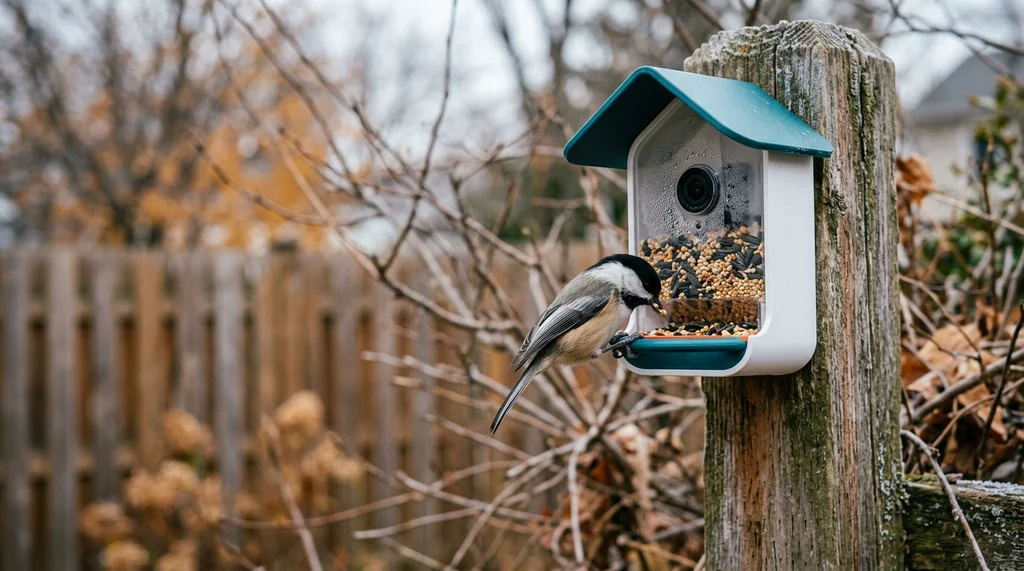
That's the promise of the smart bird feeder — a category that has grown from a novelty into a legitimate birding tool over the past several years. These devices combine motion-sensitive cameras, Wi-Fi connectivity, and AI-powered species recognition into a package that hangs from your shepherd's hook and reports back to your phone like a wildlife correspondent. After three seasons of testing them alongside traditional feeders, tracking 34 confirmed species through the companion apps, and spending what David now categorizes on his spreadsheet as a "significant ongoing technology budget," this guide covers everything you need to decide whether a smart feeder belongs in your yard — and if so, which one.
Key Takeaways
- All major smart bird feeders require 2.4GHz Wi-Fi only — separating your router's bands before setup prevents the most common pairing failure
- Bird Buddy Pro costs $299 plus ~$80/year for full 1080p video, totaling ~$700 over five years; Birdfy delivers comparable video at $164–$190 with no mandatory subscription
- Cold weather reduces lithium battery capacity by 30–50%, so check battery status more frequently during winter when bird activity is highest
- Solar charging on Bird Buddy's fixed panel provides ~20% daily charge gain but consumption runs 25–33% per day, making a large battery (like Birdfy's 9,000 mAh) more reliable than solar alone in northern or shaded yards
- Switching exclusively to black oil sunflower seeds increased yard visitation by 300% compared to generic mixed seed blends across three years of testing
What Is a Smart Bird Feeder, and How Does the Technology Actually Work?
A smart bird feeder is, at its core, a standard seed feeder with a camera module and wireless connectivity built in. The camera detects motion, captures images or video when a bird lands, and transmits that footage to a companion smartphone app. What separates a smart feeder from simply zip-tying a trail camera to a tube feeder is the AI identification layer — software trained on hundreds of thousands of real feeder visits that attempts to match the captured image against a species database and return a name.
The underlying technology most manufacturers use is a MobileNet neural network architecture, specifically chosen because it runs efficiently on devices with limited processing power. This matters because most smart feeders perform what's called edge inference — processing the image locally on the device rather than sending raw footage to a cloud server for analysis. Edge inference reduces latency, keeps the system functional during internet outages, and addresses some privacy concerns, but it also constrains the model's size and complexity. A MobileNet model running on a small embedded processor cannot match the accuracy of a server-side model with unlimited computational resources.
Multiple commercial products specify that their AI systems were trained on actual bird feeder footage rather than museum specimens or controlled laboratory photography. This is a meaningful distinction. A cardinal photographed through a glass window at 6:47 AM in flat winter light looks substantially different from a cardinal posed under studio conditions. Training on real feeder visits — including motion blur, partial occlusion, and variable lighting — produces more accurate identifications under real-world conditions.
Current consumer-grade AI systems average recognition capability across 6,000 or more species. More advanced commercial implementations push past 11,000 species. For context, North America hosts roughly 900 to 1,000 regularly occurring bird species, which means even the baseline consumer models cover the relevant range many times over. The practical limitation isn't the species database — it's identification accuracy for the species that actually show up.
Manufacturers report accuracy rates above 90% for common backyard species under good lighting conditions. Independent testing tells a more complicated story. For a house finch or a white-breasted nuthatch landing squarely on the perch in full daylight, the AI performs impressively. For a juvenile bird in transitional plumage, a species at the edge of its range, or any visitor photographed in motion or shadow, verification against an established resource like the Cornell Lab's All About Birds or Google Lens remains genuinely necessary. The AI is a helpful first identification, not a final authority.
The AI Bird Feeder Landscape: Key Models and What They Offer
The smart feeder market has consolidated around a handful of serious players, each with distinct hardware and software philosophies. Understanding the differences before purchasing saves considerable frustration.
Bird Buddy Smart Feeder Pro
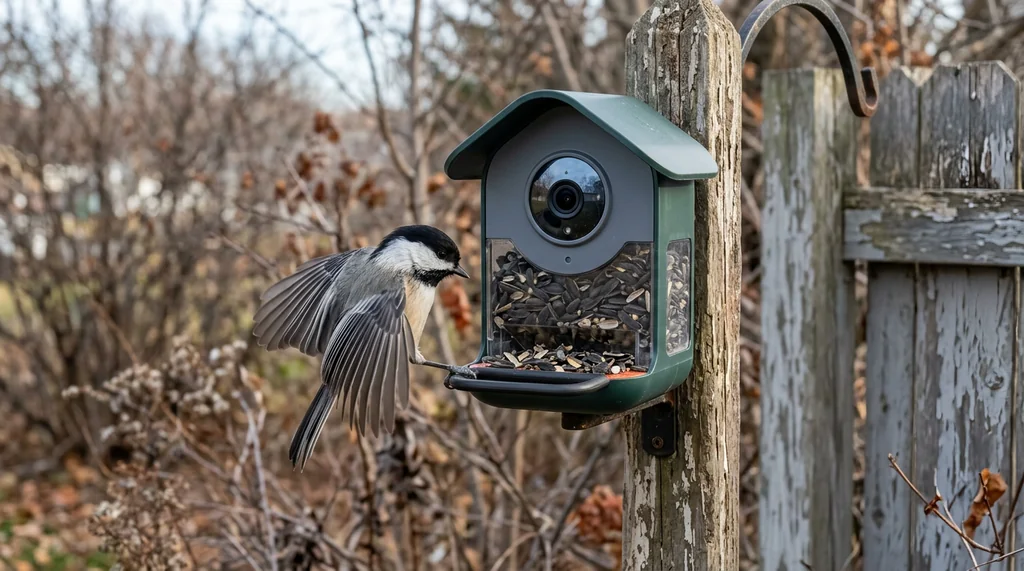
Bird Buddy entered the category as a premium-build early entrant and remains the option with the most polished app experience. The Pro model shoots 2K vertical video and 5-megapixel stills, captures 720p HD video (full 1080p requires a paid subscription), and holds 3.8 cups of seed. The camera sensor is capable of 1080p operation, but the firmware runs it at 720p to conserve battery life — a tradeoff that's worth understanding before purchase.
Battery capacity is 3,800 mAh. Under standard conditions, Bird Buddy delivers five to fifteen days per charge. In high-traffic yards, that can drop to five or six days. Cold weather reduces lithium battery capacity by 30 to 50 percent during cold snaps, which is a real consideration for anyone in a northern climate. The solar roof accessory helps substantially in south-facing, unshaded locations, providing roughly 20 percent charge gain on a clear winter day at mid-latitude. Pollen and dust accumulation on the solar cells can reduce that efficiency by another 20 percent, so the panel needs periodic wiping with a soft damp cloth.
The Bird Buddy app is consistently rated 5 out of 5 for usability. Species cards are genuinely engaging — Sophie, who is eight and keeps a bird journal, finds them more compelling than field guide entries, which says something about how well they're designed. The feeder can be shared with up to ten people via the app, making it well-suited for households where multiple people want access to the notification stream.
Bird Buddy Pro is currently priced at $299. The app includes AI identification, but full video quality requires a subscription that runs approximately $80 per year. Over five years, that's $400 in recurring charges beyond the hardware cost — a number worth factoring into the total ownership calculation.
Netvue Birdfy
Birdfy positions itself as the higher-resolution, lower-maintenance competitor. Depending on the model, it offers 1080p or 2K resolution, holds 1.5 liters (roughly 6 cups) of seed, and carries a substantially larger battery — 5,200 mAh in the base Feeder 2 model and 9,000 mAh in premium configurations. Real-world testing has documented Birdfy achieving up to four months of battery life under moderate use and nine months in high-activity environments on a single charge. That's a meaningful operational difference.
Birdfy's solar panel is detachable and adjustable, allowing you to aim it directly at the sun regardless of the feeder's orientation. Bird Buddy's panel is fixed position with limited adjustability, which matters if your optimal feeder placement isn't also your optimal sun-exposure location. Birdfy also features a removable battery pack that allows hot-swapping without bringing the feeder indoors — a practical advantage during winter when you'd prefer not to disrupt established bird activity.
Birdfy claims AI identification capability across more than 6,000 bird species. Pricing runs $164 to $190 depending on the model, which is $110 to $135 less than Bird Buddy Pro. For buyers primarily motivated by video quality, seed capacity, and lower maintenance frequency, Birdfy offers a compelling alternative.
Budget-Friendly Options Worth Knowing
The subscription-free smart feeder has become a legitimate product category. BROAIMX ships with a 32GB to 64GB local storage card, shoots 1080p HD video, and claims AI identification of over 11,000 species with lifetime free access. CINMOORE offers 4-megapixel 2.5K resolution with a 10,000-plus species database, also subscription-free. These options represent a genuine shift from the previous norm where AI identification was reliably gated behind monthly fees.
At the higher end of the budget spectrum, the CoolFly Aura offers up to 2.5K Ultra HD resolution with a 150-degree field of view and color night vision — specifications that exceed most competitors in the visual capture department. Some models in this tier also include air pumps for seed management, preventing the seed compaction that plagues standard tube feeders in humid conditions.
Camera Bird Feeder Setup: The Technical Requirements Nobody Mentions
The marketing materials for smart bird feeders universally emphasize what happens after setup — the beautiful species cards, the notification of a rare visitor, the time-lapse of a busy winter morning. They are considerably less forthcoming about what's required to get there.
Wi-Fi Requirements
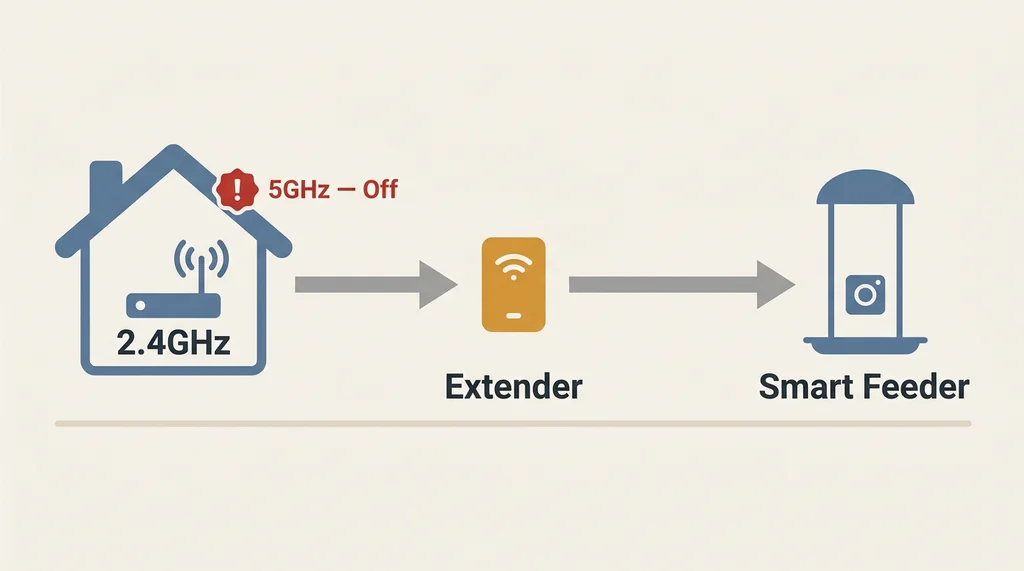
All major smart bird feeder brands operate exclusively on 2.4GHz Wi-Fi networks. They are incompatible with 5GHz bands. This is the single most common setup failure point, because modern mesh network systems and many routers broadcast both frequencies under the same network name, and the feeder will consistently attempt and fail to connect to the 5GHz signal.
The fix requires logging into your router's admin interface (typically accessible at 192.168.1.1 or 192.168.0.1 in a browser) and either separating the two bands into distinct networks with different names or enabling a 2.4GHz-only mode. This is a five-minute task once you know it's necessary, but discovering it after forty-five minutes of failed pairing attempts is not a pleasant afternoon.
Smart feeders also require a minimum of 2 Mbps upload speed at the feeder's physical location — not at your router, but at the spot where the feeder will actually hang. Exterior brick siding can reduce Wi-Fi signal strength by nearly 40 percent. A feeder mounted on a pole at the far end of a yard, behind a brick wall, may have perfectly adequate signal for casual browsing but insufficient bandwidth for stable 2K video streaming. A dedicated Wi-Fi extender positioned between the router and the feeder costs $30 to $60 and solves this reliably.
Pairing Protocols
Bird Buddy uses Bluetooth for initial pairing, then hands off to Wi-Fi for ongoing operation. Birdfy uses a QR code scan displayed on the phone screen for initial pairing. Both approaches work, but both also require the feeder battery to be above 20 percent charge before the device will attempt pairing — a detail that's easy to miss if you're setting up a feeder that arrived partially discharged.
For Bird Buddy specifically, the pairing mode requires the protrusions on the feeder cover to align vertically with the buckle slits before the device enters pairing mode. This mechanical alignment step is documented in the setup guide but not prominently flagged, and misalignment is responsible for a disproportionate share of "my feeder won't connect" complaints in user forums.
Placement Considerations
Smart feeder placement involves balancing several competing requirements simultaneously. The Cornell Lab's placement guidance for window strike prevention applies here: feeders should be within 3 feet of windows or more than 10 feet away. The 3-to-10-foot zone creates the velocity conditions for fatal collisions.
Cardinals, which are among the most photographed feeder visitors, stay within 10 to 15 feet of dense shrubs and trees in nature. They also perform their characteristic twelve-second safety scan before committing to a feeder. Positioning a smart feeder in an open, exposed location optimizes for solar charging and Wi-Fi signal while simultaneously discouraging the birds you most want to photograph. The best placement is usually a compromise: within 15 to 20 feet of a mature tree or dense shrub, on the south or east face of the yard, within reasonable Wi-Fi range.
Some smart feeder models, including the Harymor, require pole-mounting on flat surfaces rather than hanging from branches or hooks. This restricts placement options in yards where flat mounting surfaces aren't available near optimal bird habitat. Before purchasing, confirm the mounting requirements match your specific yard configuration.
The Bird Identification Camera: What AI Gets Right and Where It Struggles
Watching the AI identify a bird in real time remains genuinely impressive, even after three seasons of familiarity. A tufted titmouse lands, the camera triggers, and within seconds the app returns a species card with range maps, behavioral notes, and a quality photograph. For common backyard species in good lighting, the accuracy is remarkable.
The limitations become apparent at the edges. Juvenile plumage confuses the system consistently — a first-year American goldfinch in its drab fall colors generates misidentifications that would embarrass a beginning birder. Female birds of sexually dimorphic species (where males and females look substantially different) create similar problems. The AI trained on thousands of brilliant male rose-breasted grosbeak images is less confident when presented with the streaky brown female.
Range and rarity create another category of errors. The AI will occasionally identify a bird as a species that doesn't occur within a thousand miles of your location. These identifications are almost always wrong — the bird is a common species in unusual lighting or partial view — but the app presents them with the same confidence as a correct identification of a house sparrow. Cross-referencing surprising identifications against eBird's regional species lists takes thirty seconds and prevents a lot of excited misreporting.
The Cornell Lab recommends treating AI identification as a starting point rather than a conclusion, and this guidance reflects the technology's actual capabilities honestly. For the 15 to 20 species that constitute the core of most backyard feeder populations, the AI performs well enough to function as a primary identification tool. For anything unusual, it functions better as a prompt to look more carefully.
One genuinely valuable feature that transcends identification accuracy is the species log. Across three seasons of testing, the app documented 34 confirmed species visiting the yard — birds that were present but not noticed during casual observation. The camera catches the brief visit of a migrating warbler that lands for forty seconds at dawn. It documents the first arrival date of the year for seasonal visitors. It builds a phenological record of yard activity that would be impossible to assemble through direct observation alone.
Some manufacturers, including Bird Buddy, emphasize that user-submitted photos contribute to global databases used by researchers tracking migration patterns and population health. With three billion birds having vanished from North American skies since 1970 — a 29 percent decline documented by the Smithsonian's National Zoo — citizen science data from backyard feeders represents a meaningful contribution to understanding what's happening and where. The smart feeder as conservation tool is not marketing language; it reflects how ornithological research increasingly works.
Solar Powered Bird Feeder Performance: The Honest Assessment
Solar integration has become a standard feature on high-end smart feeders, and the appeal is obvious. A feeder that charges itself removes the most tedious maintenance requirement — carrying the unit inside every week or two to charge via USB. The reality is more nuanced.
The Bird Buddy Solar Roof provides approximately 20 percent charge gain on a clear sunny day at mid-latitude in winter. The feeder uses between 25 and 33 percent of battery capacity per day under typical conditions. The net charge delta — gain minus consumption — is approximately 17 percent on a good winter day. Bird Buddy's marketing claims that three days of good sunlight can bring the battery from empty to full and that the feeder will likely never need charging with the Solar Roof. In a south-facing yard with no shading and strong winter sun, this is plausible. In a yard with trees, north or east orientation, or significant cloud cover, the math changes substantially.
Users north of roughly 40 degrees North latitude should expect the Solar Roof to perform significantly better in summer than winter. The sun sits lower in the sky from October through February, potentially shading summer-sunny locations entirely. A spot that gets six hours of direct sun in July may get two hours in January — or none, if a roofline or tree blocks the low winter sun angle.
Birdfy's adjustable, detachable solar panel addresses this limitation more elegantly. The ability to aim the panel independently of the feeder's position means you can optimize both bird habitat and solar exposure separately rather than compromising both.
Solar panels on current models require at least four hours of direct sunlight daily for consistent operation. Pollen and dust accumulation can reduce charging efficiency by roughly 20 percent, which makes the spring pollen season — when bird activity is also high — a period of particular battery stress. Wiping the panel with a soft damp cloth every two to three weeks maintains efficiency without risk of damage.
For buyers in consistently sunny climates with south-facing yards, solar integration genuinely delivers on its promise. For buyers in the northern tier, in shaded yards, or in climates with significant cloud cover, a larger battery capacity (as found in Birdfy's premium models) may be more practically useful than solar charging.
Subscription Costs and the True Price of Smart Feeder Ownership
The purchase price of a smart bird feeder is the beginning of the cost calculation, not the end. Understanding the subscription landscape before buying prevents the frustration of discovering that the feature that motivated the purchase requires a monthly payment.
AI identification is the most commonly subscription-gated feature. Bird Buddy includes basic identification in the base app but gates full video quality (1080p vs. 720p) behind a premium subscription running approximately $80 per year. At that rate, five years of subscription fees totals $400 in recurring charges beyond the $299 hardware cost — making the true five-year ownership cost closer to $700.
Birdkiss, another market entrant, starts subscription pricing at $2.99 per month, which is lower than Bird Buddy's annual rate but still represents $36 annually for what is often marketed as a core feature rather than a premium add-on.
The emergence of subscription-free models with lifetime AI identification represents a genuine market response to this frustration. BROAIMX and CINMOORE both offer perpetual AI identification without recurring fees. The tradeoff is typically in app polish and community features — the species card design, the social sharing functionality, the integration with citizen science databases — rather than in core identification capability.
For buyers who use a smart feeder primarily as a camera and species logger, the subscription-free options deliver the essential functionality at lower total cost. For buyers who value the curated app experience, the social features, and the contribution to research databases, Bird Buddy's premium subscription offers genuine value beyond identification alone.
Practical Maintenance: Keeping Your Smart Feeder Running
Smart feeders require all the standard feeder maintenance plus additional attention to their electronic components.
Seed reservoir cleaning follows the same protocol as traditional feeders: a 1:9 bleach-to-water solution every two weeks, complete rinsing, and full drying before refilling. Wet seed molds quickly, and mold inside a camera feeder creates the additional problem of potentially contaminating the camera module. The reservoir should be completely dry before refilling — a detail that's easy to shortcut and consistently causes problems.
The camera module itself requires occasional cleaning. A soft lens cloth removes the fingerprints, water spots, and dust accumulation that degrade image quality over time. The camera housing on most models is rated for weather resistance, but "all-weather" marketing language covers a wide range of actual performance. Real-world durability varies by model; independent reviewers have documented some units withstanding Pacific Northwest winters with 20-plus inches of rain, snow, and hail with no degradation, while others have shown moisture infiltration after heavy rain.
Battery management in winter requires specific attention. Lithium batteries lose 30 to 50 percent of effective capacity in cold temperatures, which means a feeder showing 60 percent battery charge in November may effectively have 30 to 40 percent of its warm-weather capacity. Checking battery status more frequently during cold snaps prevents the feeder going offline during the period when bird activity — and the value of monitoring it — is highest.
The solar panel needs attention during spring pollen season. Pollen accumulation is invisible to casual inspection but measurable in charging efficiency. A quick wipe every two to three weeks during April and May maintains the 20 percent charging efficiency that pollen accumulation would otherwise eliminate.
For seed management, the same principles that govern traditional feeders apply: black oil sunflower seeds remain the highest-value offering for the broadest range of species. Switching exclusively to black oil sunflower seeds increased yard visitation by 300 percent compared to generic mixed seed blends across three years of testing — a result that holds regardless of whether the feeder has a camera. Buy seed in quantities usable within four to six weeks to maintain freshness. Nyjer seed stored longer than two months loses oil content and birds will reject it, which means an expensive seed sitting in a clogged tube feeder is worse than no seed at all.
Squirrels, Smart Feeders, and the Limits of Technology
It would be incomplete to discuss smart bird feeders without acknowledging that the same motion detection system that photographs your first-of-season rose-breasted grosbeak will also photograph every squirrel visit in equivalent detail. In yards with active squirrel populations, this generates notification volumes that become genuinely disruptive — users report receiving 50 or more daily notifications for a single returning squirrel.
Most smart feeder apps now include sensitivity controls and species filters that allow squirrel motion to be logged without triggering notifications. This is a software solution to what remains a hardware problem: the feeder is still being raided, the seed is still being consumed, and the camera is still running its battery down photographing the raids.
Mr. Fitzgerald — named by Max, who is five and finds squirrels considerably more sympathetic than the rest of the household does — has conducted reconnaissance on every feeder in the yard including the camera feeders. Neither Bird Buddy nor Birdfy deters him physically. The Brome Squirrel Buster Plus, priced at $79 to $95, closes its ports when weight exceeds 1.3 pounds and remains the most effective physical deterrent for tube-style feeders. Squirrels average eight to sixteen ounces, well above the threshold that triggers port closure.
The 5-7-9 rule for feeder placement — 5 feet high, 7 feet from any horizontal jumping surface, 9 feet below any overhead jumping point — applies to smart feeders as it does to traditional ones. Squirrels can leap horizontally up to ten feet, jump vertically nearly five feet from a standing position, and drop nine feet from above without injury. Placement that ignores these physics will produce a smart feeder that documents its own raiding in high definition.
A dedicated squirrel feeding station positioned 30 feet or more from primary bird feeders, stocked with corn and peanuts at $5 to $8 per month, redirects foraging pressure more effectively than any deterrent mechanism. After 47 documented failed access attempts against the Brome Squirrel Buster Plus, Mr. Fitzgerald now primarily forages at his dedicated station and conducts only occasional reconnaissance of the bird feeders. The app's notification filters handle the rest.
Who Should Buy a Smart Bird Feeder?
After three seasons and a learning tax that now totals $2,271.99 across all bird-feeding experiments, the honest answer is: it depends on what you want from the experience.
Smart feeders deliver genuine value for birders who want a species record of their yard without committing to dawn-to-dusk observation. The camera catches what you miss. The species log builds a phenological record that becomes more interesting with each passing season. For households with children — Sophie's engagement with the Bird Buddy species cards has been consistently higher than her engagement with any field guide — the technology creates an accessible entry point to serious birding that binoculars and reference books alone don't match.
The technology is also well-suited for anyone who wants to contribute to citizen science without the time commitment of formal monitoring programs. The photos submitted through apps like Bird Buddy feed directly into research databases tracking population trends and migration timing. That's a meaningful contribution that happens automatically as a byproduct of watching your feeder.
Smart feeders are a harder sell for birders primarily interested in attracting specific species rather than documenting what arrives. The camera doesn't change which birds visit — seed selection, feeder type, placement relative to cover, and habitat quality do that work. A camera feeder with the wrong seed in the wrong location will document its own failure in excellent resolution.
They're also a harder sell for anyone without reliable 2.4GHz Wi-Fi coverage at the feeder location, anyone in a heavily shaded yard expecting solar charging to eliminate battery management, or anyone unwilling to engage with ongoing subscription costs for premium features. These aren't reasons to avoid the category — they're reasons to choose carefully within it.
The best smart feeder is the one that matches your yard's infrastructure, your tolerance for maintenance, and your primary use case. For most buyers, Birdfy offers the better combination of battery life, seed capacity, and video quality at a lower price point. For buyers who prioritize app experience and community features and have a south-facing yard with strong solar exposure, Bird Buddy Pro delivers a more polished experience worth the premium. For buyers who want AI identification without subscription fees, the BROAIMX and CINMOORE options represent a genuinely useful alternative that the market didn't offer two years ago.
The category is maturing quickly. Bird Buddy has announced a Bird Buddy 2 and updated Pro model for 2026, and the broader market is moving toward higher resolution, larger batteries, and subscription-free AI as competitive baseline features rather than premium differentiators. Buying now means buying into a category that will look substantially different in eighteen months — which is either a reason to wait or a reason to enjoy the current generation while the next one develops, depending on your patience for watching an empty feeder.
What remains constant is the thing that makes any feeder worth having: the moment a bird lands, the light is good, and you see something you've never quite seen before. The smart feeder just makes sure you don't miss it because you happened to be looking somewhere else.