Smart Bird Feeder Battery Life: Birdfy vs Bird Buddy
Smart Bird Feeder Battery Life: Birdfy vs. Bird Buddy Compared
The promise of a smart bird feeder is simple: mount it, connect it, and let the camera do the watching while you go about your day. The reality, as anyone who's invested in this technology quickly discovers, is that the promise lives or dies on one unglamorous specification — battery life.
After three seasons of testing smart feeders (and $2,271.99 in accumulated learning costs), smart bird feeder battery performance has become the factor I track most obsessively. Not video resolution. Not AI accuracy. Battery. Because a feeder that needs weekly charging is a feeder that spends significant portions of its life dark, offline, and missing exactly the moments it was purchased to capture.
Here's what the numbers actually look like between the two dominant platforms — and what they mean for your yard.
Key Takeaways
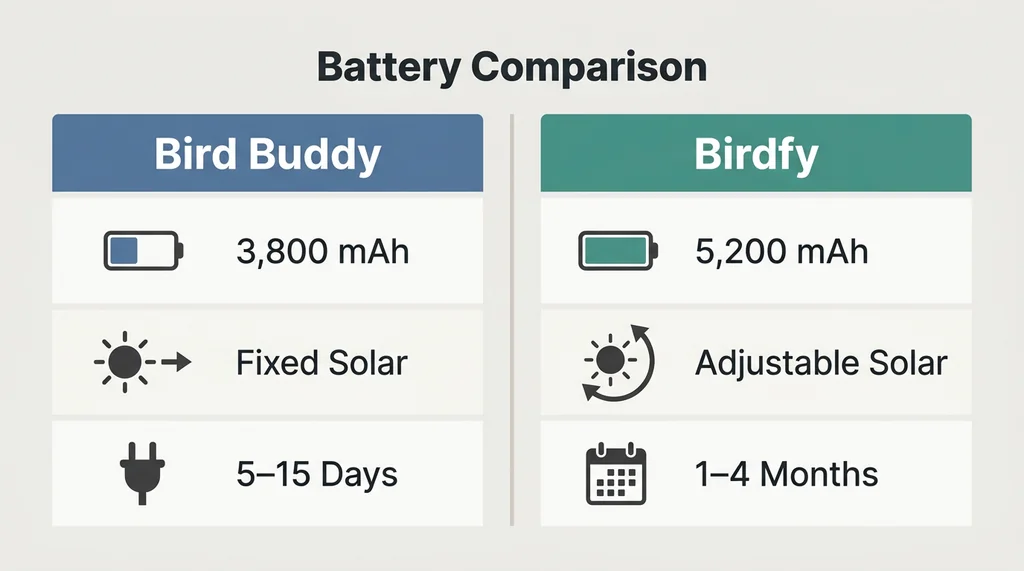
- Birdfy's 5,200 mAh battery lasts up to four months under moderate use, compared to Bird Buddy's 5–15 days on a single charge.
- Bird Buddy requires removing the camera module indoors to charge, creating a full coverage gap; Birdfy's hot-swap battery allows the camera to keep recording during charging.
- Birdfy's adjustable solar panel can be aimed independently of feeder position, while Bird Buddy's fixed panel is limited to whatever angle the feeder faces.
- Lithium batteries lose 30–50% of effective capacity in cold weather, cutting Bird Buddy's already shorter runtime harder than Birdfy's larger battery.
- Wipe solar panels with a damp cloth every two to three weeks to recover the roughly 20% charging efficiency lost to pollen and dust buildup.
Bird Buddy Battery Life: The Honest Assessment
The Bird Buddy Smart Feeder Pro carries a 3,800 mAh battery. Under standard usage conditions, Bird Buddy's own documentation and most independent testing put runtime at somewhere between 5 and 15 days per charge. Some professional reviews have rated the battery experience more favorably, but user-generated data and comparative testing consistently tell a different story.
In high-traffic yards — the kind where a territorial male cardinal performs his twelve-second assessment ritual every morning at 6:47 AM, and where a persistent squirrel (ours is named Mr. Fitzgerald, courtesy of a five-year-old with strong opinions about squirrel dignity) triggers motion detection at inconvenient intervals — that runtime can collapse to five or six days. The motion detection and video recording triggered by every visitor draws down the battery faster than any spec sheet accounts for.
Without solar support, most users report needing to recharge every two to three weeks under moderate conditions. That's a charging cycle every 14 to 21 days, minimum.
The charging process itself introduces a secondary problem: Bird Buddy requires removing the camera module from the feeder to charge it indoors. This isn't a minor inconvenience. While the camera module is inside charging, the feeder is essentially a decorative seed holder. No video. No identification. No notifications. Whatever visits during that window — including, with some frequency, species you've never documented before — goes unrecorded.
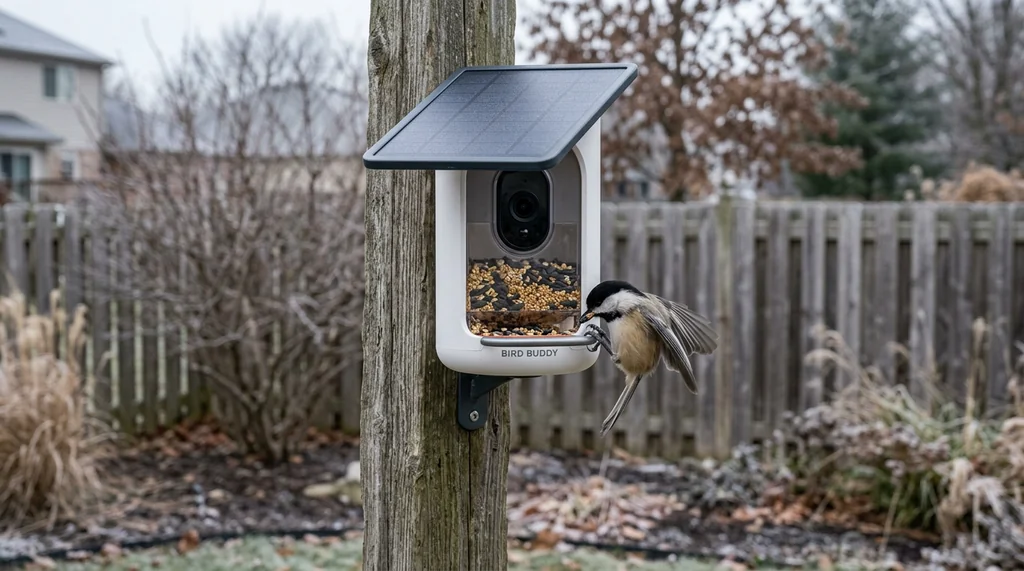
Bird Buddy's fixed solar panel option helps, but "helps" is doing real work in that sentence. The panel's fixed position means its charging efficiency depends entirely on how the feeder happens to be oriented relative to the sun. Users in yards where the optimal bird-attracting location (within 10 to 15 feet of dense shrubs, which is where cardinals and most songbirds prefer to feed) doesn't align with optimal solar exposure report the panel providing only marginal assistance — sometimes requiring weekly manual charging even with the solar accessory attached.
One documented measurement from real-world winter testing at 42.3° North latitude found the Bird Buddy Solar Roof providing approximately 20% charge gain on a clear sunny day, with daily camera usage consuming 25 to 33% of battery capacity. The net math produces a charge deficit on most winter days even with full sun — meaning the solar roof delays charging intervals rather than eliminating them.
Birdfy Battery: A Different Design Philosophy
The Birdfy Feeder 2 base model ships with a 5,200 mAh battery — 37% more capacity than Bird Buddy's 3,800 mAh before accounting for any other differences. Premium Birdfy models step up to 9,000 mAh.
The capacity difference translates directly into real-world runtime. Under moderate use, the 5,200 mAh Birdfy battery has been documented lasting approximately four months. Even under heavier activity, independent testing consistently places Birdfy runtime at one to two months — compared to Bird Buddy's 5 to 15 days under similar conditions.
That's not a marginal difference. That's a fundamentally different maintenance relationship with the device.
The solar integration story is also meaningfully different. Birdfy's solar panel is detachable and adjustable, meaning it can be aimed directly at the sun independent of where the feeder body is positioned. This matters more than it might initially seem. Feeder placement optimized for bird attraction — near cover, at the right height, positioned for good camera angles — rarely coincides with the angle that maximizes solar charging. An adjustable panel lets these two requirements operate independently. Birdfy owners in well-positioned yards report the solar panel maintaining charge levels effectively enough that manual recharging becomes genuinely rare.
When charging is necessary, Birdfy's design allows the battery pack to be removed and charged while the camera remains active. The feeder keeps recording. There's no downtime, no coverage gap, no missed visitors during the charging cycle. This is a significant operational advantage for anyone who's experienced the frustration of returning a charged Bird Buddy module to find a fresh set of unidentified footprints in the seed tray.
The Solar Powered Bird Feeder Question
Both platforms offer solar integration, but the effectiveness gap is wide enough to influence purchasing decisions.
For Birdfy, solar is a genuine solution to the charging problem. The adjustable panel, combined with the larger base battery, means that users with reasonable sun exposure can largely forget about manual charging. The ability to aim the panel independently of the feeder orientation makes this practical rather than theoretical.
For Bird Buddy, solar is better understood as a charging supplement. The fixed panel design limits efficiency to whatever angle the feeder happens to face, and the smaller base battery means the panel needs to work harder to maintain charge. In shaded yards, north-facing installations, or during winter months when the sun sits lower in the sky from October through February, Bird Buddy users should expect to maintain a manual charging schedule regardless of the solar accessory.
One practical note for any solar powered bird feeder setup: pollen and dust accumulation on solar cells can reduce charging efficiency by roughly 20%. Wiping the panel with a soft damp cloth every two to three weeks is worth adding to the maintenance routine — it's a small action with a measurable impact on daily charge gain.
Choosing the Best Smart Bird Feeder for Your Situation
Battery life doesn't exist in isolation. It intersects with how you use the feeder, where you live, and what you're trying to accomplish.
If low maintenance is the priority, Birdfy is the clearer choice. The larger battery, adjustable solar panel, and hot-swap battery design add up to a feeder that can run for months between interventions in favorable conditions. For anyone who travels, works long hours, or simply doesn't want bird feeding to become a charging management project, this matters.
If image quality and app experience are the priority, Bird Buddy Pro's 2K video, 5-megapixel stills, and well-regarded app interface make it the stronger performer — provided the battery limitations are managed proactively. Bird Buddy Pro is PCMag's top-rated smart bird feeder for a reason. The tradeoff is real, but so is the quality difference.
If the yard has high bird traffic, factor in the activity-dependent battery drain. A feeder in a yard with consistent cardinal pairs, competitive territorial males, and active squirrel reconnaissance (Mr. Fitzgerald logs approximately 47 documented access attempts against the Brome Squirrel Buster Plus before retreating to his dedicated distraction station 30 feet away) will drain any battery faster than manufacturer estimates suggest. High-traffic yards effectively halve the advertised runtime for both platforms, making Birdfy's larger capacity advantage more pronounced, not less.
If the installation site has limited sun exposure, neither solar panel will fully offset daily battery consumption. Birdfy's adjustable panel gives more flexibility, but shaded north-facing yards will require manual charging for both systems. Budget the time accordingly.
Cold weather compounds everything. Lithium batteries lose 30 to 50 percent of effective capacity during cold snaps — meaning a feeder that lasts two months in October may need attention every three to four weeks by January. This affects both platforms, but hits Bird Buddy's smaller battery harder in absolute terms.
Practical Battery Management, Regardless of Platform
A few habits extend runtime meaningfully for either system:
Adjust motion sensitivity settings to reduce false triggers from wind-blown branches, passing cars, or the squirrel who has memorized the feeder's detection radius. Every unnecessary recording event draws battery. Most apps allow sensitivity tuning — it's worth spending fifteen minutes calibrating this after installation.
For Birdfy owners, orient the adjustable solar panel toward true south (in the Northern Hemisphere) rather than defaulting to whatever angle looks natural. Even a 15-degree adjustment can meaningfully increase daily charge gain.
For Bird Buddy owners, plan charging cycles around low-activity windows — early afternoon on weekdays, or during periods of poor weather when bird visits naturally decrease. This minimizes the coverage gap from having the camera module indoors.
Keep solar panels clean. The 20% efficiency loss from pollen and dust is avoidable with minimal effort.
The smart bird feeder battery question doesn't have a single right answer — it has a right answer for your specific yard, your charging tolerance, and your priorities. Birdfy's larger battery, adjustable solar, and hot-swap design make it the lower-maintenance choice by a meaningful margin. Bird Buddy Pro's image quality and app experience make it the better choice for users willing to manage the charging cycle actively.
What neither platform will do is run indefinitely without attention. The feeders that stay online longest are the ones paired with solar panels positioned for actual sunlight, maintained with clean cells, and configured with realistic motion sensitivity settings from day one.