Bird Buddy vs Netvue Birdfy: Smart Feeder Compared
Bird Buddy vs Netvue Birdfy: Which Smart Bird Feeder Is Actually Worth It?
The smart bird feeder category has matured faster than anyone expected. Three years ago, these devices felt like expensive novelties — overpriced gadgets for people who wanted to post hummingbird videos on Instagram. Today, they've become legitimate tools for serious backyard birders, and the two devices that dominate nearly every comparison are the Bird Buddy and the Netvue Birdfy.
After three seasons of testing smart feeders, spending a total of $2,271.99 on bird-feeding equipment (a figure David tracks in a dedicated spreadsheet category labeled "significant ongoing technology budget"), and confirming 34 species in the backyard using app logs, there's finally enough real-world data to give this comparison the honest treatment it deserves. The short version: both are genuinely good products with meaningfully different strengths. The longer version is more useful.
Key Takeaways
- The Netvue Birdfy's battery ranges from 5,200 to 9,000 mAh and can last up to nine months on a single charge in high-activity yards, versus Bird Buddy Pro's 3,800 mAh delivering 5 to 15 days.
- Both devices require a 2.4GHz WiFi connection with at least 2 Mbps upload speed at the feeder location; exterior brick walls reduce signal by nearly 40%, making a $30–$60 extender often necessary.
- Cold weather reduces lithium battery capacity by 30 to 50 percent, making the Birdfy's larger battery and removable hot-swap pack a functional advantage for winter feeding.
- The Bird Buddy Pro's adjustable solar panel is fixed to feeder orientation, while the Birdfy's detachable panel can face south independently — resolving the conflict between bird-attracting placement and solar charging.
- Bird Buddy 2 and an updated Pro model are announced for 2026, making timing a factor if image quality and app polish are your primary criteria.
What a Smart Bird Feeder Actually Does
Before comparing these two specifically, it helps to establish what the category promises — and where it consistently falls short.
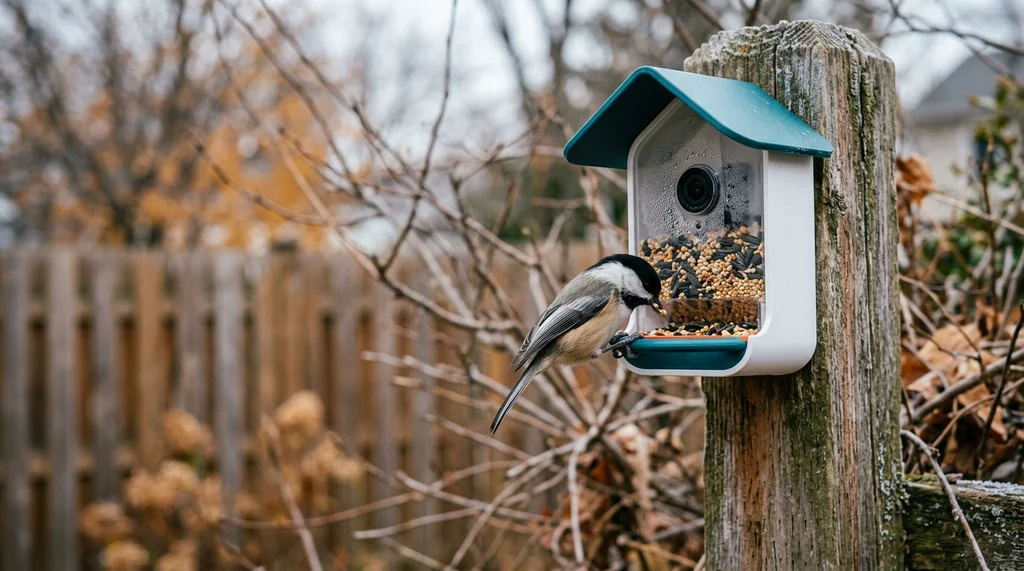
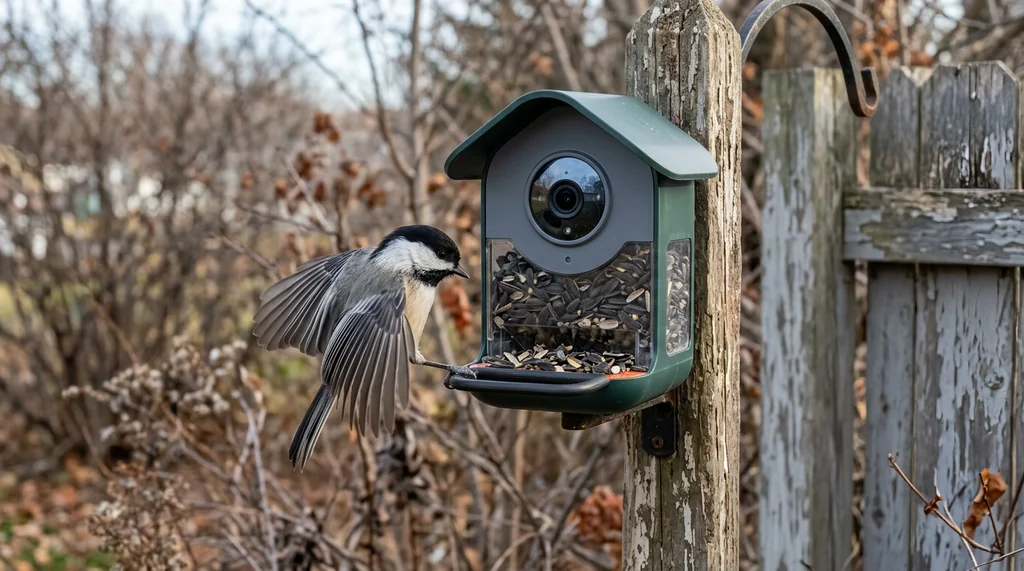
A smart bird feeder combines a seed reservoir with a camera module and an AI identification system. When a bird lands, the camera captures a photo or video, the onboard AI attempts to identify the species, and the app sends a notification with the result. Most systems also maintain a species log, allow photo sharing, and offer some form of community feature.
The AI identification piece is the headline feature. Consumer-grade systems in this category typically recognize around 6,000 or more bird species. Advanced commercial systems push past 11,000. Most manufacturers report accuracy rates above 90% for common backyard species — a claim that holds up reasonably well for chickadees, house sparrows, and cardinals, but gets shakier with juvenile birds, species in non-breeding plumage, or anything genuinely unusual.
Two technical constraints affect every device in this category without exception. First, all major smart feeders — Bird Buddy and Birdfy included — operate exclusively on 2.4GHz WiFi networks. The 5GHz band is incompatible. This matters more than it sounds: many modern mesh networks default to 5GHz, and exterior brick siding can reduce WiFi signal strength by nearly 40%, which compounds placement challenges. Second, stable streaming requires a minimum of 2 Mbps upload speed at the feeder's physical location, not at the router. These aren't dealbreakers, but they're the first things to verify before purchasing either device.
Bird Buddy vs Birdfy: The Specs Side by Side
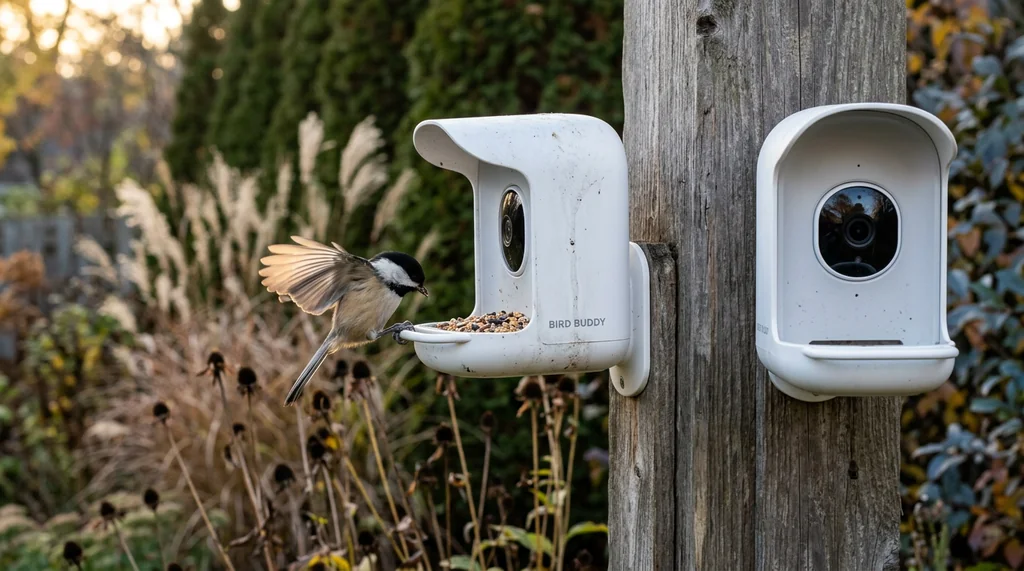
The Bird Buddy Smart Feeder Pro and the Netvue Birdfy represent different philosophies about what matters most in this category.
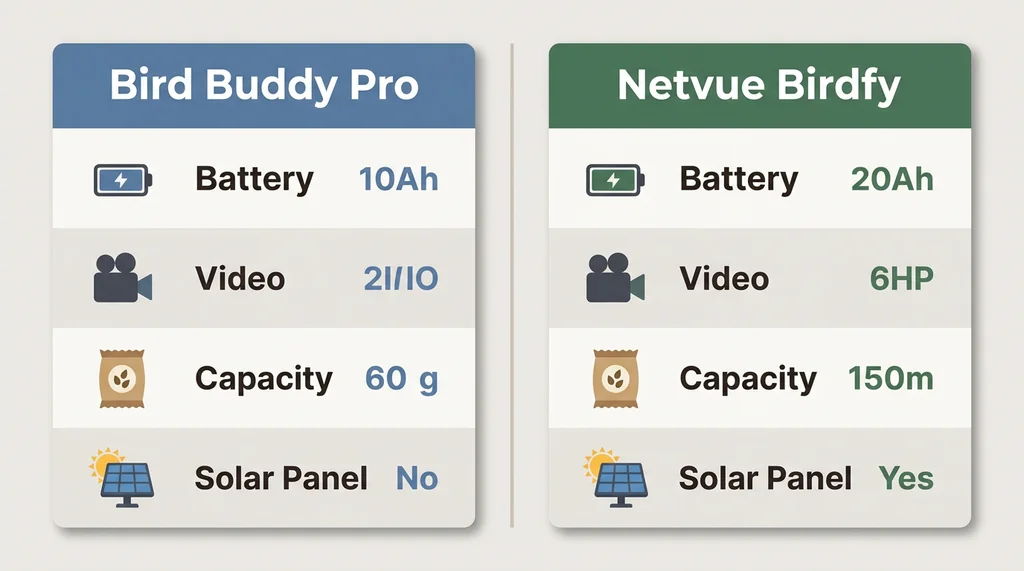
Bird Buddy Pro shoots 2K vertical video and captures 5-megapixel stills. The seed reservoir holds 3.8 cups. Battery capacity is 3,800 mAh, delivering roughly 5 to 15 days per charge under standard usage conditions — though in high-traffic yards, that can drop to five or six days. The solar panel is fixed position, meaning its orientation is tied to feeder placement. Initial pairing uses Bluetooth, which hands off to WiFi for ongoing operation. The app supports sharing with up to ten people. PCMag named it their top-rated smart bird feeder. Price: $299.
Netvue Birdfy offers 1080p or 2K resolution depending on the model, with a 1.5-liter (approximately 6-cup) seed capacity — meaningfully larger than the Bird Buddy's reservoir. Battery capacity ranges from 5,200 mAh on the base Feeder 2 model to 9,000 mAh on premium versions. Documented battery life reaches one to two months under standard use and up to four months under moderate use. The solar panel is detachable and adjustable, allowing direct sun aiming independent of feeder orientation. The Birdfy also features a removable battery pack enabling hot-swap replacement without bringing the feeder indoors. Pairing uses a QR code scan rather than Bluetooth. Price range: $164 to $190.
The price difference is substantial — roughly $110 to $135 less for the Birdfy depending on configuration.
Netvue Birdfy Review: Real-World Performance
The Birdfy's headline advantage is practical: it simply requires less attention. The larger battery means fewer charging interruptions. The adjustable solar panel means the feeder can face the optimal bird-attracting direction while the panel faces south for maximum sun exposure. The removable battery pack means a dead feeder doesn't require dismantling the setup — swap the pack, done.
In real-world testing, the Birdfy AI achieved nine months of battery life on a single charge in high-activity environments. That's not a typo. The larger battery capacity (up to 9,000 mAh on premium models, versus Bird Buddy's 3,800 mAh) makes a meaningful difference in day-to-day maintenance burden.
The AI identification system has been validated against a 25-year bird-watching knowledge base and claims recognition capability across more than 6,000 species. For North American backyard birding, this covers the territory well — North America hosts roughly 900 to 1,000 regularly occurring species, so 6,000-species coverage means the AI handles virtually every realistic visitor.
Temperature resistance is notable: the Birdfy has been tested in conditions below -65°F and above 100°F. For anyone in the northern tier running feeders through January cold snaps, this matters. Cold weather reduces lithium battery capacity by 30 to 50 percent during cold snaps, so a larger starting capacity isn't just a convenience feature — it's insurance against winter battery failures.
The video quality at 1080p is good. Whether it justifies the upgrade to a 2K model depends on how much you value capture quality versus cost savings. For identification purposes, 1080p is more than sufficient. For shareable content or detailed observation of subtle field marks, 2K is noticeably better.
The main Birdfy limitation worth acknowledging: the app experience is functional but less polished than Bird Buddy's. The community and social features are less developed, and the notification customization is less granular. For users who primarily want identification and video capture, this is a minor concern. For users who value the social and journaling aspects of the experience, it matters more.
Bird Buddy Review: Where Premium Justifies Itself
The Bird Buddy's case rests on three genuine strengths: image quality, app experience, and build quality.
The 5-megapixel still photography is the best in the consumer smart feeder category. When a Northern Cardinal performs its characteristic twelve-second safety scan before committing to the feeder — a behavior documented consistently across three years of daily observation — the Bird Buddy captures that moment with enough detail to see individual feather texture. For identification of birds with subtle field marks, or simply for the pleasure of a well-composed bird portrait, the image quality difference is real.
The app is legitimately excellent. Build durability has been rated 5 out of 5 by reviewers who put it through Pacific Northwest winters involving more than 20 inches of rain, snow, and hail. App user-friendliness consistently earns 5 out of 5 across independent assessments. The species card system — where each identified bird gets a dedicated card with information about the species — has proven particularly engaging for younger birders. Sophie (age 8) finds the species cards more compelling than field guide entries, which is meaningful evidence for households using smart feeders as educational tools.
The Bird Buddy also supports up to ten shared users per feeder, making it the stronger choice for families or households where multiple people want access to the same feed.
The honest limitations: battery life is the Bird Buddy's persistent weakness. At 3,800 mAh, the base battery delivers 5 to 15 days under standard conditions. In a yard with heavy activity — the kind where the cardinal pair arrives at 6:47 AM and Mr. Fitzgerald conducts regular reconnaissance throughout the day — that range compresses toward the lower end. The fixed solar panel helps in south-facing setups but provides approximately 20% charge gain on a clear winter day at northern latitudes, which doesn't fully offset daily consumption under heavy use.
The solar panel's pollen and dust accumulation problem is also real: efficiency drops by roughly 20% when cells aren't kept clean. Wiping the panel with a soft damp cloth every two to three weeks is necessary maintenance, not optional.
At $299, the Bird Buddy Pro requires a specific use case to justify the premium. South-facing yards with strong 2.4GHz WiFi coverage, users who prioritize image quality and app experience, and households with children who will engage with the educational features are the clearest fits. Users in shaded yards, mesh-network homes, or cold climates where battery management becomes burdensome will find the Birdfy's practical advantages more compelling.
AI Bird Identification: How Good Is It Really?
Both devices use MobileNet neural network architecture for on-device image recognition — a practical choice that enables edge inference, keeping the system functional during internet outages and reducing latency. The tradeoff is model size constraints that limit the ceiling on accuracy and species coverage compared to cloud-based systems.
For common backyard species, both perform well. Manufacturers report accuracy rates above 90% for species like Black-capped Chickadees, House Finches, American Goldfinches, and Northern Cardinals. The twelve-second cardinal assessment behavior actually works in the camera's favor — a bird sitting still for twelve seconds gives the AI multiple frames to work with.
Where both systems struggle: juvenile birds in transitional plumage, female birds of species where sexual dimorphism is pronounced (the AI tends to underperform on female Rose-breasted Grosbeaks, for example), and anything genuinely unusual. One persistent experience across multiple smart feeder reviews involves receiving 50 or more daily notifications for a single returning cardinal — the AI logs each visit as a new identification event rather than recognizing the individual bird.
The notification volume problem is real and worth managing proactively. Both apps allow notification customization, but the default settings lean toward over-notification. Spending ten minutes adjusting sensitivity settings after setup prevents the system from becoming an annoyance.
For citizen science applications, the Birdfy's open architecture is worth noting. Open-source implementations in this category can integrate with iNaturalist via API, automatically contributing feeder data to research databases. For serious birders interested in contributing to population monitoring, this is a meaningful differentiator.
Best Bird Feeder Camera: Practical Setup Considerations
Regardless of which device you choose, several setup factors determine whether the investment pays off.
WiFi placement: Verify 2.4GHz signal strength at the intended feeder location before purchasing. Exterior brick walls reduce signal by nearly 40%. A dedicated WiFi extender ($30 to $60) is often the difference between reliable operation and constant disconnection frustration.
Solar panel orientation: The Birdfy's adjustable panel wins here by design. Bird-attracting feeder placement and optimal solar charging placement often conflict — cardinals need feeders within 10 to 15 feet of dense shrubs or trees, which may mean partial shade. The ability to aim the Birdfy's panel independently of feeder orientation solves a problem the Bird Buddy's fixed panel cannot.
Seed capacity and maintenance rhythm: The Birdfy's 1.5-liter (6-cup) reservoir versus the Bird Buddy's 3.8-cup capacity means meaningfully different refill schedules. At current seed spending levels of $47 per month for black oil sunflower seeds, a larger reservoir doesn't reduce cost, but it does reduce the frequency of the interaction required. For a feeder positioned 12 to 15 feet from the house, fewer trips matters.
Cold weather battery management: Both devices use lithium batteries subject to 30 to 50 percent capacity reduction during cold snaps. The Birdfy's larger battery and removable pack design handles this more gracefully. For winter feeding — particularly important given that cardinals are year-round residents who don't migrate and become increasingly feeder-dependent from fall through winter — battery reliability in cold conditions is a genuine operational concern.
Subscription costs: Some smart feeders in this category require ongoing subscriptions for full functionality. At $80 per year, five years of subscription fees adds $400 to the total cost of ownership. Both Bird Buddy and Birdfy offer meaningful free-tier functionality, but verifying exactly what requires a subscription versus what's included is worth doing before purchase.
The Honest Recommendation
The bird buddy vs birdfy decision ultimately comes down to what you're optimizing for.
Choose the Netvue Birdfy if: battery life and low-maintenance operation are priorities, you're in a cold climate, your yard has shaded or non-south-facing feeder positions, you want the larger seed reservoir, or the $110 to $135 price difference is meaningful. The Birdfy is the more practical device for most backyard setups, and its video quality at 2K is genuinely excellent.
Choose the Bird Buddy Pro if: image quality is your primary criterion, you have an ideal south-facing setup with strong 2.4GHz coverage, you have children who will engage with the species card and educational features, or you want the most polished app experience currently available in the category. The Bird Buddy earned its PCMag top rating for real reasons.
Both devices are legitimate tools that do what they claim. Neither will deter Mr. Fitzgerald — that requires the 5-7-9 rule and a Brome Squirrel Buster Plus, full stop. But both will reliably identify the species visiting your yard, capture moments worth keeping, and make the backyard feeding experience meaningfully richer.
The best bird feeder camera is the one that actually stays charged, connected, and positioned where birds want to be. On that practical standard, the Birdfy edges ahead for most setups. But if image quality matters most, the Bird Buddy Pro earns its premium.
Bird Buddy has announced a Bird Buddy 2 and updated Pro model for 2026. If you're not in a hurry, that announcement is worth factoring into timing. If you're ready now, either device represents a genuine upgrade over any non-camera feeder you've used before.