Bird Buddy Solar Roof: Real-World Performance Review
Bird Buddy Solar Roof: Is It Worth the Upgrade?
The Bird Buddy is a genuinely clever piece of hardware. The app is satisfying, the species cards are charming, and the 5-megapixel camera captures moments that would otherwise disappear in the time it takes to grab binoculars. But the battery — that's where the conversation gets complicated. If you've owned a Bird Buddy for more than a few weeks in an active yard, you already know the sinking feeling of opening the app to find a charging icon where your bird activity should be.
The Solar Roof is Bird Buddy's answer to that problem. It promises to extend battery life dramatically, potentially eliminating manual charging altogether. Whether it actually delivers on that promise depends almost entirely on where your feeder lives and what you expect from the accessory. This review breaks down the real-world performance, the limitations that marketing materials gloss over, and who should — and shouldn't — spend the money.
Key Takeaways
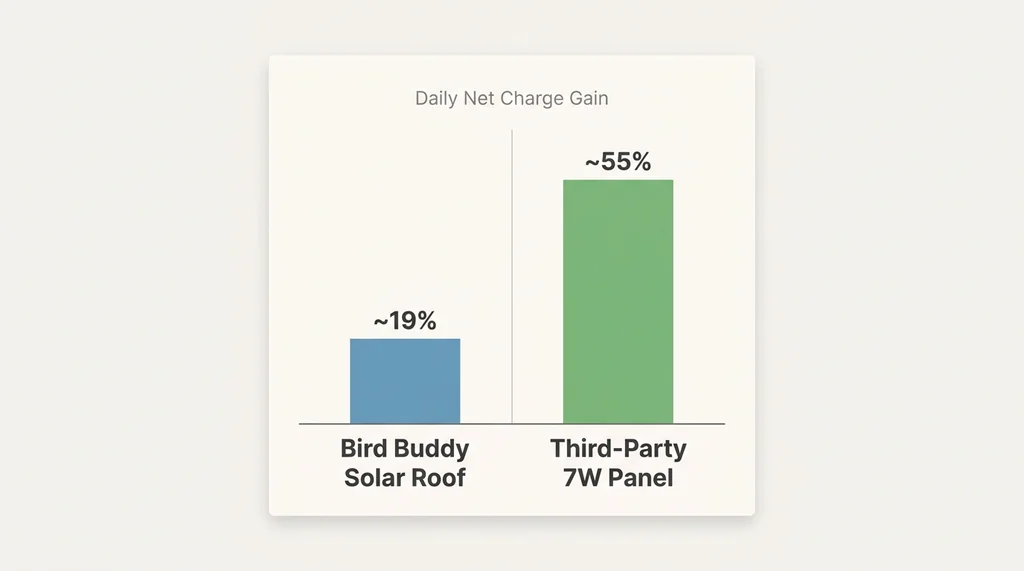
- The Solar Roof delivers only 17–20% net charge gain on a clear winter day, while a $27 third-party 7-watt panel produces roughly 55% on the same day.
- High-traffic yards can drain the Bird Buddy battery from one month to 5–6 days, making the Solar Roof most valuable for active feeders in sunny, hard-to-reach locations.
- The Solar Roof requires at least 4 hours of direct sunlight daily — shaded placements near shrubs or tree cover will see limited benefit.
- Cold weather reduces lithium battery capacity by 30–50%, and the Solar Roof is least effective in winter when it is needed most for northern latitudes above 40°N.
- Wipe the solar panel with a damp cloth every 2–3 weeks to prevent pollen and dust from cutting charging efficiency by up to 20%.
How the Bird Buddy Solar Works
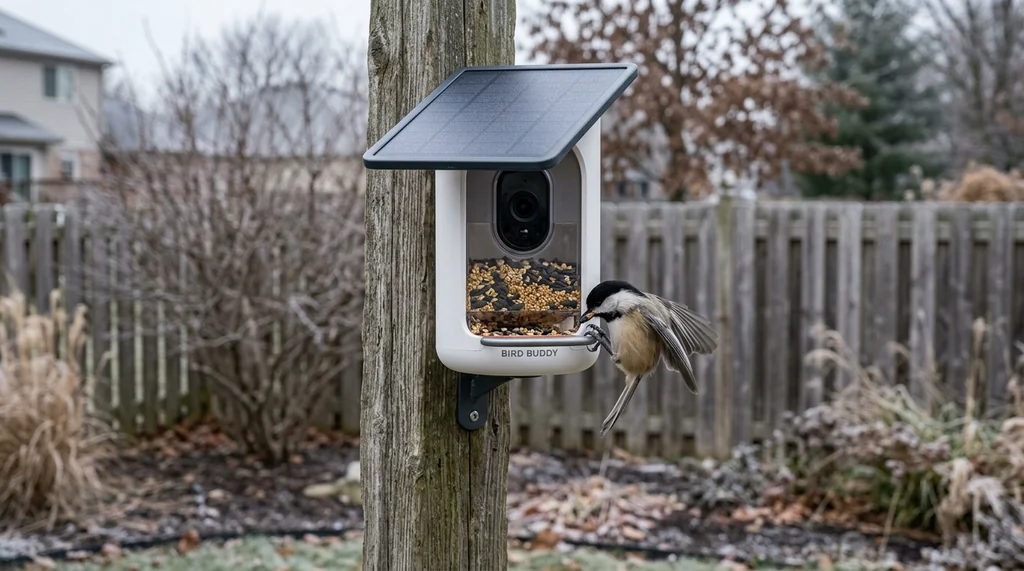
The Solar Roof is a detachable accessory that snaps onto the top of the standard Bird Buddy feeder. It connects to the camera module via a USB-C cable, which routes under the feeder's exterior shell to protect it from rain and weather exposure. That cable routing detail matters more than it sounds — a poorly seated connection is one of the first things to check if the roof isn't performing as expected. The app displays a lightning bolt icon when the roof is receiving sufficient direct sunlight to charge, which makes monitoring straightforward.
Bird Buddy's official documentation makes a bold claim: three days of good sunlight can bring the battery from empty to full, and with the Solar Roof installed, the feeder will "likely never need charging." That framing sets expectations that real-world conditions don't always support.
The Bird Buddy camera module uses between 25% and 33% of battery capacity per day under typical conditions. On a clear winter day at mid-latitude, independent testing found the Solar Roof provides approximately 17% to 20% net charge gain after accounting for daily consumption. On the same test day, a third-party 7-watt solar panel produced roughly 55% charge gain — more than three times the output of the official roof. That comparison isn't a knock on Bird Buddy's design so much as an honest calibration of what a small integrated panel can realistically accomplish.
Bird Buddy Battery Life: The Core Problem the Solar Roof Solves
To understand whether the solar roof is worth it, it helps to understand exactly how quickly the Bird Buddy battery drains without it.
Under normal conditions — moderate bird activity, reasonable temperatures, standard use — the battery lasts approximately one month per charge. That sounds manageable. But "normal conditions" describes a feeder that isn't particularly interesting to birds. In a well-established yard with consistent traffic, battery life can drop from one month to five or six days. The camera triggers on every visit, processes the image, runs it through the AI identification system, and pushes a notification. Multiply that by dozens of daily visitors and the battery drains fast.
Cold weather compounds the problem. Lithium batteries lose 30% to 50% of effective capacity during cold snaps. A feeder that lasts three weeks in October may need charging every ten days by January. For feeders in remote locations, mounted high, or simply inconvenient to reach, that charging frequency becomes genuinely burdensome.
The Solar Roof addresses this by providing a continuous trickle charge throughout the day whenever sunlight hits the panel. It doesn't solve the battery problem so much as it slows the drain — an important distinction that shapes whether the upgrade makes sense for any given setup.
What "Solar Bird Feeder" Performance Actually Looks Like
The gap between marketing language and field reality is where most buyer frustration originates with solar bird feeder accessories. Bird Buddy's manufacturer framing — "may never need charging" — describes an optimistic scenario that requires specific conditions to materialize.
Full sun placement: The Solar Roof requires at least four hours of direct sunlight daily for consistent operation. Not bright overcast. Not dappled shade under a tree canopy. Direct, unobstructed sunlight. This requirement immediately disqualifies a significant percentage of feeder placements, because the spots that attract the most birds — near dense shrubs, under tree cover, within 10 to 15 feet of escape routes — are often the spots with the least reliable sun exposure.
Latitude and season: Users north of roughly 40° North latitude should expect meaningfully different performance in summer versus winter. The sun sits lower in the sky from October through February, and spots that receive full afternoon sun in July may be partially shaded by rooflines, fences, or neighboring structures during winter months. If solar performance matters most during cold-weather months when battery drain is highest, this is the period when the roof is least effective.
Panel cleanliness: Pollen and dust accumulation on solar cells can reduce charging efficiency by nearly 20%. A panel that performed well in March may underperform in May if it hasn't been wiped down. A soft damp cloth every two to three weeks is sufficient maintenance, but it's a step that's easy to overlook.
Users who report the feeder staying at 99% charge consistently share a common profile: south-facing placement, minimal shade, temperate climate, and moderate bird activity. That's a real outcome — it's just not the universal outcome.
The Smart Bird Feeder Accessories Decision Framework
The Solar Roof isn't the only way to manage Bird Buddy battery life, and for some setups, it isn't the best way. Understanding the alternatives clarifies when the official accessory earns its cost.
Third-party solar panels: As noted above, a $27 third-party 7-watt panel significantly outperformed the official Solar Roof in direct comparison testing — 55% charge gain versus 17% to 20% on the same day. Third-party panels require some improvisation in mounting and cable management, and they lack the aesthetic integration of the official roof. But for users in partially shaded locations or northern latitudes where solar output is marginal, a higher-wattage panel may be the practical solution.
Manual charging schedule: For feeders in easily accessible locations, a simple biweekly charging routine costs nothing and guarantees consistent uptime. The Bird Buddy's USB-C charging port means any standard cable works. If the feeder is mounted at a comfortable height near an outlet, the Solar Roof's convenience benefit largely disappears.
Premium subscription considerations: Users on Bird Buddy's premium subscription tier — which unlocks full 1080p video quality versus the default 720p cap — tend to see faster battery drain because the camera is working harder. For premium subscribers in high-traffic yards, the Solar Roof shifts from a nice-to-have to a near-necessity for maintaining consistent uptime without weekly manual charging.
The Solar Roof makes the most compelling case for feeders that are difficult to access, located in genuinely sunny positions, or paired with premium subscriptions in active yards. It makes a weaker case for shaded placements, northern winters, or setups where manual charging is already part of the routine.
Installation and Monitoring
Installation is straightforward. The roof attaches to the top of the feeder, and the USB-C cable tucks under the exterior shell. The critical step is ensuring that cable is fully seated and properly routed before mounting — a loose connection won't charge, and diagnosing the problem from the ground is frustrating. Take an extra thirty seconds during installation to confirm the cable is secure.
Once installed, the Bird Buddy app provides the primary monitoring tool. The lightning bolt icon appears when the roof is receiving sufficient direct sunlight to charge. If the icon is absent during what should be peak sun hours, that's the signal to check panel cleanliness, cable connection, or feeder positioning. The app's battery percentage display updates regularly enough to track whether the roof is maintaining, gaining, or losing ground against daily consumption.
One practical note: the winter sun angle issue is worth evaluating before purchasing. Walk to the feeder location at noon on a clear winter day and observe how much direct sun actually reaches the top of the feeder. If rooflines, fences, or tree branches are casting shadows across the mounting surface, the Solar Roof's effectiveness will be limited regardless of how sunny the broader yard feels.
Who Should Buy the Bird Buddy Solar Roof
The upgrade earns its cost for a specific type of Bird Buddy owner. If the feeder is positioned in a location that receives four or more hours of direct sunlight daily year-round, the Solar Roof will meaningfully reduce charging frequency and may, in ideal conditions, eliminate it. South-facing placements in temperate climates are the sweet spot.
Premium subscribers in high-traffic yards — the setups where battery life drops to five or six days without assistance — will see the most dramatic improvement. The math changes significantly when the alternative is climbing a ladder twice a week versus once a month.
For feeders in partial shade, northern latitudes with significant winter use, or setups where manual charging is already easy, the case is weaker. The honest framing is that the Solar Roof is a maintenance-reducing tool, not a maintenance-eliminating one. Users who approach it with that expectation tend to be satisfied. Users who expect the "never need charging" scenario in suboptimal conditions tend to be disappointed.
The third-party panel option is worth considering for anyone whose primary concern is maximizing charge gain rather than aesthetic integration. It requires more setup creativity, but the performance difference in marginal sun conditions is substantial enough to matter.
For the right yard, the Bird Buddy Solar Roof is a genuinely useful accessory that transforms a weekly chore into a seasonal one. For the wrong placement, it's an expensive reminder that marketing copy and physics don't always agree.