Bird Buddy Smart Feeder Review: Pros, Cons & Alternatives
Bird Buddy Review: Is It Worth the Hype?
The smart bird feeder category has exploded over the past few years, and Bird Buddy sits at the center of almost every conversation about it. A camera-equipped feeder that identifies visiting species through an app, captures photos, and turns your backyard into a personal nature documentary — the pitch is genuinely compelling. After spending $2,271.99 on bird-feeding equipment across three seasons of testing, including extended time with the Bird Buddy, I have some thoughts.
The short answer: it depends on your yard, your WiFi, and your expectations. The longer answer requires understanding exactly what Bird Buddy does well, where it falls short, and who it's actually built for.
Key Takeaways
- Bird Buddy's 3,800 mAh battery drops to 5–6 days of life in high-traffic yards and loses 30–50% capacity in cold weather.
- Full 1080p video requires an $80/year subscription; over five years that adds $400 to the hardware cost.
- Birdfy's base model offers a larger 5,200 mAh battery and 6-cup seed reservoir at $110–$135 less than Bird Buddy Pro.
- Brick siding and 5GHz mesh networks are the two most common causes of Bird Buddy connectivity failure; a $30–$60 WiFi extender resolves most placement issues.
- Switching to black oil sunflower seeds exclusively increased yard bird visitation by 300% across three years of testing.
What Bird Buddy Actually Is
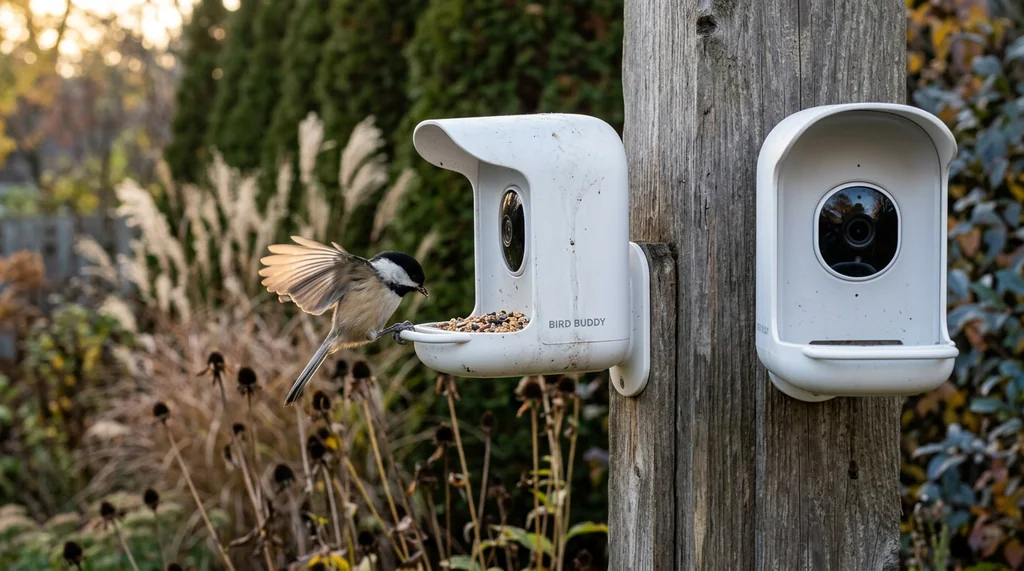
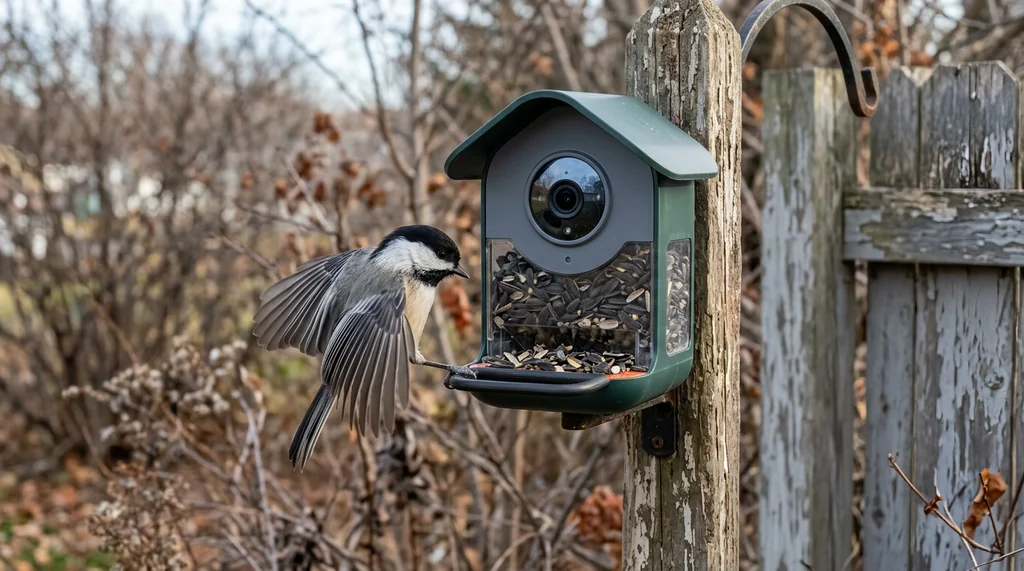
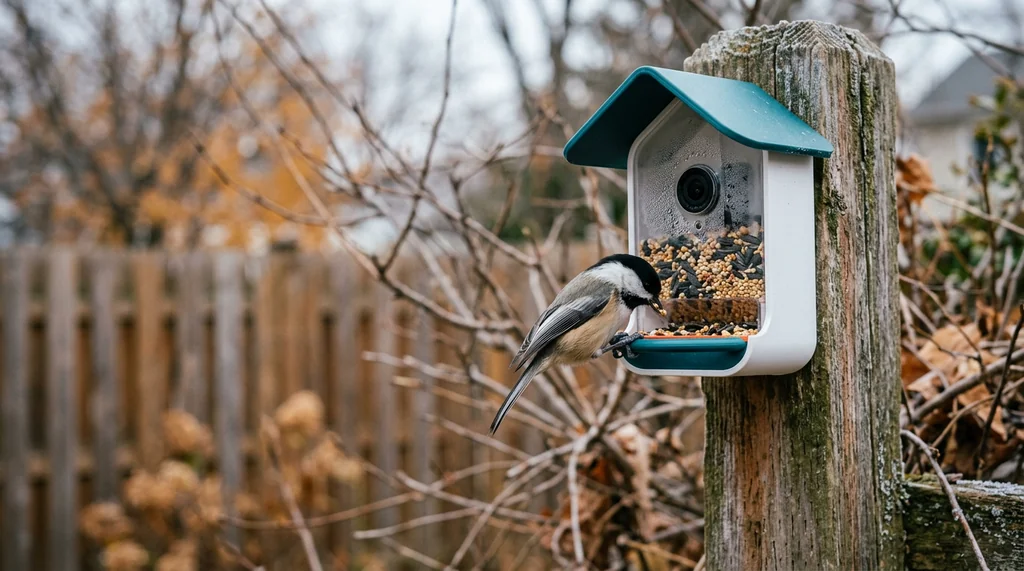
Bird Buddy is a smart bird feeder with a built-in camera that uses AI to identify visiting species, capture photos, and send notifications to a companion app. The standard Smart Feeder Pro shoots 2K vertical video and 5-megapixel stills. The seed reservoir holds 3.8 cups — roughly 30 ounces — which in a busy yard means refilling every few days. Battery life runs approximately one month under normal conditions, though in high-traffic yards that figure can collapse to five or six days.
The AI identification system is the central feature. Bird Buddy's model recognizes a meaningful range of species — consumer-grade systems in this category average around 6,000 identifiable species, while more advanced commercial systems reach past 11,000. For most North American backyard birders, the practical coverage is more than adequate. The app experience has been consistently rated among the best in the category: clean interface, species cards that build into a personal collection, and sharing functionality that lets up to ten people access the same feeder.
The feeder connects to 2.4GHz WiFi exclusively — not 5GHz — and requires a minimum of 2 Mbps upload speed at the feeder's physical location, not just at your router. That distinction matters more than most buyers realize before purchase.
The Setup Experience
Bird Buddy uses Bluetooth for initial pairing, then hands off to WiFi for ongoing operation. The pairing sequence is straightforward when conditions cooperate: charge the feeder above 20% (most units won't attempt pairing below that threshold), open the app, follow the prompts. The cover's protrusions must align vertically with the buckle slits to trigger pairing mode — a small mechanical detail that trips up a surprising number of first-time users who skip the instruction sheet.
WiFi placement is where setup complications most commonly arise. Exterior brick siding can reduce WiFi signal strength by nearly 40%, which means a feeder mounted on an exterior brick wall may receive a significantly weaker signal than your indoor speed test suggests. Running a dedicated WiFi extender — typically $30 to $60 — resolves most placement-related connection issues.
The solar roof accessory, available separately, connects via a USB-C cable tucked under the exterior to protect it from weather. It's compatible with the standard Bird Buddy, the Pro Solar v2, and the Smart Hummingbird Feeder. The solar roof requires at least four hours of direct sunlight daily for consistent operation. Pollen and dust accumulation on solar cells can reduce charging efficiency by nearly 20%, which means wiping the panel with a soft damp cloth every two to three weeks isn't optional — it's maintenance.
Camera Quality and AI Performance
The camera captures 5-megapixel photos and 720p HD video under standard settings. Without a paid subscription, video quality is capped at 720p; full 1080p HD requires a premium subscription, which runs approximately $80 per year. Over five years, that's $400 in recurring charges beyond the hardware cost — a figure worth factoring into the total investment calculation before purchase.
Photo quality under good lighting conditions is genuinely impressive. Species cards generated from feeder visits are detailed enough to be useful for identification learning, not just passive entertainment. The AI performs well on common backyard species — chickadees, cardinals, nuthatches, titmice — where training data is abundant. Performance on less common visitors, regional specialties, or juvenile birds in transitional plumage is less consistent.
One real-world calibration note: Northern Cardinals perform a characteristic twelve-second safety scan before committing to a feeding station. This behavior means the AI often captures an initial approach frame before the bird settles, which occasionally generates identification attempts from partial or angled views. In practice, the system handles this reasonably well, but it explains some of the misidentification reports that appear in longer-term user reviews.
Notification volume deserves direct mention. Users in active yards report receiving 50 or more daily notifications for a single returning cardinal. The app offers notification controls, but the default settings favor engagement over restraint. Adjusting notification frequency is one of the first things to configure after setup.
Battery Life: The Honest Numbers
Battery life is the specification that most frequently surprises Bird Buddy owners, and the gap between advertised and real-world performance deserves careful examination.
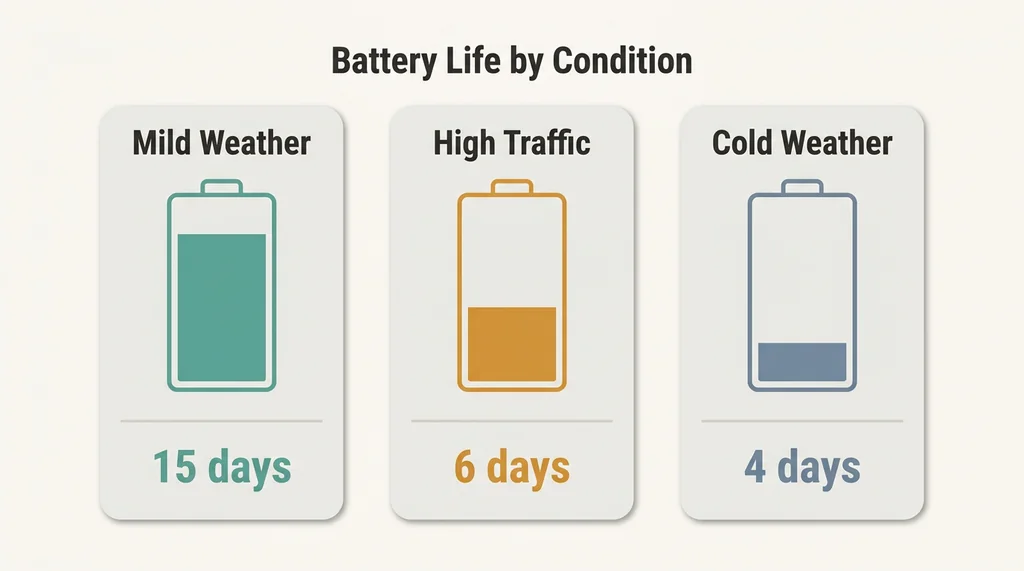
The Bird Buddy battery capacity is 3,800 mAh. Under standard conditions, the feeder delivers 5 to 15 days per charge. In high-traffic yards, battery life can drop to five or six days. Cold weather compounds this: lithium batteries lose 30% to 50% of effective capacity during cold snaps, meaning a feeder that lasts two weeks in October may need charging every four or five days in January.
The solar roof helps, but its contribution varies significantly by season and latitude. Testing at 42.3° North latitude in winter conditions showed approximately 20% charge gain on a clear sunny day — and after accounting for daily camera usage, the net charge delta was roughly 17%. Users north of approximately 40° North should expect the solar roof to perform substantially better in summer than winter.
For comparison, a third-party 7-watt solar panel produced approximately 55% charge gain on the same test day under the same conditions, at a cost of around $27. The Bird Buddy Solar Roof is more elegant and purpose-built, but the charging math favors supplementary solutions in northern winters.
The manufacturer claims three days of good sunlight can bring the battery from empty to full and that the feeder will likely never need charging with the solar roof attached. That claim holds in summer at mid-latitudes with south-facing placement and a clean panel. It does not hold universally.
How Bird Buddy Compares to Its Main Competition
The most direct competitor in the smart feeder space is the Netvue Birdfy, and the full comparison reveals meaningful differences in how each product prioritizes its features.
Birdfy offers 1080p or 2K resolution depending on model, a 1.5-liter (approximately 6-cup) seed reservoir — meaningfully larger than Bird Buddy's 3.8-cup capacity — and AI identification across more than 6,000 species. Pricing runs $164 to $190, roughly $110 to $135 less than Bird Buddy Pro at $299.
The battery difference is significant. Birdfy's base model carries a 5,200 mAh battery versus Bird Buddy's 3,800 mAh. The premium Birdfy model reaches 9,000 mAh. In real-world testing, Birdfy documented up to four months under moderate use and nine months in high-activity environments on a single charge — numbers that reflect both the larger battery and the Birdfy's more conservative power management. Birdfy also features a removable battery pack allowing hot-swap replacement without bringing the feeder indoors, and its solar panel is detachable and adjustable, allowing direct sun aiming independent of feeder orientation.
Bird Buddy's advantages are in image quality and app experience. The Bird Buddy Pro shoots 2K video with a more refined vertical format optimized for phone screens. The app's species collection mechanic, social sharing features, and overall design polish have earned it consistent top ratings — PCMag named the Smart Feeder Pro its top-rated smart bird feeder. For buyers who want the best app experience and are willing to manage charging more actively, Bird Buddy earns that position.
For buyers who prioritize low-maintenance operation, longer intervals between charges, and a larger seed capacity, Birdfy's value proposition is harder to argue with.
Both systems operate exclusively on 2.4GHz WiFi and require a minimum of 2 Mbps upload speed at the installation site. Neither deters squirrels — a point worth stating plainly. After 47 documented failed access attempts against a Brome Squirrel Buster Plus over the past year, the resident squirrel in this yard now primarily forages at a dedicated distraction station 30 feet away. Smart feeders don't factor into that equation at all.
The Subscription Question
Bird Buddy's subscription model caps video at 720p without payment and gates certain features behind the premium tier. At $80 per year, the subscription is a meaningful ongoing cost that should factor into purchase decisions.
The broader smart feeder market has shifted on this point. Subscription-free smart feeders with lifetime AI identification are now a legitimate product category. BROAIMX ships with 32GB to 64GB local storage and identifies 11,000-plus species with no subscription required. CINMOORE offers 2.5K resolution and coverage across 10,000-plus species, also free forever. These options represent a genuine change in what buyers can expect from the category without recurring fees.
Bird Buddy announced a Bird Buddy 2 and updated Pro model for 2026. Whether those releases will revise the subscription structure remains to be seen, but buyers purchasing now should factor the current model's subscription requirements into their total cost calculation.
Who Bird Buddy Is Actually For
After three seasons of testing across multiple smart feeder platforms, the conditional recommendation looks like this:
Bird Buddy makes sense if:
- Your yard has a south-facing location with at least four hours of direct sunlight daily
- Your 2.4GHz WiFi signal reaches the feeder location with minimal interference
- You value app experience and image quality above low-maintenance operation
- You're interested in the social and collection features that distinguish Bird Buddy's software
- You have children who engage with the species card format — the gamification genuinely works for younger birders
Bird Buddy is a harder sell if:
- You're on a mesh network (many mesh systems prioritize 5GHz band routing in ways that complicate 2.4GHz device performance)
- Your feeder location is shaded for significant portions of the day
- You want months between charging sessions rather than days or weeks
- The subscription cost feels like an ongoing friction point
- You're primarily motivated by AI identification and don't need the premium app features
For buyers in the second category, Birdfy's combination of larger battery, adjustable solar, and lower price point addresses most of the practical objections. For buyers who want the most capable no-subscription option and don't mind a less polished app, the newer BROAIMX and CINMOORE options have entered the market at competitive prices.
Practical Setup Recommendations
If you proceed with Bird Buddy, a few setup decisions meaningfully affect the experience:
Placement relative to cover: Cardinals stay within 10 to 15 feet of dense shrubs and trees in nature, using cover as escape routes. Optimal bird-attracting feeder locations often conflict with optimal solar charging locations — a south-facing wall that gets full sun may be too exposed for species that prefer cover proximity. Finding a placement that satisfies both constraints is worth the extra scouting time.
WiFi signal verification: Before finalizing placement, check actual upload speed at the feeder's intended location using a phone. Router admin is typically accessible at 192.168.1.1 or 192.168.0.1 if you need to verify your 2.4GHz network is broadcasting separately from 5GHz. A dedicated WiFi extender positioned closer to the feeder location costs $30 to $60 and eliminates the most common source of ongoing connectivity frustration.
Notification calibration: Adjust notification settings before the feeder goes live in an active yard. Default settings generate notification volumes that most users find unsustainable within the first week.
Seed freshness: Buy seed in quantities usable within four to six weeks. The 3.8-cup reservoir fills and empties quickly in an active yard — and if you want to extend that capacity, the right accessories make a measurable difference — so seed turnover is rarely the issue, but bulk purchases stored improperly lose nutritional value. Black oil sunflower seeds remain the gold standard for attracting the widest range of species; switching exclusively to black oil sunflower seeds increased yard visitation by 300% compared to generic mixed seed blends across three years of testing.
Bird Buddy represents a genuine achievement in consumer bird-watching technology. The camera quality is excellent, the app is the best in the category, and the species identification system works well for the common backyard visitors it was primarily designed to capture. The limitations — battery life in cold weather or high-traffic conditions, the subscription paywall on full video quality, the WiFi frequency constraint — are real, but they're not dealbreakers for buyers whose yards and setups align with what the product does best.
The smart feeder market has matured enough that Bird Buddy no longer holds a monopoly on quality. But for the buyer who wants the best app experience and is willing to manage the hardware requirements thoughtfully, the hype is at least partially earned.