Oriole Birdfeeder Buying Guide: Best Feeders & Setup Tips
Oriole Birdfeeder: Complete Buying Guide
Most backyard birders spend years attracting cardinals and chickadees before they think seriously about orioles. Then one May morning, a flash of impossible orange lands in a nearby tree, and suddenly nothing else matters. Baltimore Orioles are among the most visually striking birds in North America — the males look like someone set a small fire and taught it to sing — and attracting them consistently requires a different approach than standard seed feeding.
This guide covers everything you need to choose the right oriole birdfeeder, set it up correctly, and keep those birds coming back throughout the season. Because orioles have specific feeding preferences, specific behavioral quirks, and a frustratingly short window during which you need to get everything right, the feeder you choose matters more than most people realize.
Key Takeaways
- Orioles don't eat seeds — attract them with nectar (1:4 sugar-to-water ratio), grape jelly, and fresh orange halves.
- Set up feeders in early to mid-April, 1-2 weeks before Baltimore Orioles arrive, to capture the critical first-two-weeks-of-May window.
- Choose a combination feeder with stable perches (3-4 inches), 16+ oz nectar capacity, and easy-to-clean removable parts.
- Change nectar every 2-3 days in heat above 75°F and clean with dilute bleach solution every two weeks to prevent mold.
- Place feeders 5-6 feet high near perching trees, and keep them 10-15 feet away from hummingbird feeders to prevent competition.
What Makes an Oriole Birdfeeder Different
Orioles don't eat seeds. This single fact eliminates the vast majority of feeders on the market and explains why backyard birders who simply hang a standard tube feeder and wait end up disappointed.
Baltimore Orioles — the species most North American backyard birders encounter — are primarily insect and fruit eaters. At feeders, they're attracted to three things: nectar, fresh fruit (especially oranges), and grape jelly. An effective oriole feeder needs to accommodate at least one of these food sources, and the best setups offer all three.
This means the structural requirements for an oriole feeder are fundamentally different from a hummingbird feeder or a seed feeder. Orioles are larger birds — adults measure 7 to 8 inches in length and weigh roughly 1.1 to 1.4 ounces — and they need stable perching space. They also feed more slowly and deliberately than hummingbirds, spending time at a feeder rather than hovering. A feeder that doesn't provide a comfortable landing spot will be ignored.
The nectar formula is also different. While hummingbirds thrive on a 1:4 sugar-to-water ratio, orioles prefer a slightly sweeter solution. Most oriole specialists recommend a 1:6 ratio (one part white granulated sugar to six parts water) or even 1:4 depending on the source, though 1:6 more closely mimics the natural sugar content of the flowers orioles favor. Use only plain white granulated sugar. No honey, no brown sugar, no commercial mixes with red dye. The same principle that applies to hummingbird nectar applies here: artificial additives serve the manufacturer's marketing, not the bird's health.
The Four Types of Oriole Feeders
Nectar Feeders Designed Specifically for Orioles
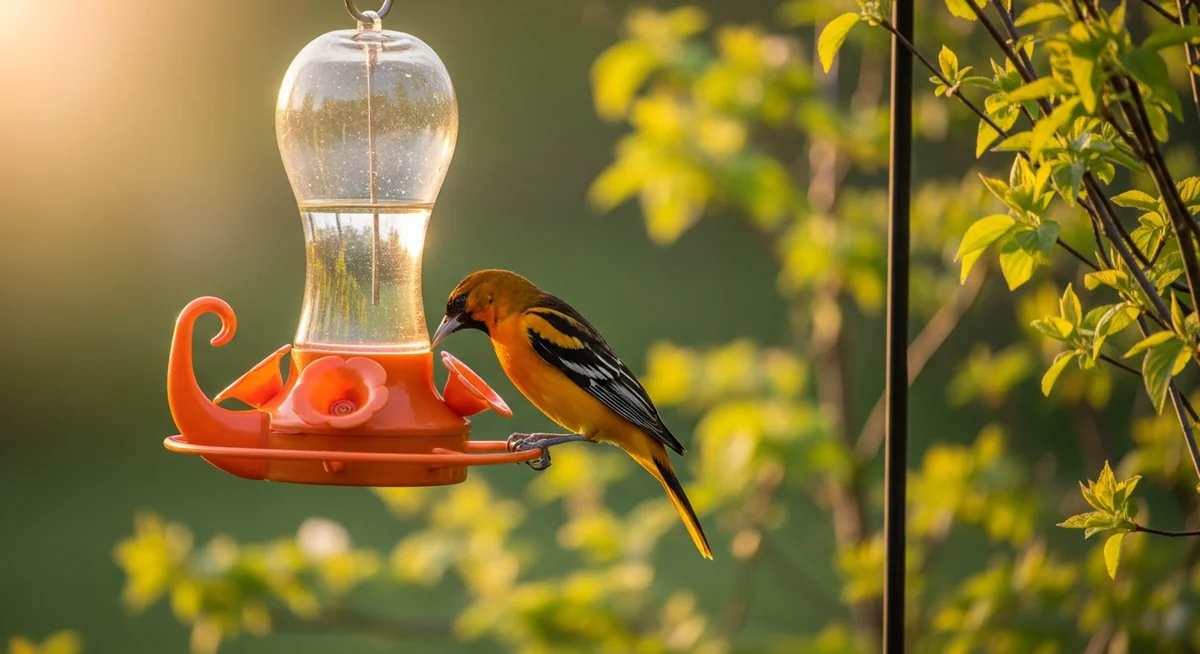
These look similar to hummingbird feeders but are built to different specifications. The feeding ports are larger to accommodate an oriole's wider beak, and the perches are longer and sturdier. Many feature a bright orange color rather than red, which aligns with orioles' strong attraction to orange — a color that appears prominently in their natural food sources like trumpet vine flowers and ripe fruit.
Capacity matters here. Orioles are seasonal visitors in most of North America, present from roughly May through August before migrating south. During peak season, a small 8-ounce feeder may need refilling every day or two if you attract multiple birds. Look for feeders in the 16 to 32-ounce range for practical maintenance.
The More Birds Vintage oriole feeder ($35-45) consistently earns strong reviews for its combination of capacity, easy cleaning, and dedicated perching space. The Perky-Pet Antique Bottle Oriole Feeder ($29) offers a more budget-friendly entry point with similar functionality.
Jelly Feeders and Jelly Cups
Grape jelly is arguably the single most effective oriole attractant available, and many experienced birders swear it outperforms nectar for bringing in first-time visitors. Dedicated jelly feeders are typically simple shallow dishes or cups mounted on a stake or hanging arm, designed to hold jelly without spilling.
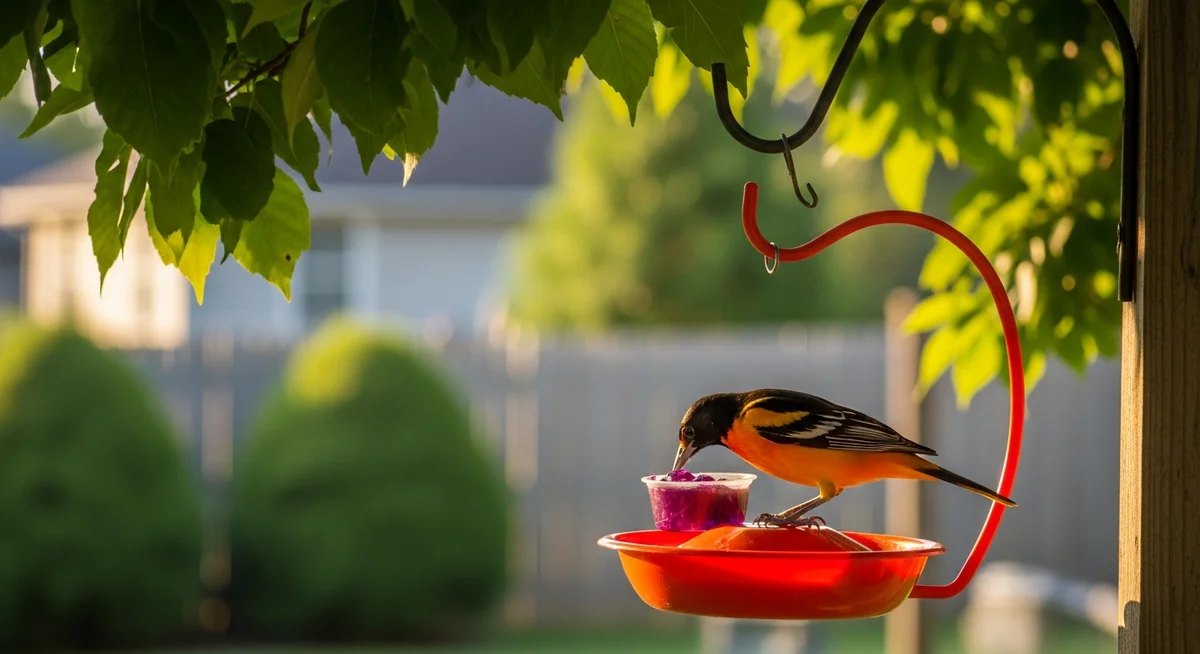
Many combination feeders include both nectar reservoirs and small jelly cups, which is often the most practical approach. If you're buying a dedicated jelly feeder, look for one with a protective roof or dome — exposed jelly spoils quickly in hot weather and attracts wasps with impressive efficiency.
Use only grape jelly without artificial sweeteners. The xylitol found in some sugar-free products is toxic to birds. Plain, store-brand grape jelly works perfectly well and costs a fraction of specialty "bird jelly" products.
Fruit Feeders and Spike Mounts
Fresh orange halves are a classic oriole attractant, particularly early in the season when birds are first arriving and scouting territories. A simple orange spike — essentially a metal or wooden stake with a pointed tip to impale orange halves — costs almost nothing and can be remarkably effective.
More elaborate fruit feeders include platforms or trays with multiple spikes for oranges plus cups for jelly. These combination designs reduce the number of separate feeders you need to maintain and create a single, visually obvious feeding station that orioles can locate more easily.
Combination Feeders
The most practical option for most backyard birders is a combination feeder that handles nectar, jelly, and fruit in a single unit. These eliminate the need to manage multiple separate feeders and create a concentrated feeding station that's easier for arriving orioles to find.
Look for combination feeders with at least four perch positions, a capacity of 16 ounces or more for nectar, and removable jelly cups that can be cleaned independently. The Grateful Gnome oriole feeder ($35) offers a well-regarded combination design at a reasonable price point.
Key Features to Evaluate Before Buying
Ease of Cleaning
This is the feature most buyers underestimate until they're dealing with fermented nectar in July heat. Oriole feeders need to be cleaned every 2 to 3 days when temperatures exceed 75 degrees — the same spoilage dynamics that affect hummingbird nectar apply here. A feeder with narrow necks, intricate internal channels, or components that don't fully disassemble will become a maintenance nightmare.
Look for wide-mouth openings, fully removable parts, and smooth interior surfaces without sharp corners where mold can establish. Dishwasher-safe components are a genuine advantage. Before purchasing, check whether the feeder comes apart completely — if the manufacturer's photos only show the assembled product, that's sometimes a warning sign.
Material: Glass vs. Plastic
Glass feeders last significantly longer — 10 or more years versus 2 to 3 years for plastic — and don't absorb staining or odors over time. They're also easier to sterilize thoroughly. The tradeoff is weight and fragility; glass feeders are more susceptible to damage if dropped during cleaning.
For oriole feeders specifically, glass is often worth the modest price premium. Oriole season is short, but the feeders need to perform reliably every year. A glass feeder purchased once typically outlasts several plastic replacements. For specific product recommendations across all feeder types, see our best oriole feeders guide.
Ant and Wasp Protection
Both ants and wasps are attracted to sweet nectar and jelly, and both will drive orioles away from a feeder if present in numbers. Ant moats — small water-filled cups that suspend between the hanging hook and the feeder body — are the most effective solution for ants and cost between $5 and $10. Many quality feeders include a built-in ant moat; if yours doesn't, an add-on moat is an easy fix.
Wasps are trickier. Bee guards (small plastic covers over the feeding ports) help with some species but can also make it harder for orioles to access the nectar. The most effective wasp deterrent is simply keeping the exterior of the feeder clean — wasps are attracted to drips and spills more than the nectar inside a sealed reservoir.
Perch Design and Stability
An oriole landing on a feeder that sways dramatically or has flimsy perches will simply leave. Perches should be long enough for the bird to stand comfortably without pressing against the feeder body, and the overall feeder should hang or mount stably without excessive movement in light wind.
Look for perches at least 3 to 4 inches long and constructed from metal or solid wood rather than thin plastic.
Placement: Getting the Setup Right
Orioles are more cautious about feeders than many backyard birds. They tend to observe from a distance before committing, which means placement matters as much as feeder selection.
Position oriole feeders in a visible location with nearby perching — a tree branch within 10 to 15 feet gives arriving birds a staging point before approaching the feeder. Unlike cardinals, which prefer cover immediately adjacent to their food source, orioles seem comfortable feeding in somewhat more open areas, but complete exposure with no nearby perching structure typically reduces visits.
Hang feeders at roughly 5 to 6 feet high. This places them at a natural perching height and makes them visible from a distance without requiring birds to drop uncomfortably low to the ground.
Keep oriole feeders separate from hummingbird feeders when possible. While both species drink nectar, orioles will dominate a shared feeding area and may exclude hummingbirds entirely. A spacing of 10 to 15 feet between the two feeding stations usually allows both species to feed without significant conflict.
Timing: The Window You Can't Miss
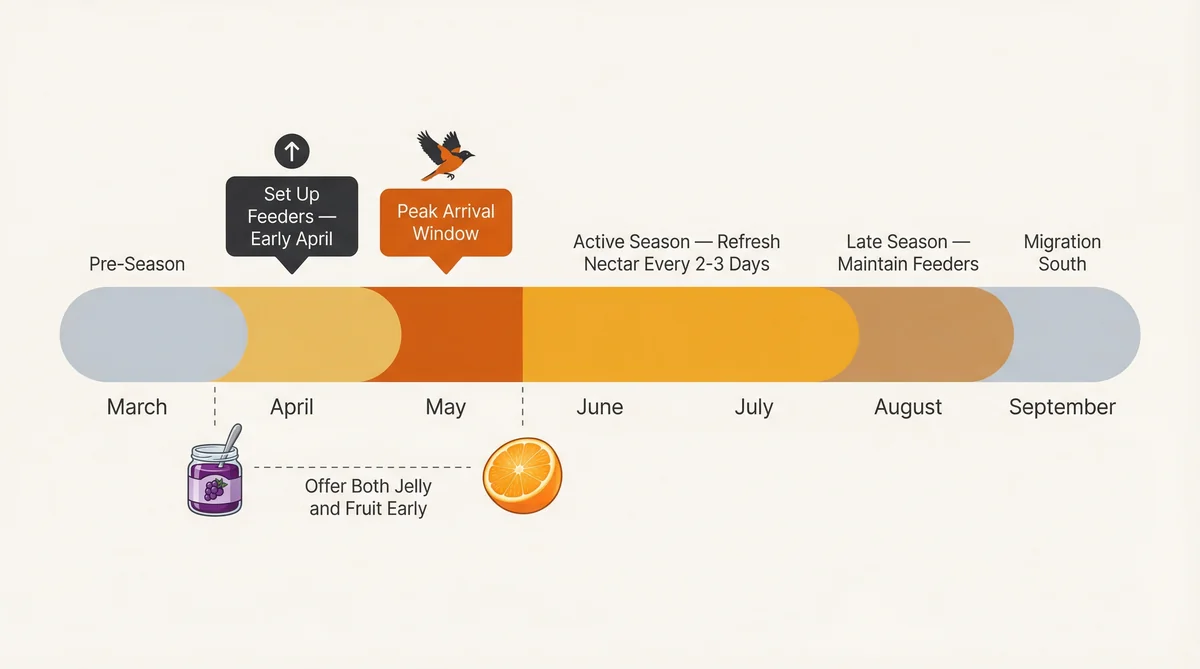
Orioles are migratory, and the timing of feeder setup is genuinely critical. Baltimore Orioles arrive in most of the eastern United States between late April and mid-May. Put feeders out 1 to 2 weeks before expected arrival — in most regions, that means early to mid-April.
The first two weeks of May represent the highest-value window for establishing orioles in your yard. Birds arriving from migration are actively scouting territories and food sources. A feeder that's visible, stocked, and positioned correctly during this window has a dramatically higher chance of establishing regular visitors than one put out in June after territories are already set.
Keep feeders up through late August. Orioles begin moving south earlier than most people expect, and maintaining feeders through the full season gives you the best chance of hosting late-season birds and juveniles making their first migration.
Nectar Preparation and Maintenance
The nectar recipe for orioles is straightforward: dissolve one part white granulated sugar in six parts warm water, allow to cool completely, and fill the feeder. Make only what you'll use within a week, and store extra in the refrigerator for up to two weeks.
Change nectar every 3 to 5 days under normal conditions, and every 2 days when temperatures consistently exceed 75 degrees. Cloudy or discolored nectar should be replaced immediately regardless of how recently it was changed. When you change the nectar, rinse the feeder thoroughly — don't simply top off a partially empty reservoir, as this dilutes old nectar with fresh rather than replacing it.
Clean feeders thoroughly with a dilute bleach solution (1 part bleach to 9 parts water) every two weeks during the season, rinse completely, and allow to dry before refilling. This schedule prevents mold and bacterial growth that can sicken birds even when the nectar itself appears fresh.
Choosing an oriole birdfeeder doesn't need to be complicated, but it does require understanding what these birds actually need: stable perching, appropriate food sources, easy access, and reliable maintenance. A combination feeder in the $30-45 range, set up in the right location before the first week of May, and stocked with fresh nectar and grape jelly will outperform an expensive feeder placed too late or maintained inconsistently.
Get the setup right once, and orioles have a way of making it a habit — returning to the same yard, the same feeder, and the same perching branch year after year with a reliability that makes every early morning in May feel like a reasonable time to be awake.
Cross-References