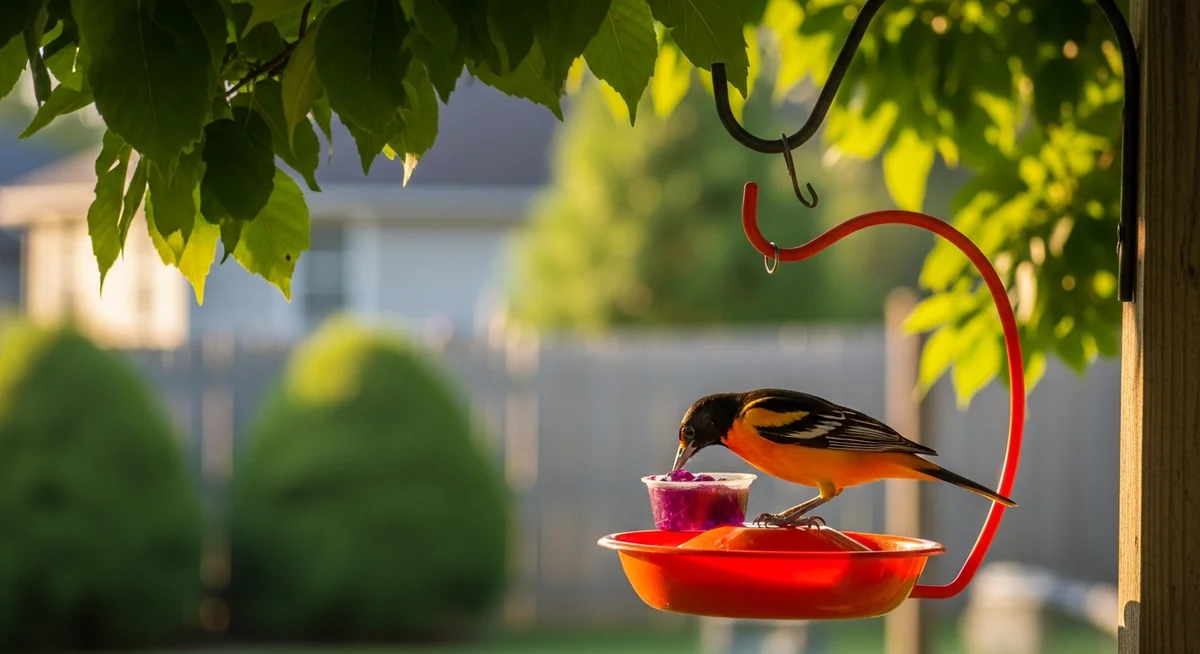
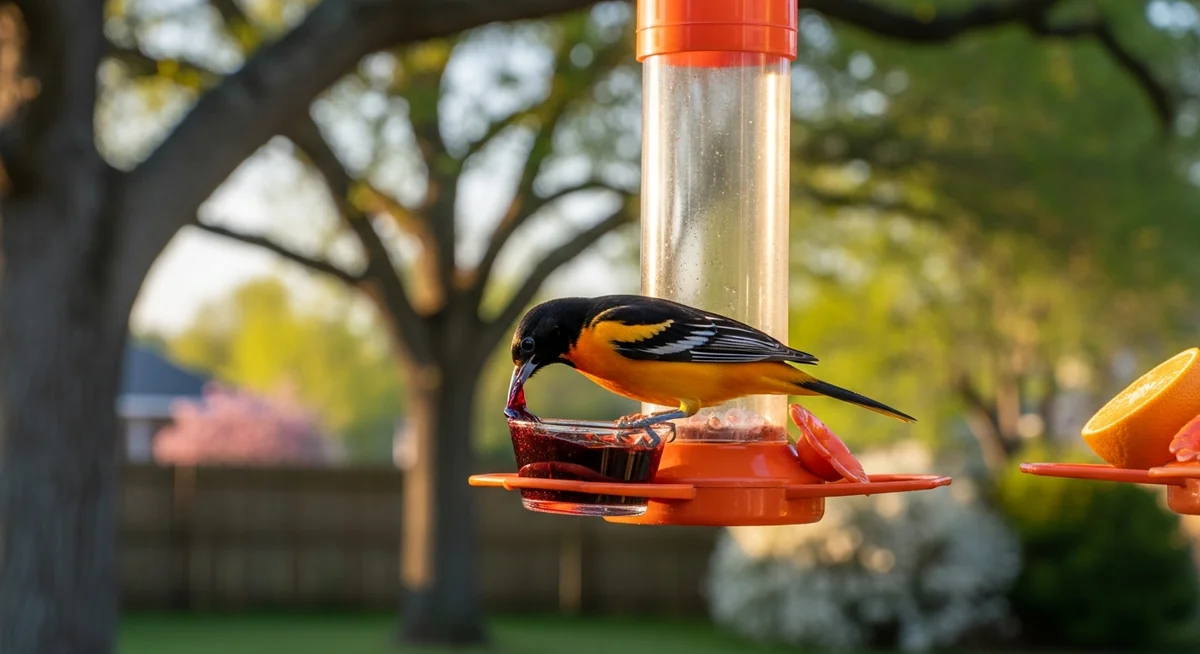
Best Oriole Nectar Recipe: Simple 1:4 Sugar Water
Homemade Oriole Nectar Recipe (1:4 Sugar-to-Water)
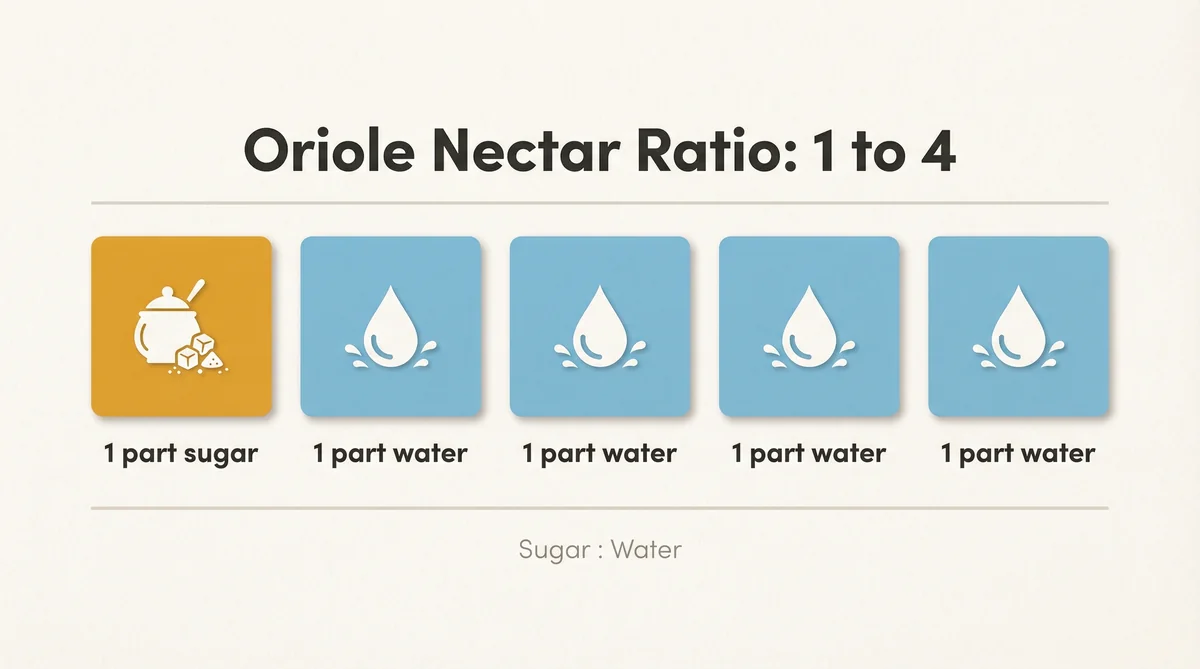
Homemade oriole nectar is one part white granulated sugar dissolved in four parts water — a 1:4 ratio, with no dye and no additives. Boil the water, stir in the sugar until it fully dissolves, then let it cool before filling the feeder. That is the whole recipe.
Orioles are among the most visually dramatic birds that will ever visit a backyard feeder. That flash of burnt orange against spring foliage is genuinely startling the first time you see it — and then you spend the next several years trying to make it happen again. The good news is that attracting orioles with nectar is far less complicated than the commercial bird food industry would have you believe. The best oriole nectar recipe contains exactly two ingredients, costs almost nothing to make, and is almost certainly safer for the birds than anything sold in a bright orange bottle.
The bad news? It took me longer than it should have to figure that out. I spent real money on commercial oriole food — bottles of amber and orange concentrate that promised irresistible results — before I understood that I was paying for dye and marketing, not nutrition. The recipe I use now is the same one my mother, Dr. Patricia Fielding, would have told me to use from the start if I'd asked her before heading to the bird supply store. It's the same formula I use for hummingbirds: one part white granulated sugar to four parts water. That's it. That's the whole thing.
Let me walk you through exactly how to make it, why the ratio matters, what to avoid, and how to set yourself up for a season of reliable oriole visits.
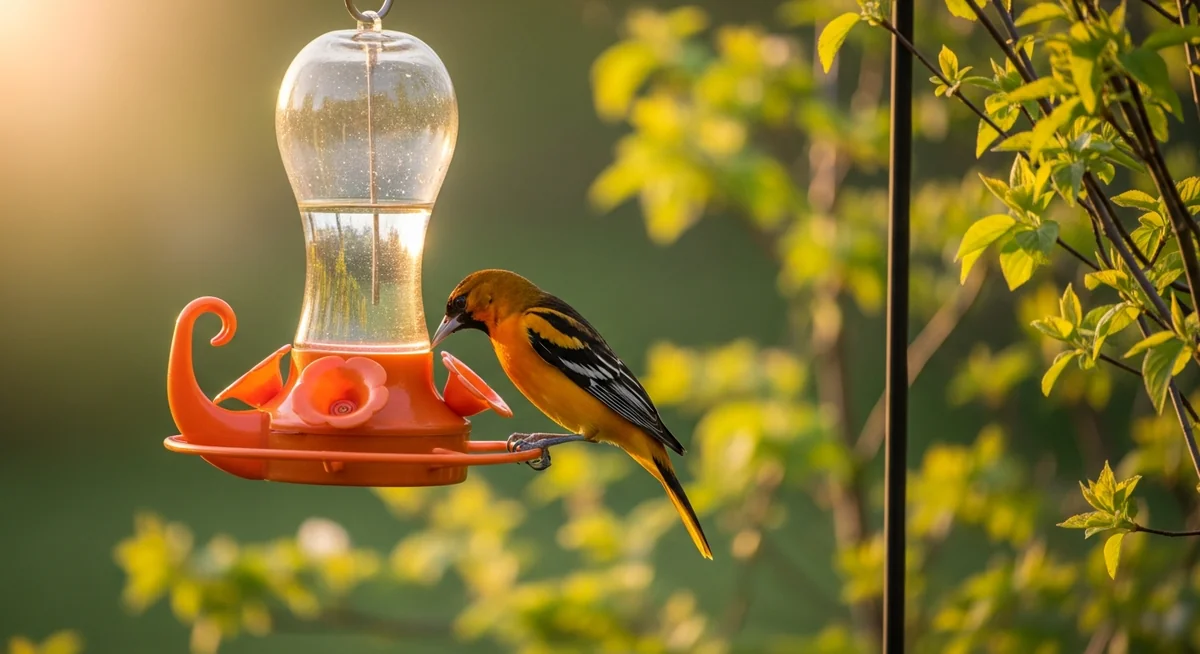
Key Takeaways
- The best oriole nectar is simply 1 part white granulated sugar dissolved in 4 parts boiled water — no dyes, no additives needed.
- Commercial oriole nectars often contain artificial dyes and preservatives that serve no nutritional purpose and may harm birds' kidneys.
- Always cool nectar completely before filling feeders, and change it every 2–5 days depending on temperature to prevent fermentation.
- Refrigerate unused nectar in a clean glass jar for up to two weeks; a double batch on Sunday saves time during peak season.
- Feeder placement in partial shade (morning sun, afternoon shade) slows nectar spoilage and keeps birds comfortable during hot weather.
The Best Oriole Nectar Recipe: Two Ingredients, One Ratio
The standard formula for homemade oriole nectar is a 1:4 ratio of white granulated sugar to water. That translates practically to one-half cup of sugar dissolved in two cups of water — a batch size that fills most oriole feeders with a little left over for refrigerator storage.
Use this table to scale the 1:4 ratio to whatever batch size you need:
| Water | White sugar (1:4) | Makes |
|---|---|---|
| 1 cup | ¼ cup | ~1 cup |
| 2 cups | ½ cup | ~2 cups |
| 4 cups | 1 cup | ~4 cups |
Some sources suggest a lighter mixture of one part sugar to six parts water, and that ratio does work. But the 1:4 concentration more closely mirrors the sugar content found in natural flower nectar, which typically falls in the 20 to 25 percent sugar range. Orioles are accustomed to that concentration from the blooms they visit in the wild, so matching it at your feeder makes the offering immediately recognizable as food. This is the same ratio used for hummingbird nectar — both birds evolved with similar flower nectar concentrations.
Here's the full preparation process:
What you need:
- White granulated sugar (standard table sugar, nothing else)
- Water
- A small saucepan or kettle
- A clean jar or container for storage
Step one: Boil the water. Start with the amount of water your recipe requires — two cups for a standard batch — and bring it to a full boil. Boiling removes chlorine from tap water and eliminates any impurities that could accelerate fermentation or introduce bacteria into the mixture.
Step two: Add the sugar while the water is hot. Remove from heat and immediately add your measured sugar — one-half cup for a two-cup batch. The residual heat does the work of dissolving.
Step three: Stir until completely dissolved. This takes about thirty seconds of active stirring. You're looking for a completely clear liquid with no visible granules. Undissolved sugar at the bottom of a feeder can ferment unevenly and create a less stable mixture.
Step four: Cool completely before filling feeders. This step matters more than it sounds. Warm nectar in a feeder can accelerate bacterial growth almost immediately, especially in summer heat. Let the mixture reach room temperature on the counter before pouring — usually thirty to forty-five minutes.
Step five: Refrigerate the remainder. Any nectar you don't use immediately can be stored in a clean glass jar in the refrigerator for up to two weeks. Making a double or triple batch on a Sunday and refrigerating the rest saves significant time during peak season when you're refilling frequently.
Why Homemade Oriole Food Outperforms Commercial Products
Walk through the bird supply section of any garden center in April and you'll find an array of commercial oriole nectars in orange bottles, amber concentrates, and pre-mixed solutions. Most of them are more expensive per ounce than the homemade version by a substantial margin. Many of them contain artificial dyes, preservatives, and additives that serve no nutritional purpose for the bird.
The orange coloring in commercial oriole food is the most common unnecessary ingredient. Orioles are attracted to orange as a color — this is well-established, which is why orange-colored feeders and orange fruit halves are effective attractants. But the dye doesn't need to be in the nectar itself. The feeder provides the visual cue. The nectar just needs to be food.
More concerning is the evidence that artificial red and orange dyes may be harmful to birds' kidneys over time. The research isn't definitive, but the precautionary principle applies clearly here: there is no benefit to adding dye to nectar, and there is potential harm. The homemade sugar-water formula avoids the question entirely.
Cost is the other obvious argument for homemade. A five-pound bag of white granulated sugar costs roughly three to four dollars and produces an enormous quantity of nectar — far more than any comparably priced commercial product. During peak season, when orioles are visiting regularly and you're refilling a feeder every few days, that cost difference adds up quickly. The homemade approach costs a matter of cents per batch.
The formula is also completely transparent. You know exactly what's in it because you made it. No preservatives, no artificial sweeteners, no compounds with long names on the ingredient list. Just sucrose and water — the same thing orioles find in the trumpet vines and orange blossoms they'd be visiting if your yard happened to contain them.
Understanding Homemade Bird Nectar for Orioles: The Science Behind the Ratio
The 1:4 sugar-to-water ratio isn't arbitrary. It reflects the approximate sugar concentration of the nectar orioles encounter in nature. Most of the flowers that orioles preferentially visit — trumpet vine, flowering quince, orange blossoms, and similar tubular blooms — produce nectar in roughly the 15 to 25 percent sugar range. A 1:4 mixture by volume lands at approximately 20 percent sugar, which sits comfortably in the middle of that natural range.
The lighter 1:6 ratio works and some birds accept it readily, but it provides fewer calories per visit and may be less immediately attractive to orioles accustomed to richer natural sources. If you're trying to establish a new feeding station or attract orioles to a yard where they haven't previously visited, the standard 1:4 concentration gives you the best chance of making a strong first impression.
One thing worth understanding about oriole digestion: unlike seed-eating birds, orioles have digestive systems specifically adapted to process liquid sugar. Their intestines are shorter and their digestive chemistry differs from birds that primarily eat seeds or insects. This is why honey, artificial sweeteners, and other sugar substitutes are genuinely problematic rather than just suboptimal — oriole digestive systems are calibrated for sucrose specifically, and other compounds can cause real harm. Plain white granulated sugar is sucrose. That's why it's the only appropriate ingredient.
The boiling step also serves a secondary purpose beyond removing chlorine. Heat kills any mold spores or bacteria present in the water before they have a chance to establish in the nectar mixture. Nectar that starts clean stays fresh longer, which matters both for the birds' health and for how frequently you need to change it.
Sugar Water Oriole Nectar: How Often to Change It
Making a perfect batch of homemade nectar is only half the equation. How long you leave it in the feeder matters enormously for both safety and effectiveness.
Under normal conditions — temperatures below 75 degrees Fahrenheit — change the nectar every three to five days. In hot weather above 75 degrees, change it every two to three days. Nectar ferments faster in heat, and fermented nectar can make birds sick. During peak summer heat, some feeders in direct sun may need changing every day or two.
The visual signs of spoiled nectar are cloudy liquid, visible mold growth, or a sour smell when you open the feeder. If you notice any of these, clean the feeder thoroughly before refilling — not just rinse, but scrub with a bottle brush and wash with a dilute bleach solution (one part bleach to nine parts water), then rinse completely and allow to dry before adding fresh nectar.
Feeder placement affects how quickly nectar spoils. A feeder in full afternoon sun will heat the nectar significantly, accelerating fermentation. Partial shade — morning sun, afternoon shade — is ideal. The nectar stays cooler, lasts longer, and the feeder remains comfortable for birds to visit during the hottest part of the day.
The Oriole Nectar Ratio and Feeder Pairing
The recipe is simple enough that the feeder you use becomes the more consequential decision. Oriole feeders differ from hummingbird feeders in meaningful ways: the feeding ports are larger to accommodate orioles' longer, wider beaks, and many models include small trays or platforms where orioles can perch comfortably while feeding.
Some of the most effective oriole setups combine a nectar feeder with small trays for fresh orange halves or grape jelly — both of which orioles find highly attractive, particularly during spring migration when they arrive hungry after a long journey. The nectar addresses their liquid sugar needs while the fruit and jelly provide additional calories and variety.
When filling any oriole nectar feeder, make sure the ports and reservoir are clean before adding fresh nectar. Residue from previous batches creates exactly the kind of surface where bacteria and mold establish quickly. A clean feeder with fresh nectar at the correct concentration — one part sugar to four parts water — is the complete formula.
Practical Notes on Batch Size and Storage
For most backyard setups with one or two oriole feeders, a double batch works well: one cup of white sugar dissolved in four cups of water. This fills the feeders and leaves enough refrigerated nectar for one or two refills before you need to make a fresh batch.
Refrigerated nectar stays fresh for up to two weeks in a clean glass jar with a tight lid. Glass is preferable to plastic for storage because it doesn't absorb odors or compounds from previous contents the way plastic can over time. A mason jar works perfectly.
If you're hosting a larger number of orioles or maintaining multiple feeders, scale the recipe proportionally. The ratio stays constant — one part sugar to four parts water — regardless of batch size. Make whatever quantity you can reliably use within two weeks before it needs to be discarded.
One practical note on the preparation process: the whole thing takes about four minutes from kettle to refrigerator once you've done it a few times. Boil, add sugar, stir, cool, jar. It becomes automatic quickly, and the simplicity is genuinely one of its virtues. There's nothing to measure twice, nothing to second-guess, no concentrate to dilute to the correct strength. Sugar, water, heat, stir, done.
The oriole nectar recipe that actually works is the one that's been working for decades before commercial bird food companies decided to improve on it. One part white granulated sugar. Four parts water. Boil, dissolve, cool, refrigerate. Change it every three to five days, more frequently when temperatures climb.
That's the complete answer to what orioles need from a nectar feeder — and it costs almost nothing to provide. For feeder recommendations to pair with this recipe, see our best oriole feeders guide. The birds don't care about the bottle it didn't come from. They care whether the sugar concentration is right, whether the feeder is clean, and whether you remembered to put it out before they arrived in May. Get those three things right, and the orioles will handle the rest.
Frequently Asked Questions
How long does homemade oriole nectar last?
Refrigerated in a clean glass jar, homemade oriole nectar keeps for up to two weeks. In the feeder, change it every 3–5 days in mild weather and every 2–3 days once temperatures climb above 75°F.
What type of sugar is best for oriole nectar?
Only plain white granulated sugar (pure sucrose). Avoid honey, raw or brown sugar, turbinado, and artificial sweeteners — they can ferment quickly or harm orioles' digestion.
Do you need to add red or orange dye to oriole nectar?
No. Dye serves no nutritional purpose and may stress birds' kidneys. Orioles are drawn to the orange color of the feeder itself, so the nectar should stay clear.
Should oriole nectar be 1:4 or 1:6 sugar to water?
Use 1:4 (one part sugar to four parts water). It produces roughly 20% sugar, matching natural flower nectar. A lighter 1:6 mix works but is less calorie-dense and less attractive when you're trying to draw orioles in.
Cross-References