Best Oriole Feeders: Jelly, Nectar & Orange Options
Best Bird Feeders for Orioles: Jelly, Nectar, and Orange Options That Actually Work
There's a particular cruelty to oriole season. These birds arrive in a flash of orange and black, usually sometime in May, and for roughly two weeks they'll investigate every feeder in the neighborhood with the discerning eye of a restaurant critic. Then they make a decision. If your yard doesn't make the cut, they move on — and they won't reconsider until next year.
The good news is that orioles are not difficult to please once you understand what they actually want. The frustrating news is that most feeders marketed to orioles miss the mark entirely, offering one food type when orioles are genuinely interested in three. After spending considerable time researching what works and what doesn't — and talking to birders who've gone through the same expensive trial-and-error process — the pattern becomes clear. The best bird feeders for orioles are the ones designed around how orioles actually eat, not how feeder manufacturers imagine they eat.
This guide covers every feeder type worth considering, from multi-purpose stations that serve nectar, jelly, and orange halves simultaneously, to specialized single-purpose options that excel in specific situations. Whether you're setting up for Baltimore orioles in the east, Bullock's orioles in the west, or the smaller Hooded and Orchard orioles that pass through on migration, the principles are the same — and the right feeder makes an enormous difference.
Key Takeaways
- Multi-purpose feeders offering nectar, jelly, and orange halves simultaneously outperform single-purpose feeders for attracting orioles
- Jelly ferments and nectar spoils within 2-3 days above 75°F — frequent cleaning and small fresh portions are essential for bird safety
- Put oriole feeders out 1-2 weeks before expected arrival (early April in the south, late April in the north) to capture territory-scouting birds
- Hang feeders at 6-10 feet in partial shade near cover, with orange coloring and clear sightlines to maximize oriole detection
- Use the 1:4 sugar-to-water nectar ratio and plain grape jelly without artificial sweeteners — freshness matters more than brand
Understanding What Makes a Good Oriole Feeder
Before getting into specific products, it's worth understanding why orioles are more demanding than, say, cardinals or chickadees. Orioles are what ornithologists call dietary generalists during breeding season, meaning they actively seek out multiple food types rather than specializing in one. A male Baltimore oriole on a May morning might want nectar for quick energy, jelly for concentrated sugar and trace nutrients, and fruit for hydration and natural sugars. These aren't interchangeable cravings — they're distinct nutritional needs.
This is why the single-purpose oriole feeder so often disappoints. A nectar-only feeder gives orioles one reason to stop. A feeder offering all three food types gives them three reasons — and in the competitive real estate market of a May morning, three reasons beats one every time.
The other factor that separates good oriole feeders from mediocre ones is color. Orioles have excellent color vision and are strongly drawn to orange. This isn't incidental — it's the same visual system that leads them to orange flowers and ripe fruit in the wild. Feeders that incorporate orange coloring or design elements consistently outperform neutral-colored feeders when placement and food quality are otherwise equal.
Finally, perch design matters more for orioles than for most feeder birds. Orioles are larger than hummingbirds but smaller than most seed-eating birds, and they need stable, comfortable perches that accommodate their body size. Thin wire perches designed for smaller birds leave orioles awkward and reluctant to linger. Wide, solid perches encourage the extended feeding visits you want.
The Best Overall Approach: Multi-Purpose Oriole Feeders
The research is consistent on this point: feeders that offer nectar, jelly, and orange halves simultaneously attract more orioles, more reliably, than any single-purpose feeder. If you're only going to buy one oriole feeder, it should be a multi-purpose design.
Birds Choice 1009 Oriole-Fest Feeder
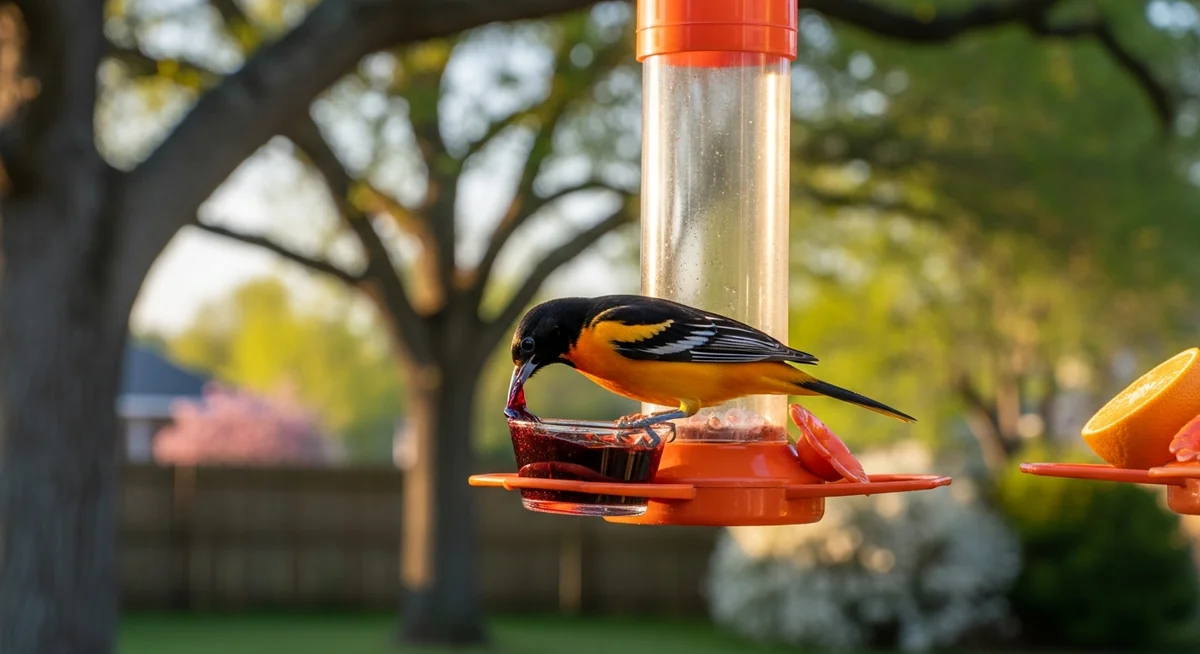
The Birds Choice Oriole-Fest earns its reputation as the best overall oriole feeder through a combination of thoughtful design and practical execution. The feeder holds 12 ounces of nectar, which is a standard and appropriate capacity — enough to last several days during early season when traffic is lighter, but not so large that nectar sits long enough to ferment during peak summer heat. Alongside the nectar reservoir, the Oriole-Fest includes dedicated stations for orange halves and jelly, meaning a single feeder can simultaneously address every food preference an oriole might arrive with.
What distinguishes the Birds Choice design from competitors is the integration. On lesser multi-purpose feeders, the different food stations feel like afterthoughts bolted onto a nectar feeder. On the Oriole-Fest, the orange and jelly stations are positioned at the same level as the nectar ports, with perching arranged so that a bird can easily move between food types without awkward repositioning. This matters because orioles often sample multiple food types in a single visit, and a feeder that facilitates that behavior gets longer visits and more return traffic.
The feeder's orange coloring is also worth noting. It's not a subtle accent — the Oriole-Fest is aggressively, unmistakably orange, which is exactly right. Visibility from a distance is part of how orioles locate food sources, and a feeder that reads as orange from across a yard is doing half the attraction work before a bird even lands.
Songbird Essentials Ultimate Oriole Feeder
The Songbird Essentials Ultimate Oriole Feeder takes a slightly different approach to the multi-purpose concept, offering a two-sided hanging design that accommodates multiple orioles feeding simultaneously. The feeder holds nectar, orange halves, and jelly, and the hanging configuration means it sways naturally in a breeze — which, counterintuitively, orioles seem to tolerate well, perhaps because it mimics the movement of the flowering plants and fruit trees they feed from in the wild.
The two-sided design is particularly useful during peak migration windows, when multiple orioles may arrive in the same yard within a short period. Single-sided feeders create competition and can lead to dominant birds monopolizing the station while subordinate birds go elsewhere. A feeder that allows simultaneous access from multiple angles reduces that conflict and keeps more birds in the yard longer.
For maximum oriole attraction, pairing the Songbird Essentials feeder with a second identical unit spaced at least ten feet away is a strategy that experienced oriole feeders consistently recommend. The logic is the same as spacing cardinal feeders to reduce territorial conflict — giving birds options reduces competition and increases overall yard traffic.
Perky-Pet Fruit Trio Oriole Nectar Feeder
The Perky-Pet Fruit Trio occupies an interesting position in the market: it's the most visually striking of the major multi-purpose feeders, with a design that leans hard into the orange aesthetic while incorporating clear nectar reservoirs that let birds see the liquid inside. The triple-serving configuration allows simultaneous jelly and fruit feeding alongside nectar, and the Perky-Pet's wide base provides the stable perching that orioles prefer.
Where the Fruit Trio distinguishes itself is accessibility. It's widely available at major retailers, priced competitively in the mid-range, and designed for straightforward cleaning — a factor that matters more than most new oriole feeders anticipate. Jelly feeders in particular require frequent cleaning because jelly ferments quickly in warm weather and can grow mold that's genuinely harmful to birds. A feeder that's easy to disassemble and clean thoroughly gets cleaned more often, which is better for the birds and better for the feeder's longevity.
Oriole Feeder Jelly: What to Know Before You Fill That Cup
Grape jelly has become the unexpected star of oriole feeding, and for good reason — orioles go absolutely wild for it. During spring migration especially, orioles will visit jelly stations repeatedly throughout the day, and a well-stocked jelly cup can attract birds that might otherwise pass through without stopping.
But the oriole feeder jelly situation has some nuances worth understanding before you buy.
Jelly Cup Design Matters Enormously
The best jelly feeders — whether standalone units or the jelly components of multi-purpose feeders — share a few characteristics. The cup should be deep enough to hold a meaningful amount of jelly without requiring constant refilling, but not so deep that smaller birds can get stuck. A depth of roughly one to two inches is the practical sweet spot. The cup should also have a wide enough diameter that orioles can access the jelly without contorting themselves — at least two inches across, with three or four inches being preferable.
Some feeders include ant moats or ant guards around jelly cups, which is worth prioritizing. Ants are powerfully attracted to grape jelly, and a feeder that's overrun with ants quickly becomes unattractive to orioles. A simple ant moat — a water-filled cup that ants can't cross — keeps jelly accessible to birds without becoming an ant cafeteria.
The Duncraft Eco-Oriole Fruit and Jelly Feeder
For birders whose primary interest is jelly and fruit feeding rather than nectar, the Duncraft Eco-Oriole is worth considering as either a standalone feeder or a supplement to a nectar-focused station. The dual-purpose design works for orioles and other fruit-loving birds, including catbirds and robins that share orioles' taste for grape jelly. If you're already attracting a variety of fruit-eating species, the Duncraft's broader appeal can actually increase the overall activity level at your feeding station, which in turn makes the area more attractive to orioles investigating a new location.
Jelly Quantity and Freshness
One practical point that experienced oriole feeders emphasize: jelly goes bad faster than you expect. In temperatures above 75 degrees — which describes most of oriole season — jelly can begin fermenting within two to three days. Fermented jelly isn't just unpalatable; it can be harmful to birds. The practical solution is to offer smaller quantities more frequently rather than filling cups to capacity and waiting for them to empty. A tablespoon or two of fresh jelly every day or two is better than a full cup that sits for a week.
The best oriole feeder jelly is plain grape jelly without artificial sweeteners or preservatives. Store-brand grape jelly works as well as premium brands — orioles aren't brand-conscious. What they are sensitive to is freshness, so the most expensive jelly in the world won't help if it's been sitting in a hot feeder for five days.
Oriole Feeder Orange: The Fruit That Started It All
Before jelly became the oriole feeding phenomenon it is today, orange halves were the classic oriole attractant — and they remain highly effective, particularly for attracting orioles that are new to a yard and haven't yet established a routine.
Why Orioles Are Drawn to Oranges
The attraction is partly nutritional and partly visual. Oranges provide natural sugars, hydration, and trace nutrients that complement nectar and jelly. But the visual component is equally important: the bright orange flesh of a halved orange is a powerful visual signal to birds that have evolved to seek out ripe, colorful fruit. An oriole feeder orange station essentially mimics the sight of ripe fruit on a branch, triggering feeding behavior that's deeply wired into these birds.
How Multi-Purpose Feeders Handle Orange Halves
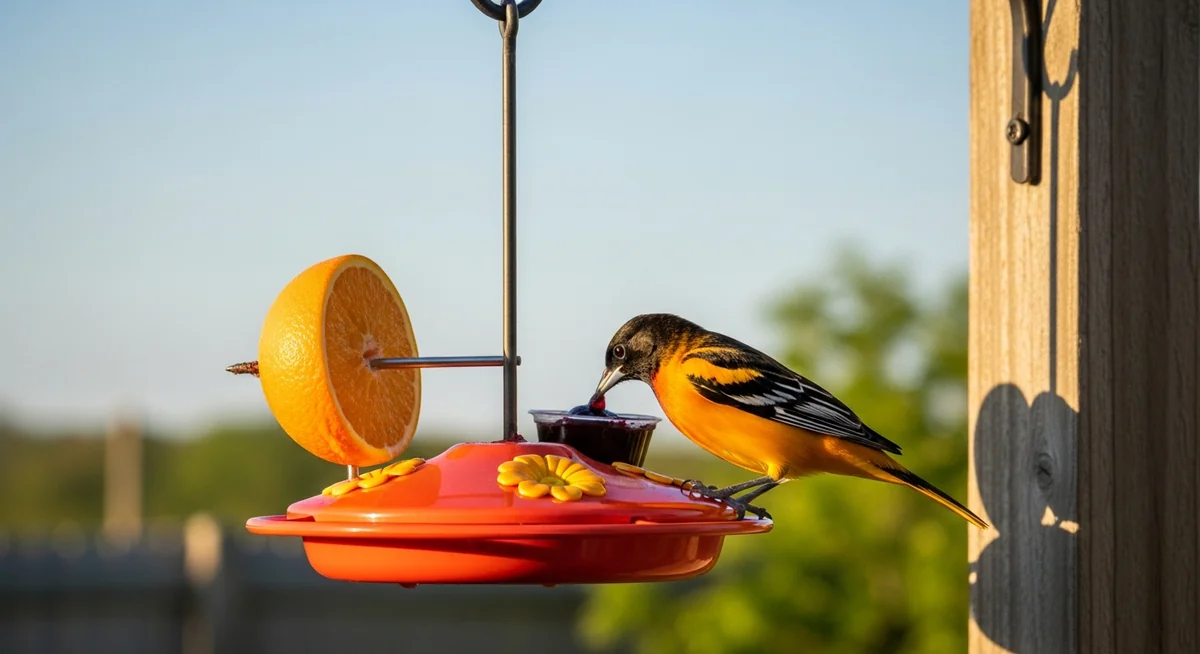
The best multi-purpose feeders accommodate orange halves through one of two mechanisms: spike systems or cup systems. Spike systems — essentially a metal or plastic spike that the orange half is pushed onto — are simple and effective, holding the fruit securely while orioles peck at the flesh. Cup systems cradle the orange half in a shallow dish, which works but can allow the fruit to shift during feeding, making it harder for birds to maintain their position.
The Birds Choice Oriole-Fest and Songbird Essentials Ultimate Oriole Feeder both use spike-style orange stations, which is the preferable design. The orange stays put, birds can feed comfortably, and the spent orange half is easy to remove and replace.
Orange Freshness and Placement
Orange halves should be replaced every two to three days during warm weather. A dried-out orange that's lost most of its juice is still edible but significantly less attractive than a fresh, juicy half. During the peak of oriole season in May and early June, some birders go through an orange every other day — which sounds extravagant until you see the results.
Placement matters too. Oriole feeder orange stations work best when the fruit is clearly visible from a distance. Positioning the feeder in a location where it catches morning light — when orioles are most actively foraging — increases visibility and can make the difference between a passing bird stopping to investigate or continuing on.
Dedicated Nectar Feeders for Orioles
While multi-purpose feeders are the best overall choice for attracting orioles, there's a legitimate case for dedicated nectar feeders in certain situations. Birders who already have good jelly and orange setups may want to add a nectar-focused feeder to increase capacity during peak migration. Others may be in areas where nectar-feeding orioles are common but jelly-focused species are rare.
First Nature 3088 Oriole Feeder
The First Nature 3088 is consistently identified as the best dedicated nectar feeder for orioles, and the reasons are straightforward. The feeder holds 32 ounces of nectar — significantly more than the 12-ounce capacity of most multi-purpose feeders — which reduces refilling frequency and ensures nectar is always available during high-traffic periods. The wide-mouth design makes filling and cleaning easier than narrow-neck alternatives, and the bright orange coloring maintains strong visual attraction.
The First Nature's limitation is its single-purpose nature. It does nectar exceptionally well, but it offers orioles nothing else. For a primary feeder, this is a meaningful drawback. As a secondary feeder supplementing a multi-purpose station during peak migration, it's an excellent choice.
The Nectar Recipe That Matters
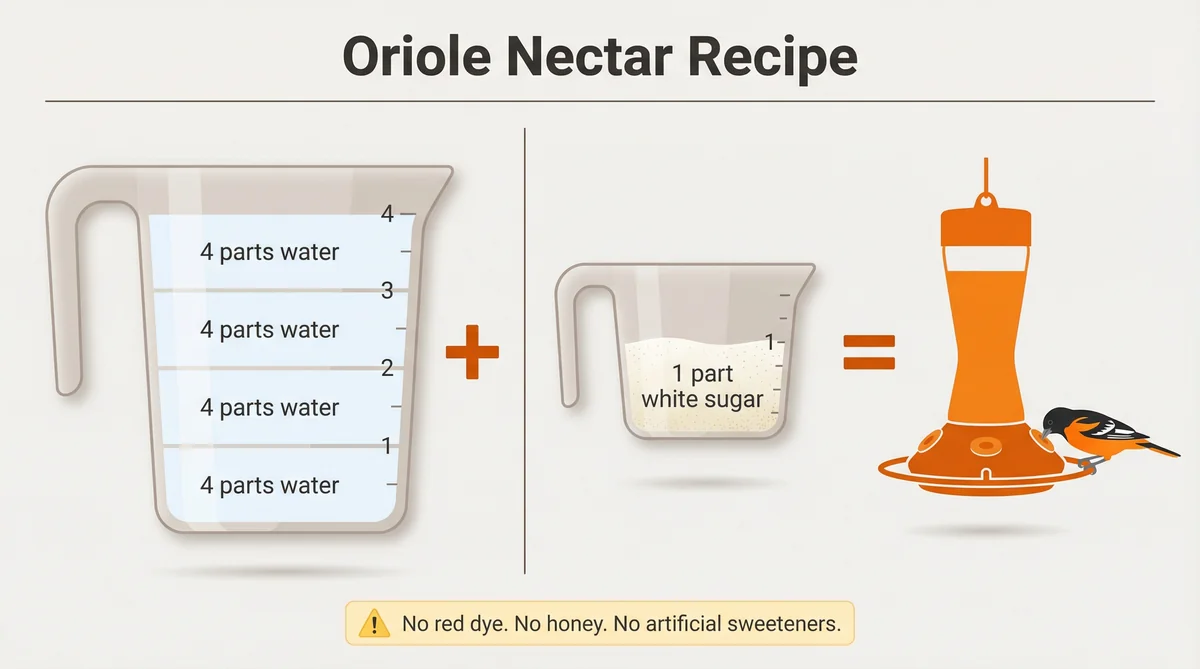
Regardless of which feeder you choose, the nectar recipe is non-negotiable: one part white granulated sugar to four parts water. This 1:4 ratio mimics the natural sugar concentration of the flower nectar orioles feed on in the wild. A stronger solution isn't more attractive — it's actually harder for birds to process and can cause dehydration. A weaker solution doesn't provide enough energy to be worth the effort of visiting.
Boil the water, dissolve the sugar completely, and let the mixture cool before filling feeders. No red dye, no honey, no artificial sweeteners. Plain white sugar and water. Store any extra in the refrigerator, where it stays fresh for up to two weeks.
Nectar should be changed every three to five days under normal conditions. When temperatures exceed 75 degrees, change it every two to three days. Fermented nectar smells slightly sour and appears cloudy — if you see either of those signs, empty the feeder, clean it thoroughly, and refill with fresh nectar.
The Fruit Oriole Feeder: Beyond Oranges
Oranges get most of the attention in oriole feeding discussions, but orioles will also investigate other fruits, particularly during migration when they're actively seeking calorie-dense food sources. A well-designed fruit oriole feeder can accommodate multiple fruit types, broadening the appeal of your feeding station.
What Fruits Work Beyond Oranges
Grape halves are the most successful orange alternative, which makes intuitive sense given orioles' enthusiasm for grape jelly. The natural sugar content and familiar flavor profile make grapes an easy transition. Apple halves work moderately well, particularly for Orchard orioles, though they don't generate the same enthusiasm as oranges or grapes. Ripe melon pieces — cantaloupe and honeydew in particular — attract orioles during the heat of summer when the hydration content is especially valuable.
The practical consideration with any fruit offering is freshness. Fruit ferments faster than jelly and considerably faster than nectar. In warm weather, fruit stations need checking daily, with spent fruit removed before it becomes a problem. This is more maintenance than most birders anticipate, but the reward — particularly during peak migration — justifies the effort.
Feeder Design for Multiple Fruits
The best fruit oriole feeders use a tray or platform design with multiple cup or spike stations rather than a single-fruit configuration. This allows you to offer two or three fruit types simultaneously, giving orioles options and increasing the likelihood that whatever they're seeking on a given day is available. The Duncraft Eco-Oriole handles this reasonably well, and several platform-style feeders marketed to fruit-eating birds in general work effectively for orioles when positioned and stocked appropriately.
Placement Strategy: Where You Put the Feeder Matters
The best oriole feeder in the world won't attract birds if it's placed poorly. Orioles are more cautious about exposed feeding stations than many backyard birds — they prefer locations that offer clear sightlines while keeping dense vegetation within reasonable reach for a quick escape.
Height and Exposure
Orioles naturally feed at mid-to-upper canopy height, often fifteen to thirty feet up in trees where they nest and forage. Ground-level feeders rarely attract orioles. Hanging feeders at six to ten feet — from a tree branch, a dedicated pole, or a deck hook — puts the feeder in the orioles' natural visual range and makes it more likely to be noticed by birds passing through at canopy height.
Avoid placing feeders in deep shade. Orioles use visual brightness to locate food sources, and a feeder tucked into heavy shade is functionally invisible to birds scanning from above. Partial shade is fine and actually preferable during hot weather to slow nectar fermentation, but the feeder should be visible from multiple angles.
Proximity to Cover
Like most feeder birds, orioles are more comfortable when cover is available nearby. A feeder positioned within fifteen to twenty feet of a mature tree or dense shrub gives orioles a staging area — a place to land and assess the situation before committing to the feeder itself. This is especially important early in the season when orioles are encountering a yard for the first time.
Weather Protection
The Fliteline Oriole Feeder includes a weather baffle as part of its design, and this feature is worth seeking out regardless of which feeder you choose. Rain dilutes nectar rapidly, making it less nutritious and accelerating fermentation. A weather baffle — either integrated into the feeder design or added as a separate dome — keeps rain out of nectar reservoirs and extends the effective life of each filling. During the frequent spring storms that coincide with peak oriole migration, weather protection can mean the difference between a functioning feeder and a diluted mess that needs immediate replacement.
Setting Up Multiple Feeders for Maximum Oriole Attraction
If you're serious about oriole feeding — and once you've seen a male Baltimore oriole at close range, serious is the only appropriate response — multiple feeders are worth considering.
The logic mirrors what works for other territorial species. A single feeder creates a resource that dominant birds can monopolize. Multiple feeders, spaced far enough apart that a single bird can't patrol all of them simultaneously, allow multiple orioles to feed at the same time. During peak migration, this can dramatically increase the number of birds using your yard.
Spacing of at least ten feet between feeders is the minimum, with fifteen to twenty feet being preferable. This isn't as much space as you'd want between cardinal feeders — orioles are less aggressively territorial than cardinals during feeding — but it's enough to prevent one bird from dominating the entire feeding station.
The ideal multi-feeder setup combines a primary multi-purpose feeder (Birds Choice Oriole-Fest or Songbird Essentials Ultimate) with a dedicated nectar feeder (First Nature 3088) positioned nearby. This gives orioles the choice of a comprehensive station or a high-volume nectar source, accommodating different preferences within the local oriole population.
Maintenance: The Part Nobody Talks About Enough
Oriole feeders require more maintenance than most seed feeders, and this reality catches many new oriole feeders off guard. Jelly ferments. Nectar spoils. Fruit rots. Orange halves dry out. All of these things happen faster than you expect during warm weather, and all of them need to be addressed promptly.
Cleaning Frequency
Jelly cups should be rinsed and refilled every two to three days during warm weather. Nectar reservoirs should be emptied, rinsed, and refilled on the same schedule. A thorough cleaning with a dilute bleach solution — one part bleach to nine parts water — should happen at least once a week during peak season, with all components rinsed thoroughly and dried completely before refilling.
This is not optional. Mold in jelly cups can cause aspergillosis, a fungal respiratory infection that's fatal to birds. Fermented nectar can cause digestive problems. The maintenance commitment is real, and it's worth factoring into feeder selection — a feeder that's easy to disassemble and clean thoroughly will get cleaned more reliably than one that requires effort to take apart.
What to Watch For
Check feeders daily during oriole season. Signs that something needs attention include cloudy nectar, visible mold in jelly cups, fruit that's dried out or showing signs of fermentation, and — most tellingly — a sudden drop in bird activity. Orioles are sensitive to food quality and will stop visiting a feeder that's offering substandard food. If your previously busy feeder goes quiet, the food is the first thing to check.
Timing: When to Put Out Oriole Feeders
The single most common mistake in oriole feeding is putting feeders out too late. Orioles arrive in most of the continental United States between late April and mid-May, depending on location, and they make their feeding territory decisions quickly. A feeder that's not in place when orioles first pass through may be overlooked entirely, even if it's set up perfectly afterward.
Put oriole feeders out one to two weeks before you expect the first arrivals. In the southern states, that means early to mid-April. In the northern states and Canada, late April to early May. Check local birding reports — eBird is invaluable for this — to see when orioles have historically arrived in your specific area.
Keep feeders stocked through June, when oriole activity typically peaks as birds are raising young and need maximum caloric intake. Activity often drops in July as families become more self-sufficient and begin ranging more widely. By August, most orioles have begun their southward migration, though feeders left in place can attract migrants passing through in both directions.
The Bottom Line on Oriole Feeders
The best bird feeders for orioles share a common characteristic: they meet orioles where they are rather than asking orioles to adapt to an inconvenient design. Multi-purpose feeders that offer nectar, jelly, and orange halves simultaneously — particularly the Birds Choice Oriole-Fest and the Songbird Essentials Ultimate Oriole Feeder — give orioles every reason to stop and stay. Dedicated nectar feeders like the First Nature 3088 serve a supplementary role, adding capacity during peak migration without replacing the versatility of a multi-purpose primary station.
The oriole feeder with jelly capability is arguably the most important feature to prioritize, given how powerfully orioles respond to grape jelly. The oriole feeder orange station is the second-most critical element, particularly for attracting birds that are new to a yard. Nectar rounds out the offering and keeps birds returning throughout the day.
Get the feeder up early, keep it clean, keep the food fresh, and position it where orioles can find it easily. Do those things consistently, and the orange flash of a Baltimore oriole landing on your feeder will become one of the reliable pleasures of May — the kind of reward that makes every bit of preparation feel entirely worth it.
Cross-References