Hummingbird Food Recipe: Perfect Sugar to Water Ratio
Hummingbird Food Recipe: The Perfect Sugar to Water Ratio (And Why It's Simpler Than You Think)
Three billion birds have vanished from North American skies since 1970. That statistic stopped me cold the first time I read it — a 29% decline, documented by the Smithsonian's National Zoo. It's the kind of number that makes a backyard feeder feel less like a hobby and more like something that actually matters.
Which is why getting the hummingbird food recipe right isn't just about convenience. It's about providing fuel that genuinely supports these birds rather than harming them. And the good news — the genuinely excellent news — is that the perfect hummingbird nectar recipe requires exactly two ingredients, costs about $4 a month at peak season, and takes four minutes to make. The bad news is that the internet has managed to complicate something beautifully simple, and that complexity has real consequences for the birds visiting your feeders.
Let's fix that. Here's everything you need to know about the sugar to water ratio for hummingbird food, what to avoid, and how to keep your nectar fresh and safe all season long.
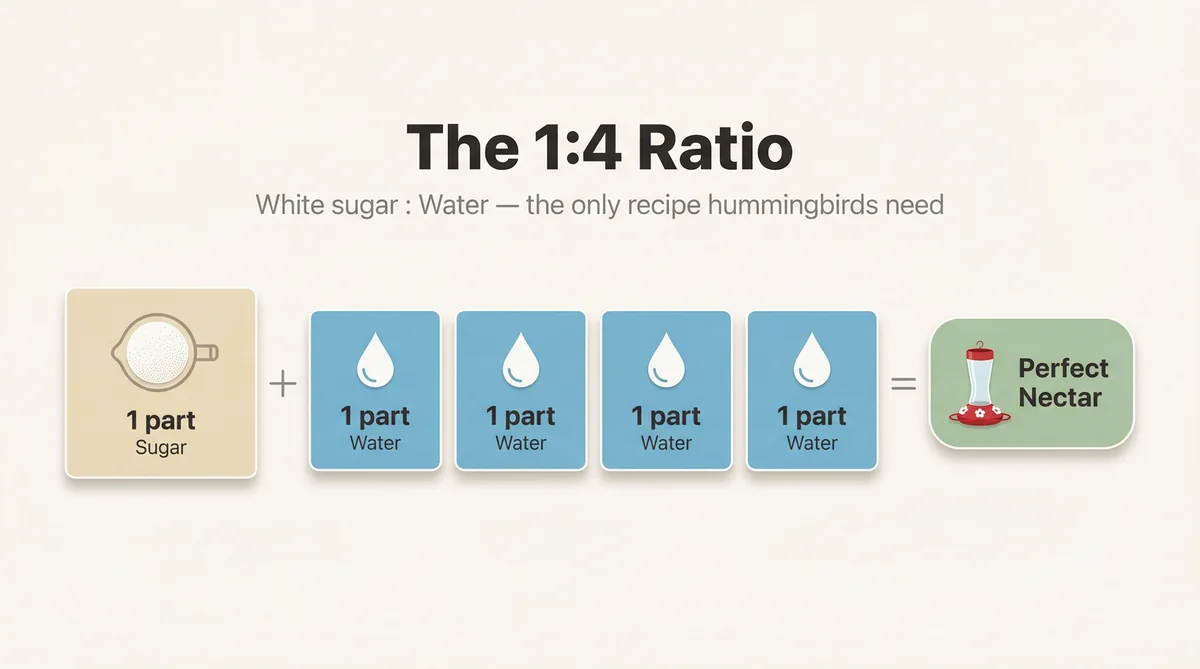
Key Takeaways
- Use a 1:4 ratio of white granulated sugar to water — this mimics natural flower nectar at ~20% sugar concentration
- Never use honey, raw sugar, corn syrup, powdered sugar, artificial sweeteners, or red dye — all can harm or kill hummingbirds
- Change nectar every 2–7 days depending on temperature, and clean feeders thoroughly every time you refill
- Homemade nectar costs ~$4/month versus $47+/month for commercial products and is the Smithsonian-recommended choice
- Place feeders 4–5 feet high, within 3 feet or beyond 10 feet of windows, and space multiple feeders at least 20 feet apart
The Perfect Sugar to Water Ratio for Hummingbird Food
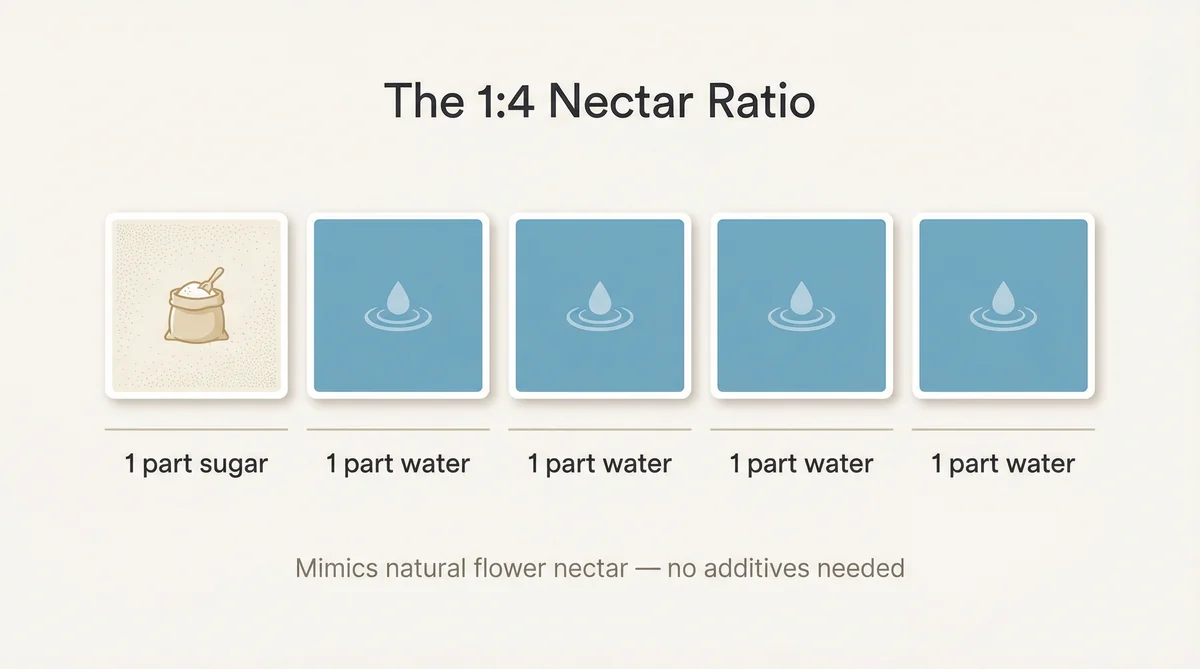
The answer is 1 part white granulated sugar to 4 parts water.
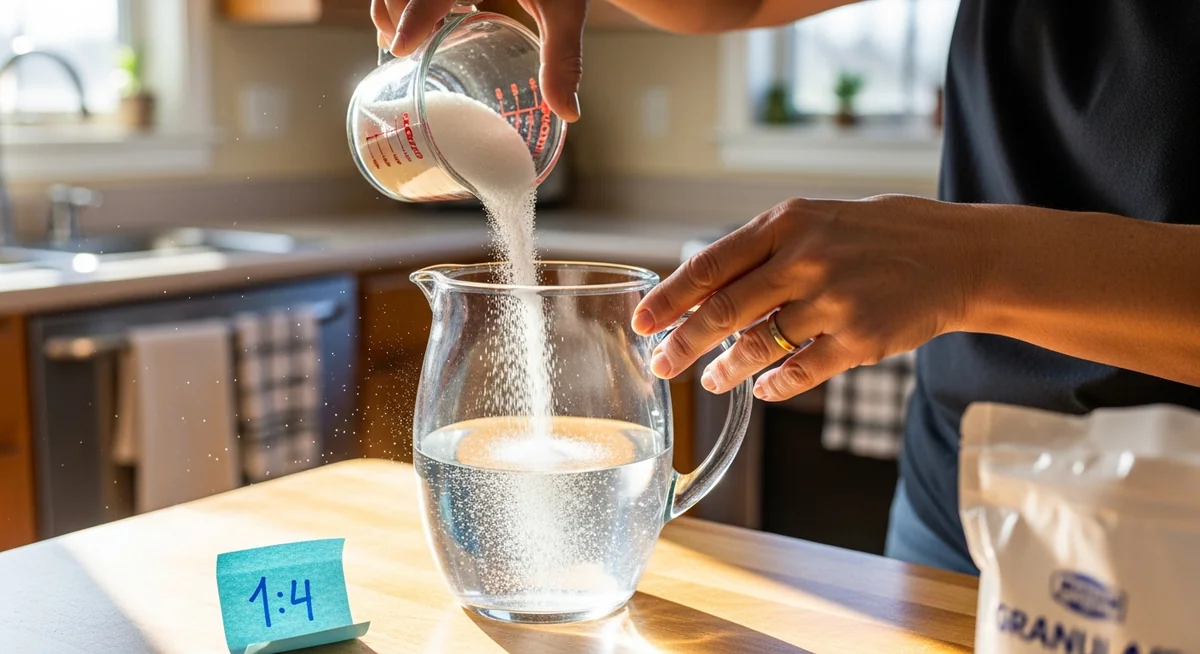
That's it. One to four. Write it on a sticky note and put it inside your cabinet door if you need to, because this ratio is the foundation of everything.
This isn't arbitrary. The 1:4 ratio produces a solution with approximately 20% sugar concentration by volume — which closely mimics the natural sugar content found in the flower nectar hummingbirds evolved to consume. The Smithsonian Institution, bird ecologists, and avian nutritionists all converge on this same ratio, and the scientific reasoning is sound: hummingbirds have extraordinarily high metabolic demands (their hearts beat up to 1,260 times per minute; their wings beat 50 to 80 times per second), and they consume approximately half their body weight in sugar every single day. They need fuel that matches what their physiology expects.
How to Scale the Recipe
The beauty of a ratio is its flexibility. Whether you're filling one small feeder or three large ones, the math stays the same:
- Small batch: ¼ cup sugar + 1 cup water = 1.25 cups of nectar
- Standard batch: 1 cup sugar + 4 cups water = 5 cups of nectar
- Large batch: 2 cups sugar + 8 cups water = 10 cups of nectar
For a full sugar-to-water conversion chart — exact sugar amounts for 1 cup, 1 quart, and ½ gallon — see our hummingbird nectar ratio guide.
The unit doesn't matter — cups, ounces, quarts — as long as the ratio holds at 1:4. A double batch (½ cup sugar, 2 cups water) fills three standard feeders and takes exactly four minutes from kettle to refrigerator. That's the batch size that works for my setup, and it's become as automatic as making coffee.
What About Stronger Concentrations?
You'll occasionally see 1:2 ratios recommended — double the sugar concentration. While hummingbirds will drink it, the 1:4 ratio is the institutional consensus for good reason. Higher concentrations can be harder on hummingbird kidneys, spoil faster in warm weather, and may deter birds who find it too thick. Stick with 1:4. The birds know what they're looking for.
The Only Two Ingredients You Need
White Granulated Sugar
Refined white table sugar — the ordinary kind in the white bag at every grocery store — is the only sweetener recommended for hummingbird nectar. This specificity matters enormously, because well-meaning substitutions cause real harm.
Never use:
- Honey — Ferments rapidly and promotes dangerous fungal growth that can cause a fatal tongue disease in hummingbirds
- Corn syrup — Wrong chemical composition; doesn't provide the sucrose hummingbirds need
- Raw or unprocessed sugars — Contain iron and other minerals that hummingbird kidneys cannot process safely
- Powdered/confectioners' sugar — Often contains cornstarch and anti-caking additives that don't belong in nectar
- Artificial sweeteners — Zero caloric value; a hummingbird drinking this would essentially be starving while appearing to feed
White granulated sugar dissolves cleanly into water and provides exactly the sucrose profile that flower nectar delivers. It's also the most affordable option by a significant margin. During peak season, when feeders need frequent refilling, that matters.
Water
Tap water is perfectly acceptable. No special filtration required, no mineral water necessary. If your tap water has heavy chlorine, a brief boil will aerate it off — but this is optional, not mandatory.
How to Make Hummingbird Nectar
The preparation is genuinely simple:
Step 1: Measure your ingredients using the 1:4 ratio in whatever batch size suits your feeders.
Step 2: Combine and dissolve. Stir or shake the sugar and water together until the sugar is completely dissolved. Cold water works fine; the sugar just takes a bit longer to dissolve.
Step 3 (Optional): Heat the mixture. Some people prefer to heat the water first — either bringing it to a boil or using hot water from the kettle. This speeds up dissolving, helps aerate chlorine from tap water, and can kill any bacteria or mold spores present. If you heat the mixture, let it cool completely before filling feeders.
Step 4: Fill feeders once the nectar is at room temperature.
Step 5: Refrigerate the remainder. Extra nectar stores well in a sealed glass jar in the refrigerator for up to two weeks. Making a larger batch once a week means you're always prepared for midweek refills without starting from scratch each time.
What Not to Add
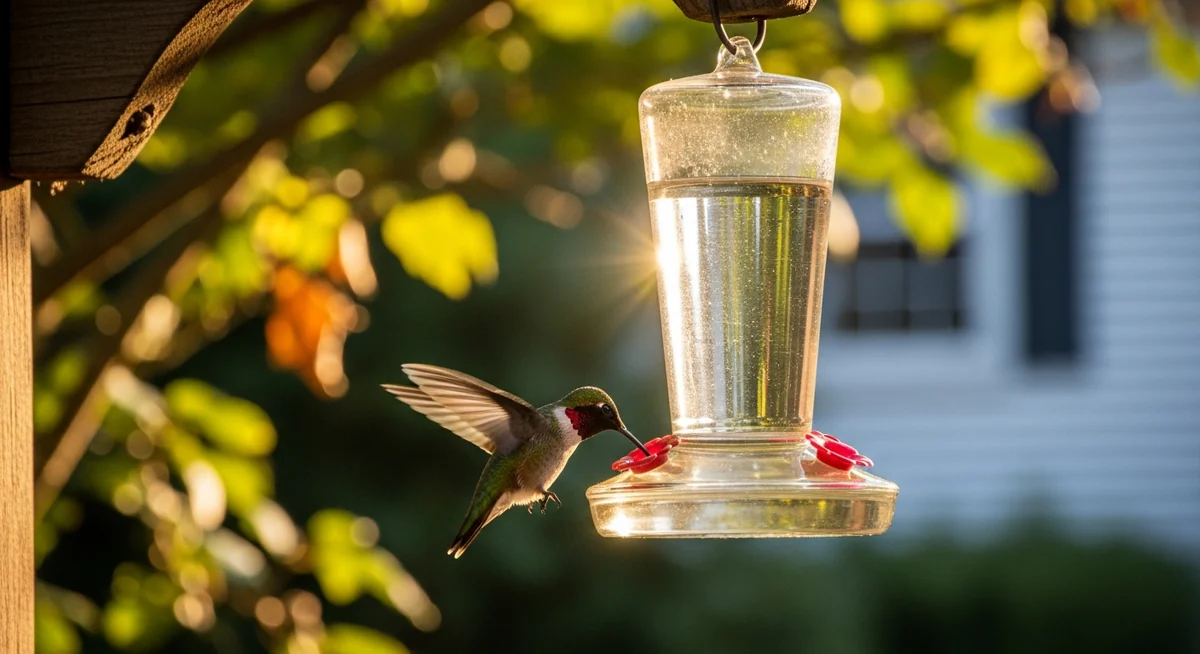
No red dye. This deserves its own paragraph because it's one of the most persistent myths in backyard bird feeding. Red food coloring is unnecessary — hummingbirds are attracted to the red color of the feeder itself, not the liquid inside. More importantly, red dyes (particularly Red Dye No. 40) have been associated with potential kidney damage in hummingbirds. Commercial nectars that use red dye are solving a problem that doesn't exist while potentially creating one that does. Clear nectar in a red feeder is exactly what these birds need.
Keeping Nectar Fresh: The Cleaning Schedule That Actually Matters
Making the perfect nectar is only half the equation. Nectar spoils — sometimes faster than you'd expect — and fermented or moldy nectar can sicken the birds you're trying to help. The cleaning schedule isn't optional maintenance; it's essential care.
Temperature-Based Replacement Guide
How often you change nectar depends directly on outdoor temperature:
| Temperature | Change Nectar |
|---|---|
| Below 70°F | Once per week |
| 70–80°F | Twice per week |
| 80–90°F | Three times per week |
| 90°F+ | Every other day |
| Near 100°F | Daily |
As a practical baseline: change nectar every 3 to 5 days under normal conditions, and every 2 to 3 days when temperatures exceed 75°F. During peak summer heat, daily checks become important. Nectar that looks cloudy, has visible mold, or smells off should be discarded immediately — don't top it off, replace it entirely.
Feeder Cleaning Protocol
Each time you change the nectar, clean the feeder. Each time. Not every other time, not when it looks dirty. Every time.
Wash feeders by hand — dishwashers can leave soap residue in hard-to-reach crevices. Use a baby bottle brush to scrub inside jars and feeding ports. For deeper cleaning, a solution of 1 part bleach to 9 parts water kills mold and bacteria effectively; rinse thoroughly and allow the feeder to dry completely before refilling. This thorough bleach cleaning every two weeks keeps feeders genuinely sanitary rather than just visually clean.
Never allow mold to remain in a feeder. Black mold in hummingbird feeders is not a cosmetic issue — it's a health hazard for the birds.
Why Homemade Nectar Outperforms Commercial Products
Commercial hummingbird nectar products exist on a wide spectrum, from concentrated liquids to pre-mixed solutions. Most have two problems: unnecessary additives (including those red dyes) and cost.
The math on homemade versus commercial nectar is stark. A standard bag of white granulated sugar costs roughly $3 to $4 and produces enough nectar to run multiple feeders through an entire peak season. Commercial nectar products, by contrast, can cost $47 a month or more when you're running multiple feeders at peak capacity. The homemade version is cleaner, cheaper, and — according to bird ecologists at the Smithsonian — the recommended choice.
The recipe requires no special equipment, no expertise, and no guesswork once you've memorized the ratio. One part sugar. Four parts water. Stir until dissolved.
Supporting Hummingbirds Beyond the Recipe
The nectar recipe is the foundation, but a few additional considerations help ensure your feeders are genuinely beneficial:
Feeder placement: Hang feeders 4 to 5 feet above the ground, positioned within 3 feet of windows or more than 10 feet away — the 3-to-10-foot zone creates dangerous window strike conditions. Partial shade extends nectar freshness and makes the feeder more comfortable for feeding birds.
Multiple feeders: Hummingbirds are fiercely territorial, particularly dominant males. Spacing feeders at least 20 feet apart allows subordinate birds to feed without constant displacement from the territory holder.
Seasonal timing: Put feeders out 1 to 2 weeks before hummingbirds are expected in your region — late March or early April in most areas. Keep feeders up for 2 weeks after you see your last hummingbird of the season, as late migrants may still be moving through.
Water: A misting fountain positioned near feeders provides both drinking water and the fine spray hummingbirds use for bathing. These birds bathe frequently to maintain feather condition, and a water source dramatically increases yard attractiveness.
The hummingbird food recipe itself couldn't be simpler: one part white granulated sugar, four parts water, no additives, changed regularly. What makes the difference between a feeder that works and one that genuinely supports these birds is the consistency of that recipe, the discipline of the cleaning schedule, and the understanding that simplicity here isn't a shortcut — it's the science. Three billion birds lost since 1970 is a number worth taking seriously. A clean feeder filled with proper nectar is a small but real response to that loss.
![Hummingbird Feeders: The Complete Guide [2026]](/_next/image?url=%2Fimages%2Fhummingbird-feeders%2Fthe-ultimate-guide-to-hummingbird-feeders%2Fimage-01-after-the-opening-introduction.webp&w=3840&q=75)