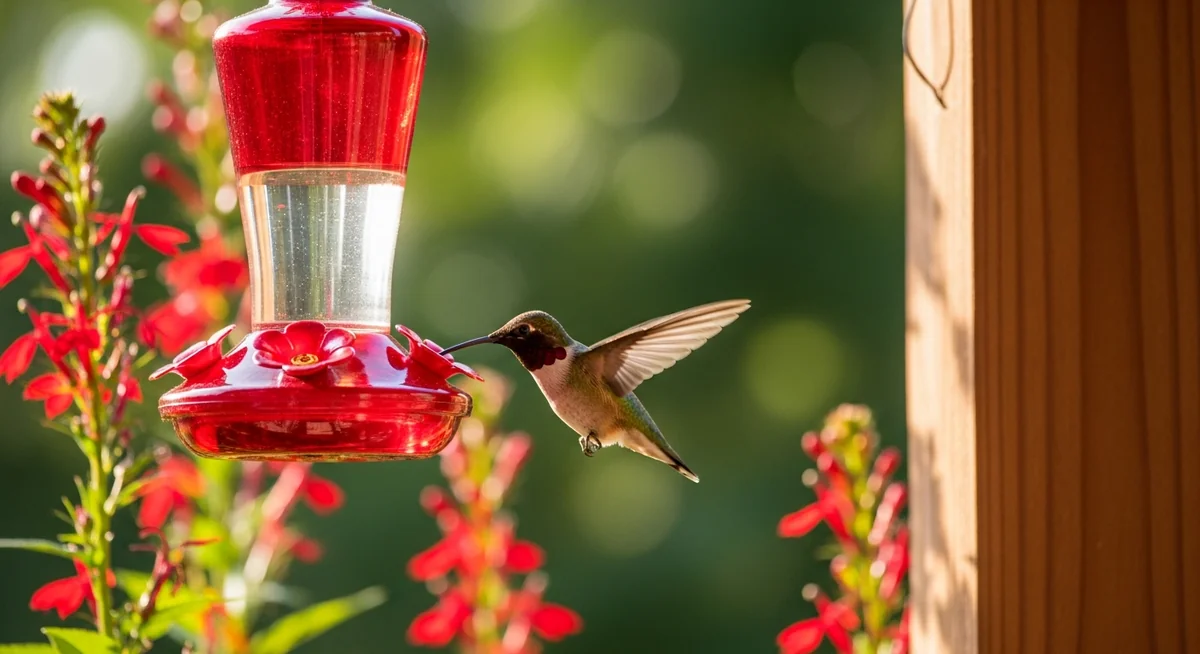
Green Hummingbird ID: 5 Species at Your Feeder
The Green Hummingbird Identification Guide: Which Species Is Actually at Your Feeder?
You've been watching your feeder for weeks. A tiny blur of green shoots in, hovers for three seconds, and vanishes before you can get a proper look. You know it's a hummingbird. You know it's green. Beyond that, you're squinting at your field guide and feeling like you're trying to identify individual raindrops.
Here's the mildly exasperating truth: almost every hummingbird you'll ever see in North America is, at baseline, green. The iridescent green back is the default factory setting for the family. What separates species from each other — and males from females, adults from juveniles — comes down to specific patches of color, body proportions, tail shape, and behavioral quirks that take a little practice to see. Once you know what to look for, though, identification clicks into place with satisfying precision.
This guide walks through the most common green hummingbirds visiting North American feeders, the field marks that actually distinguish them, and the behavioral clues that help when the light is bad and the bird won't hold still. If you're still setting up your feeder, our ultimate hummingbird feeder guide covers everything from feeder selection to nectar recipes.
Key Takeaways
- Male hummingbirds can be identified by gorget color: ruby red (Ruby-throated), rose-pink crown (Anna's), black with purple band (Black-chinned), and orange-red (Rufous).
- Female and juvenile hummingbirds share green backs; check flank color and tail base — rufous-washed flanks and rufous tail bases point to Rufous or Broad-tailed females.
- Anna's Hummingbird is the only common North American species that sings from a perch and does not migrate south in winter.
- Male Broad-tailed Hummingbirds produce an audible metallic wing trill in flight, allowing identification before the bird is seen clearly.
- Use 8x42 binoculars with the sun at your back to catch the iridescent gorget flash that confirms species identity.
Why "Green Hummingbird" Isn't Enough of an Answer
Approximately 15 species of hummingbirds regularly visit feeders across the United States. The vast majority share that same metallic green plumage across the back and crown. What varies dramatically is everything else: the color of the throat (gorget), the shape and color of the tail, the length and curvature of the bill, the presence or absence of white or rufous flanks, and the overall size.
Adding to the challenge, hummingbird plumage is structural rather than pigmented. The iridescent colors — the flashing ruby, the glowing violet, the electric magenta — are produced by microscopic platelets in the feather barbules that refract light like tiny prisms. This means a male Ruby-throated Hummingbird's throat can appear black, dark brown, or blazing red depending entirely on the angle of light. A bird that looks dull in shadow can transform into something extraordinary when it turns toward the sun. Patience and position matter enormously in hummingbird identification.
The Ruby-Throated Hummingbird: The Eastern Standard
For anyone feeding hummingbirds east of the Mississippi, the Ruby-throated Hummingbird (Archilochus colubris) is almost certainly what you're seeing. It dominates in eastern states so thoroughly that it's often the only hummingbird species a backyard birder in New England, the Mid-Atlantic, or the Southeast will encounter during the migration window from May through September.
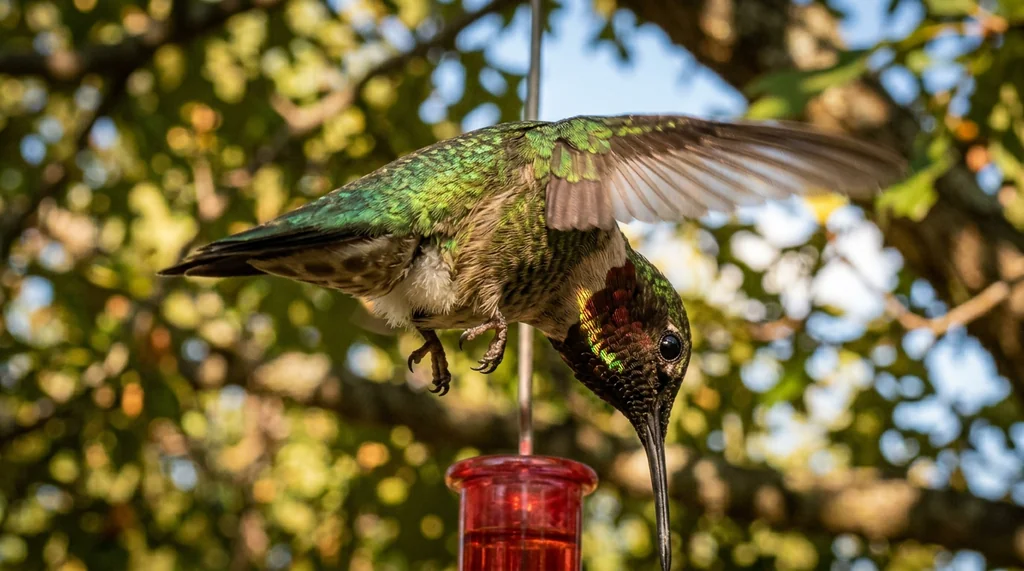
Adult male field marks: Metallic green back and crown, bright white chest, and the defining feature — a gorget of iridescent ruby red that can flash from black to brilliant crimson depending on light angle. The tail is forked and dark, with no white tips on the outer tail feathers.
Adult female field marks: Green back, white underparts with faint streaking on the throat, and white tips on the outer three tail feathers. The lack of any gorget color and those white tail tips are the key identifiers. Females are also slightly larger than males.
Juvenile field marks: Juveniles of both sexes resemble adult females. Young males may show a few iridescent feathers beginning to appear on the throat by late summer, but it's a scattered, patchy effect rather than a full gorget. Young females are essentially identical to adult females in the field.
Size and proportion: The Ruby-throated is a small hummingbird even by hummingbird standards — roughly 3 to 3.75 inches in length. The bill is straight and medium-length, slightly longer in females than males.
One behavioral note worth knowing: the territorial male is not subtle. He will chase every other hummingbird — and often large insects, other bird species, and apparently his own reflection — with aggressive intensity. If you're watching a feeder and one bird is doing all the chasing, that's your dominant male.
Anna's Hummingbird: The Year-Round Western Resident
Anna's Hummingbird (Calypte anna) is the most commonly encountered hummingbird on the Pacific Coast and is one of the few North American hummingbirds that doesn't migrate south for winter. In parts of California, Oregon, and Arizona, Anna's are year-round residents at feeders.
Adult male field marks: The male Anna's has a gorget that extends onto the crown — both the throat and the top of the head are covered in iridescent rose-pink to magenta feathers that can appear dark purplish-gray in poor light. The back is metallic green, the belly is grayish-green, and the tail is dark and slightly rounded.
Adult female field marks: Green back, grayish underparts, and a small but usually visible patch of iridescent pink or red feathers in the center of the throat. This central throat patch is the key distinction from female Ruby-throated — female Anna's almost always show at least a few iridescent spots, while female Ruby-throated are clean white on the throat.
Size: Anna's is a noticeably larger hummingbird than the Ruby-throated, measuring around 3.9 to 4.3 inches. Side by side, the difference is obvious. When seen alone, the slightly heavier body and proportionally shorter bill help.
Voice: Anna's is one of the few hummingbirds with a genuine song — a scratchy, buzzy series of chips and squeaks that males produce from a perch. If you hear a hummingbird singing rather than just chipping, you're almost certainly watching an Anna's.
Rufous Hummingbird: The Green-Backed Female Problem
The Rufous Hummingbird (Selasphorus rufus) creates the most common identification confusion for backyard birders in the West, and increasingly in the East, where vagrants appear with growing frequency during fall migration.
Adult male field marks: Males are largely unmistakable — the back, sides, and tail are bright rufous (rusty orange), with a white chest and an iridescent orange-red gorget. There's nothing else quite like them.
Adult female and juvenile field marks: Here's where it gets genuinely tricky. Female and juvenile Rufous Hummingbirds have green backs, green crowns, white underparts with buffy or rufous-washed flanks, and rufous at the base of the tail feathers. From above, a female Rufous can look very similar to a female Ruby-throated. The key differences: look for that warm buffy or rusty wash on the flanks and sides, and check the tail. Female Rufous show rufous at the base of the outer tail feathers, which creates a warm orange-brown base visible when the tail is spread or pumped.
Behavior: Rufous Hummingbirds are legendarily aggressive, even by hummingbird standards. A single Rufous at a feeder will often attempt to drive off every other hummingbird present regardless of size or number. If your yard suddenly has a tiny green-backed bird that seems determined to run everyone else off, a female or juvenile Rufous is a strong candidate, especially in late summer and fall.
Broad-Tailed Hummingbird: The Mountain West Species
The Broad-tailed Hummingbird (Selasphorus platycercus) is the mountain counterpart to the Ruby-throated — the default hummingbird at feeders across the Rocky Mountain states from spring through late summer.
Adult male field marks: Rose-magenta gorget on a white chest, metallic green back, and a distinctive feature that identifies males before you even see them clearly: the outer primary feathers of males are narrowed in a way that produces a loud, metallic trill during flight. If you hear a high-pitched, cricket-like trill from an approaching hummingbird, that's a male Broad-tailed.
Adult female and juvenile field marks: Green back, buffy or cinnamon-washed flanks, and rufous at the base of the tail. Female Broad-taileds are so similar to female Rufous Hummingbirds that even experienced birders sometimes can't distinguish them in the field without a bird in hand. Geographic range helps considerably — if you're in Colorado or Utah in June, it's probably Broad-tailed. If it's September anywhere along the Pacific Coast, Rufous becomes far more likely.
Black-Chinned Hummingbird: The Western Counterpart
The Black-chinned Hummingbird (Archilochus alexandri) is structurally nearly identical to the Ruby-throated and occupies the western equivalent of its range, breeding across the interior West from British Columbia to Texas.
Adult male field marks: The gorget is black with a narrow band of iridescent violet-purple at the lower edge. In poor light, the entire gorget looks black. In good light, that purple band is visible and distinctive. The back is metallic green, the underparts are white with greenish sides.
Adult female field marks: Essentially identical to female Ruby-throated — green back, white underparts, white-tipped outer tail feathers. In areas where both species could theoretically occur, separation is extremely difficult. Bill shape offers a subtle clue: Black-chinned tends to have a slightly longer bill that droops very slightly at the tip, while Ruby-throated is straighter. The tail-pumping behavior is more pronounced in Black-chinned, which habitually dips its tail while hovering.
Field Identification in Practice: The Four Questions
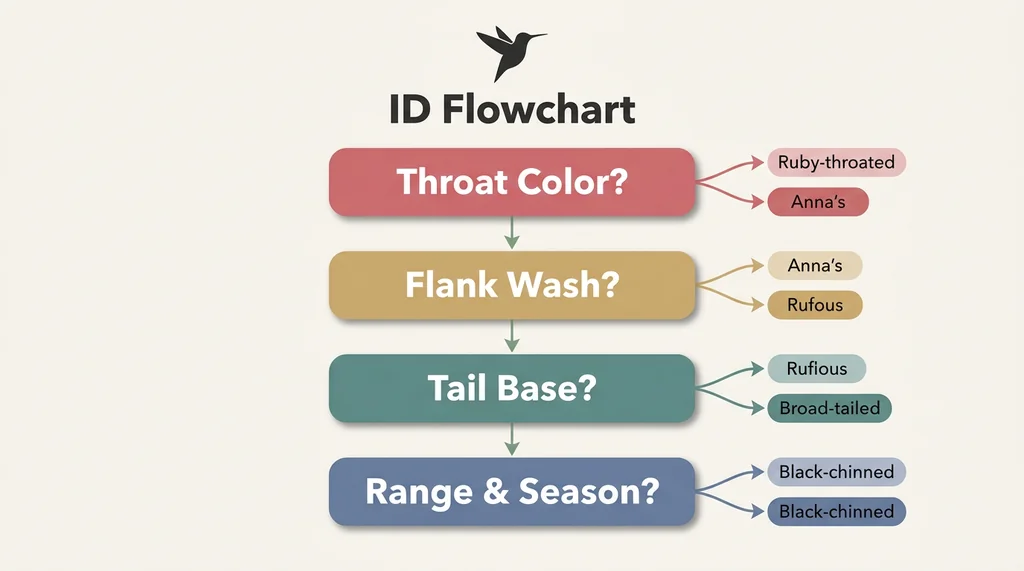
When a green hummingbird appears at your feeder, running through four quick questions will get you to an identification most of the time:
1. What color is the throat? Ruby red points to Ruby-throated (male). Rose-pink extending onto the crown is Anna's (male). Black with a purple lower band is Black-chinned (male). Orange-red is Rufous (male). No color, or just a few scattered iridescent spots, means female or juvenile — proceed to question two.
2. Are the flanks buffy or rufous-washed? Clean white or grayish flanks favor Ruby-throated or Anna's female. Warm buffy or rusty flanks point toward Rufous or Broad-tailed female.
3. What does the tail look like when spread? White tips on outer tail feathers with no rufous base: Ruby-throated or Black-chinned female. Rufous at the base of the tail feathers: Rufous or Broad-tailed female.
4. Where are you, and when is it? Range and season resolve most remaining ambiguities. East of the Mississippi from May through September: almost certainly Ruby-throated. Pacific Coast year-round: Anna's. Rocky Mountains in summer: Broad-tailed. Late summer or fall anywhere in the West: add Rufous to the candidate list.
A Note on Light and Patience
Hummingbird identification rewards patience more than speed. The iridescent gorgets that define most species are only visible when light strikes them at the correct angle, and a bird hovering in shade can look completely different from the same bird in direct sun. Watching a feeder with 8x42 binoculars from a consistent position — ideally with the sun at your back — gives you the best chance of catching that diagnostic flash of color. A window-mounted feeder brings birds close enough to study gorget color without binoculars at all.
Hummingbirds also have excellent color vision and are strongly attracted to red, which means a feeder with red components will draw them to a predictable location. Once they're hovering reliably in front of you, the identification details that seemed impossible to catch in flight become much more manageable. The green blur that frustrated you in week one becomes, with a little practice, a recognizable individual with a name.