Bee-Proof Hummingbird Feeders That Actually Work
Bee-Proof Hummingbird Feeders That Actually Work (And Why Most Don't)
There are 784 products on Amazon right now claiming to solve your bee problem. That number is both reassuring and overwhelming in equal measure — reassuring because you're clearly not alone in this struggle, overwhelming because someone has to sort through them.
Bees discovering a hummingbird feeder isn't a minor inconvenience. A single scout bee communicates the location back to the hive, and within hours you can have dozens of bees monopolizing every feeding port while your hummingbirds hover in frustrated circles, burning through the 10-to-15-minute feeding intervals their metabolisms absolutely require. Given that hummingbirds must consume approximately half their body weight in sugar daily — with a heart rate of up to 1,260 beats per minute to sustain — a feeder they can't access isn't just annoying. It's a genuine problem for the birds you're trying to help.
The good news is that bee-proof hummingbird feeders that actually work do exist. The better news is that the science behind why they work is straightforward once you understand it. Here's what you need to know before spending a single dollar.
Key Takeaways
- Recessed feeding ports are the single most important bee-deterrent feature—they physically prevent bees from reaching nectar without relying on behavioral tricks.
- Eliminate yellow accents from feeders; bees are strongly attracted to yellow while hummingbirds prefer red, making color choice a simple first fix.
- Saucer-style feeders outperform bottle-style designs for bee resistance because their structural design naturally keeps nectar below port openings.
- Leak-proof construction is non-negotiable—any dripping or pooling nectar creates accessible sugar surfaces that will attract bees regardless of other features.
- Consistent maintenance (filled ant moats, regular nectar changes every 2–5 days, biweekly cleaning) is essential for sustained bee resistance and hummingbird health.
Why Bees Find Your Feeder in the First Place
Understanding the problem makes the solution obvious.
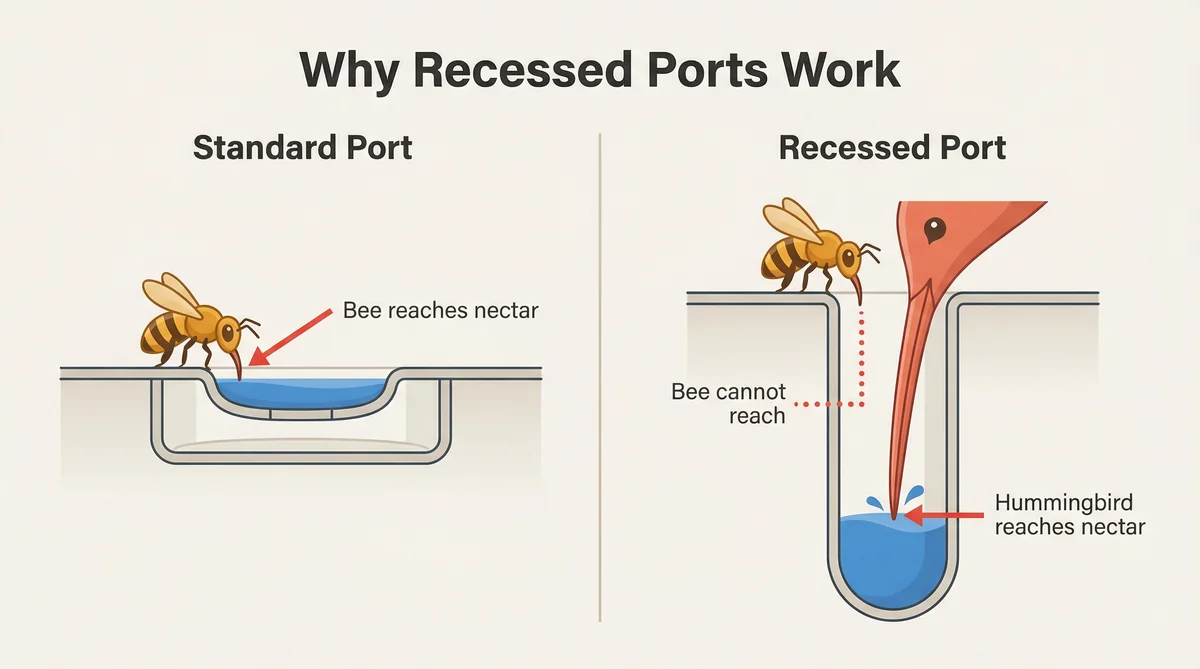
Bees and hummingbirds are both after the same thing: sugar water. But they access it differently. Hummingbirds have long, specialized tongues that can lap nectar from deep within flowers and feeders. Bees need to physically contact the liquid surface. That distinction is the entire engineering principle behind effective bee-proof design.
The second factor is color. Hummingbirds are strongly attracted to red — it's hardwired into their visual system, and the research on this is consistent. Bees, meanwhile, are strongly attracted to yellow. This explains why so many older feeder designs with yellow flower-shaped feeding ports were essentially bee magnets with a hummingbird feeder attached. The yellow accents were advertising to every bee within foraging distance.
The third factor is proximity. Nectar that drips, leaks, or pools around feeding ports creates accessible sugar surfaces that bees can reach without any specialized anatomy. A leaky feeder is an open invitation.
Effective bee-proof feeders address all three of these factors simultaneously. Feeders that only address one or two of them tend to disappoint.
The Design Features That Actually Keep Bees Out
Recessed Feeding Ports
This is the single most important feature to look for. In a well-designed bee-proof feeder, the feeding port sits recessed inside a small chamber or tube. The nectar level is kept low enough that a hummingbird's tongue can reach it, but a bee's shorter body cannot make contact with the liquid surface.
The physics here are simple and reliable. Bees aren't being deterred by smell or color or any behavioral trick — they're physically unable to reach the nectar. This is passive, permanent protection that doesn't degrade over time or require any maintenance.
When evaluating feeders, look for port designs described as "raised," "recessed," or featuring "insect guard tips." Nectar Guard tips — small flexible membranes that hummingbirds can push aside with their beaks but that spring back to block insect access — are another effective variation on this principle, available as both integrated features and aftermarket additions compatible with several popular feeder brands.
Leak-Proof and Drip-Free Construction
A feeder that leaks is a feeder that will have bees. Full stop.
Nectar pooling around the base of a feeding port, dripping down the exterior of the feeder, or collecting in the tray below creates exactly the accessible sugar surface that bees need. Quality bee-proof feeders use precision-engineered seals, flow-control designs, and tight tolerances to prevent this.
This is one area where construction quality genuinely matters. A $12 feeder with poor seals will undermine every other bee-deterrent feature it has. The mid-range options — roughly $19 to $35 — tend to hit the sweet spot where construction quality is sufficient to maintain a dry exterior without requiring you to spend premium prices.
Ant Moats
Ants are a separate problem from bees, but they're worth addressing in the same breath because the solution is integrated into most quality bee-proof feeders: the ant moat.
An ant moat is a small water-filled reservoir positioned above the feeder. Ants attempting to descend the hanging wire encounter the water barrier and can't cross it. It's elegantly simple and genuinely effective when properly maintained — the key phrase being "properly maintained." A dry ant moat is a useless ant moat. During hot weather, check the water level every day or two.
Most modern bee-proof feeders include integrated ant moats as a standard feature. If you're evaluating a feeder that doesn't have one, factor in the cost of a separate ant moat ($5 to $10) before comparing prices.
Color: Eliminate the Yellow
If your current feeder has yellow feeding ports or yellow flower accents, replacing those components — or replacing the feeder entirely — may solve a significant portion of your bee problem before you change anything else.
Red-colored feeders are substantially less attractive to bees. Many feeders now ship with red port covers specifically for this reason. If your feeder has removable yellow port covers, check whether the manufacturer sells red replacements. This is an inexpensive first step worth trying before investing in a new feeder.
The Best Bee-Proof Feeders by Category
Best Overall: Saucer-Style Feeders
Saucer feeders — flat, dish-shaped designs where the nectar sits in a shallow reservoir below the feeding ports rather than in a hanging bottle above them — have a structural advantage when it comes to bee exclusion.
Because the nectar sits below the ports, gravity doesn't push it toward the openings. The nectar level stays low in the dish, naturally recessed from the port openings. Hummingbirds hover and insert their beaks downward to feed; bees attempting to access the same ports can't reach the nectar surface.
After three years of testing four different feeder types — glass bottle, saucer, window-mounted, and decorative — the saucer design has consistently outperformed the others in both hummingbird traffic and bee resistance. The $16 red plastic saucer feeder that's been hanging for three years now handles roughly 80% of total hummingbird traffic in the yard, and bee intrusions are rare compared to the bottle-style feeders tested previously.
Saucer feeders in the $15 to $25 range from reputable brands offer solid construction and easy cleaning. The wide, shallow design means every surface is accessible during cleaning — important because nectar residue that isn't removed becomes a mold problem, and mold is harmful to hummingbirds.
Best Mid-Range: Feeders with Integrated Nectar Guard Tips
Several well-reviewed feeders in the $19 to $35 range incorporate Nectar Guard tips or equivalent flexible membrane systems directly into the port design. These feeders offer an extra layer of protection beyond recessed ports alone.
The eWonLife 2-Pack (typically around $20 to $25 for two 16-ounce feeders with five feeding ports each) and comparable FEED GARDEN 2-Pack options have accumulated thousands of verified reviews with ratings clustering around 4.4 out of 5 stars. The volume of real-world usage data behind these products — the eWonLife model has over 10,400 reviews — provides meaningful confidence that the bee-deterrent claims hold up in actual garden conditions.
Two-packs are worth considering for a specific reason: territorial spacing. Hummingbirds are aggressively territorial, and a single dominant bird will attempt to monopolize one feeder. Spacing two feeders at least 20 feet apart allows subordinate birds to feed without constant conflict. The cost per feeder in a quality two-pack is typically lower than buying two individual feeders separately.
Best Premium: Specialty Pest-Free Designs
Specialty retailers like Backyard Wild Birds and Birdwatchers Supply and Gifts carry feeders specifically engineered for comprehensive pest exclusion — ant resistance, bee protection, and wasp deterrence in a single design. These typically run $30 to $45 and feature polycarbonate construction, flow-control mechanisms, and raised port designs.
Polycarbonate construction offers durability advantages over standard plastic: better UV resistance, less warping over time, and more precise tolerances that maintain seal integrity through repeated temperature cycles. If you're in a climate with significant temperature swings between seasons, the material upgrade is worth the price difference.
These feeders also tend to be easier to clean thoroughly, which matters more than it might seem. Nectar should be changed every 3 to 5 days under normal conditions and every 2 to 3 days when temperatures exceed 75 degrees. A feeder that's difficult to clean properly will be cleaned less often, and stale or moldy nectar is actively harmful to hummingbirds.
Budget Option: Starting at $11.59
Walmart's dedicated hummingbird feeder category includes bee-resistant options starting around $11.59. At this price point, construction tolerances are less precise and bee exclusion is less reliable — but for a gardener who wants to test whether hummingbirds will visit a particular location before investing more, a budget feeder with red coloring and basic port design is a reasonable starting point.
The important caveat: inspect budget feeders for drips and leaks immediately after filling. If the feeder leaks, the bee problem will persist regardless of other design features.
What Doesn't Work (And Why)
Petroleum Jelly and Similar Deterrents
Coating feeder surfaces with petroleum jelly, cooking spray, or similar sticky substances to deter bees is a persistent piece of folk wisdom that causes real harm. These substances get onto hummingbird feathers and feet, compromising the feather structure they depend on for flight and temperature regulation. Avoid this approach entirely.
Fake Wasp Nests
Paper wasp nest decoys work on the principle that wasps are territorial and won't establish near an existing colony. The research on effectiveness is mixed, and they do nothing for honeybees or bumblebees, which don't share the same territorial instincts. Not harmful, but not a reliable solution.
Moving the Feeder
Moving a feeder to a new location when bees discover it can provide temporary relief — bees communicate specific locations back to the hive, and a moved feeder may confuse returning scouts long enough to break the foraging pattern. This is a legitimate short-term tactic, not a long-term solution. Hummingbirds will find the moved feeder quickly; bees will eventually rediscover it.
Insecticide Sprays Near Feeders
This should be obvious, but it bears stating: any pesticide application near a hummingbird feeder is dangerous to the birds. Beyond the direct toxicity risk, hummingbirds eat insects as a significant protein source. A yard treated with broad-spectrum insecticides offers hummingbirds nectar but removes the insects they need for complete nutrition.
The Coexistence Approach: A Better Frame
The most effective long-term strategy isn't elimination — it's coexistence through design.
Bees are essential pollinators facing serious population pressures. The goal of bee-proof hummingbird feeders isn't to harm bees or drive them from your yard; it's to direct them toward appropriate food sources while keeping the hummingbird feeder accessible to hummingbirds. This distinction matters both ecologically and practically.
A yard with native flowering plants provides bees with far superior nutrition compared to plain sugar water. Planting native species — particularly those that bloom in succession through the season — gives bees what they actually need while reducing their interest in the feeder. The Honey Bee Suite, a well-regarded resource on bee behavior, explicitly frames bee-proof hummingbird feeders as tools for peaceful coexistence rather than exclusion.
If bee pressure on your feeders is severe, consider whether nearby plantings might redirect foraging behavior. A patch of flowering herbs or native wildflowers positioned away from the feeder area can draw bee attention effectively. This isn't a replacement for a properly designed feeder, but it's a meaningful complement.
Maintenance: The Factor Most Reviews Don't Mention
The best bee-proof feeder on the market will underperform if it isn't maintained properly. Three maintenance practices make a significant difference:
Keep ant moats filled. Check water levels every one to two days in hot weather. An empty moat is no moat.
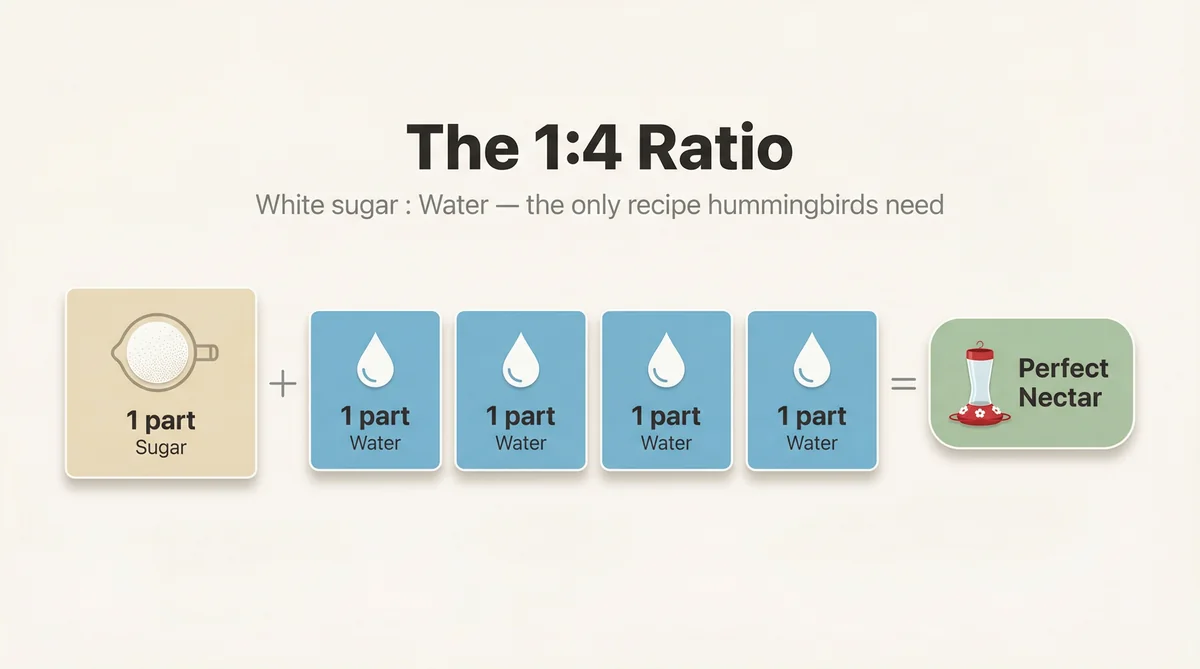
Change nectar on schedule. Every 3 to 5 days in normal conditions, every 2 to 3 days when temperatures exceed 75 degrees. Fermented nectar attracts more insects, not fewer, and is harmful to hummingbirds. The 1-part-sugar-to-4-parts-water ratio — made with plain white granulated sugar and no additives, no red dye — stays fresh longer than commercial nectars and costs approximately $4 per month at peak season usage.
Clean feeders thoroughly every two weeks. A dilute bleach solution of 1 part bleach to 9 parts water, followed by a complete rinse and full drying before refilling, prevents mold and nectar residue buildup that degrades both port seals and bee resistance over time.
The Bottom Line on Bee-Proof Hummingbird Feeders
The market has genuinely good options at every price point, but the features that matter are consistent: recessed or guarded feeding ports, leak-proof construction, red coloring without yellow accents, and integrated ant moats. A quality feeder in the $20 to $35 range addresses all of these requirements reliably.
Saucer-style feeders earn a particular recommendation for bee resistance because their design advantage is structural and passive — it works without any moving parts, membranes, or maintenance. The two-pack options from established brands offer solid performance at reasonable per-feeder cost, with the added benefit of enabling the territorial spacing that lets more birds feed successfully.
What won't work: sticky deterrents, insecticides, or any approach that harms the bees you're trying to redirect. The goal is a feeder that hummingbirds can use freely and bees cannot — not a feeder that harms either.
Get the design right, maintain it consistently, and the birds will handle the rest. Hummingbirds are remarkably good at finding reliable nectar sources and returning to them with impressive loyalty — the same territorial male has been arriving at exactly 6:47 AM for three consecutive seasons now, which suggests that once you solve the bee problem, you're likely to have very dedicated return customers.