Best Finch Feeders for Goldfinches and Thistle Seed
Best Finch Feeders for Goldfinches and Thistle Seed
There's a particular frustration that comes with setting up what should be a simple feeder situation and watching nothing happen. You've bought the nyjer seed. You've hung something that looks perfectly reasonable. And yet the goldfinches — those bright, acrobatic little birds you can see visiting three other yards on your street — won't come near it. The feeder just hangs there, full and ignored, while you spend another morning wondering what you're doing wrong.
Here's what's actually happening: goldfinches are picky in ways that aren't immediately obvious, and the finch feeder market has enough variation in design, quality, and seed compatibility that choosing the wrong one genuinely matters. The good news is that once you understand what these birds actually need from a feeder, the path forward gets much clearer. This guide covers the best finch feeders for goldfinches and thistle seed, how to evaluate the options honestly, and what to do once the feeder is hung to give yourself the best chance of success.
Key Takeaways
- Nyjer seed spoils within two months; replace it every four to six weeks to prevent birds from rejecting it.
- Mesh feeders allow 8–10 goldfinches to feed simultaneously, outperforming tube feeders for flock capacity.
- Position feeders within 3 feet of windows or more than 15 feet away to prevent fatal bird-window collisions.
- Cluster two or three feeders within a few feet of each other to increase goldfinch activity, unlike cardinals which need 20-foot spacing.
- Scrub feeders with a 10:1 water-to-bleach solution every two weeks and discard any clumped, moldy, or odorous seed immediately.
What Makes a Goldfinch Feeder Different
Goldfinches — American Goldfinches in particular — have small, pointed beaks adapted for extracting seeds from tight spaces. This beak design is the opposite of, say, a Northern Cardinal's thick conical bill, which evolved to crack open large seeds with significant force. A goldfinch beak is a precision tool, narrow and nimble, perfectly suited for nyjer (also sold as thistle seed) and other small seeds.
This beak morphology has a practical consequence for feeder design: goldfinches can use feeders that larger birds simply cannot navigate. A tube feeder with small ports, a mesh feeder with tight weave, or an upside-down feeder that requires hanging below the perch to eat — these all work for goldfinches because of how their beaks and bodies function. Larger nuisance birds like European Starlings (which weigh 2.5 to 3.5 ounces, compared to a goldfinch's roughly 0.4 ounces) are excluded not by mechanical force but by geometry.
Goldfinches are also highly social. The collective noun for a group of finches — a "charm" — tells you something about how they prefer to operate. They feed in flocks, and a single feeder that accommodates only two or three birds at once will underperform compared to one that lets eight or ten feed simultaneously. This is why mesh feeders, which allow birds to cling across the entire surface rather than queuing at fixed ports, often outperform tube feeders in raw bird-count terms.
Nyjer Seed: The Foundation Gets Complicated
Before discussing feeder designs, nyjer seed deserves its own section because it's where many setups fail silently. Nyjer — the small, black, oil-rich seed also marketed as thistle — is expensive relative to other seeds, and it spoils faster than most people realize.
Nyjer seed stored longer than two months loses significant oil content, and birds will reject it. This isn't a preference quirk; it's a nutritional response. Fresh nyjer is energy-dense in a way that makes it worth the effort for goldfinches to seek out. Stale nyjer is barely worth eating, and birds seem to know this. If you've hung a feeder and birds ignore it despite apparently good placement, stale seed is the first thing to check.
The practical implication: buy nyjer in quantities you can realistically use within four to six weeks. Buying in bulk to save money often costs more in discarded seed than it saves in per-pound price. Store what you have in a sealed container away from heat and humidity, and when in doubt, replace it. A bag of fresh nyjer costs a few dollars. An empty feeder costs you the birds.
Moisture is the other enemy. Wet nyjer molds quickly inside tube feeders, creating clogs that block seed flow and a health hazard for birds. If your feeder doesn't drain well or doesn't open easily for cleaning, wet weather will turn it into a problem fast. This is a design consideration, not just a maintenance one — and it's why drainage and cleanability should rank high on your feeder evaluation criteria.
The Four Feeder Types, Honestly Evaluated
Tube Feeders
The classic finch feeder design: a long, narrow plastic or polycarbonate tube with small ports and perches sized for finches. Tube feeders are good at controlling seed flow and limiting access to small-beaked birds, which makes them naturally selective without any additional hardware.
The weakness is cleaning. Narrow tubes are genuinely difficult to sanitize thoroughly, and wet or moldy seed in the lower sections can go unnoticed for days. Look specifically for models that open at the bottom for drainage and cleaning access, or that include a cleaning brush. A feeder you can't clean properly is a feeder that will eventually harm the birds you're trying to attract.
The Droll Yankees Nyjer Tube is the benchmark here. It's built from polycarbonate and metal rather than cheap injection-molded plastic, includes drainage ports at the bottom, and comes with a lifetime warranty — a meaningful signal of build confidence. At 2-pound capacity, it handles a reasonable volume without requiring daily refills. It's not the cheapest option, but it's the one most likely to still be functioning in five years.
For budget-conscious setups, the Stokes Select "Little-Bit" feeder is worth knowing about. At 0.5-pound capacity, it's genuinely compact and inexpensive, which makes it a reasonable starting point or a supplementary feeder for a multi-station setup. The limitation is obvious: smaller capacity means more frequent refills, which matters if you're filling during peak season when goldfinch activity is high.
Mesh Feeders
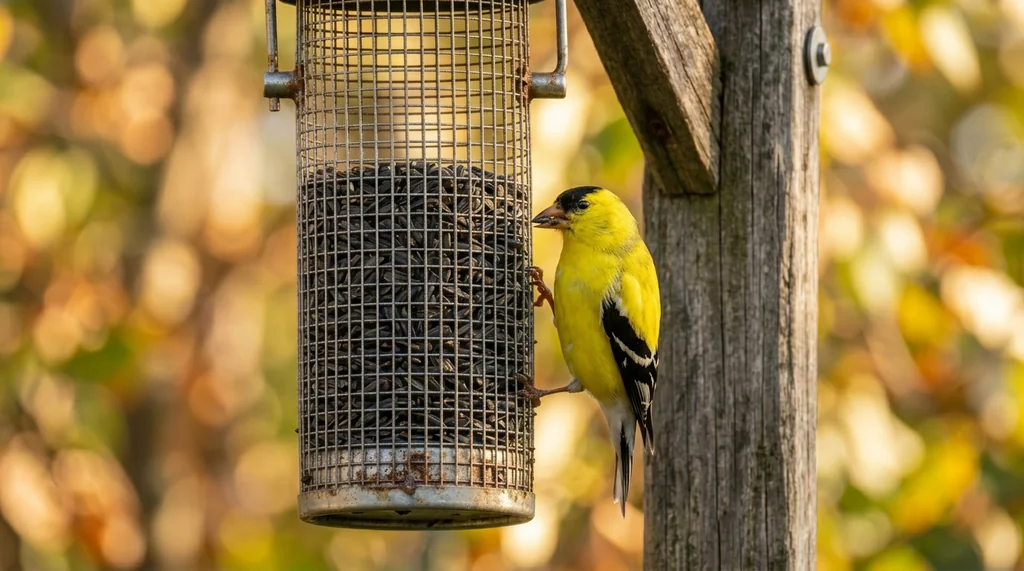
Mesh feeders are constructed from metal mesh rather than solid material with drilled ports. Birds can cling to the entire exterior surface, which means a charm of goldfinches can feed simultaneously rather than competing for a fixed number of perches.
For flocks, mesh feeders are often the most efficient design available. The open structure also allows air circulation around the seed, which reduces the moisture buildup that causes mold in enclosed tubes. From a cleaning standpoint, mesh feeders are generally easier to disassemble and scrub than narrow tubes.
The Perky Pet No/No Finch feeder is the most frequently cited mesh option. It's constructed entirely from metal — no plastic components — and includes an inner baffle system that helps manage seed flow. At 1.5-pound capacity and 100% metal construction, it's reasonably durable and handles flock feeding well. "No/No" refers to no plastic and no wood, which the manufacturer positions as a longevity and hygiene claim. In practice, all-metal construction does resist the cracking and fading that affects plastic feeders in UV exposure over time.
Sock Feeders
Sock feeders are inexpensive mesh-bag style feeders, typically disposable or semi-disposable. They're popular as starter options because they cost almost nothing and goldfinches take to them readily.
The safety concern here is real and worth stating plainly: sock feeders must be inspected regularly and discarded immediately if they develop any tears. Birds can become fatally entangled in torn mesh. This isn't a theoretical risk — it happens. Sock feeders are not appropriate for extended use without consistent monitoring, and if you're not checking them every few days, they're not appropriate at all. For occasional supplementary use with attentive monitoring, they're fine. As a primary feeder left unattended for weeks, they're a liability.
Upside-Down Feeders
Upside-down feeders require birds to hang below the perch to access seed — a position that goldfinches manage easily and that larger nuisance birds like grackles and starlings cannot sustain. This design is specifically effective at excluding the birds most likely to raid a nyjer feeder: grackles, which are heavy and cannot feed comfortably inverted, and starlings, which use a prying beak motion that doesn't work from below.
If starling pressure is a problem in your yard — and in many areas, with over 200 million European Starlings across North America, it is — an upside-down feeder solves the problem without cages, baffles, or weight-activated mechanisms. The trade-off is that some birds that could benefit from nyjer, including certain sparrow species, also struggle with the inverted position. For goldfinch-specific feeding, this is rarely a concern; goldfinches adapt to the position quickly and often seem to prefer it once they learn it.
Placement: The Variables That Actually Matter
A well-chosen feeder in the wrong location will underperform a mediocre feeder in the right location. Placement affects bird safety perception, seed quality, and squirrel access simultaneously.
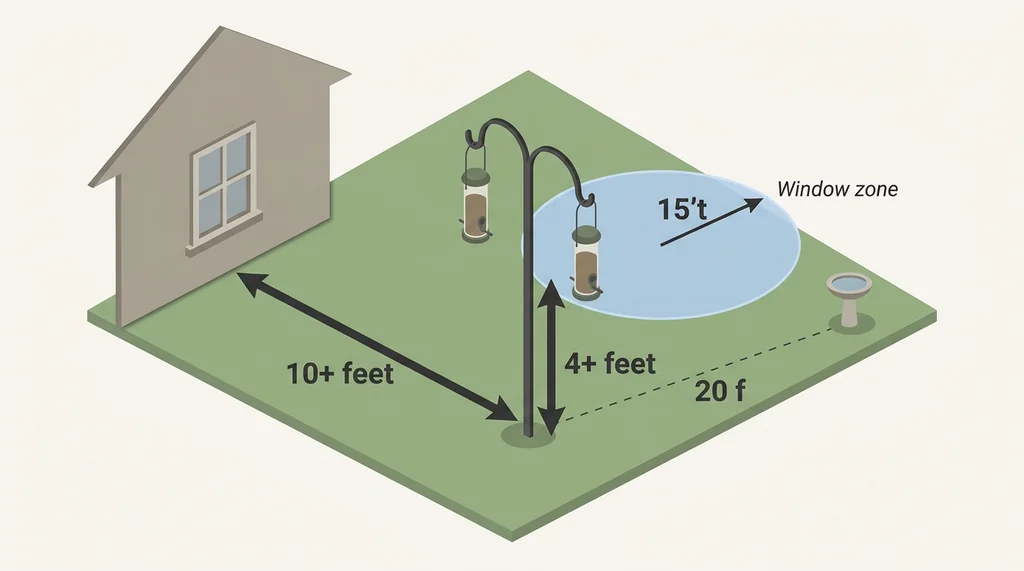
Height: Hang finch feeders at least 4 feet above the ground. This provides birds with adequate sightlines and limits ground-level predator access. There's no strong evidence that goldfinches prefer specific heights the way cardinals prefer 5 to 6 feet, but keeping feeders well off the ground is basic best practice.
Distance from structures: Maintain at least 10 feet between the feeder and tree trunks, fence posts, or other structures a squirrel could use as a launching point. Squirrels can leap horizontally up to ten feet, so anything closer than that is an invitation. Unlike nyjer seed, which squirrels find less appealing than sunflower seeds, the feeder itself can still be damaged or knocked down by persistent squirrel activity.
Window placement: Position feeders either within 3 feet of windows or more than 15 feet away. The danger zone sits between those distances — at 3 to 10 feet, birds build enough speed to sustain fatal impact if they flush from the feeder toward a window reflection. Closer than 3 feet, they don't have room to reach dangerous velocity. This applies to finch feeders exactly as it does to any other feeder type.
Clustering: Because goldfinches are social feeders, clustering multiple feeders together increases activity more than spreading them across the yard. For seasonal patterns and timing tips, see our goldfinch attraction guide. Unlike cardinals, which require at least 20 feet of spacing between feeders to reduce territorial conflict, goldfinches actively prefer to feed near other goldfinches. Two or three feeders within a few feet of each other will attract more birds than the same feeders placed at opposite ends of the yard.
Attraction Strategies Beyond the Feeder Itself
Color
There's some evidence that yellow feeders attract goldfinches more readily than other colors, likely because goldfinches associate yellow with flowers — their natural foraging environment. This is a single-source claim and shouldn't be treated as established science, but it costs nothing to consider when choosing between otherwise equivalent options. The Perky Pet Solar Finch feeder, which features a decorative lighthouse design with LED lighting, plays in this territory aesthetically, though its primary appeal is visual rather than functional.
Water
A shallow birdbath positioned within 20 to 30 feet of your feeding station meaningfully increases yard attractiveness for goldfinches year-round. Goldfinches bathe frequently, and a reliable water source can draw them to your yard even when natural seed sources are abundant. Keep the water fresh — changing it every two to three days prevents mosquito breeding and keeps the water appealing.
Patience
New feeders often sit empty for up to two weeks before birds discover them, particularly when natural food sources are abundant. This is normal behavior, not a sign of failure. Goldfinches are cautious about new objects in familiar territory and may observe a feeder from a distance for days before approaching. Resist the urge to move the feeder if birds haven't appeared within the first few days — moving it resets the discovery clock.
Cleaning and Maintenance: The Part People Skip
Feeder hygiene directly affects bird health and feeder longevity, and it's the part of finch feeding that gets neglected most often. The standard protocol is a 10:1 water-to-bleach solution — one part bleach to nine parts water — used to scrub the feeder thoroughly, followed by complete rinsing and drying before refilling. Do this every two weeks minimum, more frequently during wet weather when mold risk is elevated.
Replace nyjer seed every few weeks regardless of whether it looks depleted. Seed at the bottom of a tube feeder can become compacted and damp while the top portion looks fine. If you see any mold — black or green discoloration, clumped seed, unusual odor — discard all the seed, sanitize the feeder with the bleach solution, and start fresh. Do not add fresh seed on top of potentially compromised seed.
Tube feeders with bottom-opening designs make this process significantly easier. If you're choosing between two otherwise comparable tube feeders, the one that opens at the bottom for cleaning access is the better long-term choice.
Comparing the Top Models
| Model | Best For | Capacity | Key Advantage |
|---|---|---|---|
| Droll Yankees Nyjer Tube | Long-term primary feeder | 2 lbs | Lifetime warranty, drainage design |
| Perky Pet No/No Finch | Flock feeding, durability | 1.5 lbs | 100% metal, mesh surface |
| Perky Pet Solar Finch | Aesthetic setups | 1.5 lbs | Decorative design, LED feature |
| Stokes Select "Little-Bit" | Budget starts, supplementary | 0.5 lbs | Low cost, compact |
The Droll Yankees Nyjer Tube earns its status as the most-recommended option through build quality and practical design rather than features. The lifetime warranty isn't marketing language — it reflects construction from polycarbonate and metal components that genuinely outlast plastic alternatives. For a primary feeder that will see daily use through multiple seasons, this is where the value calculation lands clearly.
The Perky Pet No/No is the better choice if flock capacity is the priority. Its mesh surface allows more simultaneous feeding positions than any tube design, and all-metal construction handles weather exposure without the cracking or yellowing that affects plastic over time.
The Stokes Select "Little-Bit" serves a different purpose: it's the right feeder when you're testing a new location, adding a supplementary station to an existing setup, or working within a tight budget. Its small capacity is a limitation for primary use but a non-issue as a secondary feeder.
Building a Setup That Actually Works
The most effective goldfinch feeding setups combine two or three feeders rather than relying on a single station. A mesh feeder as the primary flock feeder, paired with a quality tube feeder for sustained seed availability, gives you both high-capacity social feeding and reliable seed access during quieter periods. Add fresh water nearby, position everything within a few feet of each other, and maintain a consistent cleaning schedule.
Budget for fresh nyjer regularly — this is not a seed you can buy once and forget. The cost of stale seed that birds won't touch is higher than the cost of buying fresh seed on a reasonable rotation.
The best finch feeders for goldfinches and thistle seed are the ones you'll actually maintain. A $90 tube feeder that goes uncleaned for two months is a worse investment than a $25 mesh feeder that gets scrubbed every two weeks. Start with quality you can sustain, establish the maintenance habit, and the birds will follow.
Goldfinches reward consistency. A yard that offers fresh seed, clean feeders, and reliable water will see increasing activity over weeks and months as local birds incorporate it into their regular circuit. The charm, once established, tends to grow.