Chickadee Feeders: Types, Seeds, and Placement
Chickadee Feeders: How to Attract These Friendly, Fearless Birds
Of all the birds that might visit your backyard, chickadees are the ones most likely to make you feel genuinely chosen. They're small enough to fit in your palm, bold enough to land within arm's reach, and curious enough to investigate you just as thoroughly as you're investigating them. Set up the right chickadee feeders, and within days you'll have a regular flock of these tiny acrobats treating your yard like their personal headquarters.
The good news: attracting chickadees is considerably more forgiving than attracting many other species. They're adaptable, adventurous, and not particularly fussy about feeder design. The less good news: "not particularly fussy" doesn't mean "anything goes." There's a real difference between a yard that chickadees visit occasionally and one they return to dozens of times per day, and that difference comes down to understanding how these birds actually think and move through their world.
Key Takeaways
- Black oil sunflower seeds and shelled peanuts are the two most effective foods for attracting and retaining chickadees at feeders.
- Tube feeders with metal ports suit chickadees' grab-and-go caching behavior better than open platform feeders.
- Place feeders within 10–15 feet of shrubs or trees, and run two or three stations to accommodate a flock's dominance hierarchy.
- A heated birdbath ($25–$35) can attract chickadees more reliably in winter than any feeder alone.
- Position feeders either within 3 feet of windows or more than 10 feet away to avoid the fatal-velocity danger zone.
Understanding Chickadee Behavior Before You Buy a Single Feeder
Chickadees don't just eat at feeders — they cache food at feeders. This is the behavioral quirk that makes them different from most backyard birds and the reason a well-stocked chickadee station can look surprisingly busy even when only a handful of birds are present.
A black-capped chickadee, the most widespread North American species, can cache up to several hundred individual food items per day during fall and winter. Each seed or nut gets tucked into a separate hiding spot — under bark, in crevices, among leaf litter — and the bird remembers each location for up to 28 days. The hippocampus of a chickadee, the brain region responsible for spatial memory, actually grows larger in autumn to accommodate this extraordinary cognitive demand. You're not just feeding birds. You're supplying a distributed pantry that keeps a small animal alive through cold snaps and ice storms.
This caching behavior has a practical implication for feeder design: chickadees strongly prefer to grab one item and fly off rather than linger. They're not platform feeders by nature. They want a perch, a quick grab, and an exit. Tube feeders and small hopper feeders suit this rhythm far better than open trays, though chickadees will use almost anything if the food is right.
The other behavioral reality worth knowing: chickadees are flock birds in winter, operating in small groups of six to twelve individuals with a clear dominance hierarchy. Higher-ranking birds eat first. Lower-ranking birds wait their turn or find a second station. If you want to attract and hold a full winter flock, having two or three feeder stations spaced around your yard matters more than having one perfect feeder.
The Best Feeder Types for Chickadees
Tube Feeders
The standard tube feeder with multiple small perches is probably the most chickadee-friendly design available. The perches are appropriately sized for a bird that weighs roughly 11 grams — about the same as two nickels. The ports dispense seeds one at a time, which suits the grab-and-go caching style perfectly. And the enclosed design keeps seeds dry, which matters significantly for food quality.
Look for tube feeders with metal ports rather than plastic. Chickadees are persistent and curious, and plastic ports get chewed and cracked over time. Metal ports last years longer and maintain a cleaner feeding edge that doesn't harbor bacteria. A tube feeder in the $25 to $40 range with metal components will outlast three or four cheaper plastic versions.
One feature worth seeking: an upside-down chickadee feeder, sometimes called an anti-starling feeder. Chickadees are acrobatic enough to feed while hanging inverted; starlings and house sparrows are not. If pest species are competing with your chickadees, an inverted feeder design solves the problem without any complicated baffling system.
Small Hopper Feeders
Hopper feeders work well for chickadees as a secondary station, particularly if you're also trying to attract other small songbirds simultaneously. The key is choosing a hopper with perches that extend far enough from the feeder body that a chickadee can land comfortably without being crowded. Hoppers that are designed primarily for larger birds — with wide platforms and big openings — tend to attract house sparrows and starlings in numbers that crowd out the chickadees you actually want.
A hopper feeder also gives you the option to offer a seed mix rather than a single seed type, which can be useful during winter when you want to support multiple species. More on seed selection below.
Suet Feeders
This one surprises people: chickadees are enthusiastic suet consumers, especially during winter when caloric demands are highest. A chickadee needs to eat roughly 35% of its body weight daily in cold weather just to maintain body temperature overnight. Suet — rendered animal fat, often mixed with seeds or nuts — delivers concentrated calories that seeds alone can't match.
A basic wire suet cage costs around $5 to $8 and will last for years. Position it near your tube feeder rather than far away; chickadees that are already visiting one station will readily investigate another within ten to fifteen feet. Suet that contains peanuts, sunflower chips, or mealworms tends to attract chickadees faster than plain suet cakes, though plain suet will work once they've discovered the station. If you're adding suet to your yard, our guide to the best suet feeders for woodpeckers covers feeder designs that chickadees benefit from as well.
During summer, opt for no-melt suet formulations. Standard suet can liquefy in heat above 90°F, becoming rancid and potentially harmful. No-melt versions are processed differently and hold their shape in warmer temperatures.
Seed Selection: What Chickadees Actually Want
Black Oil Sunflower Seeds
The single most effective seed for chickadees is black oil sunflower seed — the same seed that dominates for cardinals and most other backyard songbirds. The thin shell is easy for a small beak to crack, the kernel inside is energy-dense, and the seed size is perfect for carry-and-cache behavior. If you stock nothing else, stock this.
Sunflower chips (the shelled kernel only) are even more efficient because there's no cracking required and no shell debris accumulating beneath your feeder. They cost slightly more per pound but produce less waste and attract a wider range of small birds, including species that can't manage whole seed shells.
Peanuts
Shelled peanuts or peanut pieces are arguably chickadees' favorite food when available. The fat and protein content is exceptional, which makes peanuts particularly valuable during cold weather. Offer them in a dedicated peanut feeder — a mesh tube or spiral wire design that lets birds extract pieces — or mix peanut pieces into a hopper feeder alongside sunflower seeds.
Whole peanuts in the shell are too large for chickadees to carry efficiently, though they'll occasionally work at one on a platform. Stick with pieces or halves for a chickadee-focused setup.
Nyjer (Thistle) Seed
Nyjer is primarily a finch food, but chickadees will eat it. It's not worth buying specifically for chickadees, but if you're already running a nyjer feeder for goldfinches or pine siskins, don't be surprised when chickadees show up to investigate. The seeds are small enough for their beaks and deliver reasonable fat content.
What to Avoid
Milo, wheat, and cracked corn fill cheap mixed seed bags but hold almost no appeal for chickadees. They'll pick around these fillers looking for sunflower seeds, and the rejected seed accumulates beneath your feeder, creating a moldy mess that can harbor disease. Spending more on quality seed costs less in the long run than buying cheap mixes that mostly end up on the ground.
Feeder Placement for Maximum Chickadee Activity
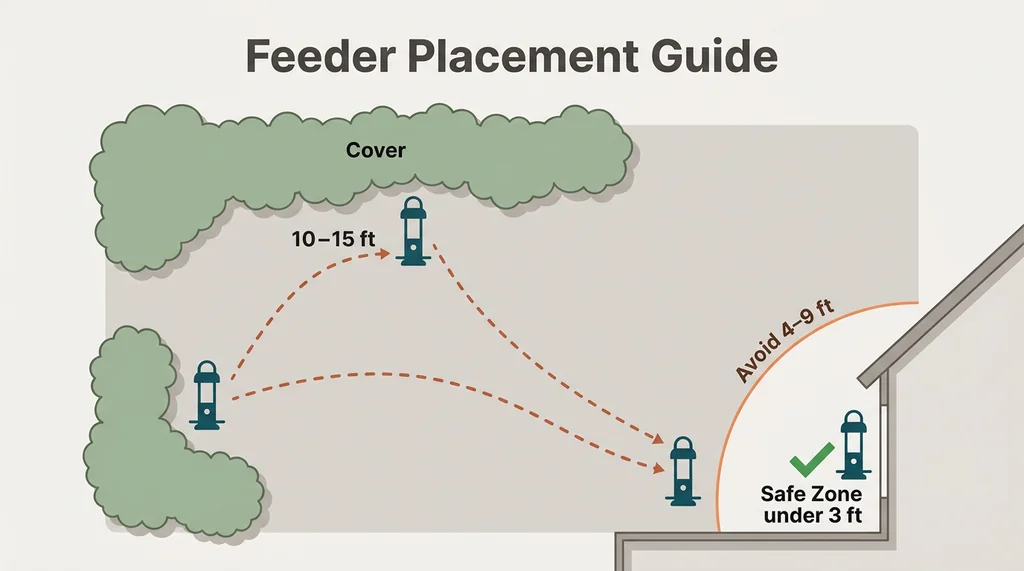
Chickadees prefer to feed near cover, though they're bolder about venturing into open spaces than most songbirds. Positioning your feeder within ten to fifteen feet of shrubs, trees, or dense plantings gives them a quick escape route and makes them more comfortable spending time at the station. A feeder in the middle of an open lawn will attract fewer visits than the same feeder near a hedgerow or garden bed.
Height matters less for chickadees than for ground-feeding species. They're comfortable at nearly any height from about four feet up to canopy level, but feeders between five and eight feet tend to be easiest to maintain and observe.
Window proximity is worth thinking through carefully. Feeders placed within three feet of a window are actually safer than those placed four to nine feet away — at very close range, birds don't build up enough velocity to injure themselves if they do fly toward the glass. The danger zone is that middle distance, where a startled bird can reach fatal speed before impact. Either tuck the feeder right up close to the window (which also gives excellent viewing) or position it more than ten feet away.
Water: The Often-Overlooked Chickadee Magnet
Chickadees need water year-round, and a reliable water source can attract them more reliably than any feeder. During winter, when natural water sources freeze, a heated birdbath becomes genuinely valuable — not just nice to have. A simple submersible birdbath heater costs around $25 to $35 and keeps a small basin ice-free through temperatures well below freezing.
Moving water attracts birds faster than still water. A small dripper or water wiggler that creates surface ripples costs around $15 to $20 and makes your birdbath visible and audible to birds flying overhead. Chickadees locate water partly by sound, and the sound of dripping or splashing carries surprisingly far through a quiet yard.
How Long Before Chickadees Find Your Feeder
New feeders often sit empty for days or even weeks while local birds assess them. This is completely normal. Chickadees are curious but not reckless — they'll watch a new object in their territory for some time before committing to it. Placing your feeder in an established location near existing shrubs or trees speeds this process, as does adding a small amount of seed directly on top of or around the feeder to make the food source obvious.
Once one chickadee discovers the station, others from the same flock follow quickly. The first visit is the hardest to earn. After that, you'll likely have daily visitors within a week, and by the second or third week, you'll start recognizing individual birds by their behavior and the slight variations in their markings.
That familiarity — the moment you realize you're watching the same bird you watched yesterday, and the day before — is when chickadee feeding stops being a hobby and starts being something closer to a relationship. These small, bold, memory-gifted birds have a way of making a yard feel genuinely inhabited, and the right feeder setup is all it takes to invite them in. For a broader look at feeder types and how they serve different species, see the complete guide to bird feeders.