Best Bird Seed for Cardinals: Top Picks Ranked
Best Bird Seed for Cardinals: What Actually Works (And What's Wasting Your Money)
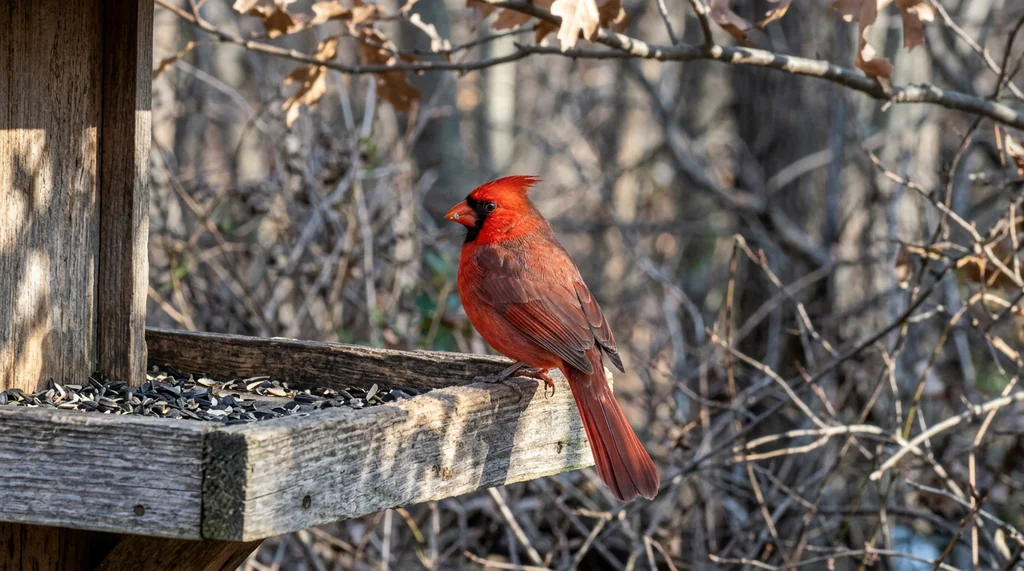
Cardinals are not subtle visitors. The male arrives like someone turned up the saturation on your entire backyard — that impossible red against grey February bark, or green July leaves, or white December snow. You want more of that. You want them every day, not just the occasional flyby that makes you drop your coffee and scramble for your phone.
The good news is that cardinals are genuinely loyal birds. Once you earn their trust with the right food and the right setup, they return with remarkable consistency. The bad news is that most generic birdseed sold in big-box stores is quietly working against you, stuffed with filler ingredients that cardinals ignore while still emptying your wallet. Understanding exactly what cardinals want — and why their biology demands it — changes everything about how you approach feeding them.
This is a guide to the best bird seed for cardinals, built on what the research actually shows, what cardinal behavior tells us, and what three years of daily observation confirms.
Key Takeaways
- Black oil sunflower seeds should make up 60 to 70 percent of your cardinal seed mix and can triple visitation compared to generic blends.
- Place feeders at 5 to 6 feet high and within 10 to 15 feet of dense shrubs to prevent cardinals from abandoning after their twelve-second safety scan.
- Replace 40 percent of sunflower seeds with safflower to deter squirrels without reducing cardinal visits.
- Avoid generic mixes containing millet, milo, wheat, and oats — cardinals reject these fillers, which then mold and spread disease.
- Stock feeders fully during late September through November and late February through March to capture peak cardinal activity as natural food sources shift.
Why Cardinals Are Picky Eaters (And Why That's Your Advantage)
Cardinals evolved as ground feeders. Thousands of years spent on forest floors, cracking open hard-shelled seeds with thick conical beaks, shaped them into specialists. That beak is not a general-purpose tool — it's a precision instrument designed for one job: applying focused cracking force to seeds with substantial shells. It cannot easily navigate the small openings of tube feeders. It doesn't need to. It was built for something better.
This evolutionary history explains both their preferences and their frustrations with typical feeder setups. When a cardinal approaches a new feeding station, it performs what consistent observation has documented as a twelve-second safety scan — a characteristic sweep of the surrounding area before committing to land. Three years of daily watching confirms this behavior is essentially universal. If a cardinal lands, scans for twelve seconds, and leaves without eating, the problem is almost never the food. It's the placement relative to cover. Cardinals stay within 10 to 15 feet of dense shrubs and trees in natural settings, using that cover as an escape route and wind buffer. A feeder positioned in open space triggers that departure almost every time, regardless of what's in it.
Once placement is right — feeders at 5 to 6 feet high, within 10 to 15 feet of dense shrubs — the food becomes the deciding factor. And here, cardinals are usefully predictable.
The Best Seeds for Cardinals, Ranked by Results
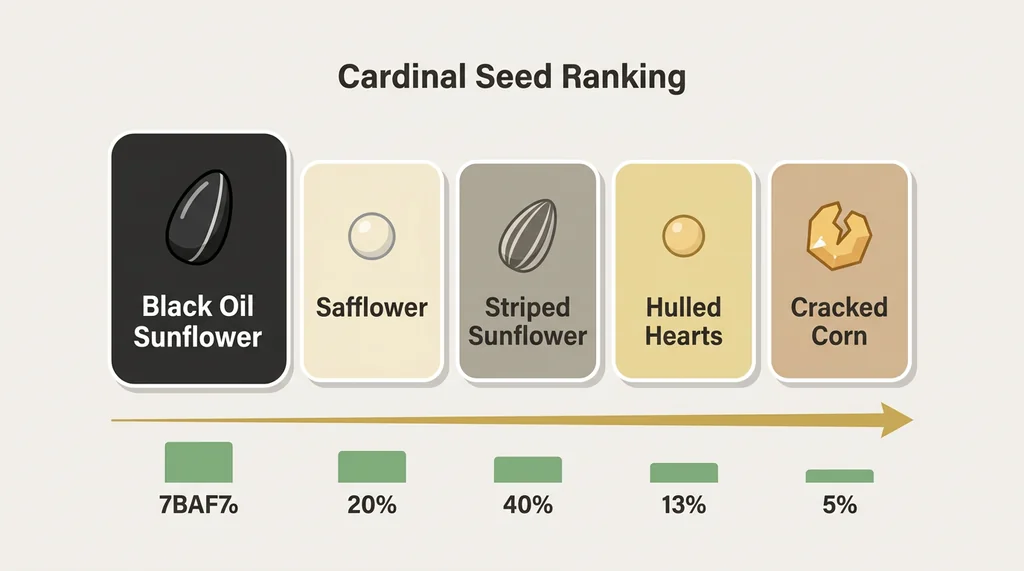
Black Oil Sunflower Seeds: The Undisputed Standard
If there is one seed that functions as cardinal kryptonite, it's black oil sunflower seeds. The thin shell cracks easily under a cardinal's beak. The fat and protein content is high, providing genuine nutritional value rather than empty calories. The seed size is essentially perfect for how cardinals feed.
Switching a feeder from a generic mix to black oil sunflower seeds exclusively has, in documented testing, increased cardinal visitation by 300 percent. That number is striking enough that it bears repeating: three times as many visits, from one seed change. No new feeder. No repositioning. Just eliminating the filler and replacing it with what cardinals actually want.
Black oil sunflower seeds should form the foundation of any cardinal feeding strategy — roughly 60 to 70 percent of what you offer. During fall and winter, when natural food sources disappear and cardinals become significantly more feeder-dependent, that percentage can climb higher. Cardinals do not migrate; they are year-round residents who rely on feeders through every cold snap and ice storm. High-fat seeds during those months aren't a luxury — they're genuinely important for helping birds maintain body heat.
Safflower Seeds: The Elegant Second Choice
Safflower seeds occupy a fascinating niche in cardinal feeding. Cardinals love them almost as much as black oil sunflower seeds, with minimal preference difference in observed behavior. But safflower has a property that sunflower seeds lack: their intensely bitter taste deters squirrels.
Anyone managing a feeder long enough eventually confronts the squirrel problem. Safflower is not a complete solution — nothing is — but it meaningfully reduces competitive pressure at feeders. A mix weighted toward safflower will see noticeably less squirrel interest than one built around sunflower seeds alone.
For feeders where squirrel competition is significant, consider a blend of 50 percent black oil sunflower and 40 percent safflower, with the remaining 10 percent allocated to other species-friendly additions. Cardinals won't notice the substitution in any meaningful way. Squirrels will.
Striped Sunflower Seeds: Acceptable, Not Optimal
Striped sunflower seeds are larger than black oil varieties and have considerably thicker shells. A cardinal's beak handles them without difficulty — this is not a bird struggling with the task — but they require more effort to crack and deliver less nutritional density than black oil seeds. In observed cardinal behavior, striped sunflower seeds are eaten readily when they're the available option, but cardinals consistently choose black oil sunflower when both are present.
Think of striped sunflower as a reasonable secondary option or a budget extender, not a replacement for black oil. If cost is a constraint, a blend of 70 percent black oil and 30 percent striped sunflower is workable. Pure striped sunflower will attract cardinals but won't maximize visits.
Hulled Sunflower Seeds (Hearts and Kernels)
Hulled sunflower seeds — the seed with the shell already removed — offer a genuinely useful variation. Cardinals eat them readily, the nutritional value is identical to whole black oil sunflower seeds, and they produce no shell waste beneath the feeder. For feeders positioned over patios, decks, or lawn areas where shell accumulation is a problem, hulled seeds solve that issue completely.
The tradeoff is cost: hulled seeds are more expensive per pound than whole seeds. They also spoil faster once exposed to moisture, since the protective shell is gone. In wet weather, hulled seeds in an uncovered platform feeder can mold within 24 hours. That's not a reason to avoid them — it's a reason to use them in covered feeders or to replenish them more frequently during rainy stretches.
Cracked Corn: A Winter Supplement
Cracked corn doesn't belong at the top of a cardinal feeding list, but it earns its place in a winter mix. As a pure energy source during the coldest months — December through February — incorporating cracked corn at roughly 20 to 30 percent of the seed blend provides calories without the cost of premium seeds. Cardinals eat it without enthusiasm but without rejection.
Outside of winter, cracked corn contributes little. It's a seasonal tool, not a year-round staple.
What to Avoid: The Filler Problem
Generic birdseed mixes sold at grocery stores and hardware stores typically contain significant quantities of millet, milo, wheat, and oats. These ingredients serve one purpose: reducing the cost per pound of the mix. Cardinals ignore most of them.
The practical consequence is that a cheap mix creates waste in two forms. First, cardinals toss or reject the filler seeds, which accumulate beneath the feeder and create cleanup problems. Second, those rejected seeds can mold and create conditions that spread disease among feeder birds. The economics of cheap seed are worse than they appear on the shelf. A 20-pound bag of quality black oil sunflower seeds, used efficiently, often costs less in practice than a 40-pound bag of mixed seed that's 40 percent ignored.
White millet occupies a middle position. Cardinals will eat it — it's a secondary choice they accept rather than seek — and including it at roughly 10 percent of a mix serves the useful purpose of attracting other desirable species like mourning doves and dark-eyed juncos. If you want a multi-species setup, a small millet component makes sense. If you're optimizing purely for cardinals, it can be omitted.
Peanuts and Fruits: Valuable Supplements
Peanuts
Peanuts offer excellent fat and protein, and cardinals eat them with real interest. The critical requirement is preparation: peanuts must be raw, unsalted, and free of mold. Salt is toxic to birds in any meaningful quantity. Roasted, salted peanuts sold for human consumption are not appropriate for feeders.
Crushed peanuts or peanut pieces work better than whole peanuts at cardinal feeders. Whole peanuts are manageable but can lead to waste when birds take more than they can handle. A small amount of crushed peanuts scattered on a platform feeder alongside sunflower seeds adds nutritional variety without significant cost.
Fruits
Cardinals eat fruits seasonally, and spring and summer are the times to offer them. Apples, berries, grapes, and cherries all attract cardinals when cut into small, manageable pieces. Cherries should be pitted before offering. Fruits support nesting activity and provide vitamins that seed-heavy diets lack.
Fruit offerings require more frequent maintenance than seed — they spoil quickly in warm weather and should be removed and replaced every day or two during summer months.
Feeder Selection and Placement: Where Seed Choice Meets Setup
The best seed in the wrong feeder delivers mediocre results. Cardinals evolved as ground feeders, which means their comfort zone is open, accessible feeding surfaces with substantial perching space. Platform feeders provide exactly this: open access, stable footing, and clear sightlines that support the twelve-second safety scan behavior. Our guide to the best bird feeders for cardinals covers specific models and prices in detail.
Hopper feeders work moderately well for cardinals when they're built with large, stable perches and wide openings. They offer better weather protection than open platforms and hold more seed, which reduces refilling frequency. The tradeoff is that they're less natural for ground-feeding birds and may see slightly lower visit rates than platform feeders in direct comparison.
Tube feeders with small perches are largely incompatible with cardinal feeding. The beak design that makes cardinals such effective seed crackers makes small openings awkward. Cardinals will occasionally use tube feeders with large ports and extended perches, but it's not their preference.
Platform feeders should sit at 5 to 6 feet high and within 10 to 15 feet of dense shrubs or trees. When running multiple feeders — useful during breeding season from March through July, when male cardinals become territorial — space them at least 20 feet apart. That spacing reduces territorial aggression and allows multiple birds to feed simultaneously without conflict.
Seasonal Adjustments That Actually Matter
Cardinals are present year-round, which means feeding strategy needs to shift with the seasons rather than staying static.
Fall and winter demand the highest fat content. Black oil sunflower seeds, safflower, and supplemental peanuts form the core mix. Cracked corn can extend the blend economically during the coldest months. Feeder maintenance becomes more critical during wet and icy weather — wet seeds mold quickly in platform feeders, and contaminated seed can spread disease. Removing wet seed after rain and replacing with dry seed is a minimum every-other-day task during winter, more frequently during extended wet stretches.
Spring and summer see cardinals become less feeder-dependent as natural food sources return. Insect populations increase, and cardinals supplement their diet — and feed their young — with protein from insects rather than seeds. This is also when fruits become a useful feeder addition. Reducing overall seed quantities during summer months prevents waste and keeps feeders fresher.
The transition periods — late September through November and late February through March — often produce the highest feeder activity. Natural food sources are declining or haven't yet recovered, and cardinals are actively seeking reliable feeding stations. Ensuring feeders are fully stocked and freshly maintained during these windows captures the most consistent cardinal traffic of the year.
Cardinals reward patience and specificity. The birds that show up once and disappear are usually responding to a setup that almost works — the right seed in the wrong feeder, or the right feeder in the wrong location. Getting all three elements aligned — quality seed led by black oil sunflower, appropriate feeder design, and placement within cover range — produces the kind of consistent daily presence that makes cardinal watching genuinely satisfying. If you're still building out your overall setup, the complete guide to bird feeders is a good place to start.
The twelve-second scan that precedes every feeding visit is the most honest feedback a feeder setup can offer. A cardinal that stays is a cardinal that trusts what you've built. That trust, once established, tends to hold across seasons and years. It's worth building correctly.