Best Bird Feeders for Cardinals: What Actually Works
Best Bird Feeders for Cardinals: A Practical Guide to What Actually Works
Northern Cardinals are not difficult birds. They're not shy, they're not picky in the way that, say, a hummingbird is picky. They're just specific. And the difference between a yard full of brilliant red visitors and a yard they ignore entirely often comes down to one thing: whether your feeder was designed with a cardinal's body in mind.
After three years of daily observation, a dedicated tripod setup at the kitchen window, and more feeder purchases than any reasonable spreadsheet should contain, here's what the research and experience consistently confirm: most feeders on the market are built for small birds. Cardinals are not small birds. They weigh between 1.5 and 1.7 ounces, carry thick conical beaks that evolved for cracking seeds on forest floors, and need a stable, open perch that lets them face forward while they eat. Give them that, and they'll come. Withhold it, and they'll watch your neighbors' feeders instead.
This guide covers the feeder types that work, the specific models worth buying, the seed choices that matter, and the placement details that most guides skim over. Cardinals are year-round residents — they don't migrate, which means they're dependent on your setup through every cold snap from November through March. Getting it right pays off in every season.
Key Takeaways
- Cardinals require a stable, open perch at 5–6 feet high within 15 feet of dense cover to feel safe enough to feed regularly.
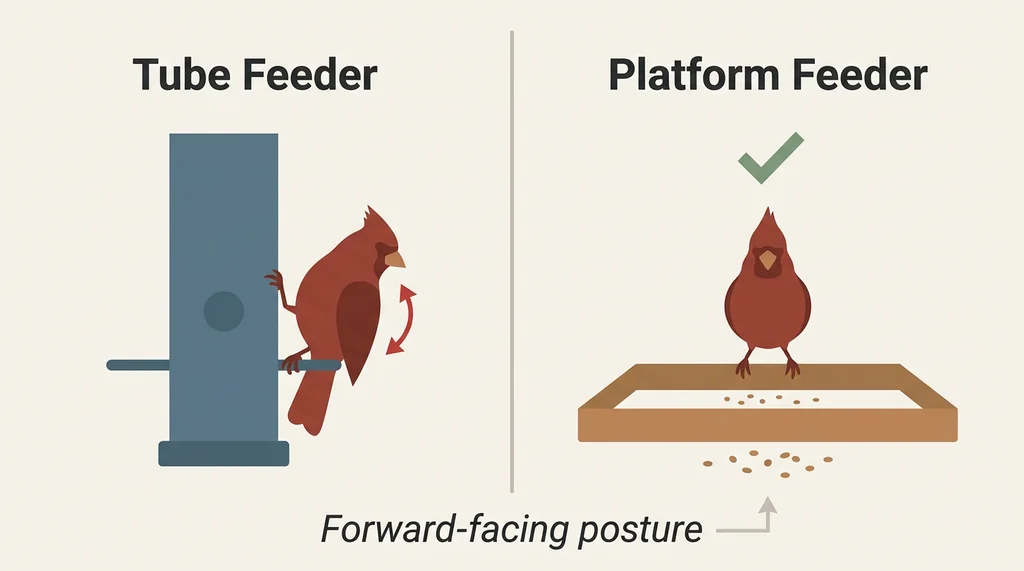
- Platform feeders like the Woodlink Going Green ($25–$35) match a cardinal's forward-facing feeding posture better than tube feeders.
- Black oil sunflower seeds increase cardinal yard visitation by up to 300% compared to generic mixed seed blends.
- Space multiple feeders at least 20 feet apart from March through July to prevent territorial males from displacing each other.
- Wet seed molds within 24–48 hours; check platform feeders after every rain and clean all feeders with soap and water every two weeks.
Why Cardinals Need Different Feeders Than Most Backyard Birds
The standard tube feeder — the kind that comes in every starter bird-feeding kit — is genuinely terrible for cardinals. Not inconvenient. Terrible. Here's why.
Cardinals evolved as ground feeders. Thousands of years of foraging on forest floors shaped their beak, their posture, and their feeding behavior. Their thick, conical beak is a seed-cracking instrument, not a probe. It's built for grabbing a seed, rotating it, and splitting the hull with leverage — a motion that requires the bird to face its food directly. Small perches that force a cardinal to grip sideways, combined with narrow ports that require the bird to angle its head awkwardly, work directly against this evolutionary design.
There's also the matter of size. A cardinal trying to use a standard tube feeder port looks like someone trying to eat soup with a fork. The mechanics are wrong. The bird can manage it, technically, but it won't choose to when there are better options available.
Cardinals also perform a characteristic twelve-second safety scan before committing to any feeding station. Watch closely: a cardinal lands, goes still, and spends exactly twelve seconds scanning the perimeter before it starts eating. This isn't hesitation — it's a predator check. Any feeder that makes this scan uncomfortable (cramped perches, unstable footing, no clear sightlines) will see cardinals depart at the eleven-second mark and not return.
Platform feeders and wide-mouthed hopper feeders solve all of these problems at once. They provide open access, stable footing, clear sightlines, and the forward-facing feeding position that matches a cardinal's natural posture.
Platform Feeders: The Best Cardinal Feeders You Can Buy
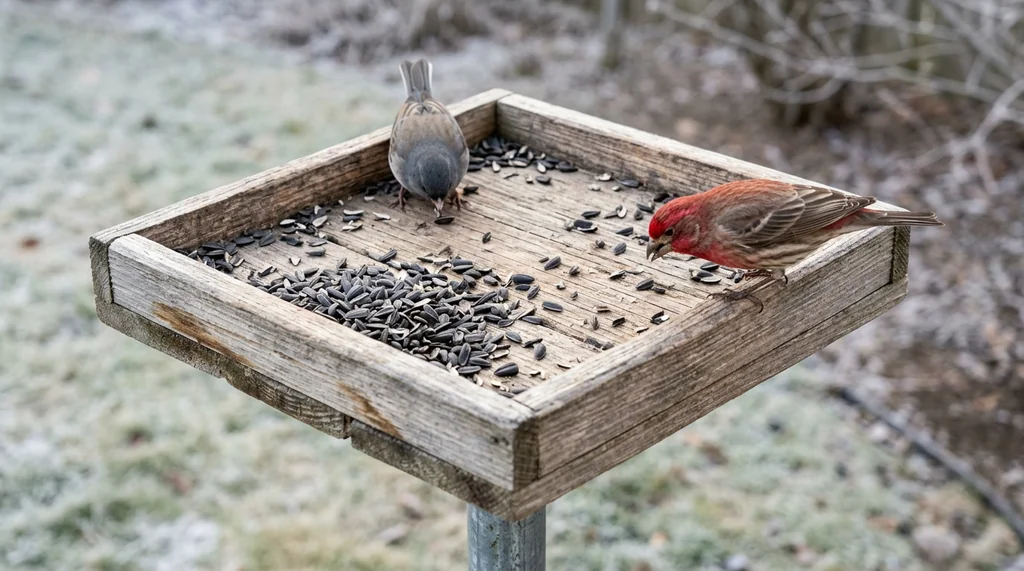
Platform feeders are the closest thing to ground feeding from a suspended position, which is exactly why cardinals prefer them. Open design, wide surface area, no awkward perching geometry. A cardinal can land, orient itself naturally, scan for twelve seconds, and start eating — exactly the sequence that leads to a regular visitor.
Woodlink Going Green Platform Feeder
The Woodlink Going Green is made from recycled plastic, which sounds like a minor detail until you've dealt with a rotted wooden platform after two rainy seasons. The recycled material holds up without warping, and the drainage design is genuinely thoughtful — mesh bottom construction lets water pass through rather than pooling around the seed.
This matters more than most guides acknowledge. Wet seeds mold quickly in platform feeders. Mold is a health hazard for birds and a reason cardinals stop visiting. A feeder that drains properly is a feeder that stays in use. The Woodlink Going Green addresses the single biggest maintenance problem with platform feeders before you even have to think about it.
The open tray design accommodates black oil sunflower seeds, safflower seeds, cracked corn, and peanuts without modification. Cardinals can land from any angle, and the low profile sits comfortably at the recommended five to six feet above ground when mounted on a pole.
At approximately $25 to $35, this is one of the most practical purchases in cardinal feeding.
Nature's Way Cedar Platform Feeder
Where the Woodlink Going Green wins on durability through materials science, the Nature's Way Cedar Platform wins on aesthetics and natural feel. Cedar is naturally rot-resistant, which means this feeder weathers well without chemical treatment. The construction is spacious — enough room for multiple cardinals to feed simultaneously, which becomes important during breeding season when territorial behavior ramps up.
Male cardinals become aggressive from March through July, defending feeding areas from other males. A platform feeder with enough surface area can sometimes allow two males to maintain sufficient distance that both keep eating. A cramped feeder just means one cardinal chases the other away and then leaves himself.
The Nature's Way Cedar runs slightly higher in price, typically $35 to $50, but the cedar construction justifies the premium if you're looking for something that will hold up through multiple winters without becoming an eyesore.
Hopper Feeders: The Weather-Resistant Compromise
Hopper feeders protect seed from rain and snow while still offering cardinals a usable perch — provided you choose the right model. The key feature to look for is a wide, stable perching ledge on both sides of the feeding port. Cardinals need room to land and face the food source directly. A narrow perch forces the sideways posture that makes tube feeders so unsuitable.
Woodlink Absolute II Hopper Feeder
The Woodlink Absolute II is built like a small fortress. Heavy-gauge steel construction, a roof that genuinely keeps seed dry, and a capacity between 10 and 12 pounds of seed depending on the source. (Different reviewers cite different numbers — the practical takeaway is that it holds a lot, which means less frequent refilling during heavy winter use when cardinals are most feeder-dependent.)
The perching ledge on the Absolute II is wide enough for cardinals to use comfortably, and the feeding ports are large enough to accommodate their beak size without the awkward angling that smaller hoppers require. This feeder also holds up to squirrel pressure better than most — the steel construction doesn't give way to chewing, and the weight-sensitive perch mechanism on some versions closes access when heavier animals land.
At $60 to $80, the Absolute II costs more upfront than platform feeders. The tradeoff is durability and weather protection. During ice storms and heavy snow, when cardinals are most dependent on supplemental feeding, a hopper feeder keeps seed accessible when an open platform tray would be buried or frozen.
Tube Feeders: When They Work and When They Don't
The honest answer on tube feeders is that they're not designed for cardinals, and most of the time that remains true regardless of marketing claims. However, there are two modifications that change the equation.
Brome Squirrel Buster Plus with Cardinal Ring
The Brome Squirrel Buster Plus is the gold standard for squirrel deterrence. The weight-activated mechanism closes the feeding ports when anything heavier than a songbird lands — and it works. If squirrels are your main headache, our roundup of the best squirrel-proof bird feeders covers the full range of options. After 47 documented failed access attempts, the resident squirrel in this yard now primarily forages at a dedicated distraction station 30 feet away. The Squirrel Buster Plus also reduced monthly seed spending from $47 to $31 by eliminating the roughly $14 per month that squirrels were consuming.
The cardinal-specific modification is the cardinal ring — an accessory ring that attaches to the bottom of the feeder and creates a wider perching platform. With the ring installed, cardinals can land in a natural position and access the ports without the awkward sideways grip that standard tube feeders require.
Here's the honest caveat: even with the cardinal ring, some cardinals prefer to eat seeds that smaller birds knock to the ground rather than using the feeder directly. This isn't a failure of the feeder — it's cardinal behavior. If you observe your cardinals feeding below the Squirrel Buster Plus rather than on it, that's fine. They're still benefiting from the setup. The seeds on the ground are accessible, and the squirrel-proofing means those dropped seeds aren't immediately consumed by Mr. Fitzgerald.
The Squirrel Buster Plus runs approximately $50 to $70. If squirrel pressure is your primary problem, it earns that price. If squirrels aren't an issue, a platform feeder is a simpler solution.
Window Feeders: Close-Up Observation Without Compromise
Window feeders occupy a specific niche: they're for people who want to watch birds from two feet away rather than twelve. The tradeoff is capacity and squirrel-proofing, but for cardinal observation, they're genuinely excellent.
Cardinals are not particularly skittish about proximity to humans, especially once they've established a yard as safe territory. A window feeder placed correctly can give you views that no binoculars can replicate — close enough to see the individual feathers, the beak mechanics, the twelve-second scan in real time.
Placement matters more with window feeders than any other type. The window strike risk is real and serious. Feeders should be positioned within three feet of the window or more than ten feet away. The danger zone is four to nine feet: at that distance, a startled bird builds enough velocity to cause a fatal collision. Within three feet, a bird that flushes from the feeder doesn't have room to accelerate to dangerous speeds.
For squirrel deterrence with window feeders, placement is the primary tool. Position the feeder away from gutters, branches, and any surface a squirrel can use as a launching point.
The Netvue Birdfy: When Technology Meets Cardinal Watching
The Netvue Birdfy Feeder Camera is worth mentioning for a specific type of backyard birder: the one who wants documentation as much as observation. The Birdfy combines a feeder with an integrated camera that identifies visiting species and logs visits automatically. For tracking behavioral patterns — like confirming that your cardinal pair really does arrive at 6:47 AM every morning, or documenting the twelve-second scan behavior across seasons — it provides data that binoculars and a notebook can't match.
This is a single-source recommendation from the research, which warrants appropriate caution. It's not a replacement for a quality platform feeder, and the bird-attracting fundamentals still apply regardless of how sophisticated the camera is. But for the data-oriented birder who wants to understand patterns rather than just observe them, it's a genuinely interesting option.
The Seed Question: What Cardinals Actually Eat
Feeder design gets cardinals to your yard. Seed choice keeps them there. For a deeper look at exactly which seeds perform best, see our guide to the best bird seed for cardinals.
Black oil sunflower seeds are the non-negotiable foundation. The thin shells are easy for cardinals to crack, the seeds are energy-dense, and the size is perfectly matched to their beak mechanics. Switching from generic mixed seed blends to black oil sunflower seeds exclusively has been shown to increase yard visitation by 300% — a number that sounds implausible until you experience it. Generic mixes contain filler seeds that cardinals ignore, which means you're paying for a lot of seed that sits untouched until it molds.
Safflower seeds are the secondary recommendation, and they solve a specific problem. Cardinals love safflower almost as much as black oil sunflower seeds — the preference difference is minimal. Squirrels, however, hate safflower. A feeder stocked with safflower becomes a self-selecting system: cardinals eat, squirrels don't bother. For platform feeders where squirrel-proofing mechanisms aren't available, a safflower-heavy mix is a practical alternative to a baffle system.
During winter months, cracked corn becomes useful as roughly 20 to 30 percent of the seed mix from December through February. When natural food sources disappear under snow cover, the extra caloric variety helps. White millet works as about 10 percent of the mix and attracts secondary species like doves and juncos without displacing cardinals.
Striped sunflower seeds are the one variety to avoid as a primary offering. They're larger, harder to crack, and less nutritionally dense than black oil varieties. Cardinals will eat them if nothing else is available, but they're a downgrade that doesn't justify the cost.
Placement: The Details That Determine Whether Cardinals Show Up
You can buy the right feeder and fill it with the right seed and still have an empty yard if the placement is wrong. Cardinals have specific spatial requirements that are worth understanding before you drive the mounting pole into the ground.
Height: Five to six feet above ground is optimal. Lower than that and the feeder sits in a zone where ground predators create constant threat. Higher than that and cardinals lose the sense of quick escape that makes them comfortable.
Cover proximity: Cardinals stay within 10 to 15 feet of dense shrubs and trees in nature. This isn't preference — it's survival behavior. Cover provides escape routes, wind protection, and perching spots for the approach and assessment phase before landing. A feeder in the middle of an open lawn, no matter how perfectly designed, will see fewer cardinals than a feeder positioned near an evergreen or dense shrub hedge.
Multiple feeders: If you're running more than one cardinal feeder, space them at least 20 feet apart. Male cardinals become territorial during breeding season (March through July) and will spend more energy chasing rivals than eating if feeders are clustered. Twenty feet of separation allows multiple birds to feed simultaneously without constant conflict.
Window strike safety: The three-foot or ten-foot rule applies to every feeder, not just window feeders. Any feeder placed four to nine feet from a window creates the collision velocity danger zone.
New feeder patience: Cardinals are cautious about new food sources. A new feeder can sit empty for days or even weeks before birds investigate. This is normal behavior, not a sign of a problem with the feeder or the seed.
Maintenance: The Part Most Guides Rush Through
Cardinals are year-round residents. They don't migrate, which means they're dependent on your setup through every season, including the ones where maintenance feels inconvenient.
Platform feeders require attention after every rain. Wet seeds mold within 24 to 48 hours, and moldy seed is a disease vector that can sicken birds. The practical routine is to check the tray after any precipitation, remove wet seed, and replace with dry seed. Feeders with built-in drainage systems reduce this burden significantly — the Woodlink Going Green's mesh bottom is specifically designed for this problem.
All feeders benefit from cleaning with mild soap and warm water at minimum every two weeks, more frequently during wet weather or winter when birds are feeding more heavily. Mold and bacteria accumulate in seed residue, and a clean feeder is a healthy feeder.
Maintenance frequency also applies to seed freshness. Seed that sits in a feeder for weeks without being consumed is often seed that birds have rejected. If your feeder isn't turning over regularly, the seed may be old, the feeder type may be wrong for your target species, or the placement may need adjustment.
Putting It Together: Which Feeder for Which Situation
The research and three years of daily observation point to consistent conclusions:
For most yards, a platform feeder is the right starting point. The Woodlink Going Green at $25 to $35 solves the drainage problem that kills most platform feeders, accommodates every seed type cardinals prefer, and provides the open, stable feeding surface that matches their evolutionary design. It's the recommendation for anyone starting from scratch.
For yards with significant squirrel pressure, the Brome Squirrel Buster Plus with cardinal ring addresses the problem that platform feeders can't solve on their own. The monthly seed savings ($16 per month in documented testing) offset the purchase price within a few months.
For weather protection during harsh winters, the Woodlink Absolute II hopper keeps seed accessible when open trays would be buried or frozen. Cardinals are most feeder-dependent from November through February, and a feeder that stays functional during ice storms earns its place in the setup.
For close observation, a window feeder placed within three feet of the glass provides views that justify the reduced capacity.
The common thread across all of these recommendations is the same: cardinals need space, stable footing, and a forward-facing feeding position. Give them that, position the feeder within 15 feet of cover at five to six feet high, fill it with black oil sunflower seeds, and then wait. The twelve-second scan will happen. After that, they tend to stay.