Mealworms for Bluebirds: Feeders, Placement & Amounts
Mealworms for Bluebirds: The Complete Feeding Guide
There is a particular kind of frustration reserved for people who have done everything right for one species and then decided to branch out. You've mastered sunflower seeds. You've optimized feeder placement. You've spent three years learning the rhythms of your yard. And then a bluebird lands on your fence post, tilts its head at you with that extraordinary electric-blue indifference, and you realize you have absolutely no idea what you're doing.
Bluebirds are not sunflower-seed birds. They are not platform-feeder birds, at least not in the conventional sense. They are insectivores first, fruit eaters second, and seed consumers almost never. Which means that everything you've learned about feeding cardinals and chickadees becomes largely irrelevant the moment you decide to attract Eastern Bluebirds to your yard. The good news is that bluebirds have one clear, consistent preference that makes feeding them remarkably straightforward once you understand it: they want mealworms, and they want them reliably.
This guide covers everything you need to know about feeding mealworms to bluebirds — from choosing between live and dried, to feeder selection, to the placement principles that make the difference between a bluebird yard and a yard where bluebirds occasionally pass through and keep moving. For feeder product recommendations, see our guide to the best bluebird feeders and mealworm stations.
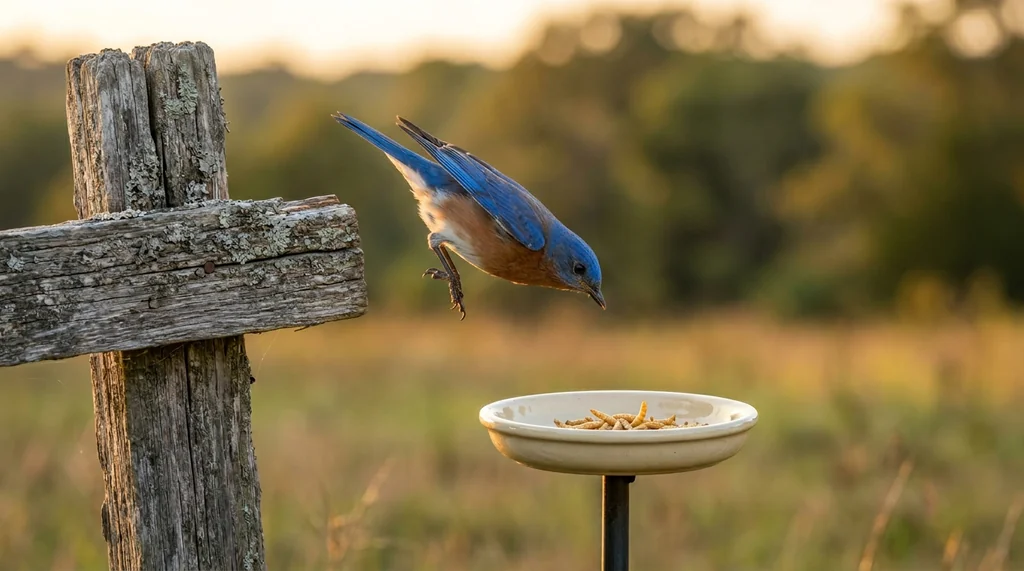
Key Takeaways
- Live mealworms outperform dried ones during nesting season (April–July) because parent birds carry them directly to nestlings
- Place mealworm feeders at 4 to 5 feet high in open areas with a perching post within 6 to 10 feet
- Mix a small number of live mealworms on top of dried ones to train bluebirds to accept the cheaper dried variety within 1 to 2 weeks
- Feed 50 to 100 mealworms per day to a non-nesting pair, increasing to 200 to 300 per day when nestlings are active
- Clean mealworm feeders every 2 to 3 days with warm water to prevent mold from frass and moisture buildup
Why Mealworms Work for Bluebirds
Bluebirds eat insects throughout most of the year. In warmer months, they hunt by perching at height and dropping to the ground to catch beetles, grasshoppers, and caterpillars — a foraging style called "sallying." In winter, when insect availability drops, they shift toward berries and fruit. Mealworms bridge both seasons because they mimic the high-protein prey bluebirds naturally seek.
Mealworms are the larvae of the darkling beetle (Tenebrio molitor), and they're about 50% protein by dry weight, with significant fat content that provides the caloric density bluebirds need for thermoregulation during cold weather. This nutritional profile is close enough to wild prey that bluebirds recognize and accept them readily, often within hours of a feeder being placed in a suitable location.
What makes mealworms particularly effective is that bluebirds are visually oriented hunters. They notice movement and high-contrast objects. Live mealworms, which writhe in a shallow dish, trigger the same visual attention response as moving insects on the ground. This is why live mealworms outperform dried ones for initial attraction, though dried mealworms have their own practical advantages once birds are established at your feeder.
Live Versus Dried Mealworms: What Actually Matters
The live-versus-dried debate is one of the first questions anyone asks when starting to feed bluebirds, and the answer is more nuanced than most sources suggest.
Live mealworms are more attractive to bluebirds that haven't been conditioned to a feeder. The movement catches attention, and the moisture content makes them easier to feed to nestlings when bluebirds are raising young. During breeding season, from roughly April through July, live mealworms are the superior choice if you want to support a nesting pair. Parent bluebirds will carry live mealworms directly to nestlings, and the soft-bodied larvae are appropriate food for birds that are only days old.
The practical downsides are real. Live mealworms require refrigeration at 40 to 50 degrees Fahrenheit to keep them dormant and slow their development into beetles. At room temperature, they pupate within days. A container of 1,000 live mealworms costs between $15 and $25 depending on supplier, and they need to be used within two to three weeks of purchase. In summer heat, a feeder of live mealworms can become a feeder of escaped beetles within a few hours if you're not monitoring it.
Dried mealworms are freeze-dried after harvest, which locks in the protein content while eliminating the management hassle. They don't require refrigeration, don't escape, and cost roughly 40 to 60 percent less per ounce than live ones. A one-pound bag of dried mealworms typically runs $12 to $18 and can be stored for months. For year-round feeding outside of nesting season, dried mealworms are entirely practical.
The catch: bluebirds that have never encountered dried mealworms sometimes don't recognize them as food initially. The trick used by experienced bluebird feeders is to mix a small number of live mealworms on top of a larger quantity of dried ones. The live ones attract attention, the birds investigate, and they discover the dried ones are also edible. Within a week or two, most bluebirds will accept dried mealworms without any live ones present.
Some feeders also rehydrate dried mealworms by soaking them in water for 20 to 30 minutes before offering them. Rehydrated mealworms have a softer texture and slightly more visual contrast against a feeder surface, which may help during the initial introduction period. Whether this is strictly necessary depends on how quickly your local bluebirds catch on — some populations accept dried mealworms immediately, others take longer.
Choosing the Right Mealworm Feeder
Standard tube feeders and platform feeders designed for seed are not appropriate for mealworms. You need a dedicated mealworm feeder, and the design matters more than most people expect.
Dish or tray feeders are the simplest option and work well for bluebirds because they simulate the open-ground foraging these birds prefer. A shallow ceramic or plastic dish, 6 to 10 inches in diameter with sides 1.5 to 2 inches high, gives bluebirds room to land and access food easily while keeping mealworms contained. Smooth sides prevent live mealworms from escaping. These dishes cost $8 to $15 and can be mounted on poles or hung from brackets.
Covered mealworm feeders add a roof or dome to protect the mealworms from rain and reduce competition from robins, starlings, and other species that will happily eat your bluebird food. The Aspects 153 Bluebird Feeder is a well-regarded option at around $25 to $35, featuring a hinged roof and perches sized for bluebirds. Some covered feeders have entrance holes sized specifically to exclude larger birds, though bluebirds can be slow to adapt to enclosed feeders if they haven't used them before.
Cling feeders mount directly to windows and allow close observation, but they require a period of adjustment for bluebirds that are already somewhat wary of human structures. If your goal is attracting bluebirds that haven't previously visited your yard, start with an open dish feeder at appropriate distance from the house before transitioning to a window-mounted option.
One practical note about feeder materials: avoid painted or treated wood for mealworm feeders. Mealworms and their frass (waste) create moisture, and treated wood can develop mold or leach chemicals. Untreated cedar, recycled plastic lumber, or smooth-sided ceramic and acrylic feeders are better choices for long-term use.
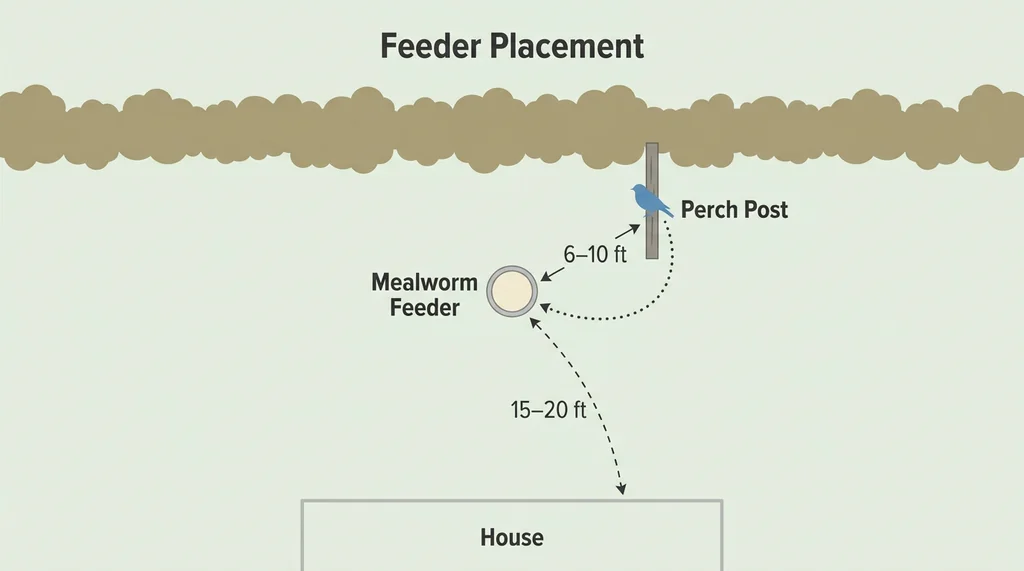
Feeder Placement for Bluebirds
Bluebirds are edge-habitat birds. They evolved in open woodlands, meadow margins, and areas where short grass meets tree lines — the kind of landscape that supports both their hunting style and their nesting preferences. This habitat preference directly informs where mealworm feeders work best.
Place mealworm feeders in open areas with clear sight lines. Bluebirds don't like to approach feeders through dense vegetation the way chickadees do. They want to see the feeder from a distance, assess it from a nearby perch, and drop down to it in a short direct flight. A feeder surrounded by shrubs on all sides will be ignored.
Height matters too. Position mealworm feeders at four to five feet above ground — lower than the optimal height for many seed feeders, but consistent with the low-perch hunting behavior bluebirds exhibit naturally. A feeder at eight feet puts food outside the visual search zone these birds use when scanning for prey.
Perching posts near the feeder significantly improve uptake. Bluebirds are perch-and-drop hunters, and they're much more likely to use a feeder that sits near a fence post, a bare branch, or a dedicated perching stake. Place a perch within six to ten feet of the feeder at a height slightly above the feeder itself. This gives bluebirds a staging point from which they can assess the feeder before committing to it.
Distance from the house is less critical for bluebirds than for many species. They're not particularly shy about human proximity once they've established a routine. A feeder 15 to 20 feet from a window is comfortable for observation without being so close it creates stress for the birds.
How Much to Feed and How Often
Overfeeding mealworms creates two problems: wasted food that attracts pests, and birds that become dependent on a single food source to the exclusion of natural foraging. The goal is supplemental feeding, not replacement feeding.
During non-nesting periods, 50 to 100 mealworms per day is a reasonable starting quantity for a pair of bluebirds. Offer them in two or three small servings rather than one large dump, which helps keep food fresh and prevents live mealworms from escaping the dish before birds arrive. Morning is the highest-priority feeding time — bluebirds are most actively foraging in the first two hours after sunrise.
During nesting season, a pair with active nestlings may need 200 to 300 mealworms per day. Parent birds make dozens of feeding trips daily, and the additional protein supports rapid nestling growth. If you see parent bluebirds carrying mealworms to a nest box repeatedly, increase your offering and check the feeder more frequently throughout the day.
Clean mealworm feeders every two to three days. Frass and dead mealworms accumulate quickly, and wet conditions accelerate mold growth. A quick rinse with warm water and occasional scrub with a mild dish soap solution keeps feeders sanitary. This is more frequent maintenance than seed feeders require, but mealworms are a higher-moisture food and the cleanup standard needs to reflect that.
Sourcing Mealworms: What to Look For
Pet stores carry mealworms, but the pricing is almost always higher than buying from dedicated bird-feeding suppliers or agricultural suppliers. A cup of 100 live mealworms from a pet store might cost $4 to $6. The same quantity from a bulk supplier costs a fraction of that.
For live mealworms, look for suppliers that ship in insulated containers with cooling packs during warm months. Mealworms that arrive warm and already beginning to pupate are a waste of money. Reputable suppliers include Rainier Mealworms, DBDPet, and several regional agricultural suppliers that sell to both bird feeders and reptile keepers.
For dried mealworms, brands like Kaytee, Wild Delight, and Hatortempt are widely available and consistently reviewed well for freshness and protein content. Check the packaging date when possible — dried mealworms stored for more than a year lose oil content and birds may reject them, similar to how nyjer seed stored beyond two months loses palatability.
Buying in bulk makes financial sense once you've established a bluebird feeding routine, but start with smaller quantities until you've confirmed your local birds are using the feeder. There's no point in storing five pounds of dried mealworms before you know whether bluebirds are present in your area in sufficient numbers to go through them.
Bluebirds are one of the more rewarding birds to feed precisely because their preferences are so specific and their response to those preferences is so immediate. Get the mealworms right, get the feeder placement right, and you'll have a bird at your feeder that most of your neighbors have never seen up close. That electric blue, that rust-orange chest, that deliberate perch-and-drop hunting style — it doesn't get old.