Bird Watching Binoculars: Best Magnification Explained
What Magnification Is Best for Bird Watching Binoculars?
The question sounds simple. It isn't.
Magnification is the number printed first on any binocular specification — the "8" in 8x42, the "10" in 10x50 — and it's almost always the first thing new birders ask about. More seems better. Higher numbers feel more impressive. If 8x lets you see something clearly at 100 yards, surely 12x lets you see it even more clearly at 100 yards?
That logic is how I ended up with a pair of 10x50 binoculars that cost $180 and lasted exactly six months before I stopped using them entirely. They weren't broken. They were just wrong for the job. The answer to what magnification is best for bird watching binoculars turns out to involve physics, biology, and a few hard lessons about what birds actually do when you're trying to watch them.

Key Takeaways
- 8x magnification is the professional standard because it balances image stability, field of view, and low-light performance for moving subjects.
- A 42mm objective lens produces a 5.25mm exit pupil, delivering brighter images during peak bird activity at dawn and dusk.
- Glasses wearers need at least 15mm of eye relief; look for adjustable eyecups to accommodate this distance.
- Budget a minimum of $150-$200 for binoculars with fully multi-coated optics that won't discourage regular use.
- 10x magnification suits open-habitat birding like shorebird flats and hawk watches; 7x suits fast-moving forest birds and beginners.
Why Higher Magnification Sounds Better Than It Is
The appeal of high magnification is completely understandable. You want to see birds closely. You want to count the spots on a thrush or read the subtle color differences that distinguish a Coopers hawk from a sharp-shinned. More magnification means more detail, right?
Here's what nobody explains when you're standing in the sporting goods aisle: magnification amplifies everything, including your own hand tremor.
The human hand, even when you're trying to hold perfectly still, moves constantly in tiny involuntary tremors. At 8x magnification, those tremors are manageable — the image wobbles slightly but remains usable. At 10x, the wobble becomes more pronounced. At 12x or higher, without a tripod, the image shakes enough to make extended viewing genuinely fatiguing. You end up spending so much mental energy trying to stabilize the view that you miss the bird entirely.
My 10x50 binoculars were 47 ounces — nearly three pounds. Holding three pounds at arm's length for even thirty seconds builds fatigue faster than you'd expect. After a morning walk, my arms ached. After two months, I started leaving the binoculars at home. After six months, they lived permanently on a shelf.
Dr. Patricia Fielding, my mother, has been studying bird physiology for forty years. She's been using the same 8x32 binoculars for twenty of those years. When I finally described my 10x50 frustrations to her, she was unsurprised. "Ornithologists almost universally use 8x," she told me. "The field of view and image stability matter more than raw magnification for moving subjects."
Moving subjects. That's the key phrase. Birds move.
The Physics of Binocular Magnification
Understanding why 8x became the professional standard requires a brief detour into optics.
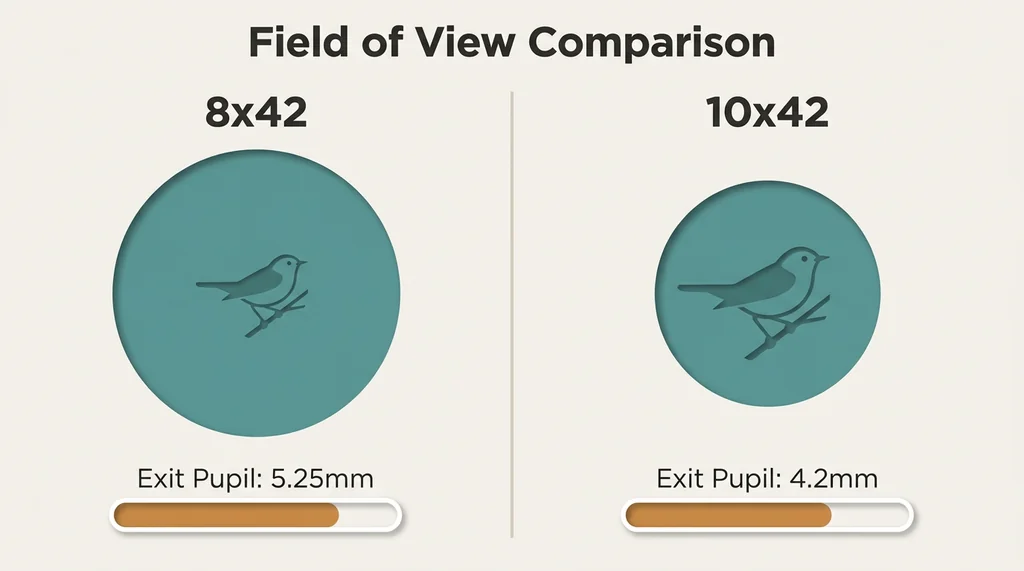
Magnification and field of view have an inverse relationship. As magnification increases, the width of your visible field decreases. A binocular rated at 8x42 might show you 420 feet of width at 1,000 yards. The same quality optic at 10x42 might show you 330 feet. That 90-foot difference is enormous when you're trying to find a warbler that just landed somewhere in a dense shrub.
This matters because birding in the field involves a specific skill called "getting on the bird" — moving your binoculars from your eyes to the sky or tree line, finding the bird with your naked eye, then raising the binoculars to your face and immediately locating the same bird in the magnified view. With a wide field of view, this is achievable. With a narrow field of view at high magnification, beginners often spend thirty seconds frantically scanning while the bird finishes its business and flies away.
Exit pupil determines low-light performance. The second number in binocular specifications — the 42 in 8x42 — is the objective lens diameter in millimeters. Divide this by the magnification to get the exit pupil: the diameter of the light beam that enters your eye. An 8x42 produces an exit pupil of 5.25mm. A 10x42 produces 4.2mm. The human pupil dilates to roughly 7mm in darkness and contracts to about 2-3mm in bright sunlight.
Dawn and dusk are peak bird activity times. The birds are moving, feeding, singing — and the light is dim. A larger exit pupil means more light reaches your eye, which means brighter, clearer images precisely when you most need them. This is why the 42mm objective lens became standard for birding binoculars rather than the smaller 32mm or 25mm options: it provides enough light-gathering for early morning and late evening observation.
Close focus distance is non-negotiable. My 10x50 binoculars couldn't focus on anything closer than 20 feet. This seems fine until a yellow warbler lands on the bush six feet from your face, and you're staring at a blurry yellow smear while you wait for it to move farther away. Current 8x42 binoculars often focus as close as 5-6.5 feet, which means backyard birders can watch the feeder from inside the house through a window without losing focus.
The 8x42 Standard and Why It Earned That Status
The birding community's convergence on 8x42 as the general-purpose standard wasn't arbitrary. It represents a set of compromises that happen to align well with how birds behave and how humans hold things.
8x magnification is powerful enough to resolve meaningful field marks at practical birding distances — the subtle eye ring on an Empidonax flycatcher, the wingbar patterns that separate confusing fall warblers — while remaining stable enough for hand-held use over extended periods.
42mm objective lenses provide an exit pupil of 5.25mm, which works well in the low-light conditions of dawn, dusk, and shaded forest interiors. The physical size also allows manufacturers to build in wide fields of view without extreme optical compromises.
Weight lands around 22-26 ounces for most quality 8x42 binoculars — heavy enough to feel substantial, light enough to wear around your neck all day without your trapezius muscles staging a protest.
The glasses-wearing birder faces one additional specification: eye relief. This is the distance from the eyepiece lens to the point where the full field of view is visible — essentially, how far back your eye can be and still see the complete image. Glasses hold your eyes roughly 12-15mm away from the eyepiece. Binoculars with less than 15mm of eye relief will show glasses wearers a darkened vignette around the image edges. The practical minimum for glasses wearers is 15mm; 18mm or more is comfortable. Binoculars marketed for glasses wearers typically feature adjustable eyecups that fold or twist down to accommodate this distance.
When Different Magnifications Make Sense
The 8x42 recommendation isn't universal. Different birding contexts genuinely favor different specifications.
7x35 or 7x50: Lower magnification with a wider field of view. Useful for forest birding where birds move quickly through dense cover and you need maximum field width to relocate them. Also excellent for beginning birders still developing the skill of getting on the bird quickly. The larger exit pupil on 7x50 makes it popular for seabirding from boat decks in rough conditions.
8x32: The compact alternative to 8x42. Same magnification, smaller objective lens, lighter weight. The 32mm objective produces a 4mm exit pupil — adequate in good light, noticeably dimmer in low-light conditions. Dr. Patricia Fielding's choice for forty years of field research, which tells you something about how capable this size can be in experienced hands. Her pair cost $180 in 2004, which works out to roughly $280 in current dollars, and they're still in daily use. The compromise is low-light performance; the gain is portability.
10x42: The choice for open-country birding — shorebird flats, hawk watches, grassland species surveys — where birds are often distant and stationary rather than nearby and moving. The narrower field of view matters less when you're scanning a mudflat for sandpipers than when you're chasing a warbler through a willow thicket. The reduced image stability is manageable when you can rest your elbows on a fence rail or car door. Many experienced birders own both 8x42 and 10x42 binoculars and choose based on the day's habitat.
10x50: My original choice, and not a bad one for specific applications. Larger objective lenses gather more light, making 10x50 binoculars useful for seabirding and hawk watching where you need both magnification and low-light performance. The weight — often 40+ ounces — makes them poorly suited for all-day carry. Many birders mount them on a tripod for extended observation sessions from a fixed point.
12x and above: Essentially requires tripod use for any sustained observation. The image shake at 12x hand-held is too significant for most people to manage. Useful for situations where the binoculars stay on a tripod: pelagic seabird watching, distant shorebird identification, hawk counting stations.
Optical Quality Matters More Than Magnification
Here's the practical truth that magnification discussions often obscure: a well-made 8x binocular outperforms a poorly made 10x binocular in almost every real-world situation.
Optical quality manifests in several ways. Lens coatings determine how much light transmits through the glass versus reflects away — fully multi-coated lenses on all air-to-glass surfaces can transmit 90-95% of available light, while uncoated or single-coated lenses might transmit only 70-80%. That difference is visible as image brightness and color fidelity, particularly at dawn.
Prism type affects image quality and binocular size. Porro prism binoculars — the traditional W-shaped design — tend to provide excellent depth perception and wide fields of view at lower price points. Roof prism binoculars use a straight-barrel design that's more compact and durable, but requires more precise manufacturing to achieve the same optical quality, which is why quality roof prism binoculars cost more than equivalent porro prism designs.
For genuinely useful birding binoculars, expect to spend $150-$200 as an entry point. Below that threshold, optical quality typically compromises the experience enough to discourage use. The sweet spot for most beginning-to-intermediate birders sits between $200-$400, where you'll find fully multi-coated optics, decent build quality, and reasonable close focus distances. Professional-grade optics from Swarovski, Leica, and Zeiss start around $1,500-$2,500 and offer real improvements in optical clarity, but the gap between a $250 binocular and a $2,500 binocular is far smaller than the gap between a $75 binocular and a $250 one.
Practical Specifications to Prioritize
When evaluating binoculars for bird watching, work through these specifications in order:
Magnification: 8x for most situations. 10x if you primarily bird in open habitats. 7x if you prioritize wide field of view for fast-moving forest birds or are buying for a child.
Objective lens: 42mm for all-around use. 32mm if weight and portability matter most and you primarily bird in good light. 50mm if low-light performance is critical and weight is secondary.
Eye relief: 15mm minimum for glasses wearers; 18mm or more is comfortable. Adjustable eyecups are essential.
Close focus: 6 feet or less for backyard birding. 10 feet is acceptable for birders who primarily watch distant birds.
Field of view: Wider is better for beginners and forest birding. Look for 330 feet or more at 1,000 yards for 8x binoculars.
Coating: Fully multi-coated on all surfaces. This is non-negotiable for image quality.
Waterproofing: Nitrogen or argon-purged, O-ring sealed construction prevents fogging and water damage. Worth prioritizing.
The Recommendation
For the vast majority of bird watchers — backyard birders, beginning field birders, people who want one pair of binoculars that works across most situations — the answer to what magnification is best for bird watching binoculars is 8x, paired with a 42mm objective lens.
This isn't a compromise position. It's the specification that professional ornithologists, experienced field birders, and optics manufacturers have collectively arrived at through decades of practical use. The physics favor it: the image stability, field of view, and low-light performance of 8x42 binoculars align with how birds actually behave and when they're actually active.
The details matter too. Look for fully multi-coated optics, a close focus of 6 feet or less, and at least 15mm of eye relief if you wear glasses. Budget at least $150-$200 for optics that won't frustrate you into abandoning them.
The best binoculars are the ones you actually use. An 8x42 you carry every morning is worth more than a 12x60 gathering dust on a shelf.