Zeiss Binoculars for Bird Watching: Every Series Compared
Best Zeiss Binoculars for Bird Watching: A Guide to Every Series
There's a particular kind of sticker shock that hits when you first look at Zeiss binocular prices. You're standing in a shop, or scrolling at midnight, and the numbers seem almost absurd for something you'll use to look at birds. Then you pick up a pair, focus on something across the room, and understand immediately why serious birders stop buying anything else.
Zeiss occupies a specific position in the optics world — alongside Swarovski and Leica, they're considered one of the three manufacturers whose products represent the ceiling of what binocular technology currently offers. But unlike some luxury goods where you're paying mostly for a name, Zeiss binoculars differ from cheaper alternatives in ways that matter in the field: light transmission, edge-to-edge sharpness, focus speed, and the ergonomics that determine whether you're still comfortable after four hours of scanning a tree line. The question for most birders isn't whether Zeiss makes excellent binoculars. They do. The question is which Zeiss binoculars make sense for your specific situation, your budget, and how you actually spend your time in the field.
This guide works through every current Zeiss series from the entry-level Terra ED up through the flagship Victory and SFL lines, covering the technical differences that actually matter for bird watching and the use cases where each model earns its price.
Key Takeaways
- The Conquest HD delivers 90% light transmission — 15-20 percentage points above budget binoculars — making it the most cost-effective Zeiss option for regular field use.
- The Victory HT reaches nearly 95% light transmission, the highest in the Zeiss lineup, giving a visibly brighter image in pre-dawn or dense forest conditions.
- The SFL 8x40 handles glare in high-contrast lighting more consistently than the Victory SF 8x32, a real-world difference not visible in specification sheets.
- Choose 8x magnification over 10x for woodland birding: the wider field of view makes it easier to find and track fast-moving birds through cover.
- The Terra ED 8x42 uses Schott ED glass and hydrophobic coatings starting around $400, outperforming most mid-range binoculars from other brands.
What Makes Zeiss Different From Other Premium Optics
Before breaking down individual models, it's worth understanding what Zeiss brings to every binocular in their lineup, because certain technologies appear across all price points.
The most significant is their T* multi-layer coating system, applied to every glass surface inside the binocular. Coatings matter because every air-to-glass interface loses a small percentage of light through reflection. A binocular with many internal lens elements — and modern roof prism designs have quite a few — can lose meaningful amounts of light before it reaches your eye. Zeiss's T* coatings minimize this loss at each surface, which is why their light transmission figures stay high even in complex optical designs.
Two ergonomic concepts appear in Zeiss marketing and are worth understanding: SmartFocus and ErgoBalance. SmartFocus refers to a focusing system calibrated for single-finger operation with minimal rotation — the idea being that you can acquire a moving bird and focus without the multi-finger grip some binoculars require. ErgoBalance describes weight distribution engineered to feel natural in extended handheld use, with mass positioned toward the back of the binocular rather than forward at the objective lenses. Both concepts address the fatigue problem that affects any birder who's spent a full day in the field.
What Zeiss doesn't always advertise: optical differences between top-tier brands — Zeiss, Swarovski, Leica — are genuinely small. Experienced birders who've used all three often describe the differences as matters of preference rather than clear hierarchy. Where brands diverge more meaningfully is in ergonomics, focus feel, and the specific compromises made in each optical design. Choosing between premium brands often comes down to which pair feels right in your hands.
Terra ED: The Entry Point That Earns Its Place
The Terra ED series sits at the bottom of the Zeiss lineup in price — roughly $400 to $500 depending on configuration — but "entry-level Zeiss" shouldn't be read as a dismissal. These are genuinely capable binoculars that outperform most mid-range offerings from other manufacturers.
The key technology in the Terra ED is Schott ED glass. ED stands for extra-low dispersion, which refers to how the glass handles different wavelengths of light. Standard glass bends different colors of light at slightly different angles, creating chromatic aberration — that faint color fringing visible around high-contrast edges like a dark branch against bright sky. ED glass reduces this significantly, producing cleaner, truer color rendition. In practical terms, this means the Terra ED delivers images that look more natural, with less of the artificial sharpening effect that cheaper binoculars use to compensate for optical limitations.
The Terra ED also features hydrophobic lens coatings that cause water to bead and roll off the objective lenses rather than spreading into a film that obscures vision. This matters more than it sounds during a rainy morning in the field when you don't have time to constantly wipe glass.
The Terra ED 8x42 is the configuration most often recommended for general birding — the 8x magnification providing a wider field of view and more stable image than 10x, while the 42mm objective lens gathers enough light for comfortable viewing in shade and overcast conditions. The Terra ED 8x32 is lighter and more compact, trading some low-light performance for portability.
Who should buy the Terra ED: beginners who want to start with genuinely good optics rather than cycling through progressively better cheap binoculars, occasional birders who want quality without flagship prices, and experienced birders looking for a reliable backup pair.
Conquest HD and HDX: The Serious Birder's Daily Driver
The Conquest series is where Zeiss starts attracting birders who've done their research. These are consistently described as the best value in the Zeiss lineup — not cheap, but offering flagship-adjacent optical performance at a price point that feels justifiable for regular use.
The headline specification is 90% light transmission. To put that in context: a budget binocular might achieve 70-75% light transmission, meaning a quarter of available light is lost before reaching your eye. The Conquest HD's 90% figure keeps images bright in the low-contrast conditions — deep forest shade, dawn, dusk — where birding often happens and where cheap optics fail most visibly.
The chassis is magnesium alloy rather than the polycarbonate used in entry-level binoculars. Magnesium alloy is lighter than aluminum and more rigid than plastic, which matters for maintaining optical alignment after the inevitable drops and knocks of field use. The weatherproofing specification is notable: the Conquest HD is rated for submersion up to 4 meters. Most birders will never test this limit, but it reflects a level of sealing that keeps moisture, dust, and fog out of the optical path in genuinely harsh conditions.
The Conquest HD 8x32 offers a field of view of 140 meters at 1 kilometer — wide enough to track fast-moving birds through woodland without losing them at the edge of the frame. The close focus limit of 1.5 meters is useful for the moments when a warbler lands unexpectedly close, or when you want to examine an insect on a nearby branch.
One practical note from users: the Conquest's focus speed is described as ideal for birding — responsive enough to acquire a moving subject quickly, but not so fast that slight hand movement causes over-adjustment. This contrasts with the Terra 10x42, which some users find focuses too quickly, making fine adjustments difficult.
The Conquest HDX represents an updated version with refined optical corrections and improved coatings. For birders who spend significant time in the field and want binoculars that will perform consistently across varied conditions, the Conquest series represents the point where the investment starts making clear practical sense.
Victory SF and Victory HT: The Flagship Experience
The Victory series is where Zeiss stops making compromises. Both the SF and HT models represent different approaches to solving the same problem: giving birders the best possible optical experience in a package that remains usable all day.
Victory SF
The Victory SF implements both SmartFocus and ErgoBalance at their most refined. The focusing system requires minimal rotation — approximately 1.5 turns from close focus to infinity — and is designed for single-finger operation. In practice, this means acquiring a bird that's moving through cover and getting it in focus happens faster than with conventional focusing systems.
ErgoBalance positions the binocular's weight distribution toward the eyepiece end rather than the objective end. Held naturally, this reduces the forward-tipping sensation that causes fatigue in extended handheld use. Birders who spend full days in the field often cite this as the feature they notice most after switching from other premium binoculars.
The Victory SF is available in 8x32, 8x42, and 10x42 configurations. The 8x42 is the most popular for general birding, offering the wide field of view and light-gathering that suits varied habitats.
Victory HT
The Victory HT takes a different approach, prioritizing maximum light transmission above other considerations. The HT designation stands for High Transmission, and the specification reflects it: nearly 95% light transmission, the highest figure in the Zeiss lineup.
This matters most in low-light conditions — pre-dawn woodland birding, late evening shorebird watching, heavily overcast days in dense forest. At 95% light transmission, the image through a Victory HT in dim conditions looks noticeably brighter than what most other binoculars can produce. For birders who regularly work in low-light environments, this specification translates directly into more birds identified rather than glimpsed.
SFL Series: The Lightweight All-Rounder
The SFL series is Zeiss's newer addition, and it addresses a specific gap in the lineup. The 8x40 configuration sits between the compact 32mm models and the full-size 42mm models, and users report that this size choice produces specific optical benefits beyond simple weight reduction.
The SFL 8x40 has developed a reputation among serious birders for exceptional color purity and glare control. One frequently cited comparison describes it as performing like a triathlete — not necessarily the absolute leader in any single category, but excelling across all of them simultaneously. In practical terms, this means the SFL handles the full range of birding conditions without the compromises that sometimes appear in more specialized designs.
The glare control point is worth examining specifically. Some users report that the Victory SF 8x32, despite its flagship status, can exhibit glare issues in certain high-contrast lighting situations. The SFL 8x40's larger objective lens and optical design appear to handle these conditions more consistently. This is a real-world performance difference that doesn't show up in specification sheets but matters when you're scanning a bright sky edge for raptors.
The SFL is also notably lighter than the equivalent 42mm models, making it a strong choice for birders who prioritize carrying comfort on long hikes or multi-day trips.
Choosing the Right Configuration: 8x vs. 10x and Objective Lens Size
Across all Zeiss series, the configuration choice matters as much as the series itself.
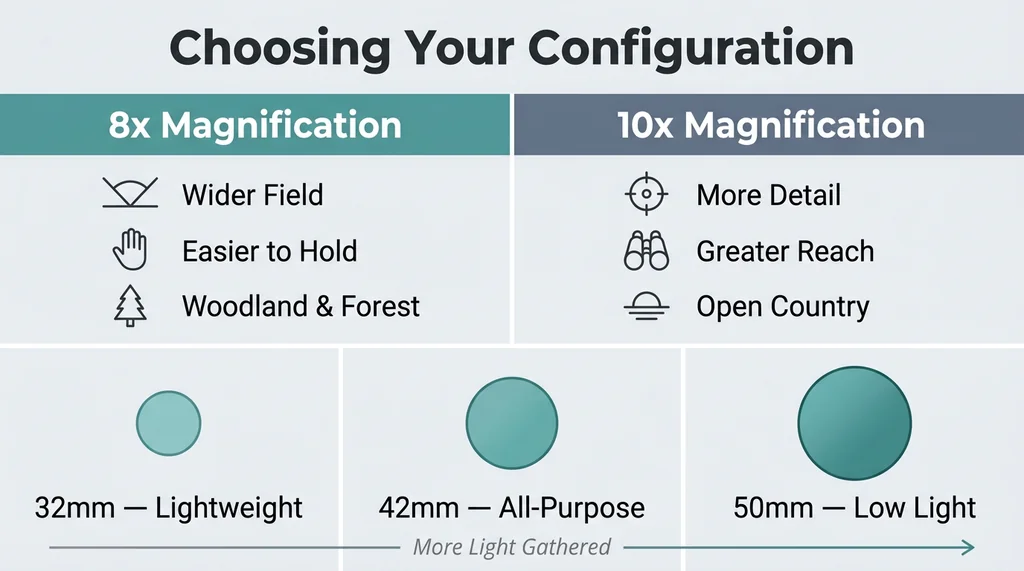
Magnification: The 8x versus 10x debate has a fairly clear answer for most birding applications. Higher magnification amplifies hand movement as much as it amplifies the image, making 10x binoculars noticeably harder to hold steady — particularly during the fatigue of a long day. More practically, 8x binoculars provide a wider field of view, which is the specification that determines how easily you can find and track a bird in the first place. In woodland habitats where birds move quickly through cover, a wider field of view matters more than the additional detail that 10x provides. Ten-power configurations earn their place for open-country birding — shorebirds, raptors at distance, waterfowl — where subjects are stationary enough to study and far enough away that magnification is genuinely useful.
Objective lens size: The 32mm versus 42mm versus 50mm choice primarily affects low-light performance and weight. A 42mm objective lens gathers significantly more light than a 32mm, producing brighter images in shade and at dawn or dusk. The 50mm models gather even more light but add substantial weight — appropriate for stationary observation from a vehicle or blind, less so for hiking. For most birders, the 8x42 configuration offers the best balance of light-gathering, field of view, and portability.
Eye relief: Birders who wear glasses should prioritize models with at least 15mm of eye relief — the distance between the eyepiece and the point where the full field of view is visible. Most Zeiss models across all series meet this threshold, but it's worth confirming for specific configurations. The Conquest and Victory series typically offer 18mm or more, accommodating glasses comfortably.
Practical Guidance: Testing Before Buying
Zeiss binoculars are expensive enough that buying based on specifications alone is a genuine risk. The ergonomic differences between series — focus feel, weight distribution, eyecup design — are significant enough to matter in daily use, and they're impossible to evaluate from a product page.
The standard advice from experienced birders is to handle as many options as possible before committing. Birding clubs, optics dealers that specialize in birding equipment, and organized bird walks where participants share their gear all provide opportunities to compare models in actual field conditions. The difference between a binocular that feels right and one that merely performs well on paper becomes clear within the first few minutes of use.
For birders upgrading from entry-level equipment, the jump to Conquest HD quality represents a meaningful, immediately perceptible improvement. For those already using quality mid-range binoculars, the step to Victory or SFL is subtler — real, but requiring direct comparison to fully appreciate.
The Zeiss lineup, from Terra ED through Victory HT, covers every serious birding application. The question is simply which combination of performance, weight, and price fits how you actually spend your time in the field — and that's a question best answered with the binoculars in your hands.