Swarovski Binoculars for Bird Watching: EL, SLC & NL Pure
Best Swarovski Binoculars for Bird Watching: A Serious Optical Investment Worth Understanding
There's a particular kind of clarity that comes through premium glass. Not just visual clarity — though that's real and immediate — but the clarity of finally understanding what you've been missing. Birders who upgrade to Swarovski optics often describe a before-and-after experience so distinct it feels like switching from standard to high definition. The birds haven't changed. The glass has.
Swarovski Optik occupies a specific position in the birding world: they're the binoculars serious birders save up for, the ones ornithologists carry into the field for decades, and the standard against which mid-range glass gets measured. Dr. Patricia Fielding, who has studied bird physiology for forty years, still references Swarovski's optical engineering when discussing what field researchers need from their equipment. That kind of professional longevity matters when you're evaluating a purchase that costs as much as a car payment.
Understanding which Swarovski binoculars best suit bird watching requires understanding what separates their lineup, what specifications actually matter in the field, and whether the price premium delivers proportional value. After spending $2,271.99 across three years of birding equipment testing — including a $180 first pair that lasted six months before becoming unusable — the question of when premium glass justifies its cost is one worth examining carefully.
Key Takeaways
- The Swarovski EL 8x42 ($2,599–$2,799) offers 399-foot field of view and 18mm eye relief, making it the most versatile single pair for woodland and open-country birding.
- The SLC 8x42 delivers comparable center-image sharpness to the EL at $700–$900 less, with the primary tradeoff being softer edge performance due to the absence of Swarovision technology.
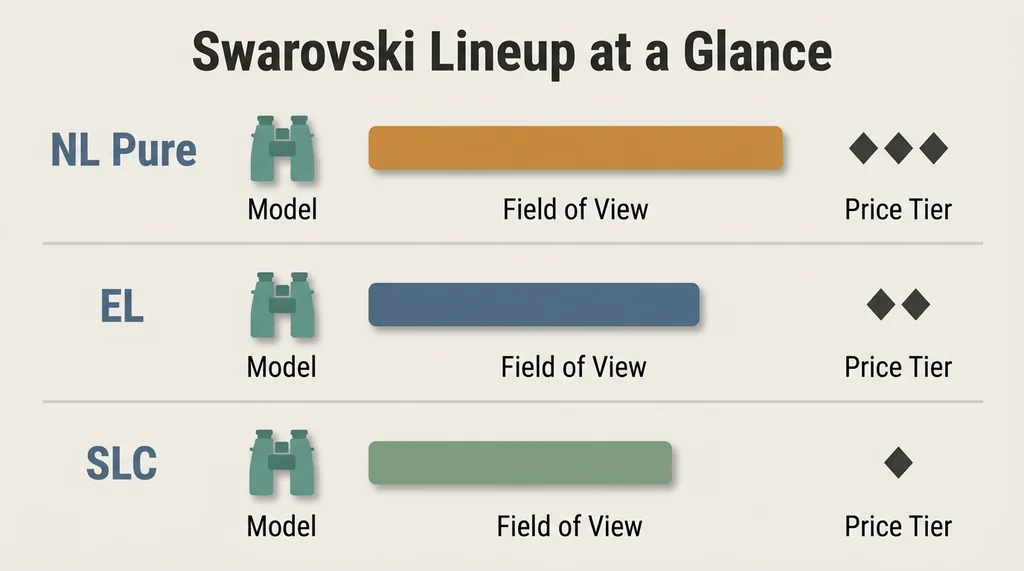
- The NL Pure 8x42 provides a 450-foot field of view and 60-degree apparent field, outperforming EL and SLC models for birders who track large flocks or bird in open habitats.
- Choose 8x magnification for woodland and feeder birding; switch to 10x for shorebird flats, hawk watches, and open grasslands where distant field marks determine identification.
- Swarovski's lifetime transferable warranty and 20–30 year typical lifespan change the cost-per-year calculation significantly compared to replacing $150–$300 binoculars every few years.
Why Swarovski Dominates the Best Binoculars for Bird Watching Conversation
Swarovski's reputation isn't marketing mythology. It's built on measurable optical advantages that compound in real-world birding conditions.
The Austrian company's manufacturing tolerances are tighter than most competitors. Their proprietary Swarovision field-flattening lens technology, introduced across the EL series, eliminates the edge distortion that makes cheaper binoculars feel like looking through a fishbowl. When a warbler moves from the center of your field of view toward the edge, it stays sharp rather than blurring into abstraction. That matters enormously when tracking fast-moving birds through foliage.
Their SWAROBRIGHT coating system maximizes light transmission in ways that become visible at dawn and dusk — the two periods when many birders do their most productive watching. Standard binoculars lose meaningful light at these low-contrast hours. Swarovski's coatings push light transmission above 90%, which translates to birds that remain identifiable when they'd disappear into shadow through lesser glass.
The fluoride HD glass used in their premium lines reduces chromatic aberration — that color fringing around high-contrast edges like a dark bird against a bright sky. Once you've seen birds without that fringing, the purple-and-green halos of cheaper optics become genuinely distracting.
None of this is theoretical. Birders who test Swarovski glass in the field consistently report that the combination of edge-to-edge sharpness, color accuracy, and low-light performance changes how they bird. They spot more. They identify faster. They stay out longer because the visual experience is less fatiguing.
The Swarovski EL Series: The Standard-Bearer for Birding Optics
The EL series represents Swarovski's flagship birding binoculars, and the 8x42 configuration has become something close to a consensus recommendation among serious birders and ornithological researchers.
EL 8x42: Why This Configuration Wins
The 8x42 specification hits a specific sweet spot that forty years of field research keeps validating. Eight times magnification provides enough reach for most birding scenarios while maintaining a wide enough field of view to track moving birds. The 42mm objective lens gathers substantial light without pushing the binoculars into territory where weight becomes a problem over long days.
The EL 8x42 weighs approximately 28 ounces and offers a field of view around 399 feet at 1,000 yards — generous enough to follow a bird in flight without losing it at the edge of the frame. Close focus sits at approximately 5.2 feet, which matters more than most beginners expect. Warblers don't stay at a polite distance. Neither do hummingbirds.
Eye relief on the EL 8x42 measures 18mm, which means glasses wearers can use these binoculars without sacrificing field of view. The twist-up eyecups adjust in multiple positions to accommodate different eye relief preferences. For birders who wear glasses — and there are many — this specification deserves as much attention as magnification.
Current retail pricing for the EL 8x42 runs approximately $2,599 to $2,799 depending on retailer and whether you're purchasing the standard or FieldPro configuration. The FieldPro package adds a carrying strap designed for all-day wear and a field bag, which matters on extended outings.
EL 10x42: When More Magnification Makes Sense
The 10x42 configuration suits birders who regularly work open habitats — shorebird flats, hawk watch ridges, open grasslands — where birds stay at distance and don't require rapid tracking through dense vegetation.
Ten times magnification reveals field marks that 8x glass renders ambiguous. The difference between a Lesser and Greater Scaup often comes down to subtle head shape visible at distance. The EL 10x42 makes those distinctions accessible. The tradeoff is a narrower field of view (approximately 330 feet at 1,000 yards) and a more pronounced shake effect that makes hand tremor more visible, particularly during cold mornings or after long hikes.
Weight stays nearly identical to the 8x42 at around 28 ounces. The same excellent eye relief and close focus specifications apply. Pricing runs comparable to the 8x42, typically within $100 of each other.
The honest answer on 8x versus 10x: if you bird primarily in woodland, thicket, or suburban settings with feeders and garden birds, 8x serves better. If your birding life involves significant time in open country, 10x earns its keep.
EL 8x32: The Lightweight Alternative
The 8x32 configuration occupies an interesting position in the Swarovski lineup. At approximately 20 ounces, it's meaningfully lighter than the 42mm versions — a difference that becomes significant on all-day outings or when binoculars hang around your neck for eight hours.
The optical quality matches the larger ELs. The same Swarovision field-flattening technology, the same coatings, the same manufacturing precision. What changes is light gathering capacity. The 32mm objective lens collects less light than a 42mm, which means performance in dim conditions steps down noticeably. For birders who do most of their watching in good light — midday garden sessions, summer mornings — this tradeoff is entirely acceptable.
Dr. Patricia Fielding has used an 8x32 configuration for twenty years of field research. That's not coincidence. For a researcher who carries equipment through varied terrain and needs reliable optics across decades of use, the weight savings and optical quality combination makes practical sense. The 8x32 EL currently retails around $2,399 to $2,499.
The Swarovski SLC Series: Serious Performance at a Lower Entry Point
The SLC series sits below the EL in Swarovski's hierarchy but above virtually everything outside the Austrian manufacturer's lineup. For birders who want Swarovski optical quality without the EL price, the SLC deserves serious consideration.
SLC 8x42: The Value Argument Within Premium Glass
The SLC 8x42 weighs approximately 28 ounces and delivers a field of view around 390 feet at 1,000 yards — nearly matching the EL's performance. The primary optical difference involves the field-flattening technology: the SLC lacks Swarovision, which means edge sharpness doesn't quite match the EL. The center of the image remains excellent. The edges show more softness.
For most birding scenarios, this difference is genuinely minor. The bird you're looking at occupies the center of the image. Edge sharpness matters most when scanning, when you're sweeping the binoculars across a treeline looking for movement. Birders who do a lot of scanning — hawk watchers, pelagic birders — notice the difference more than birders who find a bird and observe it.
Current pricing for the SLC 8x42 runs approximately $1,799 to $1,999, placing it roughly $700 to $900 below the EL 8x42. That's a meaningful difference that represents real money toward other birding equipment or experiences.
The SLC also offers excellent eye relief at 17mm — close enough to the 18mm benchmark for glasses wearers that it shouldn't disqualify the model.
SLC 10x42: Open Country Performance
The SLC 10x42 follows the same logic as its EL counterpart but at the SLC price point. For birders who need 10x magnification and find the EL pricing difficult to justify, the SLC delivers the core optical performance that makes Swarovski worth discussing at all.
The NL Pure Series: Swarovski's Wide-Field Revolution
Swarovski's NL Pure series represents a different design philosophy entirely. Where the EL and SLC prioritize balanced performance across all parameters, the NL Pure pushes field of view to extremes previously unavailable in premium glass.
The NL Pure 8x42 delivers a field of view of approximately 450 feet at 1,000 yards — dramatically wider than competing models. The 8x32 version reaches 468 feet. These numbers sound abstract until you're watching a flock of shorebirds moving in coordinated flight and can follow the entire group without losing birds at the edges.
The NL Pure also achieves a 60-degree apparent field of view, creating an immersive experience that experienced birders describe as looking through a window rather than a tube. The optical quality matches or exceeds the EL series by most measurements.
The cost reflects this engineering achievement: NL Pure 8x42 retails around $3,199 to $3,399. For birders who prioritize field of view above all other specifications — those who bird in open habitats with large flocks, or who find conventional binoculars visually constrictive — the NL Pure represents the current pinnacle of available optics.
Specifications That Matter When Choosing Between Swarovski Models
Magnification and Objective Lens
The 8x42 configuration suits the widest range of birding situations. The 10x42 serves open-country specialists. The 8x32 rewards those who prioritize weight savings and bird primarily in good light. The NL Pure configurations serve those for whom field of view is the defining specification.
Eye Relief for Glasses Wearers
Every Swarovski model in the EL, SLC, and NL Pure lines offers 17mm to 18mm of eye relief, meeting the threshold that allows glasses wearers to use the full field of view. The twist-up eyecups on all current models adjust to multiple positions. This is non-negotiable for anyone who wears corrective lenses — and it's one area where Swarovski consistently delivers across their entire lineup.
Close Focus Distance
All current Swarovski birding models focus to approximately 5 to 6.5 feet. This matters for garden birding, feeder watching, and any situation where birds approach closely. A binoculars' minimum close focus distance determines whether a butterfly on the nearest flower or a hummingbird at a feeder six feet away resolves into sharp detail or blurs into an unusable smear.
Weight and Extended Use
The 8x32 models across both EL and NL Pure lines run 20 to 22 ounces. The 42mm models across all series run 26 to 30 ounces. Over a full day of birding, that 6 to 8 ounce difference registers in neck and shoulder fatigue. For birders who spend occasional hours at a feeder station, weight matters less than for those who hike several miles daily with binoculars around their neck.
Making the Investment Decision
Swarovski binoculars represent a genuine long-term investment rather than a purchase to be replaced in a few years. The company's warranty is lifetime and transferable. Their repair service maintains older models. Birders regularly use Swarovski glass for twenty to thirty years without optical degradation — which changes the cost calculation substantially when amortized across that kind of lifespan.
For birders coming from entry-level glass in the $150 to $300 range, the jump to Swarovski pricing is significant. The optical difference is equally significant. Whether that difference justifies the cost depends on how seriously you bird, how often you use your binoculars, and whether optical quality affects your enjoyment and identification success in meaningful ways.
The EL 8x42 remains the model most consistently recommended by professional ornithologists and serious recreational birders who want one pair of binoculars to handle every situation. The SLC 8x42 delivers comparable performance at a lower price point for those who find the EL pricing difficult to justify. The NL Pure series serves birders for whom field of view is the primary criterion.
What the best Swarovski binoculars for bird watching share across all configurations is this: optical quality that stops being a limiting factor in your birding. When the glass gets out of the way and lets you simply watch birds, that's when you understand why serious birders save up for Austrian glass.