Nikon Binoculars for Bird Watching: Model Guide
Best Nikon Binoculars for Bird Watching: A Practical Guide to Choosing the Right Pair
Three years ago, I bought my first pair of binoculars without asking a single useful question. They were 10x50s, weighed 47 ounces, cost $180, and were functionally useless for backyard birding within six months. The magnification was too high for tracking movement through branches, the minimum focus distance of 20 feet meant I couldn't watch anything closer than the far edge of my yard, and the 12mm eye relief gave me a permanent headache. My husband David, who wears glasses, couldn't use them at all.
That $180 mistake taught me more about binoculars than any spec sheet ever could. It also sent me down a research path that eventually led to my current 8x42s — a pair I've used daily for three years with zero regrets — and to a much deeper understanding of what actually matters when you're choosing optics for watching birds.
Nikon makes some of the best binoculars for bird watching available at any price point. But "best Nikon binoculars for bird watching" isn't a single answer. It's a question that depends on where you're watching, how long you're watching, whether you wear glasses, and how much you're willing to spend. This guide breaks all of that down.

Key Takeaways
- 8x42 binoculars offer a 420-foot field of view and enough light-gathering for dawn-to-dusk birding without the image shake of 10x magnification.
- Eyeglass wearers need at least 14mm eye relief; 18mm with adjustable eyecups eliminates the full-field-of-view problem entirely.
- The Nikon Monarch 7 ATB 8x42 uses ED glass and waterproof construction at a price accessible enough for a first serious pair.
- A minimum close focus distance above 16 feet makes binoculars impractical for feeder watching where birds are often within 10 feet.
- The Nikon Monarch HG adds a field flattener over the Monarch 7, extending sharp focus to the image edges for scanning treelines and open water.
Why 8x42 Became the Standard Configuration
Before getting into specific Nikon models, it's worth understanding why the 8x42 configuration dominates birding recommendations. The first number is magnification; the second is the diameter of the objective lens in millimeters.
My current binoculars are 8x42 roof prism with a 6.5-foot close focus, 18mm eye relief, and a 420-foot field of view at 1,000 yards. I paid $240 for them three years ago. They weigh 24 ounces. David has a pair with the same 18mm eye relief and adjustable eyecups specifically because he wears glasses — a detail that matters more than most beginners realize.
The 8x magnification hits a practical sweet spot. It's powerful enough to resolve detail on a bird 40 yards away, but stable enough to use handheld without image shake turning every sighting into a blur. Nikon's own guidance suggests 8x to 10x for forest birding and 8x to 12x for open environments like coastlines or lakes. But they also note that objective lenses over 50mm become unwieldy for extended handheld use. Physics doesn't negotiate on that point.
The 42mm objective lens collects enough light for comfortable viewing from dawn through dusk. If you're primarily watching at feeders during daylight hours, a 30mm or 32mm lens works fine. If you're out at first light chasing warblers, the extra light-gathering of a 42mm becomes genuinely useful.
My mother, Dr. Patricia Fielding, who has been studying bird physiology for forty years, has used 8x32 binoculars for field research for two decades. They weigh 18 ounces and cost $180 in 2004 — closer to $280 in today's money. Her argument for the smaller objective is simple: you're carrying them all day, every day, and ounces become pounds by mile three. She's not wrong. But she also isn't watching cardinals from a kitchen window with a $25 tabletop tripod, which changes the weight calculation considerably.
Nikon Binoculars for Bird Watching: Model by Model
Nikon EDG 7x42: When Money Isn't the Constraint
The EDG 7x42 represents Nikon's flagship birding binocular, and the specifications justify the price for serious observers. The field of view measures 419 feet at 1,000 yards, and the 6mm exit pupil — calculated by dividing the objective diameter by magnification — delivers exceptional brightness in low-light conditions.
Exit pupil matters most at dawn and dusk, when birds are most active and light is most limited. A 6mm exit pupil nearly matches the maximum dilation of a human pupil in low light, which means you're losing almost no available light through the optics. The EDG also uses extra-low dispersion (ED) glass, which reduces chromatic aberration — that faint color fringing that appears around high-contrast edges in lesser optics.
The 7x magnification rather than the more common 8x is a deliberate choice. Lower magnification means a wider field of view, easier tracking of moving birds, and more image stability. For experienced birders who prioritize finding and following birds over maximum detail, 7x is often the better choice. For beginners, the difference is less significant than the price tag.
The EDG is priced above $2,000. That's not a typo, and it's not for everyone. But if you're comparing it to dedicated spotting scopes or planning to use binoculars professionally, the optical quality is genuinely in a different category.
Nikon Monarch HG 8x42: The Most Sensible Choice
Expert reviews consistently cite the Monarch HG 8x42 as the best overall Nikon binocular for birding, and the reasoning holds up. It uses the same ED glass and field flattener system as the EDG series — the field flattener ensures sharpness extends to the edges of the image, not just the center — at less than half the price.
The field flattener is worth pausing on. Many binoculars, particularly at mid-range prices, show soft focus or distortion toward the edges of the field. When you're scanning a treeline for movement, that edge softness means you're effectively working with a smaller usable field of view than the specifications suggest. The Monarch HG doesn't have that problem.
For birders who have moved past the beginner stage and want optics that won't limit their observation, the Monarch HG is the answer. It handles everything from dense woodland birding to open-water scanning without compromise.
Nikon Monarch 7 ATB 8x42: The Value Argument
The Monarch 7 ATB 8x42 shares the same 420-foot field of view as my current binoculars and uses ED glass at a price point that's accessible without being entry-level. ATB stands for All-Terrain Binoculars, indicating waterproof and fog-proof construction — both essential for outdoor use where weather doesn't follow your schedule.
The Monarch 7 represents where I'd direct most people asking for a first serious birding binocular. It's not a beginner's pair that you'll outgrow in a year, but it's not so expensive that the investment feels paralyzing. The optical quality is genuinely high, the construction is durable, and the 8x42 configuration is versatile enough to work in most birding environments.
If you're coming from entry-level binoculars and wondering whether the upgrade is worth it, the answer is usually yes. The difference between adequate optics and good optics is most apparent in difficult conditions: overcast days, shade under a canopy, fast-moving targets. That's exactly when you need binoculars to perform.
Nikon Monarch 7 8x30: For Birders Who Prioritize Portability
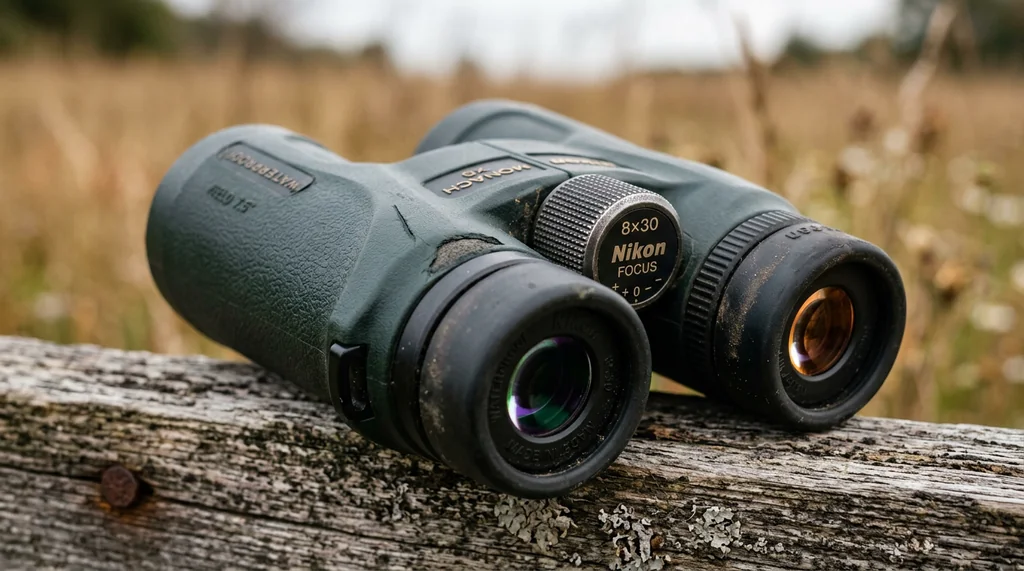
At 15.3 ounces, the Monarch 7 8x30 is the option for birders who cover significant ground on foot. The smaller objective lens sacrifices some low-light performance compared to the 42mm variants, but the optical quality remains high and the weight reduction is substantial.
My mother's logic applies here: if you're hiking to find birds rather than waiting for them to come to you, the weight difference between a 30mm and 42mm objective accumulates across miles. The 8x30 is also a reasonable choice for travel birding, where luggage weight and packability matter.
The trade-off is real, though. In dense forest at dawn, the smaller objective lens will show you a dimmer image than the 42mm equivalent. If most of your birding happens in good light — mid-morning at feeders, midday at open water — the 8x30 handles it without issue.
Nikon Action EX Extreme 8x40: The Porro Prism Option
Porro prism binoculars have a distinctive offset barrel design that looks old-fashioned compared to the sleek inline barrels of roof prism models. Tom at my local hardware store uses porro prism binoculars himself and has made a convincing case for them on multiple occasions. The optical path in a porro prism design produces a three-dimensional quality to the image that many experienced birders prefer, and the manufacturing is mechanically simpler, which means equivalent optical quality at lower cost.
The Action EX 8x40 is the budget-friendly porro prism recommendation in Nikon's lineup. One significant limitation: the minimum close focus distance is 16.4 feet. For backyard feeder watching, where birds are often closer than that, this creates a real problem. You'll be pulling binoculars away from your eyes to see anything on or near the feeder. For field birding where subjects are typically further away, this limitation disappears.
Nikon Aculon A211 7x35: Under $100 and Honest About It
The Aculon A211 offers a 488-foot field of view — wider than any other model in this lineup — at a price under $100. That field of view is genuinely useful for beginners who are still developing the skill of finding and following birds through optics.
The limitations are real. Eye relief is short, which means eyeglass wearers will struggle. The optics don't use ED glass, so chromatic aberration is visible in high-contrast situations. The construction isn't waterproof. But as a first pair for someone who wants to know whether birding is something they'll stick with before committing serious money, the Aculon serves that purpose.
Genuinely useful binoculars start around $150 to $200. Below that threshold, you're typically compromising on optical quality in ways that make the experience less enjoyable. The Aculon sits just under that range and is honest about what it is.

The Specifications That Actually Matter
Eye relief is the distance between the eyepiece and where your eye needs to be to see the full field of view. Eyeglass wearers need 14mm minimum, and 18mm or more is more comfortable. David's 8x42s with 18mm eye relief and adjustable eyecups were not an accident — that spec was the primary filter before we looked at anything else.
Close focus distance determines how near a bird can be before the binoculars can't resolve it. For feeder watching, anything above 10 feet becomes limiting. For trail birding, 15 feet is usually adequate. The Action EX's 16.4-foot minimum is the outer edge of acceptable for mixed use.
Waterproofing and fog-proofing aren't optional for serious outdoor use. Fog-proofing typically means the internal optics are nitrogen-purged to prevent internal fogging when moving between temperature extremes. A fogged eyepiece at the moment a rare bird appears is a specific kind of frustration.
Weight compounds across time. Twenty-four ounces feels fine for the first hour and noticeable after four. If you're planning extended field sessions, the difference between a 15-ounce and 24-ounce binocular is worth factoring seriously.
Choosing Based on Where You Bird
Open environments — coastlines, lakes, meadows — favor higher magnification and wider fields of view. Birds are often distant and relatively stationary, so 10x magnification becomes practical rather than problematic. The EDG or Monarch HG in a 10x configuration handles this well.
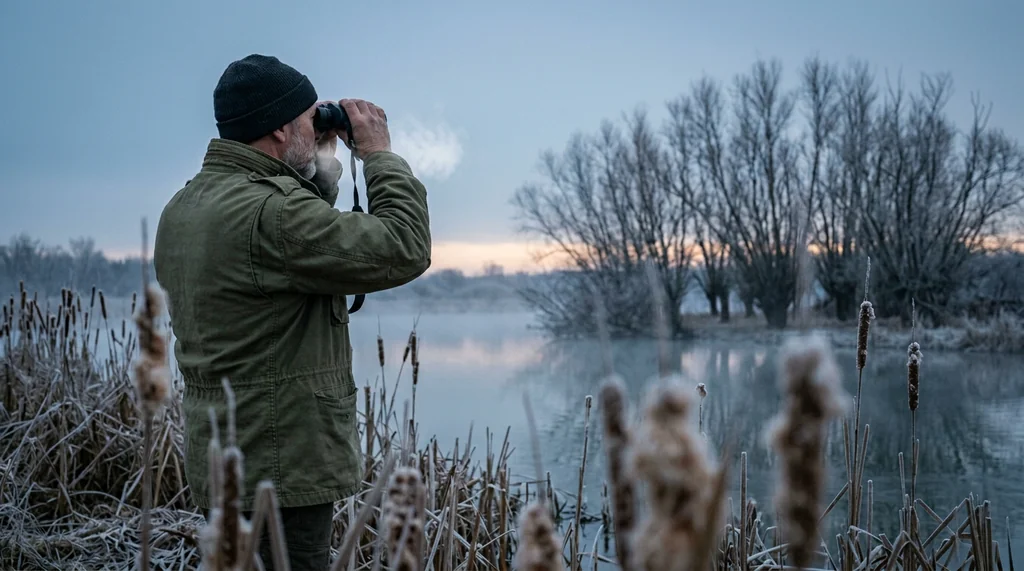
Dense forest and woodland birding rewards lower magnification and wide field of view. Tracking a warbler through branches at 10x is an exercise in frustration. At 8x with a 420-foot field of view, the same bird is manageable. This is why 8x42 is the consensus recommendation for general use — it's optimized for the hardest birding environment.
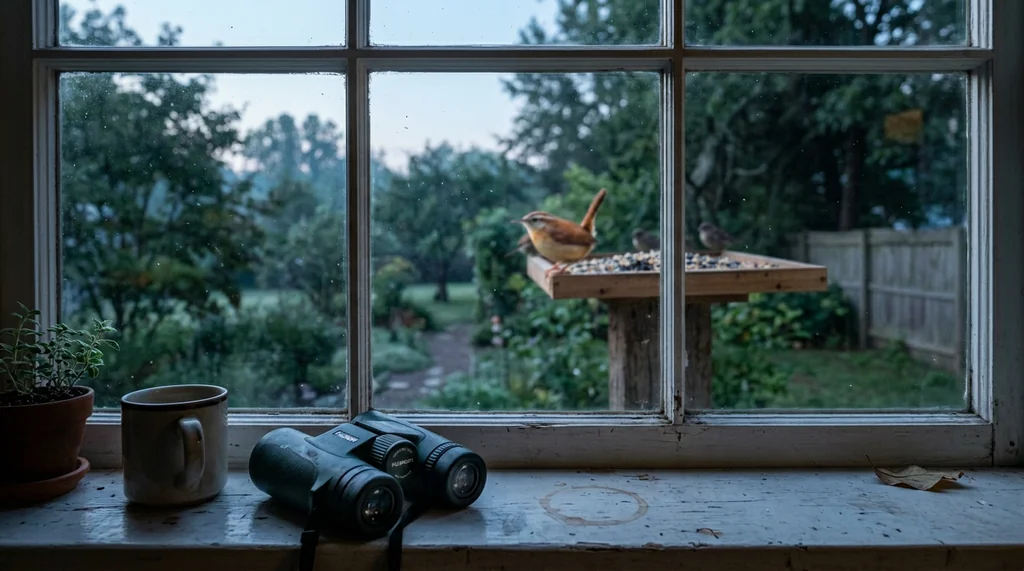
Backyard feeder watching has its own requirements: close focus distance, comfortable eye relief for extended sessions, and often the ability to mount on a tripod for prolonged observation. My $25 tabletop tripod by the kitchen window is not glamorous, but it means I can watch the cardinal pair for an hour without arm fatigue.
Nikon's lineup covers every legitimate birding need from casual backyard watching to professional field research. The Monarch 7 ATB 8x42 is where most birders should start their search — high enough quality to last years, accessible enough not to require a lengthy justification. The Monarch HG is the upgrade path when you're ready for it. The EDG exists for those who've decided that optics are worth the investment of a used car.
Whatever you choose, the right binoculars are the ones you'll actually carry. The most optically perfect pair in a drawer because it's too heavy or too expensive to risk in the field serves nobody. Start with the specifications that match your actual birding habits, and let the optics follow from there.