Lightweight Binoculars for Bird Watching: Real Trade-Offs
Best Lightweight Binoculars for Bird Watching (Without Sacrificing What Actually Matters)
My first pair of binoculars cost $180 and weighed 47 ounces. That's nearly three pounds hanging from your neck, which sounds manageable until you've spent forty minutes tracking a cooperative warbler through dense canopy and your shoulders start sending formal complaints. Those 10x50s lasted six months before the focusing mechanism became so stiff they were essentially decorative. Expensive, neck-destroying decoration.
That was three years ago. Since then, the binocular education has continued — through a second purchase, through borrowing Tom's porro-prism models from the hardware store to test at home, through watching Dr. Patricia Fielding use the same 8x32s she's owned for twenty years to spot things I miss entirely with my theoretically superior optics. Forty years of studying bird physiology will teach you what actually matters in a pair of binoculars, and apparently it isn't maximum weight.
This guide covers what I've learned about finding the best lightweight binoculars for bird watching — not just which models deserve consideration, but why the specifications matter, where the real trade-offs live, and how to avoid the mistakes that cost most beginners more than they expect.
Key Takeaways
- Mid-sized 8x30 to 8x33 binoculars weigh 15–22 ounces and deliver better optical performance than compacts while cutting 2–8 ounces versus full-sized 8x42 models.
- Exit pupil below 3mm (as in 8x22 compacts) causes image blackout when hands shift even slightly, making compacts harder to use for birders with shaky hands.
- Glasses wearers need at least 16mm of eye relief; the Opticron Savanna R 8x33 provides 20mm, making it the strongest lightweight option for spectacle users.
- The Snypex Knight D-ED 8x32 at 380 grams uses ED glass to reduce chromatic aberration and is the lightest mid-sized option reviewed without major optical compromise.
- Spending at least $150 avoids the cycle of cheap replacements; Dr. Patricia Fielding's $180 binoculars from 2004 have outlasted twenty years of field research.
Why Lightweight Binoculars Deserve Serious Consideration
There's a persistent assumption in birding circles that serious optics are necessarily heavy optics. Full-sized 8x42 binoculars — the acknowledged industry standard — deliver excellent brightness and a wide field of view precisely because their 42mm objective lenses gather substantial light. My current pair hits 24 ounces with a 420-foot field of view and 6.5-foot close focus, and for three years of daily use, those specs have served well.
But 24 ounces adds up. Extended field sessions, backpacking routes, or simply managing binoculars alongside a camera bag and a thermos makes weight a genuine functional concern, not just a comfort preference. For birders managing wrist pain, arthritis, or neck injuries, the difference between 18 ounces and 24 ounces isn't trivial — it determines whether a two-hour morning walk stays enjoyable through the second hour.
The legitimate question isn't whether to go lightweight, but which compromises are acceptable when you do.
The Three Categories and What Each Actually Delivers
Full-Sized Binoculars (8x42 and Similar)
The 8x42 configuration dominates birding recommendations for good reason. The 42mm objective lens gathers enough light to perform creditably at dawn and dusk — precisely when many species are most active. The 8x magnification strikes a balance between bringing distant subjects close and maintaining enough field of view to actually locate birds in the first place.
The weight penalty is real. Most quality 8x42 models fall between 22 and 30 ounces. For birders without physical constraints, this is manageable. For anyone dealing with fatigue, joint issues, or very long sessions, it becomes a limiting factor.
Mid-Sized Binoculars (8x30, 8x32, 8x33)
This is where the most interesting engineering happens right now, and where most birders seeking lightweight options should look first.
Mid-sized binoculars with 30-33mm objective lenses typically weigh between 15 and 22 ounces — a meaningful reduction from full-sized models — while retaining substantially better optical performance than true compacts. The smaller objective lens does reduce light-gathering capacity, but modern lens coatings and prism treatments have narrowed that gap considerably compared to what mid-sized optics delivered even a decade ago.
The Snypex Knight D-ED 8x32 weighs 380 grams (about 13.4 ounces) and consistently earns top marks for optical quality in this category. ED glass — extra-low dispersion — reduces chromatic aberration, the color fringing that makes high-contrast edges look slightly blurry or rainbow-edged. At 380 grams, this is genuinely light without the optical compromises that characterize the compact category.
The Opticron Savanna R 8x33 lands at 428 grams and offers 20mm of eye relief — a specification that matters enormously for glasses wearers. Its open-bridge design reduces weight while improving grip, and the value proposition is strong for birders who want quality optics without spending over $400.
The Hawke Endurance ED 8x32 uses a magnesium alloy body to keep weight at 539 grams while maintaining structural rigidity. It's heavier than the Snypex but offers a different balance of durability and optical performance that suits birders in wetter or rougher conditions.
The Kowa YF 8x30 takes a different approach entirely: porro prism design rather than the roof prism configuration most modern binoculars use. Porro prisms naturally produce a slightly wider, more three-dimensional image and typically cost less to manufacture to a given optical standard. The Kowa YF weighs 473 grams, and its ergonomics — the wider body of porro designs gives more natural hand placement — make it easier to hold steady than its weight alone would suggest.
Compact Binoculars (8x22, 8x25, 9x28)
Compacts are genuinely small. The Steiner Safari UltraSharp 8x22 weighs 228 grams — barely half a pound. For backpacking birders, travelers, or anyone who wants binoculars that disappear into a jacket pocket, that matters.
The trade-offs are real and worth understanding clearly. A 22mm objective lens gathers significantly less light than a 32mm lens. In full daylight, the difference is minimal. At dawn, dusk, or in dense forest shade, it becomes noticeable — images appear dimmer, and fine detail is harder to resolve. Additionally, smaller binoculars produce a smaller exit pupil (the disc of light that reaches your eye), which makes precise eye alignment more critical. Birders with shaky hands or less precise motor control often find true compacts frustrating because the image blacks out if the eye drifts even slightly.
The Pentax 9x28 DCF LV addresses one common compact frustration with an unusually large focus wheel, making adjustment faster and more intuitive. At 366 grams, it's light without being as optically constrained as 22mm models.
The Minox BD 7x28 offers a solution worth knowing about: fixed focus. No focus wheel, no adjustment — the optics are calibrated for a set distance range. For birders who struggle with manual focusing due to arthritis or limited hand dexterity, this design removes a significant obstacle. The 7x magnification (lower than most birding binoculars) and 340-gram weight combine with fixed focus to create something genuinely useful for a specific user profile, even if it's not the right choice for most.
The Specifications That Actually Determine Performance
Exit Pupil: The Number Most People Ignore
Exit pupil is calculated by dividing objective lens diameter by magnification. An 8x42 produces a 5.25mm exit pupil. An 8x32 produces a 4mm exit pupil. An 8x22 produces a 2.75mm exit pupil.
Why does this matter? Your eye's pupil dilates to roughly 5-7mm in low light and contracts to 2-3mm in bright conditions. When the exit pupil is smaller than your dilated pupil, the binocular becomes the limiting factor in low-light performance — you're not getting all the light your eye could handle. For daytime birding in good light, a 2.75mm exit pupil is adequate. For dawn chorus sessions or forest birding in overcast conditions, it becomes a meaningful constraint.
For older birders whose pupils don't dilate as widely, or for anyone with shaky hands, a larger exit pupil also provides more forgiveness in eye alignment — the image stays bright even if your eye isn't perfectly centered on the eyepiece.
Eye Relief: Non-Negotiable for Glasses Wearers
Eye relief measures the distance from the eyepiece lens at which the full field of view is visible. Glasses wearers hold their eyes approximately 12-15mm further from the eyepiece than non-glasses wearers, because the glasses themselves occupy that space.
Binoculars with less than 14mm of eye relief effectively exclude glasses wearers from the full field of view — they see a circle of image surrounded by black. My husband David wears glasses and uses 8x42s with 18mm eye relief and adjustable eyecups specifically because anything less turns birding into an exercise in frustration. The Opticron Savanna R's 20mm eye relief makes it particularly well-suited for glasses wearers among lightweight options. For anyone who wears glasses, 16mm should be considered the minimum; 18mm or more is preferable.
Field of View: How Much You Can See at Once
Field of view is typically expressed as feet visible at 1,000 yards. A 420-foot FOV (my current binoculars) means you see a 420-foot-wide swath of the world at 1,000 yards distance. Wider is generally better for birding, because birds move, and a narrow field of view means constantly repositioning to track them.
Higher magnification typically narrows the field of view — 10x binoculars generally show less of the scene than 8x binoculars of comparable quality. This is one reason 8x remains the dominant choice for birding despite the appeal of more magnification: the wider field of view makes actually finding and following birds dramatically easier.
Close Focus Distance
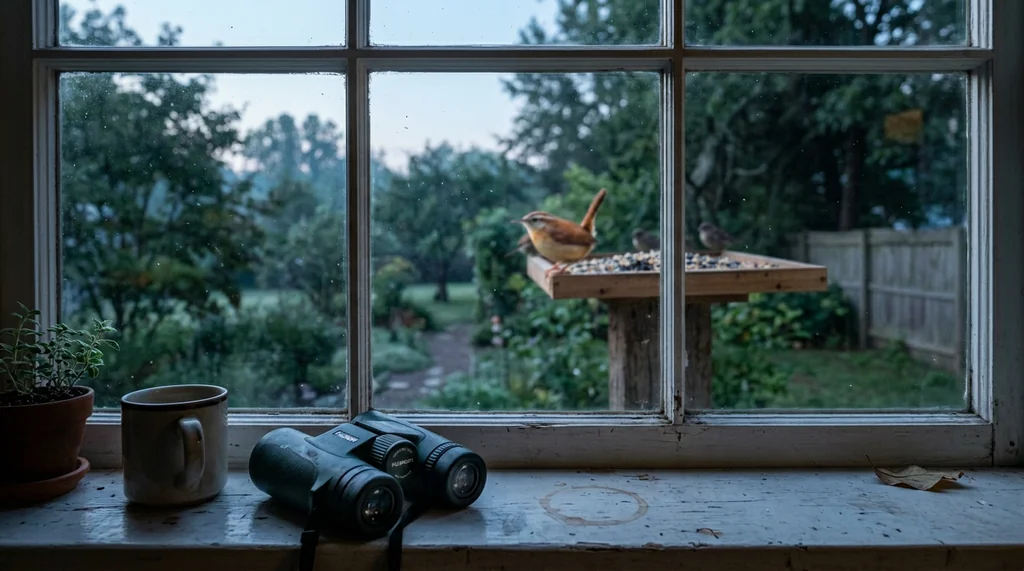
For backyard birding, close focus distance matters more than most specifications guides acknowledge. A binocular that can't focus closer than 10 feet is useless for the chickadee on the feeder three feet from the window. My current 8x42s focus to 6.5 feet, which handles most situations. Many compact binoculars struggle with close focus — check this specification carefully if you do significant feeder watching or garden birding.

Making the Right Choice for Your Specific Situation
For Backpacking and Travel
The compact category earns its place here. If weight and packability are the primary constraints, the Steiner Safari UltraSharp 8x22 at 228 grams is genuinely impressive for its size. Accept the low-light limitations, bring them in your shirt pocket, and use them for daytime observation in open habitats where light is plentiful.
For Birders with Physical Limitations
This is where the research points most clearly toward mid-sized over compact. The instinct is to go as light as possible, but a 380-gram binocular that's easy to hold steady is more functional than a 228-gram binocular that produces a blacked-out image every time your hands move. The Snypex Knight D-ED 8x32 at 380 grams or the Minox BD 7x28 at 340 grams with fixed focus represent better solutions than the lightest possible option.
For anyone managing neck pain specifically, a mid-sized binocular on a quality harness (which distributes weight across the chest and shoulders rather than hanging from the neck) often solves the problem more effectively than switching to a compact.
For Glasses Wearers
Prioritize eye relief above almost everything else. The Opticron Savanna R 8x33 with 20mm eye relief is purpose-designed for this need. Avoid any model under 16mm, regardless of how appealing other specifications appear.
For Budget-Conscious Buyers
Quality lightweight binoculars don't require a $1,000 investment. The $150-$300 range now includes models with ED glass and phase-corrected prisms — features that were exclusive to premium optics a decade ago. The Opticron Savanna R and Kowa YF 8x30 both deliver genuine optical quality at prices that don't require a difficult conversation about discretionary spending.
Dr. Patricia Fielding's 8x32 binoculars cost $180 in 2004 — roughly $280 in today's money. Twenty years of field research later, they still perform. The lesson isn't that cheap binoculars are always adequate; it's that the right binoculars at a reasonable price, properly cared for, outlast multiple rounds of budget replacements.
What the Specifications Won't Tell You
Binoculars that look identical on paper can feel dramatically different in hand. The focus wheel's smoothness and placement, the eyecup adjustment mechanism, the texture and shape of the grip — these determine whether a binocular becomes a natural extension of your hands or something you're always slightly fighting.
If possible, handle binoculars before purchasing. Many birding specialty retailers will let you test optics, and some online retailers have generous return policies that allow real-world evaluation. Tom at the hardware store has lent out his porro-prism models for home testing on multiple occasions — that kind of hands-on evaluation reveals things no specification sheet captures.
Pay particular attention to how quickly you can raise the binoculars and find a bird. This sounds simple, but it's actually a complex interaction of weight, balance point, eyecup position, and field of view. A binocular you can raise and acquire a moving target with in under two seconds is functionally superior to one that requires adjustment every time, regardless of what the optical specifications say.
The best lightweight binoculars for bird watching aren't the lightest available — they're the lightest option that doesn't compromise the performance you actually need for how and where you bird. For most people, that points toward the mid-sized 8x30 to 8x33 category: meaningfully lighter than full-sized models, genuinely capable optically, and available at prices that make quality accessible.
The compact category earns its place for specific use cases — travel, backpacking, supplemental optics — but works best when users understand its limitations going in. And full-sized binoculars remain the right answer for anyone who prioritizes optical performance over portability and doesn't have physical reasons to reduce weight.
Whatever category fits your situation, spend at least $150. The savings from going cheaper rarely survive contact with a morning in the field.