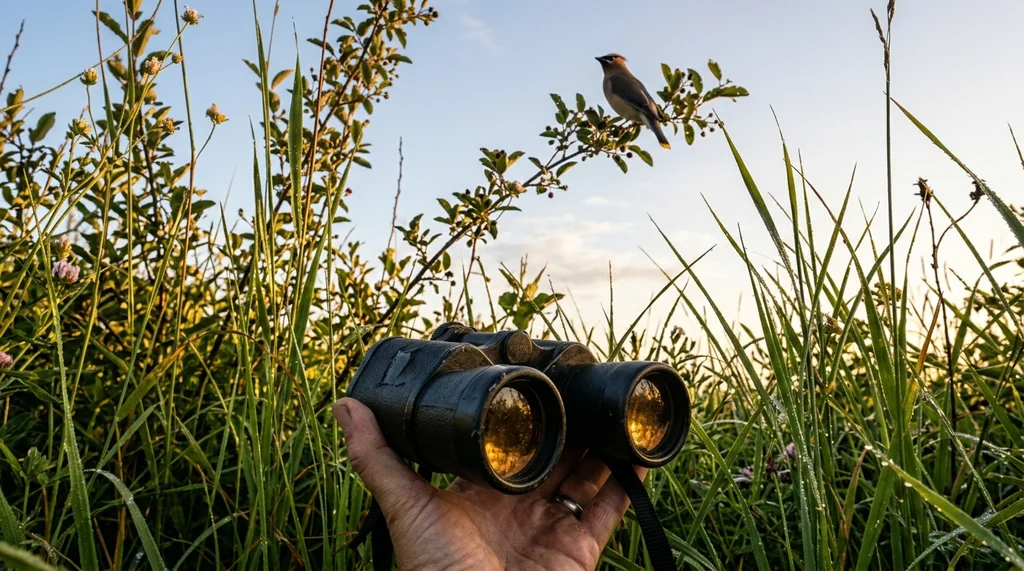
Best Budget Binoculars for Bird Watching
Best Budget Binoculars for Bird Watching: Affordable Picks That Actually Work
Three years ago, I handed over $180 for a pair of 10x50 binoculars at a big-box sporting goods store. The salesperson assured me they were "great for birding." They were 47 ounces, had 12mm of eye relief, and couldn't focus on anything closer than 20 feet. They lasted six months before the internal fogging made them essentially useless. That $180 was my tuition for the most important lesson in birding optics: the specifications printed on the box matter more than the brand name on the strap.
The good news is that the budget for genuinely useful binoculars has dropped dramatically. Manufacturing precision that once required a $1,500 investment now shows up in $200 models. Professional ornithologists and major birding organizations now openly acknowledge that the performance gap between a $250 pair and a $2,500 pair has narrowed to the point where most backyard birders — and many serious field observers — will never notice the difference. The gap between a $50 pair and a $250 pair, however, remains enormous and unforgiving.
This guide covers the best budget binoculars for bird watching based on real specifications, field-tested performance data, and the hard-won understanding that comes from getting this purchase wrong before getting it right. If you want to know which models actually deliver, and which specs to prioritize when the price tags all start to blur together, read on.

Key Takeaways
- 8x42 is the standard birding configuration because 8x magnification stays stable while breathing and a 42mm objective lens gathers enough light for dawn and dusk observation.
- A field of view above 400 feet at 1,000 yards — like the Athlon Midas ED's 426 feet — makes a measurable difference when tracking birds through dense foliage versus the Nikon P7's 361 feet.
- Glasses wearers need a minimum of 14mm eye relief, with 16–18mm recommended for extended sessions; verify this spec before purchasing any binoculars.
- Set the diopter adjustment once by focusing each eye independently, then use only the central focus wheel — this resolves the most common complaint that binocular images never look sharp.
- Remove dust with a bulb blower before touching lens glass; dragging grit across coated surfaces with a cloth causes permanent micro-scratches that degrade image quality over time.
Why Binocular Specifications Matter More Than Price
Before getting into specific models, it's worth understanding what the numbers actually mean — because this is where most first-time buyers go wrong, including this one.
The 8x42 Standard and Why It Exists
The birding world has largely settled on 8x42 as the ideal specification for general use, and there are concrete reasons for this consensus.
The "8" refers to magnification. At 8x, the image is stable enough to hold steady while breathing, and the field of view remains wide enough to track a bird moving through dense foliage. Higher magnification sounds appealing — 10x or 12x seems like it would show more detail — but it also amplifies every small hand tremor, narrows the field of view, and reduces the amount of light reaching your eye. My first binoculars were 10x50, and tracking a warbler through moving branches was genuinely exhausting. The image never felt still.
The "42" refers to the diameter of the objective lens in millimeters. A 42mm objective lens gathers substantially more light than a 25mm compact lens, which makes a real difference at dawn and dusk — exactly when many species are most active. The tradeoff is weight. A 42mm lens requires a larger housing, which is why most 8x42 binoculars weigh between 20 and 26 ounces. My current 8x42s weigh 24 ounces, and after three years of daily use, I've never found that weight to be a problem.
Field of View: The Underrated Specification
Field of view is measured in feet at 1,000 yards, and it directly determines how easy it is to find and follow birds. A wider field of view means you can scan a larger area without moving the binoculars, and when a bird flushes from a branch and relocates 30 feet to the left, you have a better chance of staying with it.
The practical difference between 361 feet and 426 feet at 1,000 yards sounds abstract until you're trying to track a nervous flicker through a canopy. That 65-foot difference in coverage can mean the difference between watching a behavior and watching empty branches where the bird used to be.
Eye Relief for Glasses Wearers
Eye relief — measured in millimeters — is the distance from the eyepiece lens at which your eye can still see the full field of view. For people who wear glasses, this number is critical. Glasses hold your eye further from the eyepiece, so you need at least 14mm of eye relief to see the complete image, and 16–18mm is more comfortable for extended use.
David, who wears glasses, went through two pairs of binoculars before we understood this. His current 8x42s have 18mm of eye relief with adjustable eyecups that lock into position, and the difference in his experience was immediate. If you wear glasses or are buying for someone who does, don't compromise on eye relief.
Close Focus Distance
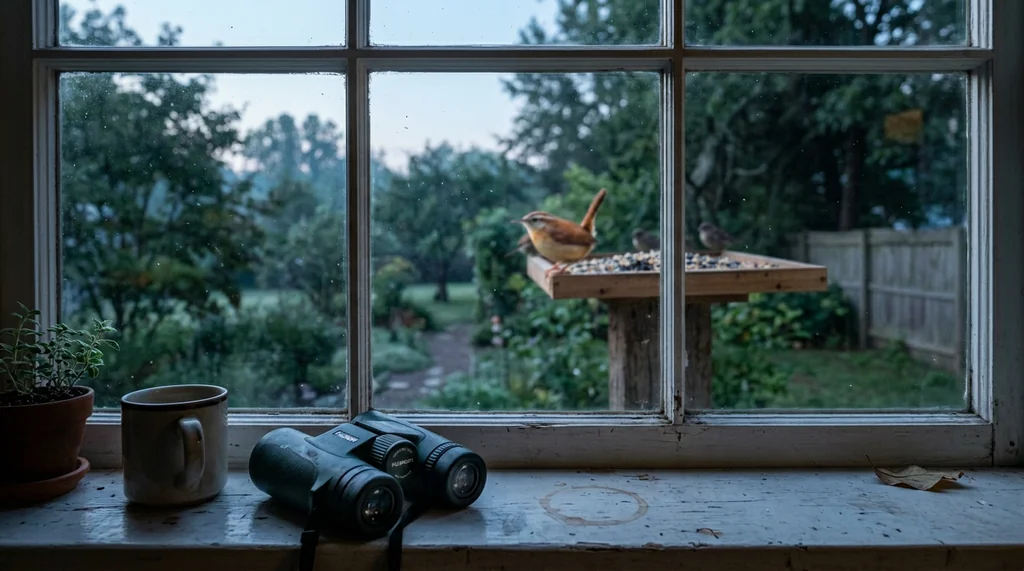
Close focus distance is how near an object can be before the binoculars can no longer sharpen it. For birding, a close focus of 6–7 feet opens up a different category of observation entirely — butterflies, dragonflies, and small songbirds at a feeder become available subjects. My current binoculars focus down to 6.5 feet, which I use constantly at the kitchen window feeder setup. My first binoculars couldn't focus closer than 20 feet, which meant anything at arm's length was a blur.
The Top Budget Binoculars for Bird Watching
Top Pick: Athlon Optics Midas ED 8x42 (~$225–$250)
The Athlon Midas ED is the strongest all-around performer in the budget category, and the specifications explain why.
The field of view is 426 feet at 1,000 yards — one of the widest available in this price range, and noticeably broader than most competitors. For tracking birds in dense vegetation or following shorebirds across open water, that width pays dividends. The ED glass (extra-low dispersion) reduces chromatic aberration, which is the color fringing that appears around high-contrast edges — the outline of a bird against a bright sky, for instance. At this price point, ED glass is a genuine value proposition.
Light gathering at dawn and dusk is excellent, which matters more than many beginners realize. The first hour after sunrise and the last hour before sunset are peak activity periods for many species, and binoculars that struggle in low light effectively shorten your most productive observation windows.
The durability credentials are solid: waterproof construction suitable for genuine field conditions, not just light rain. The housing is built to handle the kind of casual abuse that comes with regular outdoor use.
One specific flaw worth knowing: the press-in lens caps have a tendency to fall out during use. This is a minor annoyance rather than a functional problem, but it's the kind of detail that matters when you're in the field and suddenly realize your front caps are somewhere on the trail behind you. A simple solution is to leave the caps off entirely or replace them with a third-party option.
For most backyard birders and beginning-to-intermediate field birders, the Athlon Midas ED is the recommendation to start with.
Runner-Up: Nikon Prostaff P7 8x42 (~$217–$220)
The Nikon Prostaff P7 is a legitimate alternative, and the Nikon name carries real meaning in optics — the company's quality control is consistent, and the warranty support is reliable.
The P7 weighs under 21 ounces, which makes it meaningfully lighter than most 8x42 competitors. Over a full day of field birding, that difference accumulates. For anyone who finds heavier binoculars fatiguing, the P7's weight advantage is worth considering seriously.
The optical quality is excellent, with good edge-to-edge sharpness and solid light transmission. The clarity in the center of the field is competitive with anything in this price range.
The tradeoff is field of view: 361 feet at 1,000 yards versus the Athlon's 426 feet. That's a meaningful difference in practice, particularly in wooded environments where birds move quickly and unpredictably. The P7 also requires more frequent focus wheel adjustments when subjects change distance rapidly, which can interrupt the flow of observation.
For birders who prioritize portability over maximum field of view — those doing a lot of walking, or who find heavier optics genuinely uncomfortable — the Prostaff P7 is a strong choice. For stationary observation from a window or a blind, the Athlon's wider field of view is the better tool.
Best for Travel: Pentax AD 8x25 WP (~$146)
The Pentax AD 8x25 WP occupies a different category entirely. At 9.6 ounces, it's genuinely pocketable — it fits in a jacket pocket without the bulk that makes most binoculars impractical to carry casually. The waterproofing is legitimate, and the construction is solid for the price.
The limitation is physics, not manufacturing. A 25mm objective lens simply cannot gather as much light as a 42mm lens. In good midday light, the Pentax performs admirably and the image is clear and usable. As the light drops — early morning, late afternoon, overcast days, forest interiors — the image degrades noticeably compared to a full-size 8x42.
For travel birding where weight and pack size are genuine constraints, the Pentax AD is a reasonable choice with clear eyes about what it can and cannot do. For primary birding binoculars, particularly for anyone interested in dawn chorus walks or low-light species, it's not the right tool.
How to Actually Use Binoculars in the Field
Owning good binoculars is only part of the equation. The technique for using them makes a larger difference than most beginners expect.
The Naked-Eye-First Method
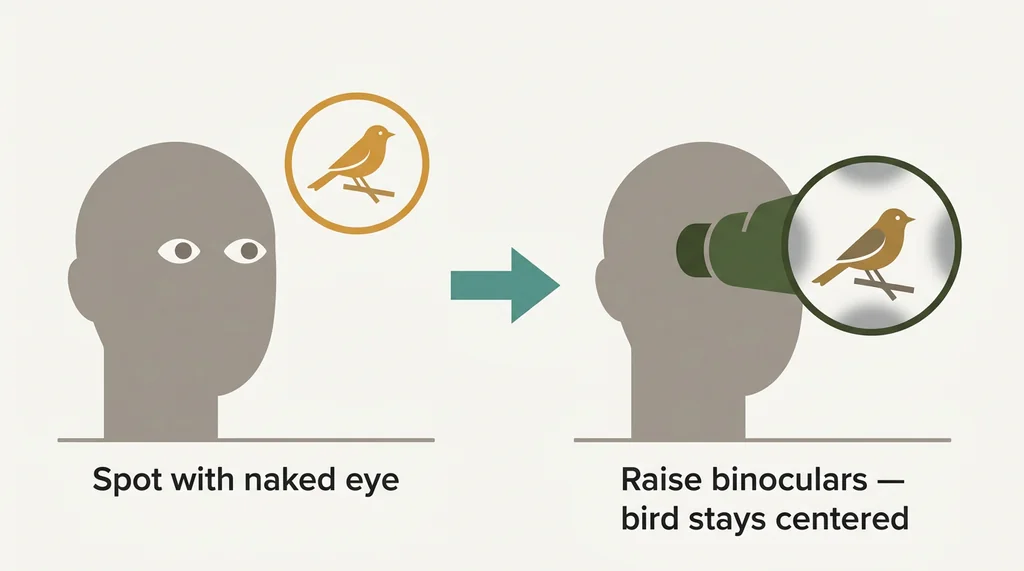
The most common beginner mistake is trying to locate birds through the binoculars. It sounds logical — more magnification should make birds easier to find — but in practice, the narrow field of view makes it extremely difficult to scan effectively. A bird that's obvious to the naked eye becomes a needle in a haystack when you're searching through 8x magnification.
The correct technique: spot the bird with the naked eye first, fix your gaze on its exact location, then raise the binoculars to your eyes without moving your head. The bird should appear in or very near the center of the field of view. This takes practice to make instinctive, but once it clicks, finding birds through binoculars becomes dramatically easier.
Focus Wheel Fundamentals
Most binoculars have a central focus wheel and a diopter adjustment on one eyepiece (usually the right). The diopter compensates for differences in vision between your two eyes. Set it once — close your left eye, focus the right eyepiece on a distant object using the diopter ring, then close your right eye and focus the left using the central wheel — and then leave it alone. After that, the central wheel handles all focusing.
A common frustration for new birders is that the image never seems quite sharp. Often this is a diopter that was never properly set, not a problem with the binoculars themselves.
Lens Care That Actually Matters
Lens coatings on quality binoculars are delicate, and the cleaning methods that seem intuitive can cause permanent micro-scratches. Breathing on a lens and wiping with a shirt sleeve — the instinctive approach — is one of the fastest ways to degrade optical quality over time.
The correct sequence: use a bulb-type blower or a lens pen to remove dust and grit before touching the glass at all. Grit particles dragged across a coated lens surface will scratch it. Once the loose debris is removed, a microfiber cloth designed for optics can address smudges. This sequence takes an extra 30 seconds and extends the useful life of the coatings significantly.
What to Look For Beyond the Top Picks
The three models above cover most situations, but the broader budget binocular market has expanded enough that it's worth understanding what separates good options from bad ones at similar price points.
Lens Coatings: The Terminology Explained
Binocular packaging uses coating terminology inconsistently, and the distinctions matter. "Coated" means one or more surfaces have a single-layer coating — minimal improvement. "Fully coated" means all air-to-glass surfaces have at least one coating layer. "Multi-coated" means some surfaces have multiple coating layers. "Fully multi-coated" means all air-to-glass surfaces have multiple coating layers — this is the standard to look for in any binoculars intended for serious use.
Both the Athlon Midas ED and the Nikon Prostaff P7 are fully multi-coated. Many binoculars in the $50–$120 range are not, and the difference in image brightness and contrast is visible.
Prism Type: Roof vs. Porro
Binoculars use either roof prisms or porro prisms to fold the light path and create a compact design. Roof prism binoculars are the sleek, straight-barreled style that dominates modern design. Porro prism binoculars have the offset barrel design that looks old-fashioned but has an optical advantage: porro prisms inherently produce better depth perception and can deliver excellent image quality at lower cost.
Tom at the local hardware store uses porro prism binoculars himself, and his reasoning is sound — at equivalent price points, porro prism designs often deliver better optical performance per dollar. The tradeoff is size and the less ergonomic shape for some hand sizes. For budget buyers willing to look past aesthetics, porro prism options from brands like Nikon and Celestron are worth examining.
The Eyecup Test
Adjustable eyecups — the rubber or plastic cups that contact your eye socket — should twist or fold smoothly and, critically, stay where you put them. Eyecups that collapse during use force constant readjustment and interrupt observation at the worst moments. Before purchasing binoculars in person, adjust the eyecups to their extended position and apply light pressure. They should hold position without springing back.
This is a detail that separates $150 binoculars from $50 binoculars more reliably than almost any other feature.
The Price Floor for Useful Binoculars
Genuinely useful birding binoculars start around $150 to $200. Below that threshold, the compromises accumulate quickly: inferior coatings that reduce light transmission, eyecups that don't hold position, optical elements that aren't properly aligned, and housings that fail quickly in field conditions.
This doesn't mean spending more always delivers more. The performance curve flattens significantly above $400–$500 for most use cases. The $225–$250 sweet spot represented by the Athlon Midas ED captures the majority of optical performance available at any price, with the remaining gap requiring $800 or more to meaningfully close.
For anyone who isn't ready to commit even to the $150–$200 range — whether because birding is brand new and uncertain, or because the budget simply isn't there — many local libraries now offer binocular lending programs. This is a genuinely useful resource that more people should know about. Testing binoculars in the field before purchasing is always preferable to relying on specifications alone, and a library program makes that possible at no cost.
A Note on Specifications for Glasses Wearers
If you or someone you're buying for wears glasses, the specification to prioritize above all others is eye relief. The minimum for comfortable full-field viewing with glasses is approximately 14mm, and 16–18mm is meaningfully more comfortable for extended sessions.
The Athlon Midas ED offers 18mm of eye relief. The Nikon Prostaff P7 also provides adequate eye relief for most glasses wearers. Verify this specification before purchasing any binoculars intended for use with glasses, because it's frequently omitted from marketing materials while being one of the most consequential numbers for daily usability.
Making the Decision
The best budget binoculars for bird watching aren't the cheapest ones available — they're the ones that deliver the specifications that matter without charging for features that don't. For most birders, that means 8x42 magnification, a field of view above 400 feet at 1,000 yards, fully multi-coated lenses, and close focus under 7 feet.
The Athlon Optics Midas ED checks every one of those boxes at $225–$250. The Nikon Prostaff P7 is the right alternative for anyone who prioritizes lighter weight. The Pentax AD 8x25 WP serves the specific need for genuinely pocketable travel optics.
The $180 I spent on my first binoculars bought me six months of frustrating, neck-straining, close-focus-failing experience with a tool that wasn't designed for what I was trying to do. The $240 I spent on my current 8x42s three years ago has paid for itself in daily use many times over. The gap between those two experiences came entirely down to specifications — not the brand, not the marketing language, not the packaging. The numbers on the box told the whole story. Learning to read them first would have saved the tuition.