Best Binoculars for Bird Watching: Budget to Premium
Best Binoculars for Bird Watching: Top Picks for Every Budget
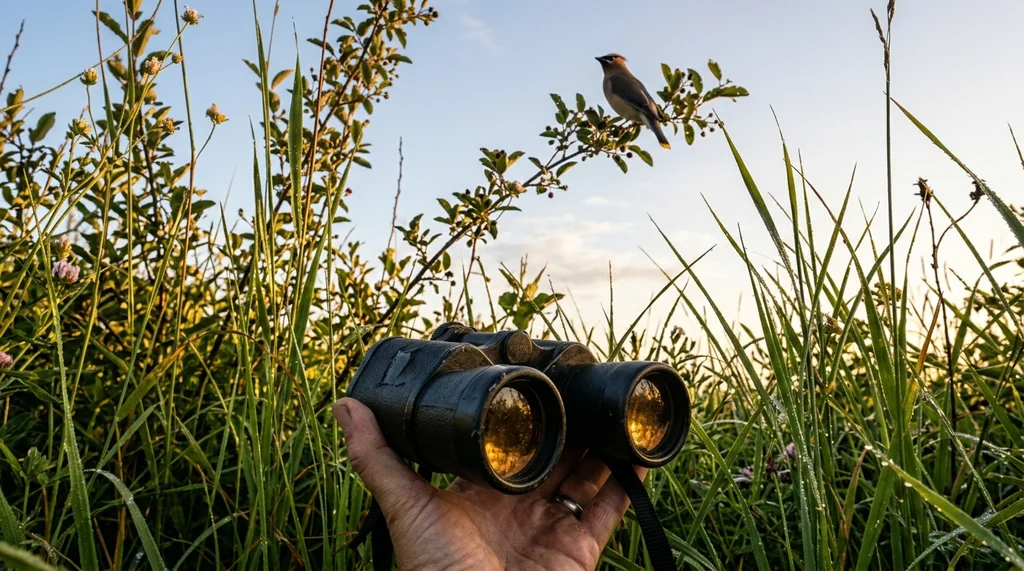
There's a particular kind of frustration that comes with watching a bird through bad optics. You can see something — a flash of red in the serviceberry, a shadow moving through the understory — but the image swims, the edges blur, and by the time your eyes adjust, the bird is gone. You're left squinting at empty branches, wondering if you imagined the whole thing.
Good binoculars don't just magnify birds. They slow them down. A sharp, bright image gives your brain enough information to actually process what you're seeing — the wing bars, the bill shape, the way a bird holds its tail. That split second of clarity is the difference between a confirmed sighting and an entry in your notebook that reads "probably a warbler? yellowish."
The problem is that binoculars are one of those purchases where the range between "entry level" and "professional grade" spans from $50 to $3,000, and the marketing language at every price point sounds nearly identical. Full multi-coated optics. Waterproof. Phase-corrected. These terms mean something, but they don't tell you whether a specific pair will actually work for watching birds at a backyard feeder or hiking a ridge at dawn. This guide cuts through the specifications to explain what actually matters, what you can skip, and which pairs earn their price tags at every budget level.
Key Takeaways
- Choose 8x magnification for general bird watching — 10x narrows the field of view and amplifies hand tremor enough to lose fast-moving birds
- Require a close focus distance of 6.5 feet or less; binoculars that can't focus under 15 feet are useless when birds land nearby
- Glasses wearers need a minimum of 15mm eye relief — 18mm or more for comfortable full-image viewing without dark vignetting
- The $200–$500 price range delivers the strongest value; the Vortex Diamondback HD ($200) and Vortex Viper HD ($500) are the top picks at each end
- Test binoculars in person by checking chromatic aberration on a high-contrast edge and timing how fast the focus wheel responds across its full range
What Makes Binoculars Good for Bird Watching Specifically
Not all binoculars are designed with bird watchers in mind. Hunting binoculars prioritize durability in cold, wet conditions and often sacrifice close-focus distance because deer aren't usually three feet away. Marine binoculars are built for scanning distant horizons, not tracking a bird that just landed in the shrubs at your feet. Stadium binoculars are designed for stationary viewing, not raising and lowering quickly a hundred times in an afternoon.
Bird watching has specific demands that shape every recommendation in this guide.
Magnification: Why 8x Almost Always Wins
The first number in any binocular specification — 8x42, 10x50, 7x35 — is the magnification. Higher feels like it should be better. It isn't, not for birds.
At 10x magnification, the image shakes with every heartbeat. Your hands tremble slightly all the time; you don't notice it until you're trying to hold a 10x image steady on a small bird in a tree. The field of view also narrows at higher magnification, which means it's harder to find a bird quickly. You raise your binoculars, and instead of a wide, sweeping view that helps you locate what you just saw with your naked eye, you're looking through a narrow tunnel.
Eight-power magnification hits the sweet spot: enough to see detail clearly, forgiving enough for hand tremor, wide enough to find birds quickly. Seven-power is excellent for beginners because it's even more forgiving, though you sacrifice some detail at distance. Ten-power has its place — hawk watching from a fixed position, scanning a distant marsh — but for general bird watching, 8x is the recommendation you'll hear from experienced birders consistently, and it's the right one.
Objective Lens Diameter: Brightness in the Real World
The second number — the 42 in 8x42 — is the diameter of the objective lens in millimeters. Larger lenses gather more light, which matters most in low-light conditions: dawn, dusk, forest understory.
The 42mm objective is the standard for general bird watching, and for good reason. It provides genuinely bright images in most conditions without making the binoculars prohibitively heavy. A 50mm objective lens gathers more light but adds significant weight — the kind of weight that matters after three hours in the field.
The 32mm objective is lighter and more compact, making it ideal for travel or for birders who prioritize portability. The tradeoff is reduced brightness in dim conditions. Dr. Patricia Fielding, who has studied bird physiology for forty years, has used 8x32 binoculars for field research for two decades — 18 ounces, compact enough to carry all day, bright enough for her purposes. For researchers and serious birders who spend full days in the field, that weight savings accumulates into something meaningful.
For most backyard and trail birders, 8x42 is the practical choice. For those who want lighter optics and primarily bird in good light, 8x32 is worth considering seriously.
Close Focus Distance: The Overlooked Specification
This one surprises new birders. Close focus distance is how near a bird can be before the binoculars can no longer focus on it. Cheap binoculars often can't focus closer than 15 to 20 feet. This sounds fine until a Yellow Warbler lands on a branch four feet from your face and you're holding what amounts to useless glass.
Good bird watching binoculars should focus to 6 feet or closer. Six and a half feet is excellent. Some premium models focus to 4.5 feet, which opens up a world of close-range observation that changes what bird watching feels like entirely.
When evaluating any pair of binoculars, find the close focus specification and take it seriously. It's not a luxury feature.
Eye Relief: Non-Negotiable for Glasses Wearers
Eye relief is the distance between the eyepiece and the point where the full image is visible. If you wear glasses, you physically cannot press your eyes against the eyepiece, so you need enough eye relief to see the complete image from farther back.
The minimum for comfortable glasses-wearing use is 15mm. Sixteen to 18mm is comfortable. Anything below 14mm and glasses wearers will see a vignetted image — a dark ring around the edges that cuts off part of the view.
For glasses wearers, 18mm or more of eye relief should be treated as a hard requirement, not a preference. The adjustable eyecups on quality binoculars twist or fold down to accommodate glasses, but the eye relief specification is what determines whether the full image is actually visible.
Prism Type: Roof vs. Porro
There are two prism designs you'll encounter: roof prism and porro prism. Roof prism binoculars are the sleek, straight-barreled style that dominates modern bird watching. Porro prism binoculars have the traditional offset-barrel design — the eyepieces are closer together than the objective lenses.
Porro prisms produce excellent optical quality at lower price points because the design is more forgiving of manufacturing tolerances. A $150 porro prism binocular will typically outperform a $150 roof prism binocular optically. The tradeoff is that porro binoculars are bulkier, less water-resistant (typically), and feel less balanced in hand.
Tom at the hardware store — who has let me test more pairs of binoculars than I can count — uses porro prism binoculars himself. He's not wrong. At the same price point, they genuinely do deliver better optics. But the roof prism design's durability, weather resistance, and handling advantages explain why they've become standard for serious bird watching.
Best Binoculars Under $200
This is the budget range where most people start, and it's where the most mistakes happen. The $50 to $100 range is largely a waste of money for bird watching — the optics are soft, the close focus is poor, and they typically won't survive a year of regular use. Genuinely useful binoculars start around $150 to $200.
Celestron Nature DX 8x42 — Around $130
The Nature DX is the entry point that actually works. It delivers 8x42 optics with a close focus of 6.5 feet, multi-coated lenses (not fully multi-coated, but adequate), and a comfortable rubber-armored body. The field of view is 388 feet at 1,000 yards — narrower than premium models, but workable.
The weaknesses are real. In low light, the image quality drops noticeably. The focus wheel is smooth but the diopter adjustment is stiff. Eye relief is 17.5mm, which is good for glasses wearers. For someone who wants to try bird watching before committing to a larger investment, this is the pair to start with.
Vortex Diamondback HD 8x42 — Around $200
At the top of this budget range, the Diamondback HD represents a significant jump in quality. Vortex's HD glass produces noticeably sharper, higher-contrast images than competing pairs at this price. The close focus is 5 feet — better than most in this range. Field of view is 393 feet at 1,000 yards.
What makes Vortex worth considering at every price point is their VIP warranty: unconditional, unlimited lifetime guarantee. No receipt required, no questions asked. For a beginning birder who might drop, sit on, or submerge their binoculars, this warranty has genuine value.
Eye relief is 16mm, which accommodates most glasses wearers comfortably. The Diamondback HD is the pair I'd recommend to anyone starting out who wants binoculars that won't need replacing in two years.
Best Binoculars in the $200 to $400 Range
This is where bird watching binoculars become genuinely excellent. The optical quality, durability, and ergonomics at this price point are hard to distinguish from pairs costing twice as much in many real-world conditions.
Vortex Crossfire HD 8x42 — Around $180
Slightly below the Diamondback HD in the Vortex lineup but worth mentioning separately because it often goes on sale in the $150 to $180 range. The Crossfire HD delivers similar optical quality to the Diamondback with a close focus of 5.5 feet and 16.5mm of eye relief. For birders who find the Diamondback out of budget, the Crossfire HD is a legitimate alternative rather than a significant compromise.
Nikon Prostaff P7 8x42 — Around $250
Nikon's Prostaff P7 represents the company's serious attempt at the mid-range bird watching market, and it largely succeeds. The fully multi-coated optics produce bright, sharp images with good color fidelity — important when you're trying to distinguish between similar species by plumage. Close focus is 8.2 feet, which is the weakest specification in this lineup and worth noting for anyone who frequently encounters birds at close range.
The P7's field of view is 426 feet at 1,000 yards, which is genuinely wide and makes finding birds easier. Eye relief is 19.4mm — excellent for glasses wearers. The focusing wheel is smooth and fast, which matters when a bird lands and disappears in the time it takes to find focus.
Bushnell Engage 8x42 — Around $200 to $250
The Engage series is Bushnell's best work in recent years, and the 8x42 configuration delivers ED (extra-low dispersion) glass at a price point where most manufacturers are using standard glass. ED glass reduces chromatic aberration — the color fringing that appears around high-contrast edges in lower-quality optics. The result is a cleaner, sharper image, particularly noticeable when watching birds against bright sky.
Close focus is 6.5 feet. Eye relief is 15.2mm, which is adequate for most glasses wearers but tight for those with thicker lenses. Field of view is 362 feet at 1,000 yards — narrower than some competitors. The tradeoff for that ED glass is worth it for birders who prioritize image quality over field of view width.
Maven B1 8x42 — Around $300
Maven is a direct-to-consumer optics company, which means their binoculars deliver specifications that would cost significantly more through traditional retail channels. The B1 in 8x42 configuration uses ED glass, fully multi-coated optics, and a close focus of 5 feet. Field of view is 420 feet at 1,000 yards.
What distinguishes Maven is their customization program: you can choose the color of the body armor and other cosmetic details. This sounds frivolous until you realize it means the company is building to order, which tends to produce more consistent quality control than mass-produced alternatives. The B1's image quality competes with binoculars costing $150 to $200 more at traditional retail.
Best Binoculars in the $400 to $800 Range
This is the range where serious bird watchers land after a few years of experience. The optical differences between this tier and the tier above are real but subtle in good light — where they become obvious is at dawn, in forest shade, and during the last thirty minutes before dark.
Zeiss Terra ED 8x42 — Around $500 to $600
Zeiss Terra ED binoculars deliver the Zeiss optical reputation at a price that doesn't require a significant life decision. The T* anti-reflective coating produces images with exceptional contrast and color accuracy. Close focus is 5.25 feet. Field of view is 399 feet at 1,000 yards. Eye relief is 18mm.
The Terra ED is lighter than many competitors at this price — 26 ounces — which matters for all-day use. The focusing wheel is precise and fast. The body is nitrogen-purged and waterproof to 330 feet, which is well beyond any conditions a bird watcher will encounter.
The honest caveat: at $500 to $600, you're paying partly for the Zeiss name. The optical quality is excellent, but the Vortex Viper HD at a similar price point delivers comparable performance. The Zeiss wins on handling and ergonomics; the Vortex wins on warranty terms.
Vortex Viper HD 8x42 — Around $500
The Viper HD is where Vortex's HD glass really shows its capabilities. The image quality is sharp, bright, and high-contrast across the full field of view — not just in the center. Close focus is 5 feet. Eye relief is 20mm, the best in this price range for glasses wearers. Field of view is 409 feet at 1,000 yards.
The Vortex VIP warranty at this price point is genuinely valuable because you're protecting a $500 investment. The Viper HD is the pair I'd recommend to someone who has been bird watching for two or three years, knows they're committed to the hobby, and wants optics that won't be a limiting factor for the next decade.
Leupold BX-4 Pro Guide HD 8x42 — Around $400 to $500
Leupold is primarily known for rifle scopes, and that heritage shows in the BX-4's build quality. The HD glass is genuinely excellent, and the 8x42 configuration delivers a 426-foot field of view at 1,000 yards — among the widest at this price point. Close focus is 6.5 feet. Eye relief is 15.4mm, which is the weakest specification for glasses wearers.
The BX-4 is particularly strong in low-light conditions, which reflects Leupold's hunting optics background. For birders who are frequently out at dawn or dusk, this performance advantage is meaningful.

Best Binoculars Over $800: When Premium Prices Are Justified
At this price point, the differences between binoculars become genuinely difficult to detect in normal conditions. What you're buying is performance in extreme conditions — low light, rain, cold — and the kind of optical quality that reduces eye fatigue during eight-hour days in the field.
Swarovski EL 8x42 — Around $2,400
The EL series is the standard against which all other bird watching binoculars are measured. The SWAROVISION field flattener lens system produces edge-to-edge sharpness that other manufacturers have spent years trying to replicate. Close focus is 4.9 feet. Field of view is 435 feet at 1,000 yards — wide for this magnification. Eye relief is 20mm.
At $2,400, these binoculars require genuine justification. For professional ornithologists, serious listers, or birders who spend hundreds of days per year in the field, the optical performance and durability justify the price over a ten-year period. For most birders, the Vortex Viper HD or Maven B1 delivers 90% of this performance at 20% of the price.
Dr. Patricia Fielding has used 8x32 binoculars that cost $180 in 2004 — roughly $280 in today's money — for twenty years of field research. The lesson there isn't that expensive binoculars aren't better. It's that the right specifications for your use case matter more than price tier.
Leica Noctivid 8x42 — Around $2,800
The Noctivid is Leica's current flagship, and it earns its reputation for low-light performance. The proprietary glass and coating technology produces images in near-dark conditions that other binoculars simply cannot match. For birders who regularly observe at dawn and dusk — owl surveys, warbler migration, shorebird watching — this performance advantage is real.
The ergonomics are exceptional, the focus wheel is the smoothest available, and the build quality is German precision manufacturing at its best. The 4.9-foot close focus and 426-foot field of view at 1,000 yards are competitive with anything in any price range.
Zeiss Victory SF 8x42 — Around $2,500
The SF (Smart Focus) designation refers to Zeiss's fast-focus design, which allows focus adjustment across the full range with less than one full rotation of the focus wheel. For tracking fast-moving birds, this matters. The image quality is among the best available anywhere, and the field of view — 459 feet at 1,000 yards — is the widest of any 8x42 binocular currently manufactured.
Binoculars for Specific Situations
For Children and Young Birders
Children need lighter binoculars with shorter interpupillary distance adjustment ranges — adult binoculars often can't adjust close enough for a child's face. The Celestron Nature DX 8x42 is too heavy for young children; the 8x32 configuration at around $100 to $130 is a better starting point. Vortex also makes the Raptor series specifically for younger users.
For Eyeglass Wearers
The minimum specification is 15mm of eye relief; 18mm or more is comfortable; 20mm is ideal. The Vortex Viper HD (20mm), Nikon Prostaff P7 (19.4mm), and Leica Noctivid (17mm) all accommodate glasses wearers well. The adjustable eyecups should twist smoothly to the fully retracted position without play or wobble.
For Travel and Portability
The 8x32 configuration saves significant weight and bulk compared to 8x42. Maven's B2 8x32 at around $350 and the Zeiss Terra ED 8x32 at around $400 are the strongest options. For extreme portability, the Swarovski CL Pocket 8x25 at around $1,200 delivers premium optics in a genuinely pocketable package.
For Stationary Observation
Birders who watch primarily from a fixed location — a kitchen window, a porch, a hawk watch platform — have different needs than those who hike. A tabletop tripod adapter and a heavier, higher-magnification pair becomes viable when you're not carrying the binoculars all day. A $25 tabletop tripod by a kitchen window, paired with 10x42 binoculars on a simple adapter, transforms extended cardinal watching into a completely different experience. The tripod eliminates hand tremor entirely, which is the main argument against 10x magnification for field use.
How to Test Binoculars Before Buying
If possible, test binoculars in person before purchasing. The specifications tell you a great deal, but ergonomics are personal. The focus wheel that feels perfectly positioned for one person's hands sits awkwardly for another's. The weight that seems acceptable holding a pair for thirty seconds becomes significant after three hours.
When testing, check these things specifically: Find a high-contrast edge — a window frame against sky — and look at the color fringing along that edge. Chromatic aberration shows up clearly here. Look at the corners of the image and note whether sharpness drops significantly toward the edges. Focus on something close, then something far, and time how quickly the focus wheel responds. Look through the binoculars while wearing your glasses if you wear them, with the eyecups fully retracted.
Most specialty optics retailers will allow outdoor testing. Some will loan pairs for field testing. The investment of an afternoon testing before a $300 to $500 purchase is always worthwhile.
The Specifications That Actually Matter: A Summary
After everything above, the practical checklist for evaluating bird watching binoculars comes down to six specifications:
Magnification: 8x for most situations. 7x if you prioritize ease of use. 10x only for stationary observation.
Objective lens: 42mm for general use. 32mm if weight is the priority. 50mm only if low-light performance is critical and weight isn't a concern.
Close focus: 6.5 feet maximum. 5 feet or less preferred.
Eye relief: 15mm minimum for glasses wearers. 18mm or more for comfortable use.
Prism type: Roof prism for durability and weather resistance. Porro prism for better optical value at lower price points.
Weight: Under 28 ounces for comfortable all-day use. Under 22 ounces for travel.
Genuinely useful binoculars start around $150 to $200. The sweet spot where quality and value intersect most strongly is the $200 to $500 range. Above $800, you're paying for performance in extreme conditions and incremental optical improvements that matter most to professionals and dedicated enthusiasts.
A regional field guide to birds costs under $25. Good binoculars cost $200 to $500. These two purchases, together, are the foundation of a bird watching practice that will last for years. Everything else — apps, feeders, field gear — builds on the ability to actually see what you're looking at.
The birds are there. The right binoculars make them visible.