10x42 Binoculars for Bird Watching: How to Choose
Best 10x42 Binoculars for Bird Watching: A Practical Guide to Finding Your Match
Three years of watching birds through kitchen glass will teach you things no specification sheet can. You learn that a 420-foot field of view means you can track a cedar waxwing across an entire hedgerow without losing it. You learn that 18mm of eye relief isn't a luxury for glasses wearers — it's the difference between seeing birds and seeing black circles. And you learn, eventually, that the question isn't which binoculars are objectively best, but which ones are best for how, where, and how long you actually watch.
The 10x42 configuration sits at the center of nearly every serious birder's conversation, and for good reason. It's the specification that most manufacturers treat as their flagship format, which means more competition, more innovation, and ultimately more value at every price point. The 10x magnification brings distant birds close enough to read the fine streaking on a sparrow's breast. The 42mm objective lens gathers enough light to keep that image bright from dawn through dusk. And the resulting 4.2mm exit pupil hits the sweet spot between daytime performance and low-light capability.
This guide covers what actually matters when choosing 10x42 binoculars for bird watching — the specifications worth caring about, the ones manufacturers inflate for marketing purposes, and specific models that consistently earn their reputations across different budgets.

Key Takeaways
- Field of view varies from 290 to 357 feet at 1,000 yards among 10x42 models — a 67-foot difference that affects your ability to track fast-moving birds.
- Glasses wearers need at least 16mm of eye relief; the Zeiss Conquest HD provides 18mm at under $1,000.
- A minimum focus distance above 12 feet prevents using binoculars on feeders visible from a typical window.
- Vortex and Maven offer unconditional lifetime warranties covering owner-caused damage; Zeiss and Swarovski cover defects only.
- The Vortex Crossfire HD at 23 ounces is the lightest 10x42 option, reducing fatigue on extended hiking birding trips.
Why 10x42 Has Become the Bird Watching Standard
The dominance of the 10x42 format didn't happen by accident. It emerged from decades of birders testing alternatives and landing on the same conclusion: 8x gives you stability but sacrifices detail on distant birds, while 12x gives you reach but punishes any hand movement and narrows your field of view considerably.
The 10x42 threads that needle. At ten times magnification, a bird 200 feet away appears as close as one standing 20 feet from you. That's the difference between identifying a warbler by general shape and reading the specific pattern of its eye ring. For New England birding specifically — where dense foliage means birds appear briefly and at distance — that extra reach over 8x binoculars matters more than it might in open grassland habitat.
The 42mm objective lens does two things simultaneously. It gathers enough light to maintain a usable image in the shadowed understory where most songbirds feed, and it keeps the binoculars at a weight that most people can hold steady for extended observation sessions. Larger objectives, like the 50mm lenses on hunting binoculars, gather more light but push weight into territory where hand tremor becomes a real problem during the ten-minute observation sessions that serious birding requires.
The physics work out to a 4.2mm exit pupil — the diameter of the light beam entering your eye. Human pupils in daylight contract to roughly 2-3mm, so the 4.2mm exit pupil provides comfortable margin. In low light, when pupils dilate to 5-7mm, you lose some of that advantage, which is why dedicated dawn and dusk observers sometimes prefer the 5mm exit pupil of 10x50 configurations. But for the vast majority of bird watching hours — mid-morning through late afternoon — 10x42 performs beautifully.
The Specifications That Actually Predict Performance
Field of View: More Important Than Most Buyers Realize
Field of view describes how wide a swath of landscape you can see at 1,000 yards. Among 10x42 binoculars, this ranges from roughly 290 feet on budget models to 357 feet on premium options like the Swarovski EL Range. That 67-foot difference sounds abstract until you're tracking a woodcock flushing through dense brush — at which point a wider field of view means the difference between staying on the bird and losing it entirely.
The Maven B1.2 offers 347 feet at 1,000 yards, which places it among the wider-FOV options in the premium segment. The Nikon Monarch M7 earns consistent praise specifically for its wide field of view relative to its price point, which is why it appears on so many "best value" lists despite competing against binoculars that cost twice as much.
When comparing models, prioritize field of view more heavily than most specification comparisons suggest. Optical sharpness differences between binoculars in the same price tier are often marginal. Field of view differences are immediately, practically noticeable.
Eye Relief: Non-Negotiable for Glasses Wearers
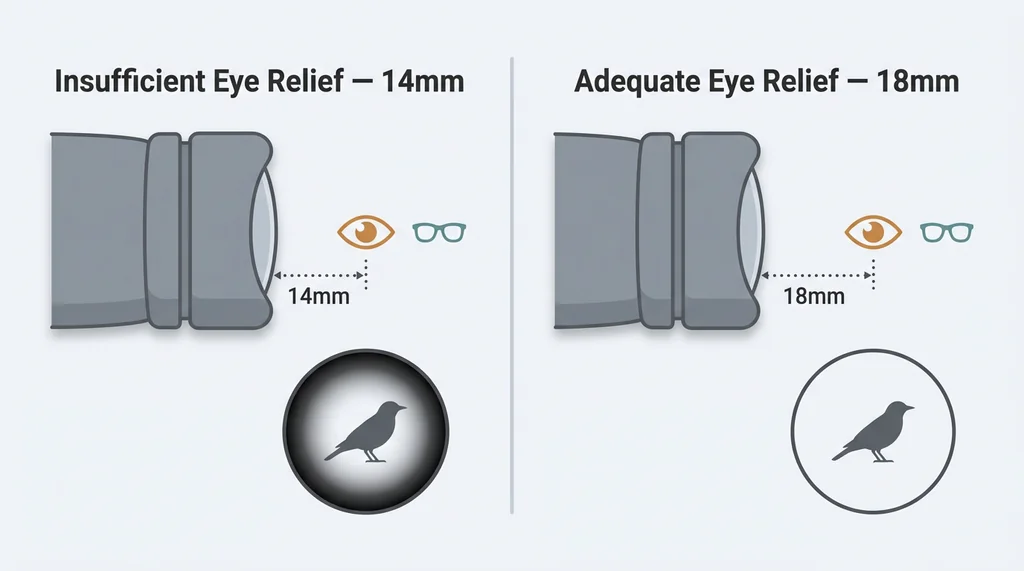
Eye relief — the distance from the ocular lens at which you can see the full field of view — matters to everyone but is critical for anyone who wears glasses. Eyeglass lenses hold your eye 12-15mm away from the binocular eyecup by default. If the binoculars offer only 14mm of eye relief, glasses wearers see a tunneled, vignette-darkened image rather than the full field.
The minimum threshold for comfortable use with glasses is generally 16mm, though 17-18mm provides meaningful additional comfort. The Zeiss Conquest HD and GPO Passion HD both offer 17-18mm of eye relief, making them reliable choices for glasses wearers who want premium optics without the frustration of a compromised view.
This specification matters even for people who don't wear glasses during bird watching. Eye relief determines how precisely your eye must be positioned to see the full image. More generous eye relief means less fatigue during extended observation sessions, because minor head movements don't immediately cut off the edges of the field.
Close Focus: Essential, Often Overlooked
Most birders think of binoculars as tools for distant observation, and they are — but the ability to focus on something only 6 or 8 feet away proves surprisingly important in practice. Butterflies, dragonflies, and near-field warblers all reward close focus capability. The Vortex Razor UHD earns particular praise for its close focus performance. The Swarovski SLC, by contrast, has a notably far minimum focus distance, which frustrates birders who do mixed habitat observation.
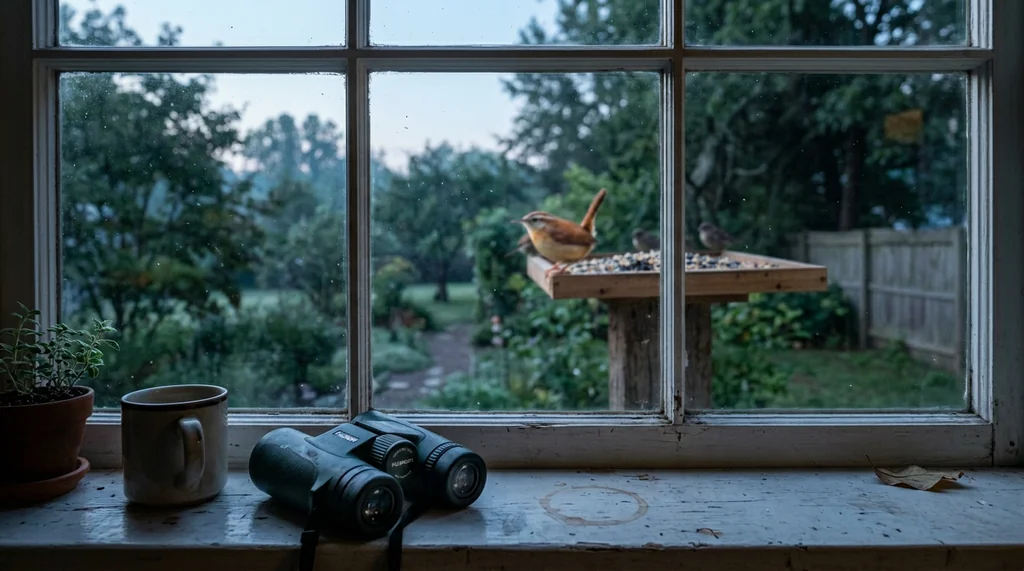
If you regularly watch birds at feeders from inside a window — a very common scenario — close focus capability directly affects whether you can use your binoculars for that purpose at all. A minimum focus distance of 8 feet works for most window-to-feeder distances. Anything beyond 12 feet starts creating situations where the feeders themselves are too close to focus on.
10x42 Binoculars Across the Price Spectrum
Premium Tier ($1,000 and Above)
Vortex Razor UHD 10x42
The Razor UHD occupies a specific position in the premium market: it's the choice for buyers who want best-in-class optical performance and are willing to accept a heavier chassis to get it. The Abbe-Koenig prism design — rather than the Schmidt-Pechan roof prisms found in most competitors — delivers 100% internal reflection without phase-coating requirements. The practical result is an image that many experienced birders describe as having exceptional contrast and edge-to-edge sharpness.
The close focus capability stands out among premium options, making it genuinely versatile for mixed-use observation. The included harness is high quality — a detail that matters more than it sounds, since some premium brands charge separately for accessories that should be standard. The primary complaint among reviewers involves the plastic focus wheel, which feels inconsistent with the otherwise premium build quality. This is a legitimate criticism rather than nitpicking: when you're paying over $1,000 for binoculars, every tactile element of the experience should match the optical quality.
Swarovski EL Range 10x42
The Swarovski EL Range adds integrated laser rangefinding to an already excellent optical platform. For birders who also hunt, or who want to log precise observation distances for scientific purposes, the rangefinding capability transforms the binoculars from a viewing tool into a data collection instrument. The 357-foot field of view at 1,000 yards is among the widest available in any 10x42 configuration.
The warranty situation deserves attention. Swarovski offers a limited warranty rather than the unconditional lifetime coverage provided by brands like Maven and Vortex. For an instrument at this price point, understanding exactly what's covered and under what conditions matters before purchase.
Maven B1.2 10x42
Maven's direct-to-consumer model eliminates retail markup, which means the B1.2 delivers optical performance that would cost significantly more through traditional retail channels. The claimed 94.5% light transmission — achieved through dielectric coatings and ED glass — places it among the best light-gathering performers in the premium segment. The 347-foot field of view is genuinely wide. Maven's unconditional lifetime warranty covers the instrument regardless of how damage occurred, which provides meaningful long-term value.
Mid-Range ($400–$1,000)
Zeiss Conquest HD 10x42
The Zeiss Conquest HD is the answer to the question "what's the best 10x42 under $1,000?" more often than any other model. The 18mm eye relief makes it the top choice for glasses wearers who want premium optics without crossing into four-figure territory. Zeiss's T* anti-reflection coating system delivers light transmission that competes with binoculars costing significantly more. The field of view is competitive without being class-leading.
For birders who wear glasses and want the best optical experience their money can buy below the premium tier, the Conquest HD is the clearest recommendation available.
Nikon Monarch M7 10x42
The Monarch M7 earns its "best overall" designation from multiple reviewers through a combination of wide field of view, ED glass that minimizes chromatic aberration, and pricing that sits below most competitors with comparable specifications. The field of view is notably wide for the price category, which makes it particularly effective for tracking fast-moving birds through varied habitat.
Nikon's ED glass reduces the color fringing that cheaper binoculars display on high-contrast edges — the boundary between a dark bird silhouette and a bright sky, for instance. At the Monarch M7's price point, finding ED glass is not guaranteed, which makes it a meaningful differentiator.
Budget and Entry-Level (Under $400)
Vortex Crossfire HD 10x42
At 23 ounces, the Crossfire HD is among the lightest 10x42 binoculars available, which makes it genuinely comfortable for extended carry during hiking-based bird watching. The optical quality is honest rather than exceptional — fully multi-coated lenses provide adequate light transmission, and the image is clean enough to identify birds reliably in good light conditions. Vortex's VIP warranty covers unlimited repair or replacement regardless of fault, which is an unconditional guarantee that many premium brands don't match.
For new birders who aren't certain they want to commit several hundred dollars to optics, the Crossfire HD provides a legitimate starting point that won't frustrate with poor image quality.
Maven C.1 10x42
Maven's entry-level C.1 applies the same direct-to-consumer approach as their premium B.1.2, delivering better-than-expected optical quality at its price point. The build quality is solid for the category, and the unconditional lifetime warranty applies across the Maven lineup. For budget-conscious buyers who want genuine long-term value rather than a disposable starter binocular, the C.1 merits serious consideration.
Practical Considerations Before You Buy
The Weight Question
Ten-power binoculars require steadier hands than eight-power, because any shake is magnified along with the image. The practical weight range for 10x42 binoculars runs from 23 ounces (Vortex Crossfire HD) to 33 ounces for heavier premium models. Magnesium chassis construction — found on premium models — adds durability without proportionally adding weight, but budget models using polycarbonate bodies tend to be lighter at the cost of long-term resilience.
If hand tremor is a consistent problem, the Canon 10x42 L IS offers optical image stabilization that dramatically reduces shake. The tradeoff is battery dependency and a price point that exceeds most premium binoculars. For most birders, a quality harness that distributes weight across the shoulders and chest — rather than neck-hanging — solves the fatigue problem more practically.
Testing Before Committing
Specification sheets describe what binoculars do in controlled conditions. They don't describe what the image looks like at dusk, how the focus wheel feels after three hours of continuous use, or whether the eye relief actually works with your specific glasses frames. If you have access to a store that allows extended testing — or a local birding club that passes equipment around — testing in varied light conditions before purchasing is genuinely worth the effort.
The differences between binoculars in the same price tier often come down to subjective image character: some people prefer cooler, high-contrast rendering; others prefer warmer, more natural color reproduction. These preferences are real and consistent, and they're impossible to predict from specifications alone.
Warranty Realities
Warranty terms vary significantly and matter more than buyers typically consider at the time of purchase. Vortex's VIP warranty and Maven's unconditional lifetime coverage represent the strongest protection available — they cover damage caused by the owner, not just manufacturing defects. Zeiss and Swarovski offer limited warranties that cover defects but not accidental damage. Nikon's warranty terms vary by model and region. Before finalizing a purchase, confirm what the warranty actually covers and whether it's transferable if you buy used.
The 10x42 format rewards careful selection because the range of quality within the format is genuinely enormous. The difference between a $150 budget model and a $1,200 premium model isn't marginal — it's the difference between watching birds and truly seeing them. But within each price tier, the differences narrow considerably, and the right choice depends on specific factors: whether you wear glasses, how far you typically observe, how long you hold binoculars at a time, and whether close focus capability matters for your primary habitat.
Start with your actual requirements rather than the most impressive specifications, and the right 10x42 binoculars for your bird watching become considerably easier to identify.