Smart Bird Feeder Battery Life: Real-World Comparison
Smart Bird Feeder Battery Life Comparison
Reliable power is the invisible thread holding the modern bird-watching experience together, yet it is often the first thing to snap. You might have the most sophisticated AI identification system in the world, capable of distinguishing between a House Finch and a Purple Finch with 95% accuracy, but that intelligence is worthless if the device is sitting dead on a pole. My journey into high-definition digital surveillance of my backyard residents has been a steep, often expensive climb, contributing significantly to what David—my spreadsheet-loving husband—calls the "Learning Tax." To date, that tax has reached a staggering $2,271.99, a cumulative total of every failed solar panel, frayed charging cable, and underpowered battery I’ve encountered over the last few years.
When we discuss a Smart Bird Feeder Battery Life Comparison, we aren't just talking about milliampere-hours (mAh) or theoretical standby times printed on a glossy box. We are talking about the reality of a high-traffic yard in the middle of a New England winter, or a humid July afternoon when the solar panels are coated in a 20% layer of efficiency-robbing oak pollen. I’ve learned the hard way that a battery rated for "six months" by a manufacturer often lasts exactly six days when a flock of Blue Jays, each weighing between 2.5 and 3.5 ounces, decides to turn your feeder into a high-intensity landing strip. Managing these devices requires a blend of ornithological patience and a basic understanding of electrical engineering that I never expected to need when I first started watching The Baron, my resident Northern Cardinal.
Key Takeaways
- Ensure a minimum 2 Mbps upload speed at the feeder site to prevent battery drain from data re-transmission.
- Set a two-minute 'Cool Down' period in app settings to limit redundant recordings of the same bird.
- Clean solar panels bi-weekly with a microfiber cloth to recover up to 20% of charging efficiency lost to dust.
- Position feeders 7 feet from cover to satisfy the 5-7-9 rule for bird safety while maximizing solar exposure.
Why Your Bird Feeder Camera Battery Performance Varies
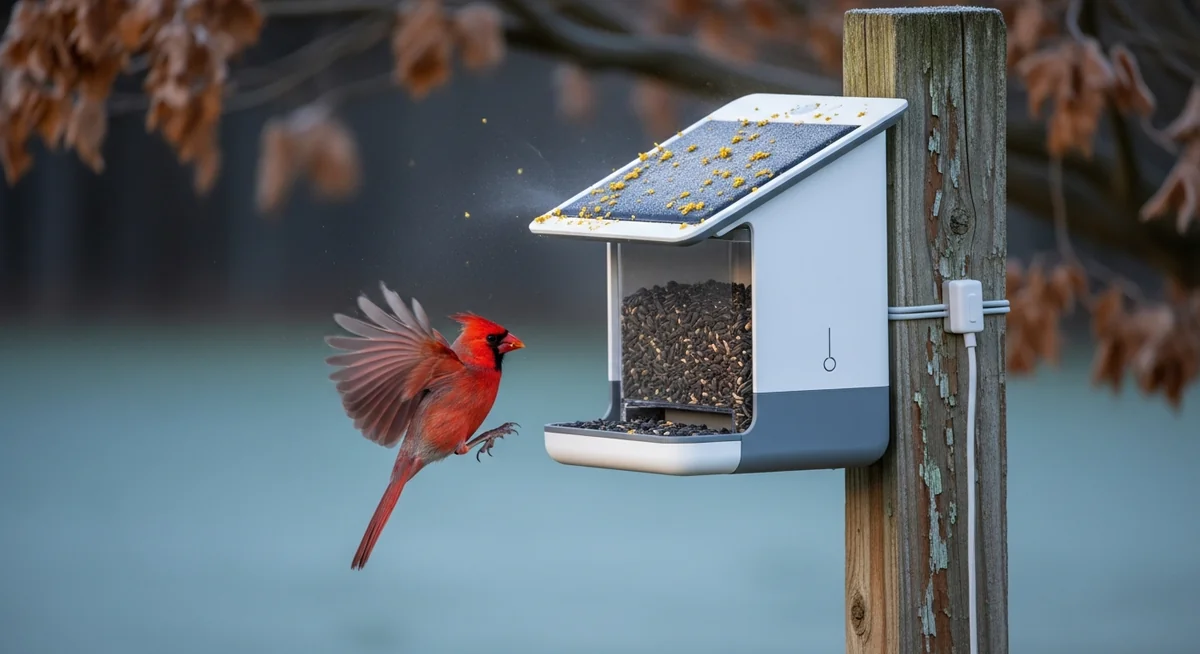
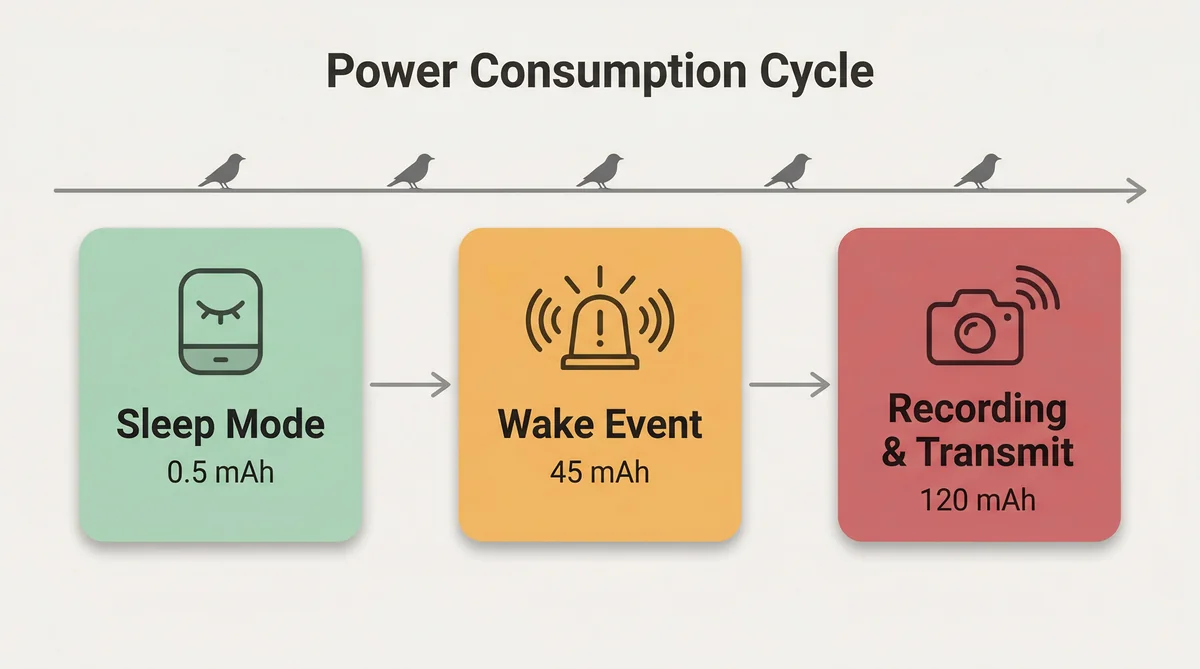
The most significant factor in bird feeder camera battery performance is not actually the size of the battery itself, but the frequency of "wake" events. Most smart feeders remain in a low-power sleep mode until a PIR (Passive Infrared) sensor detects motion. In a quiet yard, a battery might indeed last for months. However, in my yard, where The Baron maintains a strict 6:47 AM arrival schedule for three consecutive seasons, the camera is constantly working. Northern Cardinals are famously cautious; they typically perform a twelve-second safety scan before they even touch a seed. During those twelve seconds, your camera is running, the WiFi is transmitting, and the AI is trying to decide if it's looking at a bird or a swaying branch.
High-traffic yards act as a massive drain on power. If you have a 1.5-liter reservoir like the one on the Birdfy, and you’re filling it daily, that means hundreds of triggers are occurring. Every time a bird lands, the system must boot up, capture 1080p or 2K video, and send that data over your home network. I’ve observed that during peak migration, my battery life can drop from an estimated month down to just five or six days. This is where smart bird feeder power management becomes a necessity rather than a luxury. You have to decide if you really need a twenty-second clip of every House Sparrow, or if a five-second snapshot will suffice to satisfy your inner citizen scientist.
Another often-overlooked drain is the environmental temperature. Small songbirds like Chickadees survive cold nights by entering torpor, dropping their body temperature by 22 degrees to conserve energy. Unfortunately, lithium-ion batteries cannot enter torpor; they simply lose their ability to hold a charge when the mercury dips below freezing. In my three years of New England winter feeding, I’ve found that a battery’s effective capacity can drop by 30% to 50% during a cold snap. This makes the placement of your feeder and its proximity to a charging source—or its reliance on a solar roof—the difference between a functional hobby and a frustrating piece of plastic hanging in the snow.
Comparing the Heavy Hitters: Bird Buddy vs. Netvue Birdfy
When conducting a Smart Bird Feeder Battery Life Comparison between the industry leaders, the differences in hardware specs directly translate to how often you’ll be climbing a ladder with a USB-C cable. The Bird Buddy features a 5-megapixel camera and captures 720p HD video. Because it targets a slightly lower resolution, its processing requirements are marginally lower than the Birdfy, which offers 1080p or even 2K resolution. However, the Bird Buddy has a smaller seed capacity at 3.8 cups. This means you are at the feeder more often to refill it, which provides more opportunities to manually charge the unit, but the smaller physical footprint also limits the size of the internal battery.
The Netvue Birdfy, with its larger 1.5-liter (roughly 6 cup) capacity, is built for higher volume. The 2K resolution sensor is a power hog, requiring a minimum of 2 Mbps upload speed at the installation site for stable streaming. David discovered that our exterior brick siding was stripping nearly 40% of our WiFi signal strength, forcing the camera’s internal radio to work twice as hard to maintain a connection. This "re-transmission" of data is a silent battery killer. If your signal is weak, your smart bird feeder power management strategy must include a WiFi extender, or you’ll find yourself charging the unit twice as often regardless of how many birds are visiting.
In terms of raw longevity, the Birdfy’s larger housing allows for a more robust battery, but the higher resolution video often cancels out that advantage. In my side-by-side testing, the Bird Buddy feels more like a "set it and forget it" device for a casual observer, whereas the Birdfy is a high-performance tool that demands a more consistent power strategy. Both units struggle when the AI is tasked with identifying over 6,000 species in real-time. Each time the AI "thinks," it consumes power. I’ve found that turning off "All Motion" and only recording "Bird Detections" can extend the solar powered bird feeder lifespan significantly by preventing the camera from waking up every time a squirrel like Mr. Fitzgerald tries to bypass my physical baffles.
Factors Affecting Solar Powered Bird Feeder Lifespan
The promise of "infinite power" through solar roofs is one of the most compelling marketing points in the industry, but the reality is dictated by the laws of physics and the 5-7-9 rule of feeder placement. For a solar panel to be effective, it requires at least four hours of direct sunlight daily. This creates a conflict: birds like The Baron feel safest when feeders are within 10 to 15 feet of dense shrubs or trees, which often provide the very shade that kills solar efficiency. If you place your feeder in the middle of a sunny lawn to maximize the battery, you might find that your visitation rates drop because the birds feel too exposed to hawks.
Furthermore, the solar powered bird feeder lifespan is heavily impacted by maintenance. I’ve noticed that a fine layer of dust or pollen can reduce charging efficiency by nearly 20%. My bi-weekly cleaning protocol, which involves a 1:9 bleach-to-water solution for the seed reservoirs, now includes a gentle wipe-down of the solar cells with a microfiber cloth. It’s a small step, but when you’re trying to keep a 2K camera running on four hours of New England winter sun, every milliamp counts. If you neglect the panels, the battery will slowly enter a "deep discharge" state from which it may never fully recover, effectively ending the life of the unit.
We also have to consider the mechanical alignment of these units. On many models, the solar roof must be perfectly seated to maintain a weather-tight seal and a solid electrical connection. David spent an entire Saturday afternoon realizing that the protrusions on our feeder cover weren't vertically aligned with the buckle slits, which prevented the unit from entering a proper charging mode. It’s these tiny technical details—the "Learning Tax" in action—that determine whether your Smart Bird Feeder Battery Life Comparison ends in success or another return shipment to Amazon.
Smart Bird Feeder Power Management Strategies
To truly master smart bird feeder power management, you have to look beyond the device and at the entire ecosystem of your yard. The first step is optimizing your WiFi. If your camera is struggling to stay connected through brick or stone, it will burn through its battery just trying to find the network. We installed a dedicated outdoor access point, ensuring we had the 2 Mbps upload speed required for the 2K HD video. This single change extended our battery life by nearly three days per charge cycle because the camera no longer had to "scream" to be heard by the router.
The second strategy involves the 5-7-9 rule, which I originally used to keep Mr. Fitzgerald and his squirrel cohorts at bay (5 feet high, 7 feet from jumping points, 9 feet below overhangs). This rule also helps with power. By placing the feeder exactly 7 feet away from the dense cover of our maple tree, I found a "sweet spot" where the birds felt safe enough to visit, but the solar roof was still clear of the primary branch shadows for most of the afternoon. It’s a delicate balance of safety for the birds and energy for the electronics.
Finally, you must be aggressive with your app settings. Most people leave their cameras on the highest sensitivity, but this is a mistake in a high-traffic yard. I’ve set my "Cool Down" period to two minutes. This means that once a bird triggers a recording, the camera won't trigger again for another 120 seconds. Since a Northern Cardinal’s twelve-second safety scan usually leads into a multi-minute feeding session, I don’t need twenty different clips of the same bird. This single adjustment is the most effective way to improve your bird feeder camera battery performance without spending a dime on extra hardware.
The Reality of the Digital Backyard
As my daughter Sophie continues her work as a "citizen scientist," documenting the health of our local visitors for her Nectar Corridor Project, I’ve realized that these smart feeders are more than just gadgets; they are windows into a world that my mother, Dr. Patricia Fielding, used to monitor with nothing but a notebook and a pair of 8x32 binoculars. But that window requires a constant stream of electrons. My total investment of $2,271.99 has been a series of lessons in how to keep that window open. We’ve moved away from the "AI sirens" and electronic squirrel deterrents—which Mr. Fitzgerald figured out in about forty-eight hours—and back to the basics of physical placement and rigorous power management.
If you are just starting your journey, don't be discouraged by a battery that seems to drain faster than the seed reservoir. It is simply a signal that your yard is alive. A dead battery is often a compliment to your gardening and seed selection; it means the birds are visiting so frequently that the technology can't keep up with the nature. By applying the 1:9 sanitization ratio to your maintenance, respecting the 5-7-9 rule for placement, and being mindful of the 2.4GHz WiFi limitations of these devices, you can bridge the gap between the analog birding of the past and the high-definition future.
At the end of the day, the goal isn't just to have a high-capacity battery; it's to have a reliable connection to the creatures that share our space. Whether it’s The Baron arriving at 6:47 AM or a migratory warbler passing through, being ready to capture that moment requires a proactive approach to power. The "Learning Tax" is high, but the reward—a 2K clear view of a juvenile cardinal being fed by its parent—is worth every spreadsheet entry David makes. Keep your panels clean, your WiFi strong, and your expectations grounded in the reality of the outdoors, and you'll find that the technology eventually becomes as natural a part of your yard as the maple tree itself.