Bird Buddy Solar Roof Review: Is It Worth the Upgrade?
Bird Buddy Solar Roof Review: Powering the Future of Backyard Birding
You’ve finally reached that point in your birding journey where your hobby requires a WiFi password and a charging cable. It starts innocently enough with a platform feeder and a bag of black oil sunflower seeds, but eventually, the allure of seeing a Tufted Titmouse in 2K high-definition becomes irresistible. However, the one thing no one tells you about smart bird feeders is the sheer frustration of the "low battery" notification. There is a specific kind of sinking feeling that occurs when you realize your camera died just minutes before The Baron—our resident Northern Cardinal who has maintained a strict 6:47 AM arrival schedule for three consecutive seasons—made his appearance.
This Bird Buddy Solar Roof review is born from that exact frustration. After spending a cumulative $2,271.99 on what David, my husband, calls my "avian surveillance state," I’ve learned that the greatest technology in the world is useless if it’s sitting on your kitchen counter plugged into a USB-C cable while the birds are throwing a party in the backyard. The solar roof is marketed as the ultimate "set it and forget it" solution, promising to harness renewable energy so you never have to bring your feeder inside again. But as someone who has wasted $1,847 on feeders that didn't work before finding my footing, I know that manufacturer promises and backyard reality often live in different zip codes.
The transition from traditional birding to using a smart bird feeder solar panel represents a significant shift in how we manage our hobby. We are moving away from simple seed refills and toward ecosystem management. If you are tired of the manual charging cycle and wondering if this specific upgrade is the key to consistent uptime, we need to look at the data, the costs, and the cold, hard reality of New England winters.
Key Takeaways
- Position the feeder to receive at least four hours of direct sunlight to maintain a six-month charge.
- Clean solar cells monthly to prevent a 20% drop in energy efficiency caused by pollen and dust.
- Sanitize the seed reservoir every two weeks using a 1:9 bleach-to-water solution to prevent avian disease.
- Account for a 5-6 day battery floor during high-traffic seasons when AI and WiFi usage peaks.
Bird Buddy Battery Life: The Reality of Constant Surveillance
When you first unbox a Bird Buddy, the technical specs are impressive: 5-megapixel photos, 720p or 1080p HD video, and a battery that the manufacturer claims can last up to a full month. In a vacuum, thirty days of battery life sounds generous. However, Bird Buddy battery life is a highly volatile metric that depends almost entirely on how popular your yard is. My yard, thanks to a steady $47 monthly investment in high-quality black oil sunflower seeds, is essentially a high-traffic airport for birds.
The camera doesn't just sit there; it uses a motion sensor to wake up, an AI to identify the species—drawing from a database of over 11,000 species in advanced models—and a WiFi radio to beam that 2K resolution footage to your phone. This requires a stable 2 Mbps upload speed at the installation site, and that constant data transmission is a massive power drain. When the juveniles from last year’s cardinal pair returned this season as adults, the activity at my feeder tripled. In high-traffic scenarios, that "one month" of battery life can quickly shrivel to five or six days.
David, who tracks our smart home metrics with the same intensity my mother, Dr. Patricia Fielding, tracks chickadee caching behavior, noted that our unit was struggling to keep up with the demand. Every time I had to take the feeder down to charge it, it felt like a failure in Bird Buddy maintenance. I wasn't just losing footage; I was interrupting the birds' routine. Cardinals, as I’ve observed over three years of daily notes, will test a new or altered feeder for exactly twelve seconds before deciding if it’s safe. Every time I removed the unit for a four-hour charge, I was resetting that trust.
The Mechanics of a Smart Bird Feeder Solar Panel
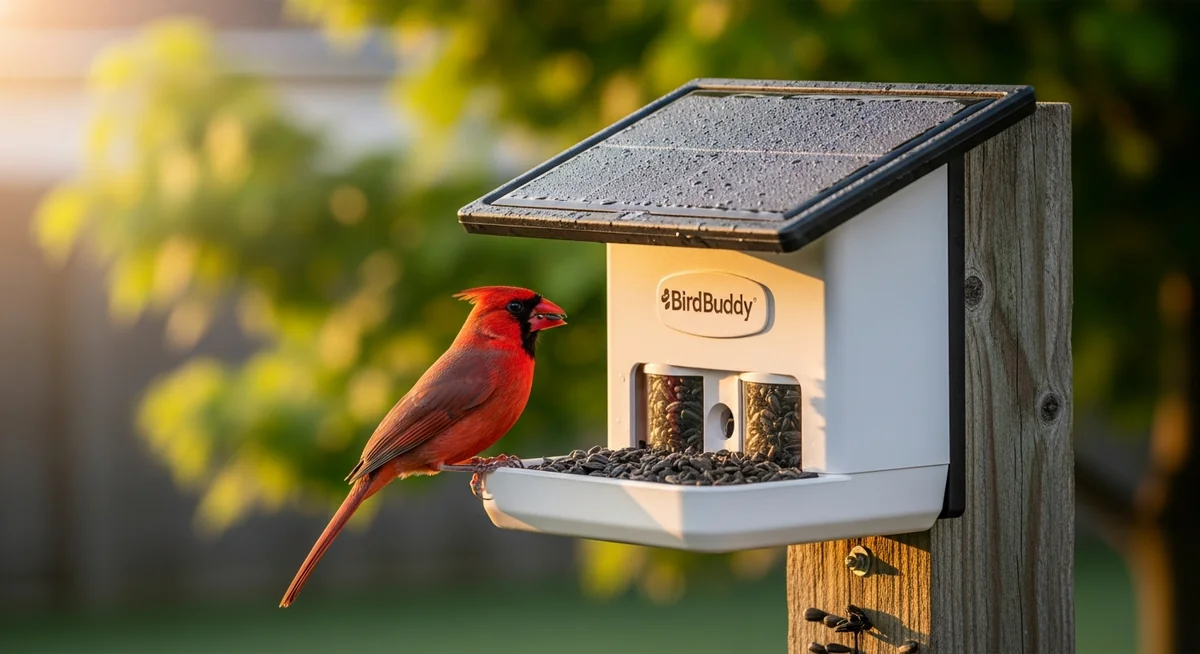
The Bird Buddy Solar Roof is designed to replace the standard white roof of the unit. It’s an integrated system, meaning the solar cells are built directly into the plastic housing. Technically, it’s a smart bird feeder solar panel that feeds directly into the internal battery via a proprietary connection. One of the more reassuring technical details I discovered is that the roof includes built-in charging circuitry. This is crucial because it regulates the flow of power, protecting the lithium-ion battery from overcharging during those long, blazing July afternoons when the sun is relentless.
For the solar roof to be effective, it requires at least four hours of direct sunlight daily. This sounds simple, but in a backyard governed by the 5-7-9 rule of squirrel proofing, placement is a delicate dance. To keep Mr. Fitzgerald—the resident squirrel chaos agent named by my son, Max—from raiding the 3.8-cup seed reservoir, the feeder must be 5 feet off the ground and 7 feet away from any jumping surface. Often, the spot that is safest from squirrels is the spot that is most shaded by the maple tree where our persistent female hummingbird nests.
When the alignment is right, however, the results are transformative. Research and real-world user data suggest that a solar-equipped unit can remain charged for up to six months without any manual intervention. For a "citizen scientist" like my daughter Sophie, who uses the app to document population health as part of our Nectar Corridor Project, that kind of uptime is the difference between a complete data set and a series of "what ifs."
Evaluating the Solar Roof Upgrade Cost and Ecosystem Value
We have to talk about the price, because as my mother always says, "Expertise is expensive, but ignorance is pricier." The solar roof is not a cheap add-on. In fact, many reviewers rightfully point out that the entire Bird Buddy ecosystem feels a bit overpriced when you start adding the "necessities." By the time you buy the solar roof, the perch extension (which I consider a borderline necessity for larger birds like cardinals), and the side fence to improve camera framing, you are "in deep" financially.
The solar roof upgrade cost must be weighed against the "learning tax" we all pay in this hobby. If you are a premium subscription user who wants to share your stream with friends or family, the consistent uptime is worth the premium. However, if you are budget-conscious, there are third-party alternatives. Some users have experimented with larger, $27 third-party solar panels from Amazon with good results. David, with his Arduino-powered monitors, actually preferred the idea of a larger external panel, but for me, the aesthetic and the "plug-and-play" nature of the official roof won out.
It’s important to remember that this upgrade is part of a larger investment. When you’ve already committed to a high-end camera feeder, the goal is to maximize the return on that investment. If the solar roof prevents even ten manual charging cycles a year, it’s saving you the hassle of climbing a ladder and the risk of the "twelve-second rejection" from your birds.

Bird Buddy Maintenance and Weather Reliability
One of the most frequent questions I get from fellow birders at Tom’s hardware store is how these high-tech gadgets handle the elements. Bird Buddy maintenance becomes slightly more complex with the solar roof, but not in the way you might think. The solar cells themselves need to be kept clean; a layer of pollen or dust can strip nearly 20% of their efficiency, much like how exterior brick siding can strip 40% of your WiFi signal.
Furthermore, we must consider the seasonal impact. Colder weather is the natural enemy of battery performance and solar efficiency. In the depths of a New England winter, when the sun hangs low and the days are short, the solar roof struggles. It won’t "likely never need charging" when it’s 20 degrees out and snowing. During these months, I still find myself bringing the unit in occasionally.
Hygiene also remains paramount. Whether you have a solar roof or not, you must adhere to a strict cleaning protocol. I use a 1:9 bleach-to-water solution every two weeks to sanitize the seed reservoir and the perches. The solar roof doesn't change the fact that birds are messy, and a smart feeder can become a vector for disease just as quickly as a $34 Woodlink platform feeder if ignored. The challenge with the Bird Buddy is that the filling door is somewhat small and can be finicky to use, especially when you’re trying to be careful around the solar circuitry.
Is the Upgrade Worth It? A Final Verdict
After three years of testing everything from $16 saucer feeders to $89 weight-activated squirrel busters, I’ve developed a fairly sharp "is it worth it" filter. The Bird Buddy Solar Roof is a specialized tool for a specific kind of birder. If your feeder is located in a remote part of your yard where running a cable or frequent trips for manual charging is a burden, it is an absolute game-changer. It provides the consistent power needed to document the 12-to-15-minute feeding intervals of high-activity species.
However, if your feeder is easily accessible and you don't mind the weekly ritual of bringing it inside, you might find the solar roof upgrade cost hard to justify. It doesn't improve the 2K resolution or the AI's ability to recognize a Blue Jay (which, by the way, weigh between 2.5 and 3.5 ounces and can occasionally trigger the Squirrel Buster Plus if you aren't careful with the weight calibration).
For me, the value lies in the peace of mind. I want to know that when The Baron arrives at 6:47 AM, my "avian surveillance state" is ready to capture the moment. I want Sophie to be able to check the app from school and see that the juveniles are healthy and feeding. In the context of my $2,271.99 total investment in birding, the solar roof is a relatively small price to pay for the elimination of "low battery" anxiety.
Ultimately, the Bird Buddy Solar Roof review comes down to your personal birding philosophy. Are you a "hands-on" birder who enjoys the daily maintenance tasks, or are you a "citizen scientist" who wants the technology to work silently in the background? If you fall into the latter camp and have at least four hours of direct sunlight, the solar roof is the bridge between a gadget and a truly automated window into the natural world. Just remember to keep those solar cells clean and your WiFi signal strong—because nature doesn't wait for a battery to reach 100%.
In the end, whether you choose the official upgrade or a $27 third-party hack, the goal is the same: to stay connected to the creatures that visit our yards. As long as the camera is rolling and the black oil sunflower seeds are fresh, the birds will keep coming back, and we will keep watching, one 2K notification at a time.