Bird Buddy Review: Is This Smart Bird Feeder Worth It?
Bird Buddy Review: A Deep Dive into High-Tech Backyard Birding
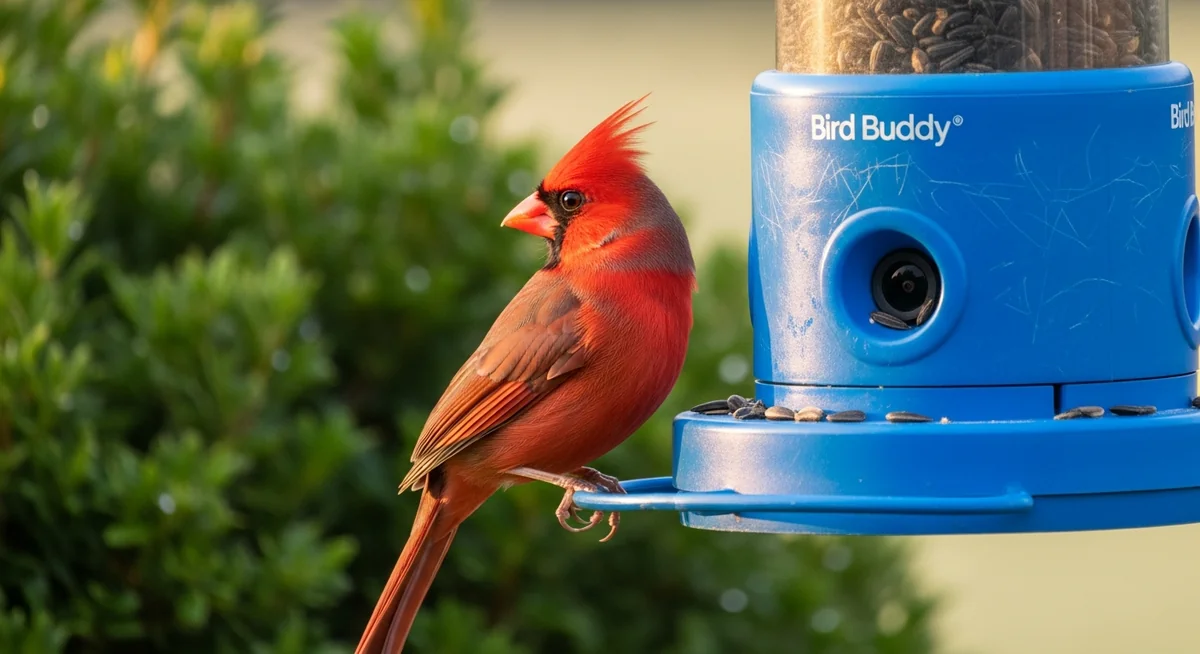
Have you ever wondered what a cardinal sees in that split second before it decides your feeder is safe? For three years, I have lived my life by the "twelve-second rule." That is the exact amount of time a Northern Cardinal—usually a male I’ve nicknamed The Baron—tests a new perch before committing to a meal. I’ve watched this ritual through my 8x42 binoculars every morning at 6:47 AM, standing twelve feet back from the kitchen window, trying to remain as still as a statue. But no matter how clear my optics are, there is always a veil between us. I am the observer; they are the observed.
That veil is precisely what the creators of the Bird Buddy promised to lift. When I first saw the advertisements for this smart bird feeder camera, my internal "learning tax" alarm went off. As many of you know, I have already spent $1,847 on feeders that didn’t work, baffles that squirrels treated like jungle gyms, and binoculars that were essentially heavy paperweights. David, my husband, has a spreadsheet dedicated to my "ornithological investments," and the entry for a $424.99 feeder required a very long conversation involving several cups of strong coffee.
However, the promise of backyard bird watching technology that could bridge the gap between my daughter Sophie’s digital world and my mother’s scientific rigor was too tempting to ignore. My mother, Dr. Patricia Fielding, has spent forty years studying bird physiology, and while she still swears by her twenty-year-old 8x32 binoculars, she was quietly curious about whether an AI bird identification app could actually keep up with a seasoned field researcher. So, I took the plunge. This Bird Buddy review is the result of months of testing, several Wi-Fi meltdowns, and at least one very confused squirrel.
Key Takeaways
- Verify a minimum 2 Mbps upload speed at the feeder location to ensure stable video postcards.
- Install a physical baffle using the 5-7-9 rule as the AI siren does not deter squirrels.
- Clean the seed tray every 14 days with a 1:9 bleach solution to maintain high-definition image clarity.
- Charge the camera module via USB-C manually if the feeder is placed in dappled shade or wooded areas.
Why I Finally Risked the Learning Tax on a Smart Bird Feeder Camera
The Bird Buddy isn't just a plastic box with a hole in it; it represents a fundamental shift in how we interact with our local wildlife. For years, I’ve been the "Hummingbird Whisperer" of the neighborhood, obsessing over 1:4 nectar ratios and the placement of my Woodlink platform feeder. But even with my level of dedication, I miss things. I miss the way a chickadee’s feathers ruffle in the wind. I miss the specific markings on a juvenile cardinal that tell me it’s one of The Baron’s offspring from the previous season.
A smart bird feeder camera changes the perspective from a distant observer to a front-row guest. The Bird Buddy is designed to capture high-resolution photos and videos triggered by motion, which are then sent directly to your phone. It’s essentially a doorbell camera for birds, but with a much more sophisticated brain. When the camera captures a visitor, it uses an AI bird identification app to tell you exactly who is at the table. For someone like me, who has spent $47 a month on black oil sunflower seeds to attract specific species, the idea of having a digital log of every visitor was incredibly appealing.
David was skeptical, not just about the price, but about the technology. He pointed out that our backyard Wi-Fi signal was "nominal at best" near the maple tree where the female cardinal usually nests. He informed me—via a very detailed chart—that for stable video streaming, we needed a minimum of 2 Mbps upload speed at the feeder's location. This is a crucial detail that many glossy advertisements skip. If your backyard bird watching technology can't talk to your router, you've essentially bought a very expensive, very pretty plastic hopper.
The Hardware Reality: Is the Backyard Bird Watching Technology Durable Enough?
When the package arrived, the first thing I noticed was the build quality. Professional reviews often rate the Bird Buddy’s construction as a 5/5, and I can see why. The plastic feels dense and high-quality, not like the brittle stuff you find on $15 big-box store feeders that crack after one New England winter. The design is sleek and modern, which David appreciated, though I was more concerned with whether the birds would find the bright blue or yellow housing intimidating.
The system I tested included the solar roof, which is an optional accessory designed to keep the internal camera module charged. In theory, this is a brilliant addition. If you place the feeder in a sunny spot—perhaps near cover, as cardinals prefer to stay within 10 to 15 feet of dense shrubs—the solar panel should keep the battery topped off indefinitely. However, our reality was a bit more complicated.
We live in a yard with mature oaks and a very large maple tree. While this is great for the "Nectar Corridor Project" I’ve been working on to replace lost trumpet vines, it’s a nightmare for solar charging. I found that the solar roof is 100% worth it if you have direct, unobstructed sunlight for several hours a day. In our dappled shade, the battery struggled. One morning, David’s spreadsheet showed the charge had dropped from 95% to 40% in just two days of heavy activity. If you live in a cloudy climate or have a heavily wooded yard, be prepared to bring the camera module inside to charge via USB-C every week or two.
There is also a documented concern regarding the longevity of the modules. While some reviewers praise the durability, others in the birding community have reported struggles with the camera modules becoming non-operational after a few months of exposure to the elements. In my testing, the unit survived three heavy rainstorms and a late-season frost without a hitch, but I did notice that the seed tray requires frequent cleaning. Because the camera is positioned so close to the food, any mold or debris—which happens quickly with wet seeds—shows up in high definition on your phone.
Testing the AI Bird Identification App: Science or Gimmick?
The heart of the Bird Buddy experience is the AI bird identification app. This is where the "hype" lives or dies. The app claims to identify over 16,000 species, which is an astounding number considering most of us only see about twenty species in our yards on a regular basis.
When the first "postcard" arrived on my phone, I felt a genuine rush of excitement. It was a Tufted Titmouse. The photo was crisp, taken from an upward angle that made the tiny bird look like a majestic mountain climber. The AI correctly identified it and provided a little "fact sheet" about its habits and diet. For Sophie, my eight-year-old, this was the "game-changer" (though I try to avoid that word, David uses it constantly). She has started a digital bird journal, and the app’s ability to "collect" species like Pokémon cards has turned her into a dedicated citizen scientist.
However, the AI isn't perfect. My mother, Dr. Fielding, sat with us one afternoon to "audit" the identifications. We had a juvenile cardinal visit—one of the three offspring brought to the feeder last May—and the AI struggled. Because the juvenile’s plumage was a mottled mix of brown and emerging red, the app initially identified it as a completely different species before correcting itself.
The app also relies heavily on the "postcard" system. You don't just get a live stream (though you can look through the camera manually); you get curated snippets. This is great for most people, but for the serious birder, it can feel a bit restrictive. One major usability gap I discovered is that you cannot share live camera access with other account holders. I wanted to give my mother access so she could watch from her house across town, but she could only view the "postcards" I shared with her, not the real-time activity. For a $424.99 investment, that feels like a missed opportunity for community birding.
Image Quality and the Lighting Hurdle
Let's talk about the photos. When the lighting is perfect—that golden hour shortly after the territorial male arrives at 6:47 AM—the images are breathtaking. You can see the individual barbs on a feather and the glint in a bird’s eye. The 2K HD resolution really shines when the sun is at the right angle.
But as any photographer will tell you, the camera is only as good as the light it receives. In suboptimal lighting, such as a gray, overcast Tuesday or the late evening hours when cardinals are most active, the quality takes a noticeable hit. The images become grainy, and the AI bird identification app starts to hesitate.
I also noticed a strange phenomenon with the "twelve-second test." Cardinals, as I’ve observed for three years, are incredibly sensitive to changes in their environment. The presence of the camera lens, which looks like a large, dark eye, seemed to extend their testing period. For the first week, The Baron would land, stare directly into the camera for nearly twenty seconds, and then fly back to the safety of the shrubs without eating. It took about ten days for the birds to treat the Bird Buddy with the same casual indifference they show my $34 Woodlink platform feeder.
The Solar Roof and Battery Life: A Husband’s Spreadsheet Perspective
I cannot write a Bird Buddy review without addressing the logistical elephant in the room: power management. David spent an entire Saturday afternoon mapping our Wi-Fi signal strength and calculating the "drain-to-charge ratio" of the solar roof.
If you're considering whether the Bird Buddy is worth it, you have to look at your specific yard. We found that on a sunny day with moderate bird activity (about 20-30 "postcards"), the solar roof could maintain the battery at a steady 80%. However, during peak season—like early June when I’m refilling my hummingbird feeders twice daily—the activity at the seed feeder is relentless. More birds mean more triggers, and more triggers mean more battery drain.
We also encountered the "95% drop" issue that some users have reported on Trustpilot. The camera would show it was charging up to 95%, and then suddenly, as if the connection had blinked, it would drop to 90% within minutes. It seems the firmware is still being refined to handle the hand-off between solar power and battery storage.
For those who aren't tech-savvy, this can be frustrating. You want to watch birds, not manage a power grid. If you aren't prepared to occasionally troubleshoot your backyard bird watching technology, the Bird Buddy might feel more like a chore than a hobby.

The Squirrel Problem: Can AI Outsmart Mr. Fitzgerald?
No bird feeder review in this house is complete without a report from the front lines of the Squirrel War. Mr. Fitzgerald, the resident squirrel named by my son Max, has a 100% success rate against every "squirrel-proof" feeder I’ve owned, with the notable exception of the Brome Squirrel Buster Plus.
The Bird Buddy is not inherently squirrel-proof. It is a plastic hopper. While it has an "AI siren" feature that is supposed to detect squirrels and play a sound to scare them away, Mr. Fitzgerald was unimpressed. The first time the siren went off, he paused for exactly three seconds, looked at the camera with what I can only describe as mild disdain, and continued eating my $47/month black oil sunflower seeds.
To make the Bird Buddy work in a squirrel-heavy environment, you must use a physical baffle. I had to mount ours on a premium pole system, standing over 80 inches high, with a 19-inch diameter baffle placed at the five-foot mark. Remember the 5-7-9 rule: squirrels can jump 5 feet up, 7 feet across, and drop 9 feet down. Without these precautions, your $400 camera will mostly provide you with high-definition close-ups of a squirrel’s belly.
Bird Buddy Worth It? The Price-to-Joy Ratio
Is the Bird Buddy worth it? The answer depends entirely on what you value in your birding experience.
If you are a budget-conscious birder who finds satisfaction in the simple act of watching through binoculars, the answer is likely no. You can buy a lot of high-quality seed and several top-tier feeders—like the Droll Yankees tube feeder or the Woodlink platform—for the price of one Bird Buddy.
However, if you are looking for a way to engage your family, or if you struggle with mobility and can't always get to the window with your binoculars, the value proposition shifts. The "joy-per-notification" is high. There is something undeniably magical about being in a grocery store checkout line and getting a notification that a Rose-breasted Grosbeak has just landed in your yard. It turns birding into a 24/7 experience that follows you wherever you go.
For Sophie, the Bird Buddy has been a gateway into a deeper understanding of nature. She’s learning about migration patterns and how different species interact. She’s even started noticing the territorial spacing I’ve talked about, observing how the Blue Jays (who weigh 2.5 to 3.5 ounces) completely dominate the smaller songbirds.
From a scientific perspective, my mother admits that the data collection is impressive. Having a timestamped, visual record of every visitor is something that was once only available to professional researchers with massive budgets. The Bird Buddy has democratized that level of observation.
The Hidden Costs: Beyond the Initial Purchase
When calculating if the Bird Buddy is worth it, don't forget the "hidden" costs David likes to highlight.
- The Subscription: While the basic app features are free, there is a "Bird Buddy Pro" subscription that unlocks more advanced AI features and higher-resolution video. This adds an ongoing cost to an already expensive device.
- Wi-Fi Extenders: If your router is in the front of the house and your birds are in the back, you will likely need a Wi-Fi mesh system or an outdoor extender to meet that 2 Mbps upload requirement.
- Seed Consumption: Because the Bird Buddy is so engaging, you might find yourself wanting to attract more birds, which means more seed. My $47 monthly seed budget has definitely felt the pressure since we installed the smart feeder.
- Maintenance Time: This is not a "set it and forget it" feeder. To keep the camera lens clear and the AI functioning, you need to clean the unit regularly. I use my standard 1:9 bleach-to-water solution every two weeks, being very careful not to submerge the camera module.
Final Verdict on the Bird Buddy Experience
After months of testing, I’ve realized that the Bird Buddy isn't a replacement for traditional birding; it’s an evolution of it. It hasn't stopped me from waking up at 6:30 AM to watch the sunrise with my 8x42s. I still value that quiet, analog moment of connection with The Baron and his family.
But the Bird Buddy has filled in the gaps. It has captured the midnight visitors I never knew we had (including a very confused raccoon) and provided Sophie with a way to share my passion in a language she understands. It has turned our yard into a digital sanctuary, providing data that even my mother finds "adequately rigorous."
If you have the budget and the Wi-Fi signal to support it, the Bird Buddy is a delight. It’s a piece of backyard bird watching technology that actually delivers on its promise of intimacy with nature, provided you're willing to manage the battery and outsmart the squirrels. It might not be the most practical way to feed birds, but it is certainly the most entertaining.
Just remember: no matter how high-tech your feeder is, the birds still run the show. They don't care about your 2K resolution or your solar roof. They care about the quality of the seed and the safety of the cover. As long as you keep providing the black oil sunflower seeds and respecting the twelve-second rule, they’ll keep coming back—whether you’re watching through a piece of glass or a smartphone screen.
In the end, the Bird Buddy didn't just give me better photos; it gave me a new way to see the world I’ve been staring at for three years. And for a "Bird Whisperer" who has already paid a heavy learning tax, that might just be worth the price of admission. Or at least, David hasn't deleted the spreadsheet entry yet, which in this house, is the highest form of praise.