AI Bird Identification: How Smart Feeders Work
Understanding AI Bird Identification in Your Backyard
You’ve likely felt that little spark of excitement when a flash of red or a streak of yellow darts past your window, only to feel a familiar twinge of frustration when you realize you missed the identification. Perhaps you were reaching for your binoculars—the 8x42s I’ve recommended before—but by the time you found the focus, the visitor was gone. It’s a common hurdle for those of us trying to document the life in our yards, especially when we’re balancing a morning coffee in one hand and a toddler like Max in the other.
This struggle is exactly why the recent surge in AI bird identification technology has felt like a bridge between our busy indoor lives and the delicate rhythms of the outdoors. We are moving into an era where our feeders don't just hold seed; they act as digital sentinels. However, as someone who has contributed $2,271.99 to the "Learning Tax"—my cumulative fund of birding equipment failures and expensive experiments—I’ve learned that "smart" doesn't always mean "simple." Before you invest in a high-tech surveillance system for your chickadees, it helps to understand the gears and code turning behind that camera lens.
The transition from traditional bird watching to machine learning bird watching represents a significant shift in how we interact with nature. It’s no longer just about catching a glimpse; it’s about data, patterns, and a level of intimacy that even my mother, Dr. Patricia Fielding, couldn't achieve during her forty years of field research with just a notebook and a pair of 8x32s. But to make this technology work for you, we need to peel back the plastic housing and look at the silicon brain inside.
Key Takeaways
- Verify at least 2 Mbps upload speed at the feeder's exact location to ensure 2K HD video functionality.
- Prioritize lighting by placing cameras in spots with morning sun and afternoon shade to improve AI confidence scores.
- Apply the 5-7-9 rule for physical placement rather than relying on AI-triggered sirens to deter squirrels.
- Clean high-tech feeders every two weeks with a 1:9 bleach solution, ensuring electronic cores are removed first.
What Actually Happens Inside a Smart Bird Feeder?
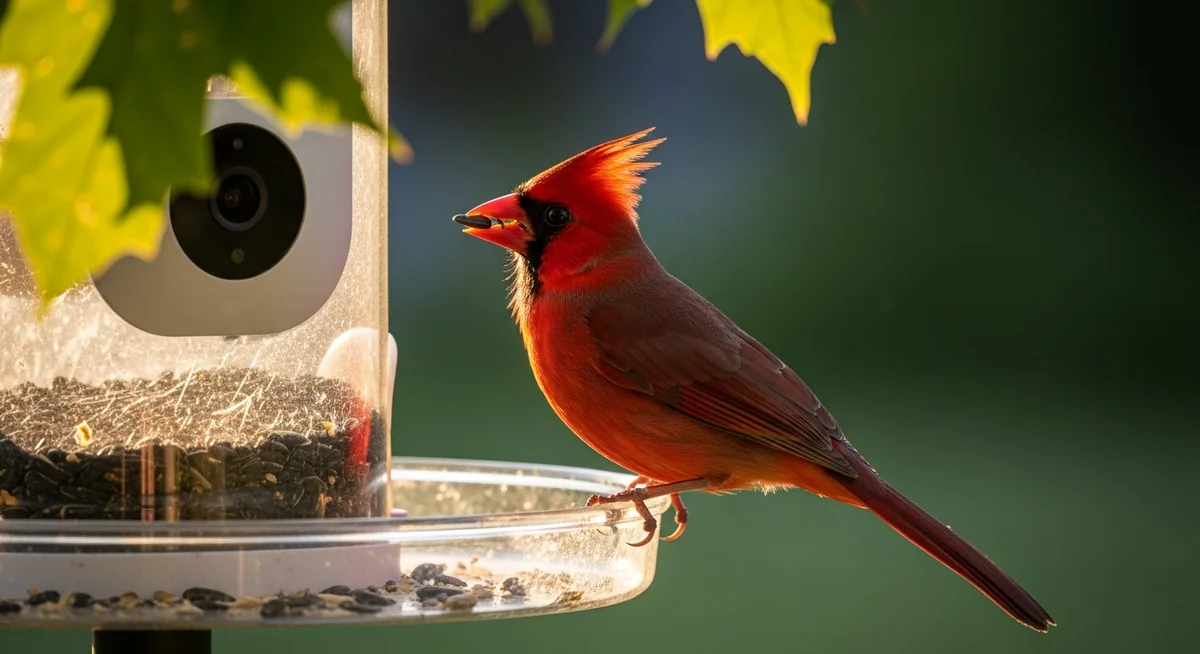
When we talk about AI bird identification, we are really talking about Convolutional Neural Networks (CNNs). Think of a CNN as a very fast, very focused artist who has been shown millions of sketches of birds. When a bird lands on your feeder, the camera captures a frame and the AI begins to break that image down into tiny pieces. It looks for the curve of a beak, the specific bars on a wing, or the unique crest of a Northern Cardinal.
These models aren't just guessing; they are comparing what they see against a massive database. Some of the most advanced commercial systems now claim to recognize over 11,000 species, though most standard consumer models sit comfortably in the 6,000+ range. This is achieved through "training," where the software is fed thousands of images of real bird visits. I’ve found that the systems trained on actual field observations—like those from BirdBuddy or Birdfy—tend to be much more accurate than those trained on static museum specimens. A bird in a museum doesn't move like the territorial male Ruby-throated hummingbird I call The Baron, who arrives at exactly 6:47 AM and hovers with a very specific, aggressive tilt.
The AI looks for "features." In the case of a cardinal, it’s not just looking for "red." It’s looking for the black mask and the thick, conical beak designed for cracking the black oil sunflower seeds I spend $47 a month on. The machine learning bird watching process happens in milliseconds, often providing an identification before the bird has even finished its initial twelve-second safety scan of the area.
The Power of an Edge Computing Bird Feeder
One of the most impressive technical feats in modern birding is the move toward edge computing. In the early days of smart tech, your feeder would have to send every image up to a "cloud" server, wait for a computer in a distant data center to figure out what it was, and then send the answer back to your phone. This required a massive amount of bandwidth and often resulted in a lag that made real-time observation impossible.
An edge computing bird feeder changes the game by doing the "thinking" right there on the device. Many of these systems use specialized hardware like the Google Coral Edge TPU (Tensor Processing Unit). This is essentially a tiny, powerful brain designed specifically to run machine learning models locally. By using "quantized" models—which are essentially streamlined, compressed versions of larger AI programs—the feeder can identify a Tufted Titmouse without needing a constant, high-speed connection to the internet.
This is particularly vital for those of us with larger yards where the Wi-Fi signal might be struggling by the time it reaches the maple tree where my persistent female hummingbird nests. While the feeder still needs a connection to send you the notification and the video clip, the actual identification happens locally. However, don't let the "local" part fool you into thinking you can skip the tech requirements. For stable 2K HD streaming and reliable logging, you generally need at least 2 Mbps of upload speed at the installation site. David, my husband, spent an entire Saturday with a signal-strength app just to find the "sweet spot" in our yard that balanced bird safety with bitrates.
Why Bird Species Recognition Isn’t Always Perfect
Despite the "AI" label, these systems can still be fooled, and understanding why will save you a lot of frustration. The research into these models shows a clear distinction between generalized and specialized identification. A pre-built model might have a fantastic grasp of "squirrels" as a broad category, but it might struggle with the nuances of your specific local fauna.
For example, a generalized model might identify a Douglas squirrel as a Fox squirrel simply because the Fox squirrel was more prevalent in its training data. This is a "closest match" scenario. I saw this firsthand during my own testing. The AI was convinced that a particularly scruffy juvenile cardinal was a "Grosbeak" for three days straight. It wasn't that the AI was "broken"; it was just that the bird's molting pattern didn't perfectly align with the "ideal" cardinal images the model had memorized.
There are also environmental factors that can cripple even the best bird species recognition software. Lighting is the most critical variable. Most smart feeders use clear acrylic structures to allow as much natural light as possible to hit the bird, but if you place your feeder in deep shade to protect your nectar from fermenting, the camera might struggle with "noise" in the image. This leads to a lower confidence score from the AI, which might result in a "Unknown Visitor" notification. To get the most out of your investment, you want the camera’s field of view to have consistent, bright illumination without being washed out by direct midday sun.
Smart Feeders as a Tool for Citizen Science
What makes this technology truly exciting—and what finally won over my skeptical mother—is the ability to track individual visitors over time. While most systems focus on species, we are seeing the emergence of individual bird recognition. By logging the exact time, duration, and frequency of visits, we can start to see the "biographies" of our backyard residents.
Sophie, my eight-year-old, has become a bit of a junior citizen scientist using these logs. We can now confirm that The Baron (the cardinal version) isn't just "a cardinal"—he’s the same male who has been performing his twelve-second safety scan on our platform feeder for three seasons. The AI logs show his peak activity during early morning and late evening, and we've even been able to track his success as a parent. Last May, the camera captured him bringing three juveniles to the feeder, staying for exactly seven minutes while he taught them how to navigate the perches.
This data visualization—daily highlights and curated galleries—turns bird watching into a longitudinal study. We aren't just looking at birds; we're monitoring the health of our local "Nectar Corridor." When a housing development nearby cleared a stand of old-growth trumpet vines, the smart logs helped me realize that our yard's visitation rates increased by nearly 25%, as the displaced birds sought out our supplemental food sources. This kind of data is invaluable for understanding how local environmental changes impact the wildlife we love.

The Squirrel War: AI vs. Mr. Fitzgerald
No discussion of smart feeders would be complete without addressing the eternal adversary: the squirrel. Some manufacturers have attempted to use AI bird identification as a weapon in the "Squirrel War." The theory is simple: the AI identifies a squirrel, and the feeder triggers a deterrent, such as a loud siren or a spray of water.
In my experience—and supported by the Google Coral project’s findings—this is where the technology often meets its match. Mr. Fitzgerald, our resident squirrel, has proven that AI sirens are largely a novelty. The first time the feeder let out a high-pitched beep, he flinched. The second time, he paused. By the third time, he simply ignored it and continued eating the black oil sunflower seeds that were meant for the cardinals.
The AI can log the squirrel's visit with a timestamped entry, which is great for David’s spreadsheets, but it doesn't replace the 5-7-9 rule of physical placement. You still need your feeder to be 5 feet off the ground, 7 feet away from jumping surfaces, and 9 feet below any overhangs. AI is a brilliant tool for identification, but when it comes to deterrence, a physical baffle or a weight-activated mechanism like the Squirrel Buster Plus (which closes its ports at 1.3 pounds) is still the gold standard. I’ve wasted too much of my $2,271.99 learning tax on "smart" deterrents that Mr. Fitzgerald figured out in under an hour.
Practical Setup and Actionable Takeaways
If you’re ready to bring AI into your yard, there are a few practical steps you should take to ensure you aren't just adding another failed gadget to your pantry.
- Prioritize Lighting Over Convenience: Don't just hang the feeder where it's easiest for you to see. Hang it where the sun will illuminate the birds' features clearly for the camera. Partial shade—morning sun and afternoon shade—is usually the sweet spot for both image quality and seed/nectar preservation.
- Test Your Upload Speed: Before you drill any holes, take your smartphone to the exact spot where the feeder will live. Run a speed test. If you aren't getting at least 2 Mbps of upload speed, your "smart" feeder will be a very expensive, very "dumb" plastic box. You might need a Wi-Fi extender to bridge the gap.
- Manage Your Notifications: AI can be "chatty." If you have a busy yard, your phone will buzz every three minutes. Learn to use the "Species Filtering" features found in apps like Birdfy or BirdBuddy. I have mine set to only notify me for "new" species or specifically for hummingbirds, so I don't miss the rare visitors while I'm at work.
- Maintain Physical Security: Use the AI to identify your birds, but use physical baffles to protect your seed. A 19-inch diameter baffle is still more effective than any AI-triggered siren.
- Clean with Precision: High-tech feeders have more nooks and crannies. You still need to perform a thorough cleaning every two weeks with a 1:9 bleach-to-water solution. Be careful not to submerge the electronic components; most "smart" cores are removable for a reason.
The Future of Our Backyard Relationships
The true value of AI bird identification isn't in the gadgets themselves, but in the way they deepen our connection to the world outside our windows. By removing the "identification barrier," we allow ourselves to move straight to the "relationship phase." We stop asking "What is that?" and start asking "Is that the same female who nested in the maple tree last year?"
My mother used to say that the bird that stays with us through the winter has a special claim on our friendship. With machine learning, that claim becomes even stronger. We can see the weight loss of a chickadee after a night of torpor, or the exact moment a juvenile cardinal finally masters the art of cracking a sunflower seed.
Yes, the learning tax is high. Yes, I have spent more on bird tech than David would like to see in a single spreadsheet. But when my phone pings and I see a 2K HD clip of a rare Rose-breasted Grosbeak that stopped by while I was making school lunches for Sophie and Max, the investment feels justified. We are using the most advanced technology we've ever created to better understand some of the oldest rhythms on the planet. And in a world that often feels disconnected, that’s a "smart" move for any backyard birder.
Just remember: the AI is the observer, but you are the steward. No amount of machine learning can replace a clean feeder, fresh water, and a yard that feels like a sanctuary. Use the tech to see them, but use your heart—and your 1:4 nectar recipe—to keep them coming back.